Monodontidaebeluga and narwhal
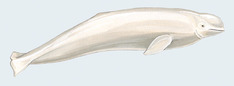


The two species of this family are found at high latitudes in the arctic seas and in most of the major rivers draining into them, south to the Saint Lawrence River. These are medium-sized whales, ranging from 4 - 6 m in length and up to around 1600 kg weight. Belugas have a very short, broad snout, while narwhales have a square head and appear to lack a snout altogether. The forehead in both species is high and globose. Members of this family lack a dorsal fin, although narwhals do have a distinctive ridge running along their backs. Adults are white (belugas) or white and black (narwhals).
As in the closely related delphinids, both species have a broadly expanded facial depression; this holds the melon, a fatty deposit believed to function in echolocation. The maxilla and frontal are expanded laterally, hiding the small zygomatic arch from dorsal view. The premaxillae lie flat in front of the nares, which are at the base of the short and broad rostrum. The length of the mandibular symphysis is less than 20% the length of the ramus, and in the upper jaw, the toothrows diverge posteriorly. Teeth are usually simple pegs in beluga (5/2 to 11/11 in number) but occasionally slightly 3-cusped. Narwhals have but two teeth, the one on the left is developed into a spiraled, forward-projecting tusk up to 2.7 m in length, and the other is rudimentary. The tusk of narwhals is found only in males; the teeth of females remain imbedded in their jaws.
Monodontids are generally found in schools, sometimes including more than 100 individuals. They migrate in response to the shifting ice pack. Both species feed mainly on the bottom, consuming a number of species of fish and invertebrates. The tusks presumably function in social behavior; males have been seen to fence with these structures, and occasionally broken-off pieces of tusk have been found imbedded in the heads of males of this species. Both species are highly vocal. Belugas make a sort of trilling sound and are sometimes known as "sea canaries."
References and literature cited:
Nowak, R.M. and J.L. Paradiso. 1983. Walker's Mammals of the World, 4th edition . John Hopkins University Press, Baltimore, MD.
Savage, R. J. G. and M. R. Long. 1986. Mammal Evolution: An Illustrated Guide. Facts on File Publications, UK. 251 pp.
Rice, D. W. 1984. Cetaceans. Pp. 447-490 in Anderson, S. and J. K. Jones, Jr. (eds). Orders and Families of Recent Mammals of the World. John Wiley and Sons, N.Y. xii+686 pp.
Vaughan, T. A. 1986. Mammalogy. Third Edition. Saunders College Publishing, N.Y. vii+576 pp.
Wilson, D. E., and D. M. Reeder. 1993. Mammal Species of the World, A Taxonomic and Geographic Reference. 2nd edition. Smithsonian Institution Press, Washington. xviii+1206 pp.
Contributors
Phil Myers (author), Museum of Zoology, University of Michigan-Ann Arbor.
Glossary
- bilateral symmetry
-
having body symmetry such that the animal can be divided in one plane into two mirror-image halves. Animals with bilateral symmetry have dorsal and ventral sides, as well as anterior and posterior ends. Synapomorphy of the Bilateria.
- chemical
-
uses smells or other chemicals to communicate
- endothermic
-
animals that use metabolically generated heat to regulate body temperature independently of ambient temperature. Endothermy is a synapomorphy of the Mammalia, although it may have arisen in a (now extinct) synapsid ancestor; the fossil record does not distinguish these possibilities. Convergent in birds.
- motile
-
having the capacity to move from one place to another.
- sexual
-
reproduction that includes combining the genetic contribution of two individuals, a male and a female
- tactile
-
uses touch to communicate