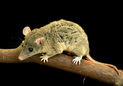
Monodelphis domesticagray short-tailed opossum



Geographic Range
Monodelphis domestica is found throughout the forests of Brazil, Bolivia, Argentina, and Paraguay. ("American Opossums", 1984; "American Opossums", 2001; Kalafut, 2005; Wilson and Reeder, 1993)
- Biogeographic Regions
- neotropical
Habitat
Gray short-tailed opossums are found in tropical forests, scrublands, and grassy areas, on the ground or in low level vegetation. As with other short-tailed opossums (Monodelphis), gray short-tailed opossums may inhabit human dwellings, where they feed on small rodents and insects. ("American Opossums", 1984; "American Opossums", 2001; Eisenberg and Redford, 1999; Wilson and Reeder, 1993)
- Habitat Regions
- tropical
- terrestrial
- Terrestrial Biomes
- savanna or grassland
- forest
- rainforest
- scrub forest
- Other Habitat Features
- suburban
- agricultural
Physical Description
Monodelphis domestica is a member of the group of short-tailed opossums, Monodelphis, which are some of the smallest didelphids. Body length of adults ranges from 10 to 15 cm. Adult males weigh between 90 and 155 g, females are between 80 and 100 g. Most individuals have light grey fur, but fur color does vary, with some popluations having more reddish or whitish fur. Their tails are naked, rat-like, and semi-prehensile. Tail length varies but is usually about half the length of the of body. (Eisenberg and Redford, 1999; Kalafut, 2005; Trupin and Fadem, 1982; Unger, 1982)
- Other Physical Features
- endothermic
- homoiothermic
- bilateral symmetry
- Sexual Dimorphism
- male larger
-
- Range mass
- 90 to 155 g
- 3.17 to 5.46 oz
-
- Range length
- 10 to 15 cm
- 3.94 to 5.91 in
-
- Average basal metabolic rate
- 0.335 W
- AnAge
Reproduction
Mating behavior in M. domestica is strongly tied to olfaction. Males habitually mark their surroundings with a chemical mark produced by a sternal gland. This scent likely serves as an advertisement to local females and a warning to local males. When a male and a receptive female meet, a precopulatory dance of sniffing, chasing, biting, and licking ensues. At the completion of this dance, the male immobilizes the female's hind legs and begins copulation, which lasts from 4 to 7 minutes. The majority of matings take place with the animals laying on their right sides. ("American Opossums", 1984; "American Opossums", 2001; Trupin and Fadem, 1982)
- Mating System
- polygynandrous (promiscuous)
Sexual maturity in M. domestica is reached by 18 to 20 weeks. Gestation lasts 14 to 15 days and females can have up to 5 litters per year. Typical litter size is from 7 to 9. (Eisenberg and Redford, 1999; "American Opossums", 2001; Eisenberg and Redford, 1999; Kalafut, 2005)
- Key Reproductive Features
- seasonal breeding
- year-round breeding
- gonochoric/gonochoristic/dioecious (sexes separate)
- sexual
- induced ovulation
- viviparous
-
- Breeding interval
- On average gray short-tailed opossums breed 4 times per year.
-
- Breeding season
- In the wild, breeding occurs most often during the spring and summer months, when daylight hours are the longest.
-
- Range number of offspring
- 1 to 15
-
- Average number of offspring
- 9
- AnAge
-
- Range gestation period
- 14 to 15 days
-
- Range weaning age
- 3 to 4 weeks
-
- Average weaning age
- 3 weeks
-
- Range time to independence
- 6 to 8 weeks
-
- Range age at sexual or reproductive maturity (female)
- 5 to 7 months
-
- Range age at sexual or reproductive maturity (male)
- 5 to 7 months
Immediately after birth, newborn M. domestica crawl to their mother's stomach and attach to a nipple. They remain attached this way for 3 to 4 weeks. After detachment the young climb on their mother and/or follow her around for another three months or more. Paternal care in M. domestica is nonexistent, moreover, in captivity when fathers are confronted with their offspring, they act aggressively towards them. (Kalafut, 2005; Trupin and Fadem, 1982)
- Parental Investment
- altricial
-
pre-fertilization
- provisioning
-
protecting
- female
-
pre-hatching/birth
-
provisioning
- female
-
protecting
- female
-
provisioning
-
pre-weaning/fledging
-
provisioning
- female
-
protecting
- female
-
provisioning
Lifespan/Longevity
Just over six years seems the most agreed upon upper lifespan in captivity. In the wild, two years is the standard lifespan. ("American Opossums", 2001; Kalafut, 2005)
-
- Range lifespan
Status: wild - 3 to 6 years
- Range lifespan
-
- Average lifespan
Status: wild - 4 years
- Average lifespan
-
- Range lifespan
Status: captivity - 6 to 10 years
- Range lifespan
-
- Typical lifespan
Status: wild - 1 to 3 years
- Typical lifespan
-
- Typical lifespan
Status: captivity - 2 to 6 years
- Typical lifespan
Behavior
Gray short-tailed opossums are solitary animals that exhibit aggressive behavior towards conspecifics. Nowhere is this more evident than in breeding, where one of the two animals of the breeding pair is often wounded in the precopulatory aggressive dance. More is known about M. domestica in captivity than in the wild. Nest building behavior has only been seen, for instance, in animals in captivity. This behavior is seems to be for thermoregulation and, in the wild, may protect animals from midday heat. ("American Opossums", 2001; Fadem and Corbett, 1997; Kalafut, 2005; Unger, 1982)
- Key Behaviors
- terricolous
- diurnal
- nocturnal
- crepuscular
- motile
- sedentary
- solitary
- territorial
-
- Range territory size
- 8000 (high) m^2
Home Range
Small South American opossums like M. domestica generally have fairly small territories, on the order of two acres or less. ("American Opossums", 1984; "American Opossums", 2001; Emmons and Feer, 1990; Fadem and Corbett, 1997)
Communication and Perception
Gray short-tailed opossums vocalize when threatened or approached by a possible mate. A series of chirps or barks is used to advertise threat level. Olfaction also plays an important role in the lives of gray short-tailed opossums; scent marking is used for territorial purposes and for assessment of reproductive condition of females. (Eisenberg and Redford, 1999; Fadem and Corbett, 1997; Kalafut, 2005; Trupin and Fadem, 1982)
- Other Communication Modes
- pheromones
- scent marks
Food Habits
Gray short-tailed opossums are omnivorous, eating insects, fruits, and small animals, such as rodents. (Fadem and Corbett, 1997; Kalafut, 2005; Trupin and Fadem, 1982; Wilson and Reeder, 1993)
- Primary Diet
- omnivore
- Animal Foods
- mammals
- insects
- terrestrial non-insect arthropods
- Plant Foods
- fruit
Predation
Specific information on predators of M. domestica was not found. Harpy eagles (Harpia harpyja), other birds of prey, and other predatory mammals are likely predators. Gray short-tailed opossums are cryptically colored and secretive, thereby avoiding some predation.
- Anti-predator Adaptations
- cryptic
Ecosystem Roles
Gray short-tailed opossums are insectivores and negatively impact insect populations where they occur. No list of predators which feed upon M. domestica has been published; however, they are likely part of the diets of other mammalian carnivores, such as other didelphids, and large birds of prey. Monodelphis domestica also acts as a host for a variety of parasites, such as the echinostomatiform protozoan Rhopalias dobbini. (Prod, 1968)
- Trematoda
- Rhopalias dobbini
Economic Importance for Humans: Positive
Gray short-tailed opossums have become a popular species in the exotic pet trade. They are important in research because they are one of the few animals to get skin cancer at a rate similar to humans. Gray short-tailed opossums are at the top of the list for full genome sequencing. Dozens of research projects are currently being done with M. domestica. (Fadem and Corbett, 1997; Kalafut, 2005; Trupin and Fadem, 1982; Unger, 1982; Wilson and Reeder, 1993)
Gray short-tailed opossums are often welcome visitors in human households, as they consume insects, scorpions, and other pests.
- Positive Impacts
- pet trade
- research and education
Economic Importance for Humans: Negative
Monodelphis domestica can invade human dwellings and become an annoyance. ("American Opossums", 1984; "American Opossums", 2001; "American Opossums", 1984; "American Opossums", 2001)
- Negative Impacts
- household pest
Conservation Status
Monodelphis domestica is both common in the wild and in the pet trade. (Eisenberg and Redford, 1999; Emmons and Feer, 1990; Kalafut, 2005)
-
- IUCN Red List
-
Least Concern
More information
-
- IUCN Red List
-
Least Concern
More information
-
- US Federal List
- No special status
-
- CITES
- No special status
Contributors
Tanya Dewey (editor), Animal Diversity Web.
David Moore (author), University of Michigan-Ann Arbor, Phil Myers (editor, instructor), Museum of Zoology, University of Michigan-Ann Arbor.
Glossary
- Neotropical
-
living in the southern part of the New World. In other words, Central and South America.

- acoustic
-
uses sound to communicate
- agricultural
-
living in landscapes dominated by human agriculture.
- altricial
-
young are born in a relatively underdeveloped state; they are unable to feed or care for themselves or locomote independently for a period of time after birth/hatching. In birds, naked and helpless after hatching.
- bilateral symmetry
-
having body symmetry such that the animal can be divided in one plane into two mirror-image halves. Animals with bilateral symmetry have dorsal and ventral sides, as well as anterior and posterior ends. Synapomorphy of the Bilateria.
- chemical
-
uses smells or other chemicals to communicate
- crepuscular
-
active at dawn and dusk
- cryptic
-
having markings, coloration, shapes, or other features that cause an animal to be camouflaged in its natural environment; being difficult to see or otherwise detect.
- diurnal
-
- active during the day, 2. lasting for one day.
- endothermic
-
animals that use metabolically generated heat to regulate body temperature independently of ambient temperature. Endothermy is a synapomorphy of the Mammalia, although it may have arisen in a (now extinct) synapsid ancestor; the fossil record does not distinguish these possibilities. Convergent in birds.
- forest
-
forest biomes are dominated by trees, otherwise forest biomes can vary widely in amount of precipitation and seasonality.
- induced ovulation
-
ovulation is stimulated by the act of copulation (does not occur spontaneously)
- motile
-
having the capacity to move from one place to another.
- native range
-
the area in which the animal is naturally found, the region in which it is endemic.
- nocturnal
-
active during the night
- omnivore
-
an animal that mainly eats all kinds of things, including plants and animals
- pet trade
-
the business of buying and selling animals for people to keep in their homes as pets.
- pheromones
-
chemicals released into air or water that are detected by and responded to by other animals of the same species
- polygynandrous
-
the kind of polygamy in which a female pairs with several males, each of which also pairs with several different females.
- rainforest
-
rainforests, both temperate and tropical, are dominated by trees often forming a closed canopy with little light reaching the ground. Epiphytes and climbing plants are also abundant. Precipitation is typically not limiting, but may be somewhat seasonal.
- scent marks
-
communicates by producing scents from special gland(s) and placing them on a surface whether others can smell or taste them
- scrub forest
-
scrub forests develop in areas that experience dry seasons.
- seasonal breeding
-
breeding is confined to a particular season
- sedentary
-
remains in the same area
- sexual
-
reproduction that includes combining the genetic contribution of two individuals, a male and a female
- solitary
-
lives alone
- suburban
-
living in residential areas on the outskirts of large cities or towns.
- tactile
-
uses touch to communicate
- terrestrial
-
Living on the ground.
- territorial
-
defends an area within the home range, occupied by a single animals or group of animals of the same species and held through overt defense, display, or advertisement
- tropical
-
the region of the earth that surrounds the equator, from 23.5 degrees north to 23.5 degrees south.
- tropical savanna and grassland
-
A terrestrial biome. Savannas are grasslands with scattered individual trees that do not form a closed canopy. Extensive savannas are found in parts of subtropical and tropical Africa and South America, and in Australia.
- savanna
-
A grassland with scattered trees or scattered clumps of trees, a type of community intermediate between grassland and forest. See also Tropical savanna and grassland biome.
- temperate grassland
-
A terrestrial biome found in temperate latitudes (>23.5° N or S latitude). Vegetation is made up mostly of grasses, the height and species diversity of which depend largely on the amount of moisture available. Fire and grazing are important in the long-term maintenance of grasslands.
- visual
-
uses sight to communicate
- viviparous
-
reproduction in which fertilization and development take place within the female body and the developing embryo derives nourishment from the female.
- year-round breeding
-
breeding takes place throughout the year
References
Andromeda Oxford Ltd. 1984. American Opossums. Pp. 830-837 in D Macdonald, ed. The Encyclopedia of Mammals, Vol. 1/1, 1 Edition. New York, NY: Facts On File, Inc..
Andromeda Oxford Ltd. 2001. American Opossums. Pp. 808-814 in D Macdonald, S Norris, eds. The New Encyclopedia of Mammals, Vol. 1/1, 1 Edition. Oxford, UK: Oxford University Press.
Bergallo, H., R. Cerqueira. 1994. Reproduction and growth of the opossum, Monodelphis domestica (Mammalia:Didelphidae) in northeastern Brazil. Journal of Zoology, 232/4: 551-563.
Eisenberg, J., K. Redford. 1999. Mammals of the Neotropics: The Central Neotropics, Vol. 3. Chicago, IL: The University of Chicago Press.
Emmons, L., F. Feer. 1990. Neotropical Rainforest Mammals: A Field Guide. Chicago, IL: The University of Chicago Press.
Fadem, B., A. Corbett. 1997. Sex Differences and the Development of Social Behavior in a Marsupial, the Gray Short-Tailed Opossum (Monodelphis Domestica). Physiology and Behaviour, 61/6: 857-861.
Kalafut, M. 2005. "Know Your STO" (On-line). Short-Tailed Opossums, Keeping and Caring for These Pets. Accessed February 15, 2006 at http://www.knowyoursto.com/.
Prod, H. 1968. Phopalias-Dobbini New Species of Parasitic Trematode of Monodelphis-Domestica-Domestica. Bulletin du Museum National d'Histoire Naturelle, 40/2: 393-395.
Stonerook, M., J. Harder. 1992. Sexual Maturation if Female Gray Short-Tailed Opossums Monodelphis-Domestica is Dependent Upon Male Stimuli. Biology of Reproduction, 46/2: 290-294.
Trupin, G., B. Fadem. 1982. Sexual Behavior of the Gray Short-Tailed Opossum (Monodelphis Domestica). Journal of Mammalogy, 63/3: 409-414.
Unger, K. 1982. Nest-Building Behavior of the Brazilian Bare-Tailed Opossum, Monodelphis Domestica. Journal of Mammalogy, 63/1: 160-162.
Wilson, D., D. Reeder. 1993. Mammal species of the world: a taxonomic and geographic reference, 2nd ed.. Washington, D.C.: Smithsonian Institution.