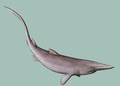
Mitsukurina owstoniElfin shark(Also: Goblin shark)
Geographic Range
Originally caught in Japan, the range is wide, but not evenly distributed. The majority of known specimens come from bays of Japan while the rest are mostly found off New Zealand, southern Africa, and in the Eastern Atlantic and Indian Oceans. Two specimens have been taken off the Mississippi and California coasts of the United States. Though this probably encompasses the range of Mitsukurina owstoni, sightings are so rare and widespread that the presence of goblin sharks could extend well beyond these areas. (Duffy, 1997; Martin, 1999)
- Biogeographic Regions
- nearctic
- palearctic
- australian
- indian ocean
- atlantic ocean
- pacific ocean
Habitat
Goblin sharks seem to live in the mid and deep-water zones of outer continental shelves and slopes. (Martin, 1999)
- Habitat Regions
- temperate
- saltwater or marine
-
- Range depth
- 40 to 1200 m
- 131.23 to 3937.01 ft
Physical Description
Mitsukurina owstoni is a fearsome looking fish with a large, flattened snout protruding from the top of its head, and has movable jaws than can extend to catch prey. The exact purpose of the flat snout is unknown, but as it is not hard or sharp enough to pin or kill prey, it is probably used to detect the faint electric signals that other fish give off. Goblin sharks have rubbery skin, rather than denticles (the sharp, pointed scales found on most sharks). Due to the blood vessels that are close to the skin, the shark has a pinkish-grey color in life, though in death it appears quite colorless because of its lack of pigment. Teeth are slender and fang-like, similar to those of the sand tiger shark. Another feature that separates goblin sharks from most other sharks is the lack of a lower lobe on the tail fin, which is also absent in other benthic sharks. Female specimens seem to be slightly larger than the males. (Berger, 1987; Compagno, 1984; Duffy, 1997; Martin, 1999; Rorem, 2002)
- Other Physical Features
- ectothermic
- heterothermic
- bilateral symmetry
- Sexual Dimorphism
- female larger
-
- Range length
- 107 to 380 cm
- 42.13 to 149.61 in
-
- Average length
- 160 cm
- 62.99 in
Development
Mitsukurina owstoni develop directly from birth, and are probably ecologically similiar to free-swimming adults when they emerge from the mother. It is not known at what age they become sexually mature, but are immature to about 2.3 m. (Martin, 1999)
Reproduction
There has been no direct study of goblin sharks in the wild, so there is no information on there mating habits.
Goblin sharksare rarely seen, and even more rarely studied in detail. Essentially all known data on goblin sharks are from accidental catches in trawling nets. Thus, since there have been no opportunities to observe goblin sharks in their natural habit (or even alive for that matter), data on reproduction and behavior are very scarce. There is no information on age at sexual maturity for either sex, number of offspring, or gestation period.
Most sharks are independent as soon as they are born. This is probably not different in the case of the goblin shark. (Martin, 1999)
- Key Reproductive Features
- iteroparous
- gonochoric/gonochoristic/dioecious (sexes separate)
- sexual
- fertilization
- ovoviviparous
Though there are no data for goblin sharks in particular, sharks in general do not provide any degree of parental investment.
- Parental Investment
- no parental involvement
Lifespan/Longevity
No goblin sharks have been studied in the wild, so not much is known about their ages or lifespans. No individuals have ever been held in captivity. (Martin, 1999)
Behavior
Due to its morphology, it is assumed that Mitsukurina owstoni is rather sluggish and accomplishes most of its hunting by swimming lazily or waiting for vertically migrating animals to come within striking distance. The protruding jaws allow substantial bites, but otherwise, Mitsukurina owstoni is not a fast or active predator. Since it seems to feed on migratory fish, it is probably active in the evening and/or morning when the migrations are going on, but there are no direct accounts of feeding times. Based on the dentition and stomach contents of this shark, scientists know it is a predator. Another theory has goblin sharks actively hunting for benthic prey using electroreceptors on its enlarged snout (similar to hammerhead sharks) and using this snout to dig up any prey it detects underneath the sand. (Compagno, 1984; Duffy, 1997; Martin, 1999)
- Key Behaviors
- natatorial
- crepuscular
- motile
Home Range
There are no available data on home range, or territories of goblin sharks.
Communication and Perception
Like all sharks, goblin sharks probably hunt using their senses of smell, sight, sound and the electrical sensing organs called ampullae of Lorenzini. Due to the depth at which they live, eyesight is probably less useful than other senses. The snout (which is abnormally large in Mitsukurina owstoni) houses the ampullae of Lorenzini which are attuned to catching otherwise undetectable prey in dark waters or on the bottom.
There is no available data on communication within the species. (Compagno, 1984; Duffy, 1997; Martin, 1999; Rorem, 2002)
Food Habits
Mitsukurina owstoni appears to feed mid-water or close to the bottom where it uses a combination of electrical sensors, smell and (minimal) eyesight to catch any vertically migrating animals that it comes across. It is also possible that they stay deep and scan the bottom for prey. Stomach records are rare, and include parts of squid, fish, ostracods, and crabs. (Compagno, 1984; Duffy, 1997; Martin, 1999; Rorem, 2002)
- Primary Diet
-
carnivore
- piscivore
- eats non-insect arthropods
- molluscivore
- Animal Foods
- fish
- mollusks
- aquatic crustaceans
Predation
There are no known predators of the goblin shark except for infrequent Japanese fishermen. (Martin, 1999)
Ecosystem Roles
As it is often difficult to deduce ecosystem roles in easily studied environments, it comes as no surprise that nothing is known about goblin sharks' role in the mid-water or benthic community besides its role as a predator.
Economic Importance for Humans: Positive
Mitsukurina owstoni has minimal economic importance. Apparently it is sometimes fished commercially off Japan. (Martin, 1999)
- Positive Impacts
- food
Economic Importance for Humans: Negative
There are no known adverse affects of goblin sharks on humans.
Conservation Status
The goblin shark is rarely found, but not thought to be threatened. ("Cites:Convention on International Trade in Endangered Species of Wild Fauna and Flora", 2004; "U.S. ESA: NatureServe Explorer Data for Listed Status in the United States", ; "2002 IUCN Red List", 2002)
-
- IUCN Red List
-
Least Concern
More information
-
- IUCN Red List
-
Least Concern
More information
-
- US Federal List
- No special status
-
- CITES
- No special status
Other Comments
Most of the biology of Mitsukurina owstoni is unknown due to the rarity of sightings and specimens. However, though rarely seen, this shark is thought to be fairly common because of its wide range. Nonetheless, because it lives in deep waters, is not a common sight for humans. Most of the information is partial, and deduced from the morphology of the shark and from samples of the few existing specimens. Other common names include: imp shark, elfin shark, and tenguzame(Japanese). Differences in extension of jaws in death lead to confusion over how many species of Mitsukurina there actually are. As of now, there is only one recognized species. However, the extant goblin shark is considered to be very closely related to a similar Cretaceous shark genus Scapanorhynchus, known from fossils. (Compagno, 1984; Duffy, 1997; Martin, 1999)
Contributors
David Armitage (editor), Animal Diversity Web.
Matthew Wund (editor), University of Michigan-Ann Arbor.
Stephen Bizer (author), University of Michigan-Ann Arbor, Phil Myers (editor), Museum of Zoology, University of Michigan-Ann Arbor.
Glossary
- Atlantic Ocean
-
the body of water between Africa, Europe, the southern ocean (above 60 degrees south latitude), and the western hemisphere. It is the second largest ocean in the world after the Pacific Ocean.

- Australian
-
Living in Australia, New Zealand, Tasmania, New Guinea and associated islands.
- Nearctic
-
living in the Nearctic biogeographic province, the northern part of the New World. This includes Greenland, the Canadian Arctic islands, and all of the North American as far south as the highlands of central Mexico.
- Pacific Ocean
-
body of water between the southern ocean (above 60 degrees south latitude), Australia, Asia, and the western hemisphere. This is the world's largest ocean, covering about 28% of the world's surface.
- Palearctic
-
living in the northern part of the Old World. In otherwords, Europe and Asia and northern Africa.
- acoustic
-
uses sound to communicate
- benthic
-
Referring to an animal that lives on or near the bottom of a body of water. Also an aquatic biome consisting of the ocean bottom below the pelagic and coastal zones. Bottom habitats in the very deepest oceans (below 9000 m) are sometimes referred to as the abyssal zone. see also oceanic vent.
- bilateral symmetry
-
having body symmetry such that the animal can be divided in one plane into two mirror-image halves. Animals with bilateral symmetry have dorsal and ventral sides, as well as anterior and posterior ends. Synapomorphy of the Bilateria.
- carnivore
-
an animal that mainly eats meat
- chemical
-
uses smells or other chemicals to communicate
- crepuscular
-
active at dawn and dusk
- ectothermic
-
animals which must use heat acquired from the environment and behavioral adaptations to regulate body temperature
- electric
-
uses electric signals to communicate
- fertilization
-
union of egg and spermatozoan
- food
-
A substance that provides both nutrients and energy to a living thing.
- heterothermic
-
having a body temperature that fluctuates with that of the immediate environment; having no mechanism or a poorly developed mechanism for regulating internal body temperature.
- internal fertilization
-
fertilization takes place within the female's body
- iteroparous
-
offspring are produced in more than one group (litters, clutches, etc.) and across multiple seasons (or other periods hospitable to reproduction). Iteroparous animals must, by definition, survive over multiple seasons (or periodic condition changes).
- molluscivore
-
eats mollusks, members of Phylum Mollusca
- motile
-
having the capacity to move from one place to another.
- natatorial
-
specialized for swimming
- ovoviviparous
-
reproduction in which eggs develop within the maternal body without additional nourishment from the parent and hatch within the parent or immediately after laying.
- pelagic
-
An aquatic biome consisting of the open ocean, far from land, does not include sea bottom (benthic zone).
- piscivore
-
an animal that mainly eats fish
- saltwater or marine
-
mainly lives in oceans, seas, or other bodies of salt water.
- sexual
-
reproduction that includes combining the genetic contribution of two individuals, a male and a female
- temperate
-
that region of the Earth between 23.5 degrees North and 60 degrees North (between the Tropic of Cancer and the Arctic Circle) and between 23.5 degrees South and 60 degrees South (between the Tropic of Capricorn and the Antarctic Circle).
- visual
-
uses sight to communicate
References
International Union for Conservation of Nature and Natural Resources. 2002. "2002 IUCN Red List" (On-line ). Accessed 03-23-03 at http://www.redlist.org/.
CITES. 2004. "Cites:Convention on International Trade in Endangered Species of Wild Fauna and Flora" (On-line). Accessed March 21, 2003 at http://www.cites.ec.gc.ca/default.cfm.
U.S. ESA. "U.S. ESA: NatureServe Explorer Data for Listed Status in the United States" (On-line ). Accessed 03-21-2003 at http://www.natureserve.org/explorer/statusus.htm.
Berger, G. 1987. Sharks. New York: Doubleday.
Compagno, L. 1984. FAO Species Catalogue: Vol. 4 Sharks of the World. Rome: United Nations Development Programme, Food and Agriculture Organization of the United States.
Duffy, C. 1997. Futher Records of the Goblin Shark, Mitsukurina owstoni (Lamniformes: Mitsukurinidae), from New Zealand. New Zealand Journal of Zoology, 24: 167-171.
Martin, R. 1999. "Biology of Sharks and Rays: Biology Of the Goblin Shark (Mitsukurina owstoni)" (On-line). Accessed March 16, 2003 at http://elasmo-research.org/education/shark_profiles/m_owstoni.htm.
Rorem, S. 2002. "Sea Creatures 101: Shark Series: The Goblin Shark: Ugly and Rare" (On-line ). Accessed 03-16-03 at http://www.suite101.com/article.cfm/aquatic_animals/87679.