Miniopterus schreibersiiSchreibers's long-fingered bat

Geographic Range
Miniopterus schreibersii is foung in Southern Europe to Japan and the Solomon Islands, Philippines, northern Africa, Africa south of the Sahara, and northern and eastern Australia (Nowak, 1997).
- Biogeographic Regions
- palearctic
- oriental
- ethiopian
- australian
Habitat
M. schreibersii has been found to roost in caves, rock clefts, culverts, caverns, and galleries (Grzimek, 1990; Nowak, 1997).
Studies of this species in India showed that the population of a given area tended to be centered in one large cave but that individuals spent part of their time in secondary roosts within a 70 km radius (Nowak, 1997).
- Habitat Regions
- tropical
- terrestrial
- Terrestrial Biomes
- savanna or grassland
- mountains
- Other Habitat Features
- caves
Physical Description
Miniopterus schreibersii has a body length of 52 to 63 mm, a tail length of 50 to 60 mm, and a forearm length of 42 to 48 mm. Its color ranges from grey to yellowish brown (Grzimek, 1990).
Miniopterus schreibersii is a medium sized bat with extremely long fingers and correspondingly broad wings (Grzimek, 1990). The second bone of the longest finger is about three times as long as the first bone. When hanging by its hind feet, this lengthened terminal part of the third finger folds back on the wing (Nowak, 1997).
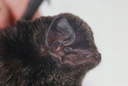
The body hairs of M. schreibersii stand erect. A small tragus is visible in the ears. This species has a short snout and hairs projecting form the upper surface of the head (Grzimek, 1990). The tail of M. schreibersii is completely enclosed within the interfemoral membrane and is proportionately longer than in many other bats of the same size (Nowak, 1997).
- Other Physical Features
- endothermic
- bilateral symmetry
-
- Range mass
- 8 to 11 g
- 0.28 to 0.39 oz
-
- Range length
- 52 to 63 mm
- 2.05 to 2.48 in
Reproduction
These bats reach sexual maturity at the age of one year (Grzimek, 1990). In a study in eastern Australia by Richardson (1977) they were found to be monestrous. Mating took place in the fall (late May to early June), with fertilization and development to the blastocyst stage immediately following. Implantation was delayed until August and births occurred in December. Each female usually has one offspring (Nowak, 1997).
The young are weaned at from 7 to 9 weeks of age. After the young are weaned females are once again ready for breeding (Grzimek, 1990; Nowak, 1997).
- Key Reproductive Features
- iteroparous
- seasonal breeding
- gonochoric/gonochoristic/dioecious (sexes separate)
- sexual
- fertilization
- viviparous
- delayed implantation
-
- Breeding interval
- These bats apparently breed once per year.
-
- Breeding season
- Mating occurs from late May to early June.
-
- Range number of offspring
- 1 to 2
-
- Average gestation period
- 240 days
-
- Range weaning age
- 42 to 90 days
-
- Average weaning age
- 52.5 days
Behavior
Miniopterus schreibersii is nocturnal. These bats spend the day in their roosts and come out just after sunset. They spend most of the night foraging and return to their caves the next morning (Grzimek, 1990). Their flight has been described as rapid and jerky (Nowak, 1997).
This species may also be highly gregarious. In Africa, a study by Van der Merwe (1975) found seasonal migrations. Pregnant females from wintering caves in the southern Transvaal moved to maternity caves in the north from late winter to late spring. In late summer the females and the weaned young moved back to the south. In one maternity cave, the juveniles alone numbered 110,000. In this study and in others from Asia, it was shown that young are not carried by the mother but are deposited in a large communal roosting group. Males were found to leave the colony by December when the young were born (Nowak, 1997).
Communication and Perception
Food Habits
Miniopterus schreibersii feeds on small beetles and insects. Feeding usually occurs at heights of 10 to 20 meters (Norak, 1997; Grzimek, 1990). Insects are caught by using echolocation.
- Primary Diet
- carnivore
Economic Importance for Humans: Positive
Bats can be extremely benefitial to humans. They eat many of the insects and pests that plague farmers and gardeners. This helps keep insects from over populating an area and it reduces the amount damage done to crops by these insects.
- Positive Impacts
- controls pest population
Conservation Status
Miniopterus schreibersii is on the IUCN red list for low risk, near threatened species. However, it is not on the CITES or U.S. ESA lists.
This species is mainly endangered in western Europe but possibly through out the world. Colonies that had contained thousands of individuals have disappeared. Miniopterus schreibersii is especially sensitive to disturbances and may be locally eradicated if disturbed by human workers or tourists (Nowak, 1997). Destruction of habitat is a serious threat to these animals.
-
- IUCN Red List
-
Near Threatened
More information
-
- IUCN Red List
-
Near Threatened
More information
-
- US Federal List
- No special status
-
- CITES
- No special status
Contributors
Nancy Shefferly (editor), Animal Diversity Web.
Heather Leu (author), University of Michigan-Ann Arbor, Phil Myers (editor), Museum of Zoology, University of Michigan-Ann Arbor.
Glossary
- Australian
-
Living in Australia, New Zealand, Tasmania, New Guinea and associated islands.

- Ethiopian
-
living in sub-Saharan Africa (south of 30 degrees north) and Madagascar.
- Palearctic
-
living in the northern part of the Old World. In otherwords, Europe and Asia and northern Africa.
- bilateral symmetry
-
having body symmetry such that the animal can be divided in one plane into two mirror-image halves. Animals with bilateral symmetry have dorsal and ventral sides, as well as anterior and posterior ends. Synapomorphy of the Bilateria.
- carnivore
-
an animal that mainly eats meat
- chemical
-
uses smells or other chemicals to communicate
- colonial
-
used loosely to describe any group of organisms living together or in close proximity to each other - for example nesting shorebirds that live in large colonies. More specifically refers to a group of organisms in which members act as specialized subunits (a continuous, modular society) - as in clonal organisms.
- delayed implantation
-
in mammals, a condition in which a fertilized egg reaches the uterus but delays its implantation in the uterine lining, sometimes for several months.
- endothermic
-
animals that use metabolically generated heat to regulate body temperature independently of ambient temperature. Endothermy is a synapomorphy of the Mammalia, although it may have arisen in a (now extinct) synapsid ancestor; the fossil record does not distinguish these possibilities. Convergent in birds.
- fertilization
-
union of egg and spermatozoan
- insectivore
-
An animal that eats mainly insects or spiders.
- iteroparous
-
offspring are produced in more than one group (litters, clutches, etc.) and across multiple seasons (or other periods hospitable to reproduction). Iteroparous animals must, by definition, survive over multiple seasons (or periodic condition changes).
- migratory
-
makes seasonal movements between breeding and wintering grounds
- motile
-
having the capacity to move from one place to another.
- mountains
-
This terrestrial biome includes summits of high mountains, either without vegetation or covered by low, tundra-like vegetation.
- native range
-
the area in which the animal is naturally found, the region in which it is endemic.
- nocturnal
-
active during the night
- oriental
-
found in the oriental region of the world. In other words, India and southeast Asia.
- seasonal breeding
-
breeding is confined to a particular season
- sexual
-
reproduction that includes combining the genetic contribution of two individuals, a male and a female
- tactile
-
uses touch to communicate
- terrestrial
-
Living on the ground.
- tropical
-
the region of the earth that surrounds the equator, from 23.5 degrees north to 23.5 degrees south.
- tropical savanna and grassland
-
A terrestrial biome. Savannas are grasslands with scattered individual trees that do not form a closed canopy. Extensive savannas are found in parts of subtropical and tropical Africa and South America, and in Australia.
- savanna
-
A grassland with scattered trees or scattered clumps of trees, a type of community intermediate between grassland and forest. See also Tropical savanna and grassland biome.
- temperate grassland
-
A terrestrial biome found in temperate latitudes (>23.5° N or S latitude). Vegetation is made up mostly of grasses, the height and species diversity of which depend largely on the amount of moisture available. Fire and grazing are important in the long-term maintenance of grasslands.
- viviparous
-
reproduction in which fertilization and development take place within the female body and the developing embryo derives nourishment from the female.
References
1999. "Species Survival Commission" (On-line). Accessed December 13, 1999 at http://www.uicn.org/themes/ssc.
Grzimek, 1990. Grzimek's Encyclopedia of Mammals. Vol 1. New York: McGraw-Hill publishing.
Nowak, R. 1997. "Long-winged Bats, or Bent-winged Bats" (On-line). Accessed December 13, 1999 at http://www.press.jhu.edu/books/walkers_mammals_of_the_world/chiroptera/chiroptera.vespertilionidae.miniopterus.html.
Vaughan, T., J. Ryan, N. Czaplewski. 2000. Mammology, Fourth Edition. Fort Worth, Texas: Saunders College Publishing.