Micropterus salmoidesAmerican black bass(Also: Green bass; Northern largemouth bass)



Geographic Range
The largemouth bass, Micropterus salmoides, is native to much of eastern North America. It has a broad range as far north as Quebec, Canada and as far south as northern Mexico. It also ranges as far east as the Atlantic coast and as far west as Texas and North Dakota. This bass is also native to a few large drainages in North America including the St. Lawrence-Great Lakes, the Hudson Bay, the Mississippi River basins, the Atlantic drainages from North Carolina to Florida, and Gulf drainages from southern Florida to northern Mexico. This species has also been observed in an isolated area from western Montana northward to southern British Columbia. Outside of its native range, the largemouth bass has been introduced in Europe, Asia, Africa, and South America. (NatureServe, 2013; Page and Burr, 1991)
- Biogeographic Regions
- nearctic
- palearctic
- oriental
- ethiopian
- neotropical
- australian
- Other Geographic Terms
- cosmopolitan
Habitat
Largemouth bass live mainly in lakes and rivers. The optimal habitat for this species include slow moving, quiet, clear waters with soft, shallow substrates. Dense vegetation is ideal for avoiding predation and being predators themselves. Although largemouth bass tend to stay in shallow water with a depth of 0.3-4 meters, they migrate during the winter to deeper water, 5-15 meters.
In its non-native range, Europe, this fish has been reported to tolerate estuaries with salinities of up to 13 ppt. ("Habitat suitability index models: Largemouth bass", 1982; Rainer and Luna, 2010)
- Habitat Regions
- temperate
- tropical
- freshwater
- Aquatic Biomes
- lakes and ponds
- rivers and streams
- Other Habitat Features
- estuarine
-
- Range depth
- 0.3 to 15 m
- 0.98 to 49.21 ft
-
- Average depth
- 4 m
- 13.12 ft
Physical Description
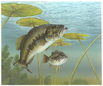
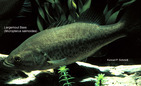
Largemouth bass have bodies that are both elongated and thick. They are the largest of the black basses, reaching a maximum recorded adult length of 97 cm and a maximum recorded adult weight of 10.1 kg. This species typically ranges from 30-40 cm in length and weigh on average 0.45-1.36 kilograms. Females tend to be larger than males. Males generally don't greyish color. They have a deep notch between their dorsal fins, along with a dark black exceed 40 cm long, but the females can reach up to 56 cm long.
The color of largemouth bass is generally olive-green, but some have been reported to be a stripe along their body. This bass has a large mouth that extends beyond the posterior edge of their eye which is what tends to separate them from other species, such as the smallmouth bass, Micropterus dolomieu.
They also have a clear separation between the first and second dorsal fins. The front fin has nine to eleven spines while the back fin has up to twelve to fourteen rays. The fry, at hatching are about 4-6 mm long. (Page and Burr, 1991; Rainer and Luna, 2010)
- Other Physical Features
- ectothermic
- heterothermic
- bilateral symmetry
- Sexual Dimorphism
- female larger
-
- Range mass
- 0.45 to 10.1 kg
- 0.99 to 22.25 lb
-
- Average mass
- 1.36 kg
- 3.00 lb
-
- Range length
- 30 to 97 cm
- 11.81 to 38.19 in
-
- Average length
- 45 cm
- 17.72 in
Development
Fertilized largemouth bass eggs are yellowish orange in color. Largemouth bass fry hatch depending on the water temperature in the nest. They usually take 2-4 days at 18-23 degrees Celsius, but can 1-3 days when temperatures are 27-29 degrees Celsius. After the eggs hatch the fry form a school and are protected by the male adult while they stay in the nest for 7-10 days. The fry then absorb their yolk sacs and can swim on their own.
Both sexes grow indeterminately about 10-15 cm during their first year. The second year this species grows about 10 cm, and they continue to grow about 5 cm a year until they are 6 years of age. At this point the growth rate decreases but does not cease. (Johnke, 1995; Von der Emde, et al., 2004)
- Development - Life Cycle
- indeterminate growth
Reproduction
Largemouth bass are polyandrous, which means one female mates with multiple males in a single breeding season. They reproduce once per year in January-March in the southern areas, and May-June in the northern parts.
Males prepare the nest at the bottom with hard packed sand, pea-gravel, clay, or marl with a very thin layer of mud covering the material. Females wait in areas of deeper water for the nests to be finished. Once the water reaches 15 degrees Celsius, spawning can commence. Once the nest is completed, the male then seeks out for a female and brings her to the nest to drop her eggs. Once the two are near the nest together, the male tries to make her stay by swimming circles around the nest. He also encourages her to drop her eggs by bumping into her numerous times. Once the eggs are dropped the male externally fertilizes them.
Largemouth bass spawn in late winter in the southern parts of the U.S. and late spring in the northern parts when water temperatures reach around 30 degrees Celsius. (Dewoody, et al., 2000; Mearelli, et al., 2002; Orlando, et al., 1999)
- Mating System
- polyandrous
Largemouth bass typically spawn in late winter, January-February, in the southern parts of the U.S. and late spring, May-June, in the northern parts when water temperatures reach around 15 degrees Celsius. They spawn in water usually 0.6-2 meters deep where hard packed sand and mud are found.
Both males and females reach sexual maturity at 3-12 months of age, though 5 months is the average. Males and females mate until they are about 12 years old. One female can produce anywhere from 3,000-45,000 offspring at once but the average is 4,000. The amount of eggs a female lays is positively influence by her size.
Females lay the eggs in the nest that the male has constructed for them and he then externally releases his sperm to fertilize the eggs. Eggs hatch in 1-5 days, with those in warmer waters hatching more quickly. Largemouth bass fry reach independence in 7-10 days but can take as long as 5 weeks.
Not much is known on the birth mass of largemouth bass fry, but they average around 4-6 mm long at birth. (Hambright, et al., 1986; Hambright, 1991; Mearelli, et al., 2002; Orlando, et al., 1999; Page and Burr, 1991; Hambright, et al., 1986; Hambright, 1991; Mearelli, et al., 2002; Orlando, et al., 1999; Page and Burr, 1991)
- Key Reproductive Features
- iteroparous
- seasonal breeding
- gonochoric/gonochoristic/dioecious (sexes separate)
- sexual
- fertilization
- oviparous
-
- Breeding interval
- Largemouth bass spawn once yearly (males) or multiple times in one breeding season (females)
-
- Breeding season
- Largemouth bass spawn in late winter in the southern parts of the U.S. and late spring in the northern parts when water temperatures reach around 15 degrees Celsius.
-
- Range number of offspring
- 3,000 to 45,000
-
- Average number of offspring
- 4,000
-
- Range time to hatching
- 1 to 5 days
-
- Range time to independence
- 1 to 5 weeks
-
- Average time to independence
- 4 weeks
-
- Range age at sexual or reproductive maturity (female)
- 3 to 12 months
-
- Average age at sexual or reproductive maturity (female)
- 5 months
-
- Range age at sexual or reproductive maturity (male)
- 3 to 12 months
-
- Average age at sexual or reproductive maturity (male)
- 5 months
Male largemouth bass prepare the nest for their fry. Once fertilized by the female, the male guards the nest, fanning the water to keep silt from building on top of the eggs. The fry then hatch and the males protect their hatchlings.
The adult largemouth bass gets hungry about 4 or 5 days after the fry have hatched and try to eat as many as his own fry as possible. After about 7-10 days, the fry that survive are ready to swim on their own and depart from their father. (Johnke, 1995)
- Parental Investment
- male parental care
-
pre-fertilization
-
protecting
- male
-
protecting
-
pre-hatching/birth
-
protecting
- male
-
protecting
Lifespan/Longevity
The average wild lifespan of the largemouth bass is 16 years, with a reported range of 15-23 years. The average lifespan of the bass in captivity is 8-12 years. The maximum lifespan in captivity is unknown. (Carey and Judge, 2000)
-
- Range lifespan
Status: wild - 15 to 23 years
- Range lifespan
-
- Typical lifespan
Status: captivity - 8 to 12 years
- Typical lifespan
-
- Average lifespan
Status: wild - 23.0 years
- Max Planck Institute for Demographic Research
- Average lifespan
-
- Average lifespan
Status: wild - 16.0 years
- Max Planck Institute for Demographic Research
- Average lifespan
-
- Average lifespan
Status: wild - 15.0 years
- Max Planck Institute for Demographic Research
- Average lifespan
Behavior
Juvenile largemouth bass are a social group because they form schools with similarly-sized fish. Adults are usually solitary and do not interact with each other. Individuals are motile but typically stay in a radius of < 0.1 km throughout life. They also have a swimming speed of up to 19 kph, but typically swim much slower at about 3-6 kph.
Because the largemouth bass are ectotherms, their metabolic rate is higher in warm water. During the spring they migrate into the warmest available waters, about 15-18 degrees Celsius. During the winter they migrate into deeper water, typically 5-15 meters.
During the day, bass may rest under lily pads or in the shade. During the evening, they become very active and move to shallow water (< 2.5m) to feed. After they are done feeding, much like the afternoons, they return to deeper waters where they rest under logs.
Males and females spawn during the spring when the water temperature reaches 15 degrees Celsius. The males prepare the nest, and when this is finished, the females come and lay their eggs. The male then externally fertilizes them and protects the nest until about 7 days after the fry have hatched. (Johnke, 1995)
- Key Behaviors
- natatorial
- diurnal
- crepuscular
- motile
- sedentary
- solitary
- territorial
-
- Range territory size
- 0.1 to 2 km^2
Home Range
A largemouth bass has a relatively small home range, generally less than 0.1 square kilometers, but it can be as high as 2 square kilometers. ("Habitat suitability index models: Largemouth bass", 1982; Hambright, et al., 1986; Rainer and Luna, 2010)
Communication and Perception
Largemouth bass depend heavily on their sight and hearing to locate their prey and feed. Bass also have internal otoliths, which allows them to hear and react to sounds from up to a kilometer away. They perceive their environment through visual, auditory, and tactile means.
The lateral line of the fish acts as a vibration detection organ. When a species in the water moves near the largemouth bass, the water molecules disperse and this vibration is picked up by the lateral line. This allows the bass to strike an object without being able to see it. Its sight also allows the bass to feed. It takes advantage of low light conditions because it can get closer to prey without being detected. (Kawamura and Kishimoto, 2002; Von der Emde, et al., 2004)
- Perception Channels
- visual
- tactile
- acoustic
- vibrations
- chemical
Food Habits
Largemouth bass are carnivores. Adult bass are known to eat a wide variety of food, whereas the young ones tend to mainly eat zooplankton and aquatic insects. Adults eat crayfish such as the red swamp crayfish, Procambarus darkii, yazoo crayfish Oroconectes hartfieldi, belted crayfish Oroconectes harrisonii, and the painted crayfish Oroconectes difficilis. They also feed on sunfish such as bluegill, Lepomis macrochirus, and green sunfish, Lepomis cyanellus. Adults also eat microcrustacens, frogs, and other largemouth bass. Adults feed all day with peaks in the early morning and late evening.
They tend to eat less in the colder months when their metabolism slows down. They cease feeding when water temperatures drop below 5 degrees C. They also stop eating while spawning. ("Habitat suitability index models: Largemouth bass", 1982; Hickley, et al., 1994; Rainer and Luna, 2010)
- Primary Diet
-
carnivore
- eats terrestrial vertebrates
- piscivore
- insectivore
- eats non-insect arthropods
- Animal Foods
- amphibians
- fish
- zooplankton
Predation
Adult largemouth bass have few predators. Young largemouth bass are targeted by great blue herons Ardea herodias, northern pike Esox lucius, walleye Sander vitreus, muskellunge Esox masquinongy, yellow perch Perca flavescens, channel catfish Ictalurus punctatus, northern water snake Nerodia sipedon, black crappie Pomoxis nigromaculatus, common carp Cyprinus carpio, and the American eel Anguilla rostrata. Multiple species of kingfishers and bitterns feed on this bass, as well. Both the young and adult largemouths are targeted by the bald eagle Haliaeetus leucocephalus. The adult largemouth bass’ main predator is humans Homo sapiens.
Bass hide and protect themselves by swimming close to logs, and under lily pads. Due to their size and speed, they are able to escape possible predation. (Hambright, 1991; Hickley, et al., 1994; Rainer and Luna, 2010)
-
- Known Predators
-
- humans Homo sapiens
- great blue herons Ardea herodias
- yellow perch Perca flavescens
- channel catfish Ictalurus punctatus
- northern water snake Nerodia sipedon
- black crappie Pomoxis nigromaculatus
- common carp Cyprinus carpio
- American eel Anguilla rostrata
- bald eagle Haliaeetus leucocephalus
- northern pike Esox lucius
- walleye Sander vitreus
- muskellunge Esox masquinongy
- kingfishers and bitterns
Ecosystem Roles
Largemouth bass are a top predator and considered a keystone species. In the ecosystem, they exert top-down control of the food web.
Largemouth bass are host to quite a few parasites including monogenean fish-gill trematodes Clavunculus bursatus, parasitic fluke Clinostomum complanatum, thorny-headed worms Neoechinorhynchus cylindratus, leeches such as Myzobdella lugubris and Desserobdella phalera, yellow fish louse Argulus flavescens, and a ectoparasitic protozoan Scyphidia tholiformis.
An ectoparasitic protozoan, Scyphidia tholiformis, is one of the most common parasites in this species. (Hambright, et al., 1986; Price and Mellen, 1980; Young and Olson, 2003)
- Ecosystem Impact
- keystone species
- fish-gill trematode Clavunculus bursatus
- parasitic fluke Clinostomum complanatum
- thorny-headed worm Neoechinorhynchus cylindratus
- leech Myzobdella lugubris
- leech Desserobdella phalera
- yellow fish louse Argulus flavescens
- ectoparasitic protozoan Scyphidia tholiformis
Economic Importance for Humans: Positive
Largemouth bass are an important source of food throughout the world. They are very popular sport fish in the United States. (Hambright, et al., 1986; Young and Olson, 2003)
- Positive Impacts
- food
- ecotourism
Economic Importance for Humans: Negative
Due to largemouth bass being highly sought for when fishing, its presence and sometimes non-native introductions impact the presence and relative density of other sought-after sportfishes. (Hambright, et al., 1986; Young and Olson, 2003)
Conservation Status
Largemouth bass are widely distributed. They are listed as a species of "Least Concern" on the IUCN Red List, and have no special status on the CITES appendices and the United States Endangered Species Act list. No major threats are known to this species. Largemouth bass are listed as low conservation concern and they don't require significant protection. They are stocked in both native and non-native water.
Bag limits exist in many states, so that the bass population can be sustainable. In some states, a fishing season exists for bass. Angling is the most used management tool for this species. (Hambright, et al., 1986; NatureServe, 2013)
-
- IUCN Red List
- Least Concern
-
- US Federal List
- No special status
-
- CITES
- No special status
-
- State of Michigan List
- No special status
Contributors
Emily Steed (author), Radford University - Fall 2015, Cari Mcgregor (editor), Radford University, Zeb Pike (editor), Radford University, Karen Powers (editor), Radford University, April Tingle (editor), Radford University, Jacob Vaught (editor), Radford University, Tanya Dewey (editor), University of Michigan-Ann Arbor.
Glossary
- Australian
-
Living in Australia, New Zealand, Tasmania, New Guinea and associated islands.

- Ethiopian
-
living in sub-Saharan Africa (south of 30 degrees north) and Madagascar.
- Nearctic
-
living in the Nearctic biogeographic province, the northern part of the New World. This includes Greenland, the Canadian Arctic islands, and all of the North American as far south as the highlands of central Mexico.
- Neotropical
-
living in the southern part of the New World. In other words, Central and South America.
- Palearctic
-
living in the northern part of the Old World. In otherwords, Europe and Asia and northern Africa.
- acoustic
-
uses sound to communicate
- bilateral symmetry
-
having body symmetry such that the animal can be divided in one plane into two mirror-image halves. Animals with bilateral symmetry have dorsal and ventral sides, as well as anterior and posterior ends. Synapomorphy of the Bilateria.
- carnivore
-
an animal that mainly eats meat
- chemical
-
uses smells or other chemicals to communicate
- cosmopolitan
-
having a worldwide distribution. Found on all continents (except maybe Antarctica) and in all biogeographic provinces; or in all the major oceans (Atlantic, Indian, and Pacific.
- crepuscular
-
active at dawn and dusk
- diurnal
-
- active during the day, 2. lasting for one day.
- ecotourism
-
humans benefit economically by promoting tourism that focuses on the appreciation of natural areas or animals. Ecotourism implies that there are existing programs that profit from the appreciation of natural areas or animals.
- ectothermic
-
animals which must use heat acquired from the environment and behavioral adaptations to regulate body temperature
- estuarine
-
an area where a freshwater river meets the ocean and tidal influences result in fluctuations in salinity.
- external fertilization
-
fertilization takes place outside the female's body
- fertilization
-
union of egg and spermatozoan
- food
-
A substance that provides both nutrients and energy to a living thing.
- freshwater
-
mainly lives in water that is not salty.
- heterothermic
-
having a body temperature that fluctuates with that of the immediate environment; having no mechanism or a poorly developed mechanism for regulating internal body temperature.
- indeterminate growth
-
Animals with indeterminate growth continue to grow throughout their lives.
- insectivore
-
An animal that eats mainly insects or spiders.
- introduced
-
referring to animal species that have been transported to and established populations in regions outside of their natural range, usually through human action.
- iteroparous
-
offspring are produced in more than one group (litters, clutches, etc.) and across multiple seasons (or other periods hospitable to reproduction). Iteroparous animals must, by definition, survive over multiple seasons (or periodic condition changes).
- keystone species
-
a species whose presence or absence strongly affects populations of other species in that area such that the extirpation of the keystone species in an area will result in the ultimate extirpation of many more species in that area (Example: sea otter).
- male parental care
-
parental care is carried out by males
- motile
-
having the capacity to move from one place to another.
- natatorial
-
specialized for swimming
- native range
-
the area in which the animal is naturally found, the region in which it is endemic.
- oriental
-
found in the oriental region of the world. In other words, India and southeast Asia.
- oviparous
-
reproduction in which eggs are released by the female; development of offspring occurs outside the mother's body.
- piscivore
-
an animal that mainly eats fish
- polyandrous
-
Referring to a mating system in which a female mates with several males during one breeding season (compare polygynous).
- seasonal breeding
-
breeding is confined to a particular season
- sedentary
-
remains in the same area
- sexual
-
reproduction that includes combining the genetic contribution of two individuals, a male and a female
- solitary
-
lives alone
- tactile
-
uses touch to communicate
- temperate
-
that region of the Earth between 23.5 degrees North and 60 degrees North (between the Tropic of Cancer and the Arctic Circle) and between 23.5 degrees South and 60 degrees South (between the Tropic of Capricorn and the Antarctic Circle).
- territorial
-
defends an area within the home range, occupied by a single animals or group of animals of the same species and held through overt defense, display, or advertisement
- tropical
-
the region of the earth that surrounds the equator, from 23.5 degrees north to 23.5 degrees south.
- vibrations
-
movements of a hard surface that are produced by animals as signals to others
- visual
-
uses sight to communicate
- zooplankton
-
animal constituent of plankton; mainly small crustaceans and fish larvae. (Compare to phytoplankton.)
References
U.S. Department of International Wildlife Service. Habitat suitability index models: Largemouth bass. FWS/OBS·82/10.16. Washington, DC: U.S. Fish and Wildlife Service. 1982.
Carey, J., D. Judge. 2000. Longevity Records: Life Spans of Mammals, Birds, Amphibians, Reptiles, and Fish. Denmark: Odense University Press.
Dewoody, J., D. Fletcher, D. Wilkins, W. Nelson, J. Anise. 2000. Genetic monogamy and biparental care in a externally fertilizing fish, the largemouth bass (Micropterus salmoides). Proceedings of the Royal Society B: Biological Sciences, 267/1460: 2431-2437.
Hambright, D. 1991. Experimental analysis of prey selection by largemouth bass: Role of predator mouth width and prey body depth. Transactions of the American Fisheries Society, 120/4: 500-508.
Hambright, K., R. Trebatoski, R. Drenner, D. Kettle. 1986. Experimental study of the impacts of bluegill (Lepomis macrochirus) and largemouth bass (Micropterus salmoides) on pond community structure. Canadian Journal of Fisheries and Aquatic Sciences, 43/6: 1171-1176.
Hickley, P., R. North, S. Muchiri, D. Harper. 1994. The diet of largemouth bass, Micropterus salmoides, in Lake Naivasha, Kenya. Journal of Fish Biology, 44/4: 607-619.
Johnke, W. 1995. The Behavior and Habits of Largemouth Bass. Uniondale, NY: Dorbil Publishing Company.
Kawamura, G., T. Kishimoto. 2002. Color vision, accommodation and visual acuity in the largemouth bass. Fisheries Science, 68/5: 1041-1046.
Mearelli, M., M. Lorenzoni, A. Dorr, R. Erra, G. Giovinazzo, S. Selvi. 2002. Growth and reproduction of largemouth bass (Micropterus salmoides Lacépède, 1802) in Lake Trasimeno (Umbria, Italy). Fisheries Research, 56/1: 89-95.
NatureServe, 2013. "Micropterus salmoides" (On-line). The IUCN Red List of Threatened Species Version 2015.4. Accessed January 24, 2016 at http://dx.doi.org/10.2305/IUCN.UK.2013-1.RLTS.T61265A18229518.en.
Orlando, E., N. Denslow, L. Folmar, L. Guillette, Jr. 1999. A comparison of the reproductive physiology of largemouth bass, Micropterus salmoides, collected from the Escambia and Blackwater Rivers in Florida. Environmental Health Perspectives, 107/3: 199-204.
Page, L., B. Burr. 1991. A Field Guide to Freshwater Fishes. Boston, MA: Houghton Mifflin Company.
Price, R., J. Mellen. 1980. Myxobolus microcystus sp. n. (Protozoa: Myxosporida) from the gills of Micropterus salmoides (Lacépède 1802) in southern Illinois. The Journal of Parasitology, 66/6: 1019-1021.
Rainer, F., S. Luna. 2010. "Micropterus salmoides (Lacepède, 1802) Largemouth black bass" (On-line). Accessed January 22, 2016 at http://www.fishbase.se/summary/Micropterus-salmoides.html.
Von der Emde, G., J. Mogdans, K. Kapoor. 2004. The Senses of Fish: Adaptations for the Reception of Natural Stimuli. New Delhi, India: Narosa Publishing House.
Young, M., B. Olson. 2003. Patterns of diet and growth in co-occurring populations of largemouth bass and smallmouth bass. Transactions of the American Fisheries Society, 132/6: 1207-1213.