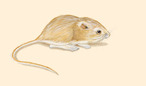
Microdipodops palliduspale kangaroo mouse
Geographic Range
Microdipodops pallidus are found in Western Nevada and a portion of bordering California.(Nowak, 1999).
Habitat
Kangaroo mice usually excavate their simple burrows near shrubs. The burrows of M. pallidus are far more simple than those of their sister species M. megacephalus (Nowak, 1999). These mice live in arid environments along sand dunes, gravelly soil, and lowlands. Microdipodops pallidus have been found at elevations ranging from 1100 - 2500 meters. They may occur sympatrically with as many as six other species of heteromyid rodents (Woods, 1990). (Nowak, 1999; Woods, 1990)
- Habitat Regions
- temperate
- terrestrial
- Terrestrial Biomes
- desert or dune
- savanna or grassland
-
- Range elevation
- 1100 to 2500 m
- 3608.92 to 8202.10 ft
Physical Description
The pale, whitish-cream dorsal pelage earns Microdipodops pallidus their name. The white coloration continues to the underside of the animal. This characteristic is used to differentiate between M. pallidus and their sister species, the darker Microdipodops megacephalus. The fur is silky and long, and the tail is neither crested nor penciled (Nowak, 1999). Much of the body is shaped to aid in its hopping locomotion; M. pallidus has long hind legs, shortened forelegs, and uses its tail for balance. The proportionately large hind feet of M. pallidus improve movement through sandy habitats by being fringed at the sides with stiff hairs. These hairs, also found on the undersurface of the hind feet, act to increase the surface area of the foot (Nowak, 1999). The kidneys of kangaroo mice are very efficient, and fat is stored in their tails (Woods, 1990).
The skull of Microdipodops pallidus is quite large in relation to body size. This is because of their extremely inflated auditory bullae, which extend onto the upper portion of the skull (Nowak, 1999; Woods, 1990). This inflation is greater than in any other member of the Heteromyidae (Nowak, 1999). Molars of kangaroo mice do not regrow, and the dental formula is 1/1, 0/0, 1/1, 3/3 = 20.
Body Length: 6.6 - 7.7 cm
Tail Length: 6.4 - 10.3 cm (Nowak, 1999; Woods, 1990)
- Other Physical Features
- endothermic
- bilateral symmetry
-
- Range mass
- 10 to 17 g
- 0.35 to 0.60 oz
Reproduction
Information about the reproduction of M. pallidus is limited. This may be due in part to the limited amount of reproductive behaviors observed while these animals are in human care (Woods, 1990). Neither the time of weaning nor that of sexual maturity is known (Woods, 1990). Kangaroo mice are believed to be polyestrous, and in the wild pregnancies have been recorded between March and September (Nowak, 1997). The average weight of young at birth is about 1 gram, and litter size ranges from 2-7 young. (Nowak, 1997; Woods, 1990)
- Key Reproductive Features
- iteroparous
- seasonal breeding
- gonochoric/gonochoristic/dioecious (sexes separate)
- sexual
- viviparous
-
- Range number of offspring
- 2 to 7
Lifespan/Longevity
The lifespan of M. pallidus is approximately 5.5 years.
Behavior
Pale kangaroo mice are nocturnal. They are believed to be solitary and are usually aggressive towards conspecifics. Researchers are not sure if this species hibernates, however these mice have been observed to enter short dormant periods in response to temperature and food reductions. (Nowak, 1999)
Microdipodops pallidus are often compared to another heteromyid group, the kangaroo rats in the genus Dipodops. Both Microdipodops and Dipodops are commonly called "kangaroo" because their jumping movement is saltatory, as in kangaroos (Norwak, 1997). Kangaroo mice are exclusively bipedal, their tail serves as a balance, and they are believed to use their forelegs to aid in turning. (Nowak, 1997)
- Key Behaviors
- terricolous
- saltatorial
- nocturnal
- motile
- sedentary
- daily torpor
- solitary
- territorial
Home Range
Male pale kangaroo mice have territories of about 6600 square meters. Female territories tend to be smaller, around 4,000 square meters. (Nowak, 1999)
Communication and Perception
Food Habits
Microdipodops pallidus are primarily granivorous. They use their incisors for husking seeds, and carry seeds to their burrows in fur-lined cheek pouches (Dayan and Simberloff, 1994). During summer these mice will also eat insects (Woods, 1990). The tail of M. pallidus stores fat for use during dormant periods (Nowak, 1999). One of the most remarkable aspects of the diet of M. pallidus and some other heteromyid species, is that they can survive for extended periods, even lifetimes, without consuming water. It is believed that their extremely efficient kidneys (Woods, 1990) and their ability to derive sufficient water from food (Nowak, 1999) are responsible for this unique adaptation to an arid environment. (Dayan and Simberloff, 1994; Nowak, 1999; Woods, 1990)
- Animal Foods
- insects
- terrestrial non-insect arthropods
- Plant Foods
- seeds, grains, and nuts
- Foraging Behavior
- stores or caches food
Predation
The large interal ear structures of this species sugget that it has very keen hearing, and uses this to detect predators. The pale color of these mice may also help it blend in with its background environment. Natural predators of pale kangaroo mice include rattlesnakes, predatory birds (mainly owls), weasels, and coyotes (Woods, 1990). (Woods, 1990)
- Anti-predator Adaptations
- cryptic
-
- Known Predators
-
- coyotes (Canis latrans)
- weasels (Mustelidae)
- owls (Strigidae)
- rattlesnakes (Crotalus)
Conservation Status
Woods (1990) describes Microdipodops pallidus as common, and the IUCN rates the species as a whole as "Lower risk/least concern". However, they rate the subspecies M. pallidus restrictus (the Soda Spring Valley pale kangaroo mouse) as vulnerable, because it is only known from one location. (Woods, 1990)
-
- IUCN Red List
-
Least Concern
More information
-
- IUCN Red List
-
Least Concern
More information
-
- US Federal List
- No special status
-
- CITES
- No special status
Other Comments
Although there are many similarities between kangaroo rats (Dipodops) and kangaroo mice (Microdipodops), these are mainly a product of convergent evolution. Microdipodops pallidus is classified with other pocket mice because of dental and skull morphology (Woods, 1990). (Woods, 1990)
Contributors
Emily Peterson (author), University of Michigan-Ann Arbor, Phil Myers (editor), Museum of Zoology, University of Michigan-Ann Arbor.
Glossary
- Nearctic
-
living in the Nearctic biogeographic province, the northern part of the New World. This includes Greenland, the Canadian Arctic islands, and all of the North American as far south as the highlands of central Mexico.

- bilateral symmetry
-
having body symmetry such that the animal can be divided in one plane into two mirror-image halves. Animals with bilateral symmetry have dorsal and ventral sides, as well as anterior and posterior ends. Synapomorphy of the Bilateria.
- chemical
-
uses smells or other chemicals to communicate
- cryptic
-
having markings, coloration, shapes, or other features that cause an animal to be camouflaged in its natural environment; being difficult to see or otherwise detect.
- desert or dunes
-
in deserts low (less than 30 cm per year) and unpredictable rainfall results in landscapes dominated by plants and animals adapted to aridity. Vegetation is typically sparse, though spectacular blooms may occur following rain. Deserts can be cold or warm and daily temperates typically fluctuate. In dune areas vegetation is also sparse and conditions are dry. This is because sand does not hold water well so little is available to plants. In dunes near seas and oceans this is compounded by the influence of salt in the air and soil. Salt limits the ability of plants to take up water through their roots.
- endothermic
-
animals that use metabolically generated heat to regulate body temperature independently of ambient temperature. Endothermy is a synapomorphy of the Mammalia, although it may have arisen in a (now extinct) synapsid ancestor; the fossil record does not distinguish these possibilities. Convergent in birds.
- granivore
-
an animal that mainly eats seeds
- herbivore
-
An animal that eats mainly plants or parts of plants.
- iteroparous
-
offspring are produced in more than one group (litters, clutches, etc.) and across multiple seasons (or other periods hospitable to reproduction). Iteroparous animals must, by definition, survive over multiple seasons (or periodic condition changes).
- motile
-
having the capacity to move from one place to another.
- native range
-
the area in which the animal is naturally found, the region in which it is endemic.
- nocturnal
-
active during the night
- saltatorial
-
specialized for leaping or bounding locomotion; jumps or hops.
- seasonal breeding
-
breeding is confined to a particular season
- sedentary
-
remains in the same area
- sexual
-
reproduction that includes combining the genetic contribution of two individuals, a male and a female
- solitary
-
lives alone
- stores or caches food
-
places a food item in a special place to be eaten later. Also called "hoarding"
- tactile
-
uses touch to communicate
- temperate
-
that region of the Earth between 23.5 degrees North and 60 degrees North (between the Tropic of Cancer and the Arctic Circle) and between 23.5 degrees South and 60 degrees South (between the Tropic of Capricorn and the Antarctic Circle).
- terrestrial
-
Living on the ground.
- territorial
-
defends an area within the home range, occupied by a single animals or group of animals of the same species and held through overt defense, display, or advertisement
- tropical savanna and grassland
-
A terrestrial biome. Savannas are grasslands with scattered individual trees that do not form a closed canopy. Extensive savannas are found in parts of subtropical and tropical Africa and South America, and in Australia.
- savanna
-
A grassland with scattered trees or scattered clumps of trees, a type of community intermediate between grassland and forest. See also Tropical savanna and grassland biome.
- temperate grassland
-
A terrestrial biome found in temperate latitudes (>23.5° N or S latitude). Vegetation is made up mostly of grasses, the height and species diversity of which depend largely on the amount of moisture available. Fire and grazing are important in the long-term maintenance of grasslands.
- viviparous
-
reproduction in which fertilization and development take place within the female body and the developing embryo derives nourishment from the female.
References
Dayan, T., D. Simberloff. 1994. Morphological relationships among coexisting heteromyids: an incisive dental character. The American Naturalist, 143(3): 462-477.
Nowak, R. 1997. "Walker's Mammals of the World 5.1" (On-line). Accessed November 19, 1999 at http://www.press.jhu.edu/books/walkers_m...orld/rodentia/rodentia.heteromyidae.html.
Nowak, R. 1999. Walker's Mammals of the World, Sixth Edition, Volume II. Baltimore, London: Johns Hopkins Univeristy Press.
Woods, C. 1990. Pocket Rodents. Pp. 131-140 in S Parker, ed. Grizmek's Encyclopedia of Mammals, Volume III. New York City, New York, USA: McGraw Hill Publishing Company.