Mephitis mephitisstriped skunk



Geographic Range
Striped skunks (Mephitis mephitis) have a range spanning most of North America. From east to west, they reach from the Atlantic to the Pacific Ocean, covering most of the continental United States and southern regions of Canada. They also range to the south over a portion of northern Mexico. (Kurta, 1995; Wade-Smith and Verts, 1982; Whitaker, 1996)
Habitat
Mephitis mephitis is commonly found in a variety of habitats including woodlands, forests, wooded ravines and grassy plains. Over time, however, they have become more prominent in areas of extreme cultivation as well as in suburban neighborhoods. Other habitats may include scrubland, riparian areas and urban environments. On average, M. mephitis is found at elevations from sea level to 1,800 m, but have been documented as high as 4,200 m. (Chapman and Feldhamer, 1982; Kurta, 1995; Wade-Smith and Verts, 1982; Whitaker, 1996)
- Habitat Regions
- temperate
- terrestrial
- Terrestrial Biomes
- savanna or grassland
- chaparral
- forest
- scrub forest
- Other Habitat Features
- urban
- suburban
- agricultural
- riparian
-
- Range elevation
- sea level to 4,200 m
- to ft
-
- Average elevation
- sea level to 1,800 m
- ft
Physical Description
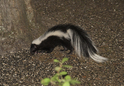
Striped skunks are easily distinguishable by their coloration pattern. With overall black pelage, they have a thin, white stripe along the center-top of their snout and forehead as well as a prominent white marking on their nape. While pattern varies greatly across individuals, the white marking on their nape typically runs along the dorsum, splitting into a thick, V-shape as it approaches their rump. Additionally, there are frequently white hairs on the edges of their bushy, black tail. With their small, triangular-shaped heads, striped skunks have short ears and black eyes that lack a nictitating membrane. Their maw holds 34 total teeth, with the following dental formula: I 3/3, C 1/1, P 3/3, M 1/2. Their legs are stout, with five-toed plantigrade feet and long foreclaws for digging. (Chapman and Feldhamer, 1982; Kurta, 1995; Nowak and Wilson, 1999; Wade-Smith and Verts, 1982; Whitaker, 1996)
They display minor sexual dimorphism, the males are slightly larger than the females. While most sources agree that M. mephitis is about the size of domestic cats, there is some discrepancy in their measurements. Their total length has been documented many times and estimates range from 465 to 815 mm. Their tail length differs slightly less; with measurements ranging 170 to 400 mm. Discrepancies are not as severe in the hindfoot measurements, with a range of 55 to 85 mm. (Chapman and Feldhamer, 1982; Kurta, 1995; Wade-Smith and Verts, 1982; Whitaker, 1996)
Measurements of body mass in M. mephitis also show a large range, between 0.7 to 6.3 kg. However, during periods of wintering, a reduction in body mass can result in losses of up to 47.7% in males and 50.1% in females, mostly due to fat metabolism. These overall differences could be an indication that M. mephitis differs in size across geographic ranges in the same way it differs in pelage patterns. (Chapman and Feldhamer, 1982; Kurta, 1995; Nowak and Wilson, 1999; Wade-Smith and Verts, 1982)
- Other Physical Features
- endothermic
- homoiothermic
- bilateral symmetry
- Sexual Dimorphism
- male larger
-
- Range mass
- 0.7 to 6.3 kg
- 1.54 to 13.88 lb
-
- Range length
- 465 to 815 mm
- 18.31 to 32.09 in
Reproduction
Under normal circumstances, female striped skunks only reproduce once a year, although males will reproduce with multiple females. After mating, females no longer associate with males and will become aggressive towards them through vocalizing, stamping their feet and fighting if necessary. (Kurta, 1995; Wade-Smith and Verts, 1982; Whitaker, 1996)
- Mating System
- polygynous
Males approach from behind and begin by smelling and licking the female’s vulva. Seeking to mount, the male moves by the female's side where he proceeds to seize her nape. Females often resist, not becoming receptive until estrous, in which case they will usually take a submissive posture. Once successfully mounted, the male continues his copulatory thrusts. Copulation typically ends one minute after the male's acceptance. (Kurta, 1995; Wade-Smith and Verts, 1982; Whitaker, 1996)
Breeding usually occurs sometime between February and April. However, a secondary period can take place in May if the first litter is lost or in other cases, such as pseudopregnancy. Gestation lasts about 59 to 77 days, beginning with a period of delayed implantation that can last up to 19 days. Mephitis mephitis can produce a litter that ranges from 2 to 10 individuals, with individual masses of 32 to 35 g. (Kurta, 1995; Wade-Smith and Verts, 1982; Whitaker, 1996)
- Key Reproductive Features
- iteroparous
- seasonal breeding
- gonochoric/gonochoristic/dioecious (sexes separate)
- sexual
- fertilization
- viviparous
- delayed implantation
-
- Breeding interval
- Female striped skunks breed once a year under normal circumstances.
-
- Breeding season
- Breeding occurs from February to April, or during May under extenuating circumstances.
-
- Range number of offspring
- 2.0 to 10.0
-
- Average number of offspring
- 4.0 to 7.0
-
- Average number of offspring
- 5
- AnAge
-
- Range gestation period
- 59 to 77 days
-
- Range weaning age
- 6.0 to 7.0 weeks
-
- Range time to independence
- 0.5 to 1.0 years
-
- Average age at sexual or reproductive maturity (female)
- 10 months
-
- Average age at sexual or reproductive maturity (female)
Sex: female - 335 days
- AnAge
- Average age at sexual or reproductive maturity (female)
-
- Average age at sexual or reproductive maturity (male)
- 10 months
-
- Average age at sexual or reproductive maturity (male)
Sex: male - 335 days
- AnAge
- Average age at sexual or reproductive maturity (male)
Although they are altricial with sparse pelage at birth, younglings have discernable patterns prior to birth. The younglings do not open their eyes until about three weeks of age and are typically weaned at six to seven weeks. It is at this time they learn to forage and hunt by following their mother in a single file line during her outings. Younglings rely on the protection of their mother, during this time she will display extremely defensive behavior. Male younglings become independent by July or August, while the female younglings may remain with their mother until the following spring. Both male and female younglings become sexually mature by the end of the first year, around 10 months of age on average. (Kurta, 1995; Wade-Smith and Verts, 1982; Whitaker, 1996)
- Parental Investment
- altricial
-
pre-fertilization
- provisioning
-
protecting
- female
-
pre-hatching/birth
-
provisioning
- female
-
protecting
- female
-
provisioning
-
pre-weaning/fledging
-
provisioning
- female
-
protecting
- female
-
provisioning
-
pre-independence
-
protecting
- female
-
protecting
- post-independence association with parents
Lifespan/Longevity
Mephitis mephitis has a high mortality rate and usually does not survive its first year due to severe weather conditions and infectious disease. Past their first year, they can live up to seven years in the wild and up to 10 years in captivity. Other factors contributing to mortality include predation and parasitism as well as risk from human road systems and a vulnerability to hunting. (Gehrt, 2005; Kurta, 1995; Wade-Smith and Verts, 1982; Whitaker, 1996)
-
- Range lifespan
Status: wild - 7.0 (high) years
- Range lifespan
-
- Range lifespan
Status: captivity - 10 (high) years
- Range lifespan
-
- Average lifespan
Status: wild - less than one years
- Average lifespan
-
- Average lifespan
Status: wild - 6.0 years
- Max Planck Institute for Demographic Research
- Average lifespan
-
- Average lifespan
Status: captivity - 10.0 years
- Max Planck Institute for Demographic Research
- Average lifespan
Behavior
Mephitis mephitis is a docile creature and often ignores other animals, except during the breeding season. Despite its passive nature, M. mephitis is well known for its defensive behavior. Although all carnivores are noted for having scent glands, members of the family Mephitidae are renowned for having enlarged anal scent glands, even more than members of family Mustelidae. These paired glands contain an overpowering, yellowish musk, which can be discharged through the anus in a fluid spray, reaching up to 6.0 meters. The resulting mist can reach even further; the scent can be detected by humans from an extremely long distance. The musk acts as an irritant to the senses and has been documented to cause nausea, intense pain and temporary blindness. If approached, M. mephitis will face an opponent while arching its back and raising its tail, then stomp the ground with its forelegs as a warning. A temporary handstand may be performed if the ground stomping is done in synchrony with backing away. If the opponent does not comply by drawing back, M. mephitis will bend its hindquarters around while still facing the intruder and spray. Impulsive movements or noises can also result in a discharge. (Houseknecht and Tester, 1978; Kurta, 1995; Wade-Smith and Verts, 1982; Whitaker, 1996)
Mephitis mephitis is solitary and primarily nocturnal, although some may be crepuscular. Circadian activity begins around twilight and may continue until daybreak. During the daytime, M. mephitis will take up refuge in the abandoned underground dens of other mammals, but may dig their own if necessary. Hollowed logs or trees, rock or brush piles and the underside of buildings may also be utilized. In areas with cold winter climates, there is a seasonal shift from the aboveground dens in the summer to the underground dens, which last from fall to early spring. Even though M. mephitis does not hibernate, they become inactive during the wintering periods, relying on fat storage for energy. During this time, it is common to see communal denning between females or even females and a single male. While M. mephitis is known to remain in a single den throughout the winter, they may occupy multiple dens during periods of warmer weather. Individuals living in areas without a cold wintering period do not undergo dormancy. (Houseknecht and Tester, 1978; Kurta, 1995; Whitaker, 1996)
- Key Behaviors
- terricolous
- nocturnal
- crepuscular
- motile
- solitary
-
- Range territory size
- 3.75 to 5.00 km^2
Home Range
Mephitis mephitis will typically occupy a home range that is stretched in a linear fashion, with their den in the periphery. (Houseknecht and Tester, 1978; Kurta, 1995; Wade-Smith and Verts, 1982; Whitaker, 1996)
Communication and Perception
Mephitis mephitis relies primarily on visual displays to ward off predators or unwanted visitors and may resort to a chemical discharge if not left alone. Although they are usually silent, an individual can produce a wide variety of sounds from low growls to birdlike chirps. Little is known about their perception; however, an individual may react to auditory or visual cues at close range. Deprivation in visual, acoustic and even olfactory sensation has been considered a potential result of their defensive capabilities in additional to their passivity. (Kurta, 1995; Verts, 1967; Wade-Smith and Verts, 1982; Whitaker, 1996)
Food Habits
Mephitis mephitis is an opportunistic feeder and will change its diet as needed. During the warmer spring and summer seasons, they are primarily insectivorous, known to feed on various grasshoppers, crickets, beetles, larvae and social insects such as bees. Other invertebrates may include worms, crayfish and other non-insect arthropods. Small mammals such as voles, as well as the eggs and young of ground-nesting birds are commonly consumed over the wintering period. Mephitis mephitis is also known to consume amphibians, reptiles, carrion and fish. While up to 80-90% of its diet is from an animal origin, M. mephitis is also known to feed on plant matter when in season. This includes corn, nightshade and fruits such as black and ground cherries. (Kurta, 1995; Verts, 1967; Wade-Smith and Verts, 1982; Whitaker, 1996)
- Primary Diet
- omnivore
- Animal Foods
- birds
- mammals
- amphibians
- reptiles
- fish
- eggs
- carrion
- insects
- terrestrial non-insect arthropods
- terrestrial worms
- aquatic crustaceans
- Plant Foods
- seeds, grains, and nuts
- fruit
Predation
Most mammals avoid Mephitis mephitis due to its defensive capabilities, however, large birds of prey are unaffected by the musk. The most prominent of these are great horned owls and eagles. Mammalian species known to prey on M. mephitis include mountain lions, bobcats, coyotes, foxes, and badgers. Even though coyotes are known to prey on them, recent research showed that M. mephitis does not avoid areas of coyote activity. (Kurta, 1995; Prange and Gehrt, 2007; Wade-Smith and Verts, 1982; Whitaker, 1996)
- Anti-predator Adaptations
- aposematic
-
- Known Predators
-
- great horned owls (Bubo virginianus)
- golden eagles (Aquila chrysaetos)
- bald eagles (Haliaeetus leucocephalus)
- mountain lions (Puma concolor)
- bobcats (Lynx rufus)
- coyotes (Canis latrans)
- gray foxes (Urocyon cinereoargenteus)
- red foxes (Vulpes vulpes)
- American badgers (Taxidea taxus)
Ecosystem Roles
Mephitis mephitis is an important source of insect control; however, it also a vector for parasitism and disease. These may include fleas, lice, mites, ticks, and botfly larvae as well as various parasitic worms. Among diseases, there have been reports of leptospirosis and canine distemper, though M. mephitis is better known as a notorious carrier of rabies. Some sources believe that communal denning aids in the spread of these infectious diseases. They may also carry a variety of other diseases including Q fever, listeriosis, pulmonary aspergillosis, pleuritis, ringworm, murine typhus, tularemia, Chagas' disease and canine parvovirus. (Gehrt, 2005; Kurta, 1995; Verts, 1967; Wade-Smith and Verts, 1982; Whitaker, 1996)
- human (Homo sapiens)
- fleas Siphonaptera (class Insecta; phylum Arthropoda)
- lice Phthiraptera (class Insecta; phylum Arthropoda)
- mites (class Arachnida; phylum Arthropoda)
- ticks Ixodida (class Arachnida; phylum Arthropoda)
- botfly larvae Oestroidea (class Insecta; phylum Arthropoda)
- (phylum Nematoda)
- (class Cestoda; phylum Platyhelminthes)
- (class Trematoda; phylum Platyhelminthes)
- (phylum Acanthocephala)
- tongue worms Pentastomida (class Maxillopoda; phylum Arthropoda)
Economic Importance for Humans: Positive
In addition to the ecosystem, Mephitis mephitis serves as an important source of insect control for human populations. At one time, their pelts were valuable for the fur trade; however, they are not currently in high demand. Mephitis mephitis may have been a source of food for native North Americans and they may have been used in medical treatments for both the natives and the pioneers. There is no indication that they are still used as a source of food or medicine, however, the clinging quality of their musk has made it valuable as a perfume foundation. Along with other members of family Mephitidae, M. mephitis can be kept as a household pet in certain areas throughout the United States as well as in other countries, though this often requires a permit. (Kurta, 1995; Verts, 1967; Wade-Smith and Verts, 1982; Whitaker, 1996)
- Positive Impacts
- pet trade
- food
- body parts are source of valuable material
- source of medicine or drug
- controls pest population
Economic Importance for Humans: Negative
Mephitis mephitis can carry diseases and parasites infectious not only to humans, but also to other domesticated animals. They are sometimes considered general pests when they dig up lawns, take up residents in buildings or when they are provoked into discharging their musk. (Kurta, 1995; Wade-Smith and Verts, 1982; Whitaker, 1996)
- Negative Impacts
-
injures humans
- carries human disease
- causes or carries domestic animal disease
Conservation Status
Striped skunks have an abundant population and are not threatened.
-
- IUCN Red List
-
Least Concern
More information
-
- IUCN Red List
-
Least Concern
More information
-
- US Federal List
- No special status
-
- CITES
- No special status
-
- State of Michigan List
- No special status
Other Comments
Members of family Mephitidae were once classified in family Mustelidae, but molecular techniques have shown differences in their phylogenetic relationship and they have since been elevated to their own family. (Detlefsen and Holbrook, 1921; Dragoo and Honeycutt, 1997; Verts, 1967; Wade-Smith and Verts, 1982)
The name Mephitis comes from the Latin word mephit, which means "bad odor". Members of family Mephitidae are also the subjects of folklore for the Native Americans. (Verts, 1967; Wade-Smith and Verts, 1982)
Members of genus Mephitis have been bred for the discovery of different patterns and pelage colors. Mephitis pudita, otherwise known as Eastern skunks, were utilized for the discovery of entirely black or white morphs as well as seal brown with white stripes and a few others. (Detlefsen and Holbrook, 1921)
Contributors
Jeffrey Kiiskila (author), Michigan Technological University, Joseph Bump (editor), Michigan Technological University, Leila Siciliano Martina (editor), Animal Diversity Web Staff.
Glossary
- Nearctic
-
living in the Nearctic biogeographic province, the northern part of the New World. This includes Greenland, the Canadian Arctic islands, and all of the North American as far south as the highlands of central Mexico.

- acoustic
-
uses sound to communicate
- agricultural
-
living in landscapes dominated by human agriculture.
- altricial
-
young are born in a relatively underdeveloped state; they are unable to feed or care for themselves or locomote independently for a period of time after birth/hatching. In birds, naked and helpless after hatching.
- aposematic
-
having coloration that serves a protective function for the animal, usually used to refer to animals with colors that warn predators of their toxicity. For example: animals with bright red or yellow coloration are often toxic or distasteful.
- bilateral symmetry
-
having body symmetry such that the animal can be divided in one plane into two mirror-image halves. Animals with bilateral symmetry have dorsal and ventral sides, as well as anterior and posterior ends. Synapomorphy of the Bilateria.
- carrion
-
flesh of dead animals.
- causes or carries domestic animal disease
-
either directly causes, or indirectly transmits, a disease to a domestic animal
- chaparral
-
Found in coastal areas between 30 and 40 degrees latitude, in areas with a Mediterranean climate. Vegetation is dominated by stands of dense, spiny shrubs with tough (hard or waxy) evergreen leaves. May be maintained by periodic fire. In South America it includes the scrub ecotone between forest and paramo.
- chemical
-
uses smells or other chemicals to communicate
- crepuscular
-
active at dawn and dusk
- delayed implantation
-
in mammals, a condition in which a fertilized egg reaches the uterus but delays its implantation in the uterine lining, sometimes for several months.
- drug
-
a substance used for the diagnosis, cure, mitigation, treatment, or prevention of disease
- endothermic
-
animals that use metabolically generated heat to regulate body temperature independently of ambient temperature. Endothermy is a synapomorphy of the Mammalia, although it may have arisen in a (now extinct) synapsid ancestor; the fossil record does not distinguish these possibilities. Convergent in birds.
- fertilization
-
union of egg and spermatozoan
- food
-
A substance that provides both nutrients and energy to a living thing.
- forest
-
forest biomes are dominated by trees, otherwise forest biomes can vary widely in amount of precipitation and seasonality.
- iteroparous
-
offspring are produced in more than one group (litters, clutches, etc.) and across multiple seasons (or other periods hospitable to reproduction). Iteroparous animals must, by definition, survive over multiple seasons (or periodic condition changes).
- motile
-
having the capacity to move from one place to another.
- native range
-
the area in which the animal is naturally found, the region in which it is endemic.
- nocturnal
-
active during the night
- omnivore
-
an animal that mainly eats all kinds of things, including plants and animals
- pet trade
-
the business of buying and selling animals for people to keep in their homes as pets.
- polygynous
-
having more than one female as a mate at one time
- riparian
-
Referring to something living or located adjacent to a waterbody (usually, but not always, a river or stream).
- scrub forest
-
scrub forests develop in areas that experience dry seasons.
- seasonal breeding
-
breeding is confined to a particular season
- sexual
-
reproduction that includes combining the genetic contribution of two individuals, a male and a female
- solitary
-
lives alone
- suburban
-
living in residential areas on the outskirts of large cities or towns.
- tactile
-
uses touch to communicate
- temperate
-
that region of the Earth between 23.5 degrees North and 60 degrees North (between the Tropic of Cancer and the Arctic Circle) and between 23.5 degrees South and 60 degrees South (between the Tropic of Capricorn and the Antarctic Circle).
- terrestrial
-
Living on the ground.
- tropical savanna and grassland
-
A terrestrial biome. Savannas are grasslands with scattered individual trees that do not form a closed canopy. Extensive savannas are found in parts of subtropical and tropical Africa and South America, and in Australia.
- savanna
-
A grassland with scattered trees or scattered clumps of trees, a type of community intermediate between grassland and forest. See also Tropical savanna and grassland biome.
- temperate grassland
-
A terrestrial biome found in temperate latitudes (>23.5° N or S latitude). Vegetation is made up mostly of grasses, the height and species diversity of which depend largely on the amount of moisture available. Fire and grazing are important in the long-term maintenance of grasslands.
- urban
-
living in cities and large towns, landscapes dominated by human structures and activity.
- visual
-
uses sight to communicate
- viviparous
-
reproduction in which fertilization and development take place within the female body and the developing embryo derives nourishment from the female.
References
Chapman, J., G. Feldhamer. 1982. Wild Mammals of North American: Biology, Management, and Conservation. Baltimore, MD: John Hopkins University Press.
Detlefsen, J., F. Holbrook. 1921. Skunk breeding. Journal of Heredity, 12/6: 242-254.
Dragoo, J., R. Honeycutt. 1997. Systematics of Mustelid-Like Carnivores. Journal of Mammalogy, 78/2: 426-443.
Gehrt, S. 2005. Seasonal Survival and Cause-Specific Mortality of Urban and Rural Striped Skunks in the Absence of Rabies. Journal of Mammalogy, 86/6: 1164-1170.
Houseknecht, C., J. Tester. 1978. Denning Habits of Striped Skunks (Mephitis mephitis). American Midland Naturalist, 100/2: 424-430.
Kurta, A. 1995. Mammals of the Great Lakes Region, Revised Edition. Ann Arbor, MI: University of Michigan Press.
Nowak, R., D. Wilson. 1999. Walker's Mammals of the World, Sixth Edition. Baltimore, MD: John Hopkins University Press.
Prange, S., S. Gehrt. 2007. Response of Skunks to a Simulated Increase in Coyote Activity. Journal of Mammalogy, 88/4: 1040-1049.
Verts, B. 1967. The Biology of the Striped Skunk. Urbana, IL: University of Illinois Press.
Wade-Smith, J., B. Verts. 1982. Mephitis mephitis. Mammalian Species, 173: 1-7.
Whitaker, J. 1996. National Audubon Society Field Guide To North American Mammals, Revised Edition. New York: Alfred A. Knopf, Inc.