Mephitis macrourahooded skunk


Geographic Range
Hooded skunks (Mephitis macroura) are found throughout the southern United States, Mexico, and Central America in Guatemala, Honduras, Nicaragua, and northwestern Costa Rica. In the United States, hooded skunks inhabit southeastern Arizona, southwestern New Mexico, and southwestern Texas. Some sources suggest the species' range is expanding in Texas due to increased human developments and fields. There are currently four recognized subspecies of hooded skunks: M. m. eximus, M. m. macroura, M. m. milleri, and M. m. richardsonii. Mephitis macroura eximus is known only in the lowlands of Central Veracruz, Mexico. Mephitis macroura macroura is located throughout southern Mexico, southwest of the Durango state all the way to Guatemala. Mephitis macroura milleri, the northern hooded skunk is found in the northern half of Mexico, up into the southern United States. Mephitis macroura richardsoni has the most southern distribution in Central America including Nicaragua and Costa Rica. (Allen, 1901; Cervantes, et al., 2002; Goodwin, 1957; Hall and Dalquest, 1950; Hall, 1981; Howell, 1901; Janzen and Hallwachs, 1982; Packard, 1965; Patton, 1974; Reid, 1997)
- Biogeographic Regions
- nearctic
- neotropical
Habitat
The habitat occupied by hooded skunks is highly variable, ranging from arid lowlands to boreal forests of 3,100 meters or plateaus of 2,400 meters altitude, and many habitats in between. There are conflicting accounts of their preferred habitat; however, it is generally accepted that hooded skunks prefer to den in rocky, vegetated areas near a permanent water body. High-elevation ponderosa pine forests, deciduous forests, forest edges, riparian zones, rocky canyons, grasslands, pastures, and arid desert lowlands are all habitats in which hooded skunks are known to occur. Hooded skunks are the most abundant skunk species in Oaxaca, Mexico, where they prefer grasslands and marshes over scrublands. Hooded skunks are most abundant during the wet season, from August to September at mean densities up to 1.7 individuals per kilometer squared. (Bailey, 1932; Cervantes, et al., 2002; Davis and Russell, 1954; Godin, 1982; Hall, 1981; Howard and Marsh, 1982; Hubbard, 1972; Reid, 1997; Rosatte, 1987)
Dens may be constructed in existing rock ledges and crevices, heterospecific burrows, or other human-created structures, although the latter is less preferred. Dens of both hooded skunks and striped skunks are relatively smaller in size than other North American skunk genera, and are usually surrounded by dense vegetation for cover. (Bailey, 1932; Hwang and Larivière, 2001; Patton, 1974; Reid, 1997)
Subspecies may be more selective in terms of preferred habitat. The larger M. m. milleri and M. m. macroura are found predominantly in more temperate climates, with M. m. macroura noted for higher elevation and mountainous terrain. Mephitis macroura eximus is endemic to lowland arid coastal plains, while M. m. richardsoni is found in more temperate deciduous forests. (Hall and Dalquest, 1950; Janzen and Hallwachs, 1982; Reid, 1997)
- Habitat Regions
- temperate
- tropical
- terrestrial
- Terrestrial Biomes
- desert or dune
- savanna or grassland
- forest
- rainforest
- scrub forest
- Other Habitat Features
- agricultural
- riparian
-
- Range elevation
- 300 to 3100 m
- 984.25 to 10170.60 ft
-
- Average elevation
- 1100 m
- 3608.92 ft
Physical Description
Hooded skunks may be distinguished from striped skunks based on the presence of long hairs on the back of the neck and head forming a ruff or hood, hence the name ‘hooded skunk’, as well as a long, bushy tail of mixed black and white hairs. Hooded skunks are generally smaller and more slender relative to striped skunks, but larger than spotted skunks of genus Spirogale. Hooded skunks have an unaltered, naked nasal pad and shorter foreclaws than hog-nosed skunks of genus Conepatus. The skulls of hooded skunks differ from those of striped skunks in terms of their larger sized auditory bullae and more pronounced sagittal crest and mastoid process. Female hooded skunks have five pairs of nipples, unlike the six pairs of mammae in female striped skunks. (Anderson, 1972; Bailey, 1932; Cahalane, 1961; Coues, 1877; Godin, 1982; Hall and Dalquest, 1950; Hall, 1981; Howell, 1901; Reid, 1997; Wade-Smith and Verts, 1982)
Total body lengths range from 558 to 790 mm, with a head to body length of 195 to 295 mm, a tail length from 357 to 400 mm, a hindfoot length of 60 to 68 mm, and a ground to shoulder height of 178 to 203 mm. Males are generally 15% larger than females and have larger skulls, but have a smaller total length than female skunks. Hooded skunks range in size from 0.4 to 2.7 kg. The dental formula of hooded skunks is the same as striped skunks, which includes 3/3 incisors, 1/1 canines, 3/3 premolars, and 1/2 molars for a total of 34 teeth. (Cahalane, 1961; Godin, 1982; Hall, 1981; Howell, 1901; Hwang and Larivière, 2001; Reid, 1997; Rosatte, 1987)
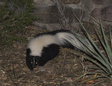
The pelage of hooded skunks has a highly variable color pattern. Hooded skunks have three main pelage pattern morphs: white-backed, black-backed, and entirely black. White-backed morphs have both a white-haired dorsal area on the back, and usually a pair of lateral white stripes running along the flanks. The black-backed morph only has the laterally running flank stripes with a black back separating them. Finally, the all-black phase is only seen in the subspecies M. m. richardsoni, and does not have white lateral stripes or a white back. The ventral pelage of hooded skunks may be a mottled white to completely black in color. Hooded skunks often have black hairs mixed into white-haired areas and individual tail hairs may be white with black coloration at the tips. Likewise, hooded skunks may have a thin vertical stripe on their rostrum running between their green eyes. (Anderson, 1972; Armstrong, et al., 1972; Bailey, 1932; Coues, 1877; Davis and Russell, 1954; Godin, 1982; Hall and Dalquest, 1950; Howell, 1901; Reid, 1997; Wade-Smith and Verts, 1982)
Mephitis macroura macroura and M. m. milleri are relatively larger compared to M. m. eximus and M. m. richardsoni. The larger subspecies can be distinguished by their relative tail lengths and skull sizes. Northern hooded skunks (M. m. milleri) have the longest mean skull length of any subspecies (males: 60 mm, females: 56 mm) and a longer tail relative to their body. Mephitis macroura macroura is medium to large-sized and has a shorter skull length (males: 56 mm, females: 54 mm) and a longer body length relative to the tail length. Both subspecies have typically more white-backed than black-backed morphs. Mephitis macroura eximus can be distinguished from M. m. richardsoni based on the range and relative tail length. Mephitis macroura eximus has a relatively longer tail than its body, while M. m. richardsoni has a shorter tail than body length. Both the latter subspecies skulls have broad mastoid processes and black-backed type pelage. (Goodwin, 1957; Hall and Dalquest, 1950; Howell, 1901)
- Other Physical Features
- endothermic
- homoiothermic
- bilateral symmetry
- Sexual Dimorphism
- male larger
- sexes shaped differently
-
- Range mass
- 0.4 to 2 kg
- 0.88 to 4.41 lb
-
- Range length
- 558 to 790 mm
- 21.97 to 31.10 in
Reproduction
Nothing is currently known of the specific mating systems of hooded skunks, although they are likely similar to the polygynous mating system present in striped skunks. (Wade-Smith and Verts, 1982)
All receptive female skunks are induced ovulators and females typically remain in estrus until ovulation following copulation, 42 hours later. Hooded skunks breed from late February to March and parturition occurs in early May to June, although birth may be later in September or October in some regions and usually coincides with the wet season. Gestation is approximately 60 days long. Litter sizes range from 3 to 8, with an average of 4 offspring, although at least one source has found only two embryos. Male hooded skunks have a baculum and their testes can be up to 19 mm in length. (Anderson, 1972; Armstrong, et al., 1972; Bailey, 1932; Hwang and Larivière, 2001; Janzen and Hallwachs, 1982; Patton, 1974; Reid, 1997)
- Key Reproductive Features
- iteroparous
- seasonal breeding
- gonochoric/gonochoristic/dioecious (sexes separate)
- sexual
- induced ovulation
- viviparous
-
- Breeding interval
- Hooded skunks breed once yearly.
-
- Breeding season
- These skunks breed from late February to March.
-
- Range number of offspring
- 3 to 8
-
- Average number of offspring
- 4
-
- Average number of offspring
- 5.3
- AnAge
-
- Average gestation period
- 60 days
-
- Average gestation period
- 61 days
- AnAge
Little is known of the parental care provided by hooded skunks. Males presumably do not engage in any defense of the offspring or mothers, as in striped skunks. One female and her kits were observed foraging together for insects and human food waste in Santa Rosa National Park, Costa Rica. The mother was not particularly aggressive towards nearby humans, and passively supervised her offspring for at least two months after birth. (Janzen and Hallwachs, 1982; Wade-Smith and Verts, 1982)
- Parental Investment
- female parental care
-
pre-independence
-
provisioning
- female
-
protecting
- female
-
provisioning
Lifespan/Longevity
Hooded skunks can live up to three years in captivity. Principle causes of mortality may include larger predators that also prey on striped skunks; diseases including leptospirosis, and feline distemper; and humans directly persecuting hooded skunks. (Coues, 1877; Davis, 1944; Hwang and Larivière, 2001; Patton, 1974; Rosatte, 1987)
-
- Range lifespan
Status: captivity - 3 (high) years
- Range lifespan
Behavior
Hooded skunks are nocturnal, rising just after dusk from their den. They are solitary animals, often found traveling along rock walls, streambeds, weedy fields, and roads. In some areas, hooded skunks aggregate at night at local garbage dumps. While foraging, hooded skunks move slowly and inconspicuously through or near dense vegetation for cover. They may pounce on prey such as grasshoppers and are not known to dig for larvae as seen in hog-nose skunks. Kits may use the cover of large obstructions to sneak and steal food from other kits. Although some sources claim secrecy and shyness are characteristic of hooded skunks, others note the approachability of hooded skunks by humans to distances as close as two meters. (Bailey, 1932; Ceballos and Miranda, 1986; Coues, 1877; Godin, 1982; Hall, 1981; Janzen and Hallwachs, 1982; Reid, 1997; Rosatte, 1987)
Home Range
The home range size of hooded skunks in Mexico can vary from 2.8 to 5.0 square kilometers. Little else is known about their home range size. (Bailey, 1932; Ceballos and Miranda, 1986; Coues, 1877; Hall, 1981; Janzen and Hallwachs, 1982; Reid, 1997; Rosatte, 1987)
Communication and Perception
Young hooked skunks are known to bite, squeal, stamp their feet, run at, raise their tails at, and even spray one another during fighting bouts. Little else is known of their communication and sexual courtship, likely due to their solitary nature. (Godin, 1982)
- Other Communication Modes
- scent marks
Food Habits
As with most skunks of North America, hooded skunks are generalist omnivores, eating insects, small vertebrates, fruits, bird eggs, and human garbage. Hooded skunks in Costa Rica utilize their forelimbs to throw bird eggs between their hindlegs, in order to break the eggs open. These skunks can be trapped using sardines, chicken, or dog food as bait. In the wild, their stomach contents include 74.3% insects, with 50% of their diet consisting of earwigs, stink bugs, and beetles. Vertebrate tissues made up 12% of the diet, and only about 1% of the diet consisted of plant material. (Bailey, 1932; Coues, 1877; Hall, 1981; Janzen and Hallwachs, 1982; Patton, 1974; Reid, 1997; Rosatte, 1987)
- Animal Foods
- birds
- mammals
- amphibians
- fish
- eggs
- carrion
- insects
- terrestrial non-insect arthropods
- terrestrial worms
- Plant Foods
- seeds, grains, and nuts
- fruit
Predation
Humans are the only confirmed predators of hooded skunks. No other complete observations of predation on hooded skunks exist, but they likely share some predators with striped skunks such as great horned owls and coyotes. When chased, hooded skunks are capable of escaping potential predators by using the burrows of other animals or the protection of jumping cholla cacti to avoid larger predators. (Hwang and Larivière, 2001; Reed and Carr, 1949; Wade-Smith and Verts, 1982)
Hooded skunks, like all skunks, will deploy their anal scent gland spray defense as a last resort after warning a potential predator using predictable body movements and vocalizations. The longitudinally-running white stripes on their rostrum and body may provide an aposematic cue to potential predators, advertising the skunk's capabilities. When frightened by a predator, hooded skunks will run one to two meters away, raise their tail over their back and face their rear end and anal glands towards the potential predator. They are capable of accurately spraying a target a few meters away. Their spray was once thought to contain the sulfide mercaptan, but it is now known that hooded skunks utilize three pairs of thiols and associated thioacetates as well as one methylquinoline as major chemical components in their anal gland fluid. Skunk spray causes a conspicuous, pungent, and persistent smell, and is a strong lachrymal agent. (Cahalane, 1961; Howard and Marsh, 1982; Hwang and Larivière, 2001; Janzen and Hallwachs, 1982; Patton, 1974; Stankowich, et al., 2011; Wade-Smith and Verts, 1982; Wood, et al., 2002; Wood, 1990)
- Anti-predator Adaptations
- aposematic
-
- Known Predators
-
- humans (Homo sapiens)
Ecosystem Roles
Little is known of the ecology of hooded skunks. They are extremely voracious insectivores and likely play a major role in decreasing local insect abundance. Hooded skunks house many parasites, many of which may be commensalistic. These include the roundworms Physaloptera maxillaries, Skrjabingylus chiwoodorum, and Skrjabingylus santaceciliae, and fleas from family Pulicidae. The rabies virus has been found in some hooded skunk specimens and there has been one reported case of feline distemper in the species. (Bailey, 1932; Carreno, et al., 2005; Dragoo, et al., 2004; Godin, 1982; Hass and Dragoo, 2006; Hwang and Larivière, 2001; Oertli, et al., 2009; Patton, 1974; Rosatte, 1987)
- Humans Homo sapiens
- Physaloptera maxillaries
- Skrjabingylus chiwoodorum
- Skrjabingylus santaceciliae
Economic Importance for Humans: Positive
Humans have traditionally been known to hunt hooded skunks for their flesh or for the anal musk glands used in some folk medicines in Guatemala. Although their pelt is currently of low economic value, hooded skunk pelts are light, fine, and airy. Hooded skunks remove large amounts of insects from their environments and are therefore beneficial to farmers looking for greater insect control. (Bailey, 1932; Coues, 1877; Davis, 1944; Patton, 1974; Reid, 1997; Rosatte, 1987)
- Positive Impacts
- food
- source of medicine or drug
- controls pest population
Economic Importance for Humans: Negative
Hooded skunks are not as infamous as striped skunks for carrying the rabies virus; however, they have been documented with the virus. Hooded skunks may consume chicken eggs and garbage around farms, and can inhabit dens below or in human-made structures, and are therefore regarded as pests by humans. They may also occasionally spray humans and dogs if provoked. (Dragoo, et al., 2004; Hass and Dragoo, 2006; Hwang and Larivière, 2001; Oertli, et al., 2009; Patton, 1974; Wade-Smith and Verts, 1982)
- Negative Impacts
-
injures humans
- bites or stings
- causes disease in humans
- carries human disease
- crop pest
- causes or carries domestic animal disease
Conservation Status
Hooded skunks are abundant throughout Mexico, the southern United States, and Central America, and are not threatened by increased human agricultural practices. Hooded skunks are listed as a species of least concern under the IUCN Red List. (Cuarón, et al., 2013; Hall, 1981; Hwang and Larivière, 2001; Patton, 1974)
-
- IUCN Red List
-
Least Concern
More information
-
- IUCN Red List
-
Least Concern
More information
-
- US Federal List
- No special status
-
- CITES
- No special status
-
- State of Michigan List
- No special status
Other Comments
Skunks were once placed in family Mustelidae, but recent mtDNA sequence data has revealed the group was paraphyletic, with skunks and stink badgers of genus Mydaus being monophyletic. This led to the creation of a novel family, Mephitidae. An ancestor of modern skunk genera from the early Pliocene epoch was recently discovered in Baja California Sur, Mexico, and is believed to indicate the geographic origin of modern skunk species. (Dragoo and Honeycutt, 1997; Wang, et al., 2013)
In Greek, the name macroura means large tail; macr- and -oura respectively. Other scientific names for hooded skunks in the past have included Mephitis mexicana, Mephitis longicaudata, Mephitis edulis, and Chincha macroura. Common names for hooded skunks include white-sided skunk, southern skunk, long-tailed Mexican skunk, and zorillo in Spanish. (Coues, 1877; Godin, 1982; Howell, 1901; Reid, 1997; Wade-Smith and Verts, 1982)
Contributors
Kevin Bairos-Novak (author), University of Manitoba, Jane Waterman (editor), University of Manitoba, Leila Siciliano Martina (editor), Animal Diversity Web Staff.
Glossary
- Nearctic
-
living in the Nearctic biogeographic province, the northern part of the New World. This includes Greenland, the Canadian Arctic islands, and all of the North American as far south as the highlands of central Mexico.

- Neotropical
-
living in the southern part of the New World. In other words, Central and South America.
- acoustic
-
uses sound to communicate
- agricultural
-
living in landscapes dominated by human agriculture.
- aposematic
-
having coloration that serves a protective function for the animal, usually used to refer to animals with colors that warn predators of their toxicity. For example: animals with bright red or yellow coloration are often toxic or distasteful.
- bilateral symmetry
-
having body symmetry such that the animal can be divided in one plane into two mirror-image halves. Animals with bilateral symmetry have dorsal and ventral sides, as well as anterior and posterior ends. Synapomorphy of the Bilateria.
- carnivore
-
an animal that mainly eats meat
- carrion
-
flesh of dead animals.
- causes disease in humans
-
an animal which directly causes disease in humans. For example, diseases caused by infection of filarial nematodes (elephantiasis and river blindness).
- causes or carries domestic animal disease
-
either directly causes, or indirectly transmits, a disease to a domestic animal
- chemical
-
uses smells or other chemicals to communicate
- desert or dunes
-
in deserts low (less than 30 cm per year) and unpredictable rainfall results in landscapes dominated by plants and animals adapted to aridity. Vegetation is typically sparse, though spectacular blooms may occur following rain. Deserts can be cold or warm and daily temperates typically fluctuate. In dune areas vegetation is also sparse and conditions are dry. This is because sand does not hold water well so little is available to plants. In dunes near seas and oceans this is compounded by the influence of salt in the air and soil. Salt limits the ability of plants to take up water through their roots.
- drug
-
a substance used for the diagnosis, cure, mitigation, treatment, or prevention of disease
- endothermic
-
animals that use metabolically generated heat to regulate body temperature independently of ambient temperature. Endothermy is a synapomorphy of the Mammalia, although it may have arisen in a (now extinct) synapsid ancestor; the fossil record does not distinguish these possibilities. Convergent in birds.
- female parental care
-
parental care is carried out by females
- food
-
A substance that provides both nutrients and energy to a living thing.
- forest
-
forest biomes are dominated by trees, otherwise forest biomes can vary widely in amount of precipitation and seasonality.
- induced ovulation
-
ovulation is stimulated by the act of copulation (does not occur spontaneously)
- insectivore
-
An animal that eats mainly insects or spiders.
- iteroparous
-
offspring are produced in more than one group (litters, clutches, etc.) and across multiple seasons (or other periods hospitable to reproduction). Iteroparous animals must, by definition, survive over multiple seasons (or periodic condition changes).
- marsh
-
marshes are wetland areas often dominated by grasses and reeds.
- motile
-
having the capacity to move from one place to another.
- native range
-
the area in which the animal is naturally found, the region in which it is endemic.
- nocturnal
-
active during the night
- omnivore
-
an animal that mainly eats all kinds of things, including plants and animals
- rainforest
-
rainforests, both temperate and tropical, are dominated by trees often forming a closed canopy with little light reaching the ground. Epiphytes and climbing plants are also abundant. Precipitation is typically not limiting, but may be somewhat seasonal.
- riparian
-
Referring to something living or located adjacent to a waterbody (usually, but not always, a river or stream).
- scent marks
-
communicates by producing scents from special gland(s) and placing them on a surface whether others can smell or taste them
- scrub forest
-
scrub forests develop in areas that experience dry seasons.
- seasonal breeding
-
breeding is confined to a particular season
- sedentary
-
remains in the same area
- sexual
-
reproduction that includes combining the genetic contribution of two individuals, a male and a female
- solitary
-
lives alone
- swamp
-
a wetland area that may be permanently or intermittently covered in water, often dominated by woody vegetation.
- tactile
-
uses touch to communicate
- temperate
-
that region of the Earth between 23.5 degrees North and 60 degrees North (between the Tropic of Cancer and the Arctic Circle) and between 23.5 degrees South and 60 degrees South (between the Tropic of Capricorn and the Antarctic Circle).
- terrestrial
-
Living on the ground.
- tropical
-
the region of the earth that surrounds the equator, from 23.5 degrees north to 23.5 degrees south.
- tropical savanna and grassland
-
A terrestrial biome. Savannas are grasslands with scattered individual trees that do not form a closed canopy. Extensive savannas are found in parts of subtropical and tropical Africa and South America, and in Australia.
- savanna
-
A grassland with scattered trees or scattered clumps of trees, a type of community intermediate between grassland and forest. See also Tropical savanna and grassland biome.
- temperate grassland
-
A terrestrial biome found in temperate latitudes (>23.5° N or S latitude). Vegetation is made up mostly of grasses, the height and species diversity of which depend largely on the amount of moisture available. Fire and grazing are important in the long-term maintenance of grasslands.
- visual
-
uses sight to communicate
- viviparous
-
reproduction in which fertilization and development take place within the female body and the developing embryo derives nourishment from the female.
References
Allen, J. 1901. The generic names of the Mephitinae. Bulletin of the American Museum of Natural History, 14/22: 325-334.
Anderson, S. 1972. Mammals of Chihuahua: taxonomy and distribution. Bulletin of the American Museum of Natural History, 148/2: 383-384.
Armstrong, D., K. Jones, Jr., E. Birney. 1972. Mammals from the Mexican state of Sinaloa. III. Carnivora and Artiodactyla. Journal of Mammalogy, 53/1: 48-61.
Bailey, V. 1932. Mammals of New Mexico. North American Fauna, 53: 1-412.
Cahalane, V. 1961. Mammals of North America. New York: MacMillan Company.
Carreno, R., K. Reif, S. Nadler. 2005. A new species of Skrjabingylus Petrov, 1927 (Nematoda: Metastrongyloidea) from the frontal sinuses of the hooded skunk, Mephitis macroura (Mustelidae). Journal of Parasitology, 91/1: 102-107.
Ceballos, G., A. Miranda. 1986. Los mamifros de Chamela, Jalisco: manual de campo. Mé́xico City: Universidad Nacional Autonoma de México.
Cervantes, F., J. Loredo, J. Vargas. 2002. Abundance of sympatric skunks (Mustelidae: Carnivora) in Oaxaca, Mexico. Journal of Tropical Ecology, 18/3: 463-469.
Coues, E. 1877. Fur-bearing animals: a monograph of North American Mustelidae. Department of Interior, United States Geological Survey of Territories, Miscellaneous Publications, 8: 1-348.
Cuarón, A., F. Reid, K. Helgen. 2013. "IUCN Red List of Threatened Species" (On-line). Mephitis macroura. Accessed October 26, 2013 at www.iucnredlist.org.
Davis, W. 1944. Notes on Mexican mammals. Journal of Mammalogy, 25/4: 370-403.
Davis, W., R. Russell. 1954. Mammals of the Mexican state of Morelos. Journal of Mammalogy, 35/1: 63-80.
Dragoo, J., R. Honeycutt. 1997. Systematics of mustelid-like carnivores. Journal of Mammalogy, 78/2: 371-376.
Dragoo, J., D. Matthes, A. Aragon, C. Hass, T. Yates. 2004. Identification of skunk species submitted for rabies testing in the desert southwest. Journal of Wildlife Diseases, 40/2: 371-376.
Godin, A. 1982. Striped and hooded skunks. Pp. 674-687 in J Chapman, G Feldhamer, eds. Wild Mammals of North America: biology, management, and economics. Baltimore: John Hopkins University Press.
Goodwin, G. 1957. A new kinkajou from Mexico and a hooded skunk from Central America. American Museum Novitates, 1830: 1-4.
Hall, E. 1981. The mammals of North America, Second Edition. New York: John Wiley & Sons.
Hall, E., R. Dalquest. 1950. Geographic range of the hooded skunk, Mephitis macroura, with description of a new subspecies from Mexico. University of Kansas Publications, Museum of Natural History, 1: 579-580.
Hass, C., J. Dragoo. 2006. Rabies in hooded and striped skunks in Arizona. Journal of Wildlife Diseases, 42/4: 825-829.
Howard, W., R. Marsh. 1982. Spotted and hog-nosed skunks. Pp. 664-673 in J Chapman, G Feldhamer, eds. Wild Mammals of North America: biology, management, and economics. Baltimore: John Hopkins University Press.
Howell, A. 1901. Revision of the skunks of the genus Chincha. North American Fauna, 20: 8-63.
Hubbard, J. 1972. Hooded skunk on the Mogollon Plateau, New Mexico. The Southwestern Naturalist, 16/3 & 4: 458.
Hwang, Y., S. Larivière. 2001. Mephitis macroura. Mammalian Species, 686: 1-3.
Janzen, D., W. Hallwachs. 1982. The hooded skunk, Mephitis macroura, in lowland northwestern Costa Rica. Brenesia, 19/20: 549-552.
Oertli, E., P. Wilson, P. Hunt, T. Sidwa, R. Rohde. 2009. Epidemiology of rabies in skunks in Texas. JAVMA, 234/5: 616-620.
Packard, R. 1965. Range extension of the hooded skunk in Texas and Mexico. Journal of Mammalogy, 46/1: 102.
Patton, R. 1974. Ecological and behavioural relationships of the skunks of Trans Pecos Texas. Ph.D. Dissertation, Texas A&M University, 1: 1-199.
Reed, C., W. Carr. 1949. Use of cactus as protection by hooded skunk. Journal of Mammalogy, 50/1: 79-80.
Reid, F. 1997. A field guide to the mammals of Central America & southeast Mexico. New York: Oxford University Press, Inc.
Rosatte, R. 1987. Striped, spotted, hooded, and hog-nosed skunk. Pp. 599-613 in M Nowak, J Baker, M Obbard, B Malloch, eds. Wild furbearer management and conservation in North America. Toronto: Ontario Ministry of Natural Resources.
Stankowich, T., T. Caro, M. Cox. 2011. Bold coloration and the evolution of aposematism in terrestrial carnivores. Evolution, 65/11: 3090-3099.
Wade-Smith, J., B. Verts. 1982. Mephitis mephitis. Mammalian Species, 173: 1-7.
Wang, X., Ó. Carranza-Castañeda, J. Aranda-Gómez. 2013. A transitional skunk, Buisnictis metabatos sp. nov. (Mephitidae, Carnivora), from Baja California Sur and the role of southern refugia in skunk evolution. Journal of Systematic Paleontology, 10/49: 1-12.
Wood, W. 1990. New components in defensive secretion of the striped skunk, Mephitis mephitis. Journal of Chemical Ecology, 16/6: 2057-2065.
Wood, W., B. Sollers, G. Dragoo, J. Dragoo. 2002. Volatile components in defensive spray of the hooded skunk, Mephitis macroura. Journal of Chemical Ecology, 28/9: 1865-1870.