Melospiza melodiasong sparrow



Geographic Range
Song sparrows, Melospiza melodia, occurs over most of North America, with highest density population in the midwestern Great Lakes region. This is one of the most common sparrows in North America and is highly variable geographically with 39 recognized subspecies in North America and Mexico (Pyle 1997). (Pyle, 1997)
Habitat
Song sparrows are referred to as partially migratory. Permanent and summer residents inhabit breeding grounds. Song sparrows are usually found in open brushy habitats, mostly along the borders of ponds or streams, abandoned pastures, thickets or woodland edge. In winter you can find them in marshes, tall weedy fields, moist ravines and brush piles. (Ryser 1985, Rising 1984) (Rising, 1984; Ryser, 1985)
- Habitat Regions
- temperate
- terrestrial
- Terrestrial Biomes
- savanna or grassland
- chaparral
- forest
- scrub forest
- Wetlands
- marsh
- Other Habitat Features
- suburban
- agricultural
- riparian
Physical Description
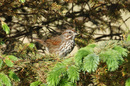
Song sparrows are mid-sized sparrows measuring between 12-17 cm. They are a monomorphic species. Song sparrows exhibit heavily streaked plumage. They are most easily recognized by dark streaks that form a central chest spot (stick pin). The head is brown with a whitish or grayish crown stripe and eye stripe. The tail is usually tinged with rusty, brown-red colored feathers, fairly long and rounded. The bill is dark brown. (Fisher and Morlan, 1996)
- Other Physical Features
- endothermic
- homoiothermic
- bilateral symmetry
- Sexual Dimorphism
- sexes alike
Reproduction
Song sparrows are known to be monogamous with occasional polygyny being observed. Males have not been reported to feed their mates. Males arrive ahead of females on the breeding grounds and begin to define their territory by puffing out their plumage, extending and fluttering their wings, and by singing from three or four main perches. Males announce their identity by territorial singing and aggressive behavior. Females announce their identity by either a high pitched note, or a nasal kind of chatter. Pair bonding occurs on the territory of the male. Females select mates, probably based on the quality of his territory. Males show readiness to mate by pouncing near their mate. They will also pounce near neighboring females while their mates are not close by. Females are more faithful to mates and reject advances of strange males while their mates come to their defense. Females will 'henpeck' their mates by opening her bill at him and giving him small pecks. (Ryser, 1985)
- Mating System
- monogamous
- polygynous
Typically all females and most males start breeding at age one. The breeding season begins in April and ends in August. Females build a nest in 5 to 10 days. The nest is made of dead grasses, weed stems, roots, and bark shreds formed into a cup with rough outer layer lined with finer grasses and sometimes hair. The nest is usually placed at the base of shrubs or clumps of grass. Females lay between 3 and 5 oval shaped, light blue or greenish-blue, spotted eggs. (Baicich and Harrison, 1997)
- Key Reproductive Features
- iteroparous
- seasonal breeding
- gonochoric/gonochoristic/dioecious (sexes separate)
- sexual
- fertilization
- oviparous
-
- Breeding interval
- Song sparrows may breed once or twice during a breeding season.
-
- Breeding season
- Song sparrows breed from April through August.
-
- Range eggs per season
- 3.0 to 5.0
-
- Average eggs per season
- 4
- AnAge
-
- Range time to hatching
- 12 to 14.0 days
-
- Range time to independence
- 18 to 20 days
-
- Average age at sexual or reproductive maturity (female)
- 1.0 years
-
- Average age at sexual or reproductive maturity (male)
- 1.0 years
Females incubate the eggs for 12 to 14 days. The young are tended by both male and female for the first 5 to 6 days, although females are more commonly observed at the nest. The young open their eyes at 3 to 4 days, they can fly well at 17 days, and are independent at 18 to 20 days. (Baicich and Harrison, 1997)
- Parental Investment
- altricial
-
pre-fertilization
- provisioning
-
protecting
- male
- female
-
pre-hatching/birth
-
provisioning
- female
-
protecting
- male
- female
-
provisioning
-
pre-weaning/fledging
-
provisioning
- male
- female
-
protecting
- male
- female
-
provisioning
-
pre-independence
-
provisioning
- male
- female
-
protecting
- male
- female
-
provisioning
Lifespan/Longevity
Song sparrows in the wild have been known to live as long as 11 years and 4 months, though many song sparrows probably die within their first year of life.
-
- Range lifespan
Status: wild - 11.0 (high) years
- Range lifespan
-
- Average lifespan
Status: wild - 136 months
- Bird Banding Laboratory
- Average lifespan
Behavior
Song sparrows are very territorial. This is the most recognizable aspect of the male. Territorial defense relies mainly on singing and occasionally agressive behavior toward other males. Song sparrows are primarily active during the day and may make small winter migrations from the northernmost parts of their range. They do not typically occur in large groups. (Ryser, 1985)
- Key Behaviors
- flies
- diurnal
- motile
- migratory
- solitary
- territorial
Communication and Perception
Song sparrows communicate primarily through body language and vocalizations. They have a range of song and call types that communicate different states and attitudes.
Food Habits
The diet of song sparrows typically consists of seeds, grains, grass, berries and, on some occasions, insects. Although song sparrows are primarily herbivorous and granivorous, during yolk formation females may consume insects or other invertebrates to supplement her diet. Since the female needs extra, high-protein food to produce her eggs, she also eats sprouting shoots and leaves, flower buds, or even algae in the spring. This new growth is known to have a higher levels of protein than old growth. Song sparrows have been reported to eat crusteaceans and mollusks in coastal areas. (Enrlich, et al., 1988; Phillips, et al., 1985)
- Animal Foods
- insects
- terrestrial non-insect arthropods
- mollusks
- aquatic crustaceans
- Plant Foods
- leaves
- seeds, grains, and nuts
- fruit
- flowers
- algae
Predation
Song sparrows are preyed upon by a number of small predators. As adults they are most likely to be preyed upon by birds of prey. As nestlings they may be eaten by snakes, raccoons, skunks, cats, weasels, and other small predators.
Song sparrows are alert and their brown, streaked coloration make them inconspicuous in the brushy habitats they occupy.
- Anti-predator Adaptations
- cryptic
-
- Known Predators
-
- birds of prey
- snakes
- raccoons
- skunks
- cats
- weasels
Ecosystem Roles
Song sparrows may help to disperse seeds.
- Ecosystem Impact
- disperses seeds
Economic Importance for Humans: Positive
Song sparrows may disperse seeds and are important members of the ecosystems in which they live.
Economic Importance for Humans: Negative
There are no negative impacts of song sparrows on humans.
Conservation Status
Song sparrows are abundant in appropriate habitats throughout their range. They are protected under the U. S. Migratory Bird Treaty Act.
-
- IUCN Red List
-
Least Concern
More information
-
- IUCN Red List
-
Least Concern
More information
-
- US Migratory Bird Act
- Protected
-
- US Federal List
- No special status
-
- CITES
- No special status
-
- State of Michigan List
- No special status
Contributors
Elizabeth Gomez (author), Fresno City College, Carl Johansson (editor), Fresno City College.
Glossary
- Nearctic
-
living in the Nearctic biogeographic province, the northern part of the New World. This includes Greenland, the Canadian Arctic islands, and all of the North American as far south as the highlands of central Mexico.

- acoustic
-
uses sound to communicate
- agricultural
-
living in landscapes dominated by human agriculture.
- altricial
-
young are born in a relatively underdeveloped state; they are unable to feed or care for themselves or locomote independently for a period of time after birth/hatching. In birds, naked and helpless after hatching.
- bilateral symmetry
-
having body symmetry such that the animal can be divided in one plane into two mirror-image halves. Animals with bilateral symmetry have dorsal and ventral sides, as well as anterior and posterior ends. Synapomorphy of the Bilateria.
- chaparral
-
Found in coastal areas between 30 and 40 degrees latitude, in areas with a Mediterranean climate. Vegetation is dominated by stands of dense, spiny shrubs with tough (hard or waxy) evergreen leaves. May be maintained by periodic fire. In South America it includes the scrub ecotone between forest and paramo.
- chemical
-
uses smells or other chemicals to communicate
- cryptic
-
having markings, coloration, shapes, or other features that cause an animal to be camouflaged in its natural environment; being difficult to see or otherwise detect.
- diurnal
-
- active during the day, 2. lasting for one day.
- endothermic
-
animals that use metabolically generated heat to regulate body temperature independently of ambient temperature. Endothermy is a synapomorphy of the Mammalia, although it may have arisen in a (now extinct) synapsid ancestor; the fossil record does not distinguish these possibilities. Convergent in birds.
- fertilization
-
union of egg and spermatozoan
- forest
-
forest biomes are dominated by trees, otherwise forest biomes can vary widely in amount of precipitation and seasonality.
- granivore
-
an animal that mainly eats seeds
- herbivore
-
An animal that eats mainly plants or parts of plants.
- iteroparous
-
offspring are produced in more than one group (litters, clutches, etc.) and across multiple seasons (or other periods hospitable to reproduction). Iteroparous animals must, by definition, survive over multiple seasons (or periodic condition changes).
- marsh
-
marshes are wetland areas often dominated by grasses and reeds.
- migratory
-
makes seasonal movements between breeding and wintering grounds
- monogamous
-
Having one mate at a time.
- motile
-
having the capacity to move from one place to another.
- native range
-
the area in which the animal is naturally found, the region in which it is endemic.
- oviparous
-
reproduction in which eggs are released by the female; development of offspring occurs outside the mother's body.
- polygynous
-
having more than one female as a mate at one time
- riparian
-
Referring to something living or located adjacent to a waterbody (usually, but not always, a river or stream).
- scrub forest
-
scrub forests develop in areas that experience dry seasons.
- seasonal breeding
-
breeding is confined to a particular season
- sexual
-
reproduction that includes combining the genetic contribution of two individuals, a male and a female
- solitary
-
lives alone
- suburban
-
living in residential areas on the outskirts of large cities or towns.
- tactile
-
uses touch to communicate
- temperate
-
that region of the Earth between 23.5 degrees North and 60 degrees North (between the Tropic of Cancer and the Arctic Circle) and between 23.5 degrees South and 60 degrees South (between the Tropic of Capricorn and the Antarctic Circle).
- terrestrial
-
Living on the ground.
- territorial
-
defends an area within the home range, occupied by a single animals or group of animals of the same species and held through overt defense, display, or advertisement
- tropical savanna and grassland
-
A terrestrial biome. Savannas are grasslands with scattered individual trees that do not form a closed canopy. Extensive savannas are found in parts of subtropical and tropical Africa and South America, and in Australia.
- savanna
-
A grassland with scattered trees or scattered clumps of trees, a type of community intermediate between grassland and forest. See also Tropical savanna and grassland biome.
- temperate grassland
-
A terrestrial biome found in temperate latitudes (>23.5° N or S latitude). Vegetation is made up mostly of grasses, the height and species diversity of which depend largely on the amount of moisture available. Fire and grazing are important in the long-term maintenance of grasslands.
- visual
-
uses sight to communicate
References
Baicich, P., C. Harrison. 1997. A Guide to the Nests, Eggs and Nestlings of North American Birds. San Diego, CA: Natural World Academic Press.
Enrlich, P., D. Dobkin, D. Wheye. 1988. The Birder's Handbook: A Field Guide to the Natural History of North American Birds. New York, NY: Simon & Schuster Inc..
Fisher, C., J. Morlan. 1996. Birds of San Francisco and the Bay Area. Redmond, Washington: Lone Pine Press.
Phillips, J., P. Butler, P. Sharp. 1985. Physiological Strategies in Avian Biology. New York, NY: Chapman and Hall.
Pyle, P. 1997. Identification Guide to North American Passerines Part 1.. Bolinas, CA: Slate Creek Press.
Rising, J. 1984. A Guide to the Identification and Natural History of the Sparrow of the United States and Canada. San Diego, CA: The Academic Press.
Ryser, F. 1985. Birds of the Great Basin: A Natural History. Reno, NV: University of Nevada Press.