Megalops atlanticusSilverfish
Geographic Range
Megalops atlanticus, commonly known as the Atlantic tarpon, is primarily found in the warm, shallow, coastal regions of the eastern and western Atlantic Ocean. These fish have a wide range along the coastal areas from the United States to Brazil in the western Atlantic and from Senegal to the Congo on the eastern Atlantic coast. They have occasionally been sighted as far north as Nova Scotia and as far south as Argentina in the western Atlantic and along the coasts of Portugal, the Azores and the south of France in the eastern Atlantic. Megalops atlanticus is also found throughout the Caribbean, Gulf of Mexico, around Bermuda and in the eastern Pacific Ocean near Cobia Island in Panama because of movement through the Panama Canal. (Luna, et al., 2005)
- Biogeographic Regions
- nearctic
- ethiopian
- neotropical
- atlantic ocean
- pacific ocean
- mediterranean sea
Habitat
Tarpon are found in estuaries, bays, lagoons and have even been known to travel up into freshwater rivers. Megalops atlanticus has the ability to tolerate euryhaline environments and can also tolerate environments which are oxygen poor by gulping air at the surface. The only environmental constraint on their habitat is temperature. They occupy warmer waters in subtropical areas and sudden temperature changes have been known to kill tarpon in large numbers. M. atlanticus is a pelagic fish. (Hill, 2002; Morey, 2000)
- Habitat Regions
- temperate
- tropical
- saltwater or marine
- freshwater
- Aquatic Biomes
- pelagic
- rivers and streams
- coastal
- brackish water
-
- Range depth
- 0 to 30 m
- 0.00 to 98.43 ft
Physical Description
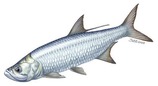
Megalops atlanticus is a large fish with a deep blue to black dorsal coloration and silver side and ventral coloration. Tarpon have a forked, homocercal caudal fin. The single dorsal fin is short and made up of 13 to 15 soft rays; the last of these rays is elongated into a heavy filament. The anal fin is a triangle and is made up of 22 to 25 soft rays; the last of these rays is also elongated into a filament but is much smaller than that of the dorsal fin. Tarpon have large pelvic fins on the abdomen and long pectoral fins made up of 13 to 15 soft rays. The scales of tarpon are cycloid and large. There are 37 to 42 of these large scales along the lateral line. (Hill, 2002; Luna, et al., 2005; Morey, 2000)
Tarpon vary greatly in size and females are generally larger than males. Megalops atlanticus can grow up to lengths of 240 cm and reach a mass of 161 kg. Females, on average, have a mean fork length of 167.7 cm whereas males have a mean fork length of 144.7 cm. (Hill, 2002; Hill, 2002; Luna, et al., 2005; Morey, 2000)
The lower jaw of M. atlanticus is large and protruding. Tarpon have very small, densely packed teeth placed all over the mouth including the jaws, tongue and skull base. In addition to these fine teeth, tarpon have a bony plate on the upturned portion of the lower jaw which helps them crush some of their prey. (Hill, 2002; Hill, 2002; Luna, et al., 2005; Morey, 2000)
Tarpon have a modified swim bladder which allows them to live in oxygen-poor environments. Alveolar tissue in the swim bladder and a duct connecting the swim bladder to the esophagus allow tarpon to breath atmospheric air. Studies have shown that tarpon are obligate air breathers. Even in oxygen-rich environments tarpon still gulp air from the surface. (Hill, 2002; Luna, et al., 2005; Morey, 2000)
- Other Physical Features
- ectothermic
- bilateral symmetry
- Sexual Dimorphism
- female larger
-
- Range mass
- 161 (high) kg
- 354.63 (high) lb
-
- Range length
- 204.5 (high) cm
- 80.51 (high) in
-
- Average length
- 156.2 cm
- 61.50 in
Development
Megalops atlanticus develops in three distinct stages over a period of months. Two to three days after spawning, the eggs hatch into planktonic leptocephalus larvae. Over a period of two to three months these leptochephalus larvae grow to a length of 6 to 25 mm and float inshore on currents to continue their development. In stage two, tarpon actually stop growing and shrink to a size of approximately 14 mm. This stage lasts anywhere from 20 to 25 days. In stage three, lasting seven to eight weeks, the tarpons continue their growth and at around 40 mm become juveniles. (Morey, 2000)
The sexual maturation of M. atlanticus is based primarily on the length of the fish. In males it occurs between 90 to 117.5 cm and in females at approximately 128.5 cm. This maturation can occur between the ages of 6 to 13 years for both sexes. (Hill, 2002)
- Development - Life Cycle
- metamorphosis
Reproduction
Tarpon spawn seasonally and are multiple spawners. These fish have been seen swimming in a circular, rotating fashion. This movement may be a way for tarpon to initiate spawning. Large schools of Megalops atlanticus, 25 to 200 individuals, migrate offshore to spawn. Tarpon are broadcast spawners. Fertilization of the eggs is external. (Hill, 2002)
- Mating System
- polygynandrous (promiscuous)
Large schools of Megalops atlanticus, 25 to 200 individuals, migrate offshore between May and August to spawn. There is some evidence to suggest that tarpon can spawn year round, but this is not common. There is also evidence to suggest that the lunar phase influences when tarpon spawn. Successful hatchings occur within the week following a new moon. These fish have a very high fecundity rate, with large females producing more than 12 million eggs. Tarpon spawn in the deeper waters and allow the currents to carry their eggs to inshore nurseries to develop. The eggs hatch into leptocephalus larvae after two or three days. (Hill, 2002)
- Key Reproductive Features
- iteroparous
- seasonal breeding
- year-round breeding
- gonochoric/gonochoristic/dioecious (sexes separate)
- sexual
- fertilization
- broadcast (group) spawning
- oviparous
-
- Breeding interval
- Megalops atlanticus spawns once annually
-
- Breeding season
- Evidence now suggests that tarpon can spawn throughout the year, but most spawn May to August
-
- Range number of offspring
- 4.5 million to 20.7 million
-
- Average number of offspring
- 12 million
-
- Range time to hatching
- 2 to 3 days
-
- Range age at sexual or reproductive maturity (female)
- 6 to 13 years
-
- Range age at sexual or reproductive maturity (male)
- 6 to 13 years
Tarpon expend energy travelling to their breeding grounds and producing their eggs and sperm, but they make no further investment in their offspring. (Hill, 2002)
- Parental Investment
- no parental involvement
Lifespan/Longevity
Megalops atlanticus is known to have a very long lifespan. Tarpon are expected to live approximately 55 years in the wild and approximately 60 years in captivity. The oldest recorded age the wild was 55 years for a female and 43 years for a male. In captivity, the oldest recorded was a female tarpon which reached the age of 63 years. (Hill, 2002; Morey, 2000)
-
- Range lifespan
Status: wild - 55 for female and 43 for male (high) years
- Range lifespan
-
- Range lifespan
Status: captivity - 63 for a female (high) years
- Range lifespan
-
- Average lifespan
Status: wild - 55 years
- Average lifespan
-
- Average lifespan
Status: captivity - 55 years
- AnAge
- Average lifespan
Behavior
Megalops atlanticus forms small schools which become larger during spawning. Tarpon migrate offshore to spawn in the summer months and are also known to make more migrations throughout the year. Little is known about the extent or frequency of their travels. Tarpon tagged in Florida have been recaptured as far west as Louisiana and as far north as South Carolina. (Hill, 2002)
- Key Behaviors
- natatorial
- motile
- migratory
- social
Home Range
Information on the home range of tarpon is unavailable. (Morey, 2000)
Communication and Perception
The word "Megalops" translates from the Greek language as "large-eyed". The eyes of Megalops atlanticus are a very prominent feature and aid tarpon in hunting for prey. Tarpon have been known to make thumping noises to communicate with those around them or to scare off predators when they become startled. These noises are produced by vibrations in the swim bladder. (Luna, et al., 2005)
- Communication Channels
- acoustic
- Perception Channels
- visual
- tactile
- acoustic
- vibrations
- chemical
Food Habits
The diet of Megalops atlanticus changes throughout development. In the first stage of their development, tarpon get nutrients directly from the water. As juveniles, they feed on zooplankton, small fish, and insects. As adults, tarpon move away from zooplankton and feed only on fish and crustaceans. Some main food sources are Atlantic needlefish (Strongylura marina), pinfish (Lagodon rhomboides), and many species of crabs and shrimp. Megalops atlanticus swallows its prey whole because of the small size of its teeth. Tarpon feed mostly on mid-water prey during the day and night. (Hill, 2002; Luna, et al., 2005; Morey, 2000; Hill, 2002; Luna, et al., 2005; Morey, 2000)
- Animal Foods
- fish
- insects
- aquatic crustaceans
- zooplankton
Predation
Zooplankton and small fish feed on M. atlanticus during the larval stage. As tarpon mature, their main predators become bull sharks (Carcharhinus leucas), great hammerhead sharks (Sphyrna mokarran), American alligators (Alligator mississippiensis) and many species of porpoise.
Tarpon exhibit a color pattern called countershading, which most fish use as a method to prevent predation. Their dorsal surface is generally a dark color. When a predator is looking down on a tarpon from above, the dark color of its dorsal side helps it blend in with the dark, deep waters. The ventral surface of most fish is lighter in color, silver in the case of the tarpon. This countershading helps it blend in with the lighter color of the surface water when a predator is looking at it from below. (Morey, 2000)
- Anti-predator Adaptations
- cryptic
-
- Known Predators
-
- zooplankton
- small fish (Actinopterygii)
- bull sharks (Carcharhinus leucas)
- great hammerhead sharks (Sphyrna mokarran)
- American alligators (Alligator mississippiensis)
- porpoises (Phocoenidae)
Ecosystem Roles
Tarpon are prey and are also predators throughout their ecosystem. Large sharks, alligators and porpoises feed on tarpon and in return tarpon feed on smaller fish, crabs and shrimp.
Lecithochirium microstomum, a trematode parasite, is found in the stomachs of tarpon, and Bivescula tarponis, another trematode parasite, occurs throughout the intestines. The isopods Nerocila acuminata and Cymothoa oestrum, and the copepod Paralebion pearsei, are found on the external surfaces of tarpon. Commensal remoras often attach themselves to large tarpon and go along for the ride. (Morey, 2000)
- Lecithochirium microstomum
- Bivescula tarponis
- Nerocila acuminata
- Cymothoa oestrum
- Paralebion pearsei
- remoras (Remora)
Economic Importance for Humans: Positive
Tarpon mainly benefit humans through recreational activities. In Florida, tarpon are a very important game fish, bringing in millions of dollars annually through charter fishing trips. In some areas, Megalops atlanticus is marketed for its flesh. It is considered a delicacy in South America despite the fact that it is very bony. Large scales of tarpon are used as ornamentation on home decorations and are also used in the manufacturing of artificial pearls. (Hill, 2002; Luna, et al., 2005; Morey, 2000)
- Positive Impacts
- food
- body parts are source of valuable material
- ecotourism
Economic Importance for Humans: Negative
There have been a few reported cases of ciguatera poisoning from eating tarpon. Ciguatera poisoning causes nausea, vomiting, and diarrhea. Neurological signs of poisoning include headache and temperature sensitivity and cardiovascular signs can include arrhythmia and reduced blood pressure. There have also been reports of injuries and even deaths to sport fishers attempting to catch tarpon. These fish are very large and have lots of thrashing power when hooked on a fishing line. When pulled into a boat they can thrash their bodies around vigorously and injure the angler. It is best to wear out the fish before pulling it on board to avoid any injury. (Hill, 2002; Morey, 2000)
- Negative Impacts
-
injures humans
- carries human disease
Conservation Status
The effects of catch and release fishing programs on Megalops atlanticus are not yet fully understood. Releasing tired fish may make them unable to recover quickly. Tarpon may then die from oxygen deprivation or become easy prey for predators. Permits are now being issued to anglers who intend to catch and kill these fish. For a small permit price, two tarpon per licensed angler are allowed to be caught and killed each day. The angler must also report information on where the fish was caught and its size to the Florida Marine Research Institute for further tarpon research. This permit program has greatly reduced the number of tarpon killed over the past few years. In 1989, just before the permit program was instituted, it is estimated that 342 tarpon were caught and killed by anglers. In 1998, the number of tarpon caught and killed by anglers decreased to 70.
Commercial harvesting of M. atlanticus is not permitted. (Hill, 2002; Luna, et al., 2005; Morey, 2000)
-
- IUCN Red List
- No special status
-
- US Federal List
- No special status
-
- CITES
- No special status
Contributors
Allison Poor (editor), University of Michigan-Ann Arbor.
Jennifer Burnham (author), University of Michigan-Ann Arbor, Kevin Wehrly (editor, instructor), University of Michigan-Ann Arbor.
Glossary
- Atlantic Ocean
-
the body of water between Africa, Europe, the southern ocean (above 60 degrees south latitude), and the western hemisphere. It is the second largest ocean in the world after the Pacific Ocean.

- Ethiopian
-
living in sub-Saharan Africa (south of 30 degrees north) and Madagascar.
- Nearctic
-
living in the Nearctic biogeographic province, the northern part of the New World. This includes Greenland, the Canadian Arctic islands, and all of the North American as far south as the highlands of central Mexico.
- Neotropical
-
living in the southern part of the New World. In other words, Central and South America.
- Pacific Ocean
-
body of water between the southern ocean (above 60 degrees south latitude), Australia, Asia, and the western hemisphere. This is the world's largest ocean, covering about 28% of the world's surface.
- acoustic
-
uses sound to communicate
- bilateral symmetry
-
having body symmetry such that the animal can be divided in one plane into two mirror-image halves. Animals with bilateral symmetry have dorsal and ventral sides, as well as anterior and posterior ends. Synapomorphy of the Bilateria.
- brackish water
-
areas with salty water, usually in coastal marshes and estuaries.
- carnivore
-
an animal that mainly eats meat
- chemical
-
uses smells or other chemicals to communicate
- coastal
-
the nearshore aquatic habitats near a coast, or shoreline.
- cryptic
-
having markings, coloration, shapes, or other features that cause an animal to be camouflaged in its natural environment; being difficult to see or otherwise detect.
- ecotourism
-
humans benefit economically by promoting tourism that focuses on the appreciation of natural areas or animals. Ecotourism implies that there are existing programs that profit from the appreciation of natural areas or animals.
- ectothermic
-
animals which must use heat acquired from the environment and behavioral adaptations to regulate body temperature
- estuarine
-
an area where a freshwater river meets the ocean and tidal influences result in fluctuations in salinity.
- external fertilization
-
fertilization takes place outside the female's body
- fertilization
-
union of egg and spermatozoan
- food
-
A substance that provides both nutrients and energy to a living thing.
- freshwater
-
mainly lives in water that is not salty.
- introduced
-
referring to animal species that have been transported to and established populations in regions outside of their natural range, usually through human action.
- iteroparous
-
offspring are produced in more than one group (litters, clutches, etc.) and across multiple seasons (or other periods hospitable to reproduction). Iteroparous animals must, by definition, survive over multiple seasons (or periodic condition changes).
- metamorphosis
-
A large change in the shape or structure of an animal that happens as the animal grows. In insects, "incomplete metamorphosis" is when young animals are similar to adults and change gradually into the adult form, and "complete metamorphosis" is when there is a profound change between larval and adult forms. Butterflies have complete metamorphosis, grasshoppers have incomplete metamorphosis.
- migratory
-
makes seasonal movements between breeding and wintering grounds
- motile
-
having the capacity to move from one place to another.
- natatorial
-
specialized for swimming
- native range
-
the area in which the animal is naturally found, the region in which it is endemic.
- oviparous
-
reproduction in which eggs are released by the female; development of offspring occurs outside the mother's body.
- pelagic
-
An aquatic biome consisting of the open ocean, far from land, does not include sea bottom (benthic zone).
- piscivore
-
an animal that mainly eats fish
- polygynandrous
-
the kind of polygamy in which a female pairs with several males, each of which also pairs with several different females.
- riparian
-
Referring to something living or located adjacent to a waterbody (usually, but not always, a river or stream).
- saltwater or marine
-
mainly lives in oceans, seas, or other bodies of salt water.
- seasonal breeding
-
breeding is confined to a particular season
- sexual
-
reproduction that includes combining the genetic contribution of two individuals, a male and a female
- social
-
associates with others of its species; forms social groups.
- tactile
-
uses touch to communicate
- temperate
-
that region of the Earth between 23.5 degrees North and 60 degrees North (between the Tropic of Cancer and the Arctic Circle) and between 23.5 degrees South and 60 degrees South (between the Tropic of Capricorn and the Antarctic Circle).
- tropical
-
the region of the earth that surrounds the equator, from 23.5 degrees north to 23.5 degrees south.
- vibrations
-
movements of a hard surface that are produced by animals as signals to others
- visual
-
uses sight to communicate
- year-round breeding
-
breeding takes place throughout the year
- zooplankton
-
animal constituent of plankton; mainly small crustaceans and fish larvae. (Compare to phytoplankton.)
References
Hill, K. 2002. "Smithsonian Marine Station at Fort Pierce: Megalops atlanticus" (On-line). Accessed October 13, 2005 at http://www.sms.si.edu/irlspec/Megalo_atlant.htm.
Luna, S., R. Reyes, R. Froese. 2005. "Species Summary: Megalops atlanticus" (On-line). Accessed October 13, 2005 at http://fishbase.org/Summary/SpeciesSummary.php?genusname=Megalops&speciesname=atlanticus.
Morey, S. 2000. "Biological Profiles: Tarpons" (On-line). Accessed October 13, 2005 at http://www.flmnh.ufl.edu/fish/Gallery/Descript/Tarpon/Tarpon.html.