Mazama americanared brocket

Geographic Range
Red brockets are native to the neotropical region ranging from southern Mexico to northern Argentina and from sea level up to 5000 m in elevation. ("Arkive images of life on earth", 2011; Abril, 2010; Hurtado and Jorge, 2006)
- Biogeographic Regions
- neotropical
Habitat
Red brockets live in dense tropical forests with closed canopies and prefer either moist or really dry climates. They tend to stay near marshes, swamps, and streams along thick vegetative cover. Their small body size helps them to move easily through water and dense vegetation and remain unnoticed by predators. When night falls, red brockets forage on forest edges, in agricultural fields, and in gardens. ("Arkive images of life on earth", 2011; Gonzalez, et al., 2009; Hurtado and Jorge, 2006)
- Habitat Regions
- tropical
- terrestrial
- Terrestrial Biomes
- savanna or grassland
- forest
- rainforest
- scrub forest
- Aquatic Biomes
- rivers and streams
- Other Habitat Features
- agricultural
-
- Range elevation
- 0 to 5000 m
- 0.00 to 16404.20 ft
Physical Description
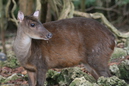
Red brockets are the largest members of the genus of brocket deer. The head and neck exhibit a light grayish-brown color. The inner thighs, throat, tail, and inner part of the ears are white. The rest of their bodies are reddish brown to chestnut red in color and young brockets are born with white spots. Males tend to be larger and have spikes to protect against predators. Their shoulder height measures 65 to 80 cm, tail length measures 8 to 15 cm, and the head to body length measures 103 to 146 cm. ("Arkive images of life on earth", 2011; Abril, 2010; Gonzalez, et al., 2009)
- Other Physical Features
- endothermic
- bilateral symmetry
- Sexual Dimorphism
- male larger
- ornamentation
-
- Range mass
- 20 to 55 kg
- 44.05 to 121.15 lb
-
- Range length
- 103 to 146 cm
- 40.55 to 57.48 in
Reproduction
Little information is known about the matings systems of red brockets.
In the northeastern Peruvian Amazon, red brocket deer conceive during all months of the year except from September and October. In Surinam, they reproduce from September to April. Depending on where the red brocket deer are located, they may have peaks in conception during the dry seasons. Females between the ages of 0 and 4 years are more capable of birthing two offspring, whereas females between the ages of 4 and 6 years usually only produce one. Females reach sexual maturity around 11 months of age and males reach maturity around 12 months of age. ("Arkive images of life on earth", 2011; Branan, 1987; Gonzalez, et al., 2009; Hurtado and Jorge, 2006)
- Key Reproductive Features
- iteroparous
- year-round breeding
- gonochoric/gonochoristic/dioecious (sexes separate)
- sexual
-
- Breeding interval
- There is little information regarding the frequency of red brocket breeding.
-
- Breeding season
- Red brockets breed throughout the year depending on rainfall.
-
- Average number of offspring
- 1.2
-
- Average number of offspring
- 1.3
- AnAge
-
- Range gestation period
- 222 to 228 days
-
- Average weaning age
- 6 months
-
- Range age at sexual or reproductive maturity (female)
- 11 to 13 months
-
- Average age at sexual or reproductive maturity (male)
- 12 months
-
- Average age at sexual or reproductive maturity (male)
Sex: male - 365 days
- AnAge
- Average age at sexual or reproductive maturity (male)
Little information is known about the parental investment of red brockets.
Lifespan/Longevity
Red brockets live between 7 and 12 years of age, but due to the elusiveness of this species, it is difficult to obtain sufficient data. ("Arkive images of life on earth", 2011; Abril, 2010; Branan, 1987; Gonzalez, et al., 2009; Hurtado and Jorge, 2007)
-
- Average lifespan
Status: wild - 12 years
- Average lifespan
-
- Average lifespan
Status: captivity - 16 years
- Average lifespan
-
- Typical lifespan
Status: wild - 7 to 12 years
- Typical lifespan
-
- Average lifespan
Status: captivity - 13.8 years
- Max Planck Institute for Demographic Research
- Average lifespan
Behavior
Red brockets are extremely hard to research because of the habitat in which they live and their predator avoidance techniques. If they are spotted by a predator or can hear something approaching, they sometimes freeze in place. When in more immediate danger, red brockets leap through the vegetative forest or swim across to the other side of a river. Red brockets are both diurnal and nocturnal and are often seen alone. Once the female gives birth, it will hide the young and leave it for an unknown period of time before coming back and nursing it until it has reached sexual maturity. ("Arkive images of life on earth", 2011; Abril, 2010; Branan, 1987; Gonzalez, et al., 2009; Hurtado and Jorge, 2006)
Home Range
Little is known about the home range of red brocket deer. ("Arkive images of life on earth", 2011; Abril, 2010; Gayot, 2004; Gonzalez, et al., 2009; Hurtado and Jorge, 2006; Licona, 2011)
Communication and Perception
Little information is known about the communication and perception of red brockets.
Food Habits
Red brocket diets consist mainly of fruit and some leaves and fibrous material. During the wet season when food availability is low, ttheir diet may consist mainly of fungi. In extreme cases where fruit and fungi become scarce, it may eat stems, bark, petioles, leaves, and animal matter instead. ("Arkive images of life on earth", 2011; Bodmer, 1990; Gayot, 2004)
- Plant Foods
- leaves
- roots and tubers
- wood, bark, or stems
- seeds, grains, and nuts
- fruit
- flowers
- Other Foods
- fungus
Predation
Red brockets stand low to the ground, have a reddish-brown fur color to camouflage with the tropical vegetation in the background, and are well adapted for moving through thick vegetative matter. Anti-predatory adaptations behaviors employed by red brockets include freezing, swimming, and camouflage. If a predator decides to chase a red brocket, it will alternate between leaping and freezing behaviors in order to confuse the predator. If red brockets are near a river, they will use their exceptional swimming skills to escape. Known predators of red brockets are pumas, jaguars, and humans. Pumas and jaguars are stealthy hunters that often wait from a distance for the most opportunistic time pounce. Humans have hunted red brockets for meat and trade. (Harmsen, et al., 2011)
- Anti-predator Adaptations
- cryptic
-
- Known Predators
-
- pumas (Puma concolor)
- jaguars (Panthera onca)
- humans (Homo sapiens)
Ecosystem Roles
Red brockets play an essential role within the Amazonian ecosystem. They alter plant communities and the overall structure of the forest by grazing and dispersing seeds. Without red brockets, certain plant seeds would not be dispersed and might become endangered or face extinction. Red brockets are also the main source of food for jaguars and pumas. (Licona, 2011)
- Ecosystem Impact
- disperses seeds
- creates habitat
Economic Importance for Humans: Positive
Red brockets provide valuable meat and a means of trade for humans. ("Arkive images of life on earth", 2011; Hurtado and Jorge, 2007; Licona, 2011)
- Positive Impacts
- food
- body parts are source of valuable material
- research and education
Economic Importance for Humans: Negative
Red brockets occasionally cause damage to agricultural fields. ("Arkive images of life on earth", 2011; Gayot, 2004; Licona, 2011)
- Negative Impacts
- crop pest
Conservation Status
Little is known of the conservation status of red brocket deer.
-
- IUCN Red List
-
Data Deficient
More information
-
- IUCN Red List
-
Data Deficient
More information
-
- US Federal List
- No special status
Contributors
Kyle Kossel (author), University of Wisconsin-Stevens Point, Christopher Yahnke (editor), University of Wisconsin-Stevens Point, Alecia Stewart-Malone (editor), University of Wisconsin-Stevens Point, Laura Podzikowski (editor), Special Projects.
Glossary
- Neotropical
-
living in the southern part of the New World. In other words, Central and South America.

- acoustic
-
uses sound to communicate
- agricultural
-
living in landscapes dominated by human agriculture.
- bilateral symmetry
-
having body symmetry such that the animal can be divided in one plane into two mirror-image halves. Animals with bilateral symmetry have dorsal and ventral sides, as well as anterior and posterior ends. Synapomorphy of the Bilateria.
- chemical
-
uses smells or other chemicals to communicate
- cryptic
-
having markings, coloration, shapes, or other features that cause an animal to be camouflaged in its natural environment; being difficult to see or otherwise detect.
- diurnal
-
- active during the day, 2. lasting for one day.
- endothermic
-
animals that use metabolically generated heat to regulate body temperature independently of ambient temperature. Endothermy is a synapomorphy of the Mammalia, although it may have arisen in a (now extinct) synapsid ancestor; the fossil record does not distinguish these possibilities. Convergent in birds.
- folivore
-
an animal that mainly eats leaves.
- food
-
A substance that provides both nutrients and energy to a living thing.
- forest
-
forest biomes are dominated by trees, otherwise forest biomes can vary widely in amount of precipitation and seasonality.
- frugivore
-
an animal that mainly eats fruit
- granivore
-
an animal that mainly eats seeds
- herbivore
-
An animal that eats mainly plants or parts of plants.
- iteroparous
-
offspring are produced in more than one group (litters, clutches, etc.) and across multiple seasons (or other periods hospitable to reproduction). Iteroparous animals must, by definition, survive over multiple seasons (or periodic condition changes).
- marsh
-
marshes are wetland areas often dominated by grasses and reeds.
- motile
-
having the capacity to move from one place to another.
- native range
-
the area in which the animal is naturally found, the region in which it is endemic.
- nocturnal
-
active during the night
- rainforest
-
rainforests, both temperate and tropical, are dominated by trees often forming a closed canopy with little light reaching the ground. Epiphytes and climbing plants are also abundant. Precipitation is typically not limiting, but may be somewhat seasonal.
- scrub forest
-
scrub forests develop in areas that experience dry seasons.
- sexual
-
reproduction that includes combining the genetic contribution of two individuals, a male and a female
- sexual ornamentation
-
one of the sexes (usually males) has special physical structures used in courting the other sex or fighting the same sex. For example: antlers, elongated tails, special spurs.
- solitary
-
lives alone
- swamp
-
a wetland area that may be permanently or intermittently covered in water, often dominated by woody vegetation.
- tactile
-
uses touch to communicate
- terrestrial
-
Living on the ground.
- tropical
-
the region of the earth that surrounds the equator, from 23.5 degrees north to 23.5 degrees south.
- tropical savanna and grassland
-
A terrestrial biome. Savannas are grasslands with scattered individual trees that do not form a closed canopy. Extensive savannas are found in parts of subtropical and tropical Africa and South America, and in Australia.
- savanna
-
A grassland with scattered trees or scattered clumps of trees, a type of community intermediate between grassland and forest. See also Tropical savanna and grassland biome.
- temperate grassland
-
A terrestrial biome found in temperate latitudes (>23.5° N or S latitude). Vegetation is made up mostly of grasses, the height and species diversity of which depend largely on the amount of moisture available. Fire and grazing are important in the long-term maintenance of grasslands.
- visual
-
uses sight to communicate
- year-round breeding
-
breeding takes place throughout the year
References
2011. "Arkive images of life on earth" (On-line). Accessed September 25, 2011 at http://www.arkive.org/red-brocket/mazama-americana/#text=Habitat.
Abril, V. 2010. Elucidating the Evolution of the Red Brocket Deer Mazama americana Complex (Artiodactyla; Cervidae). Cytogenetic and Genome Research, 128: 177-187.
Bodmer, R. 1990. Responses of ungulates to seasonal inundations in the Amazon floodplain. Journal of Tropical Ecology, 6: 191-201.
Branan, W. 1987. Reproductive ecology of white-tailed and red brocket deer in Suriname. RES. SYMP. NATL. ZOOL. PARK, 6: 344-351.
Gayot, M. 2004. Comparative diet of the two forest cervids of the genus Mazama in French Guiana. Journal of Tropical Ecology, 20: 31-43.
Gonzalez, S., J. Maldonado, J. Ortega, C. Talarico, L. Bidegaray. 2009. Identification of the endangered small red brocket deer ( Mazama bororo) using noninvasive genetic techniques (Mammalia; Cervidae). Molecular Ecology Resources, 9: 754-758.
Harmsen, B., R. Foster, S. Silver, L. Ostro, C. Doncaster. 2011. Jaguar and puma activity patterns in relation to their main prey. Mammalian Biology, 76: 320-324.
Hurtado, G., L. Jorge. 2007. Assessing the sustainability of brocket deer hunting in the Tamshiyacu-Tahuayo Communal Reserve, northeastern Peru. Conservation- Biological Conservation, 138: 412-420.
Hurtado, G., L. Jorge. 2006. Reproductive biology of female Amazonian brocket. European Journal of Wildlife Research, 3: 171-177.
Licona, M. 2011. Using ungulate occurrence to evaluate community-based conservation within a biosphere reserve model. Animal Conservation APR 2011 pages: 206-214 volume: 14 issue: 2, 14: 206-214.