Macroscelideaelephant-shrews(Also: sengis)

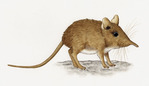

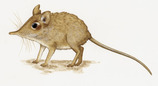

Once considered a divergent family of the order Afrosoricida, elephant-shrews are now placed in their own order, the Macroscelidea. Recent evidence suggests that they may belong to a clade of African mammals, the Afrotheria, which also includes hyraxes, elephants, sea cows, aardvarks, golden moles, and tenrecs. Elephant-shrews are a small group, represented by a single family, the Macroscelididae, including 4 genera and 19 living species. They are adapted for leaping, with hind limbs much longer than forelimbs. In one genus, Rhynchocyon, this is carried to an extreme with the toes on the hind foot being reduced to three in number. Elephant-shrews have elongated snouts and large eyes and ears. They range from mouse-sized to the size of a squirrel or large rat. Some species are brightly colored.
Elephant-shrews differ from members of the Insectivora in that they have complete auditory bullae, large jugals, complete zygomatic arches, and relatively small olfactory lobes of the brain. The upper canine has two roots, like a premolar. Technically, elephant-shrews can be recognized by a combination of their size, dental formula (1-3/3, 1/1, 4/4, 2/2-3 = 36-42), their quadrate molars, palate perforated by large gaps or fenestrae, and the limb characters mentioned above.

Elephant-shrews are insectivorous and do most of their foraging at night. Many species also include some fruits, seeds, and other vegetable material in their diets. Most appear to live in monogamous pairs. They are excellent hoppers, fleeing from predators with long bounds. The may create elaborate trail systems through leaf litter. Elephant-shrews are precocial at birth and their litter size is small. They are found in a variety of habitats in northernmost Africa and south of the Sahara.
Literature and references cited
Murphy, W.J., E. Eisirik, S.J. O'Brian, O. Madsen, M. Scally, C.J. Douady, E. Teeling, O.A. Ryder, M.J. Stanhope, W.W. de Jong, and M.S. Springer. 2001. Resolution of the early placental mammal radiation using Bayesian phylogenetics. Science 294238-2351.
Rathbun, G. B. Elephant-shrews or sengis. http://www.calacademy.org/research/bmammals/eshrews/ accessed 1/17/04.
Vaughan, T. A. 1986. Mammalogy. Third Edition. Saunders College Publishing, Fort Worth. vii+576 pp.
Yates, T. L. 1984. Insectivores, elephant shrews, tree shrews, and dermopterans. Pp. 117-144 in Anderson, S. and J. K. Jones, Jr. (eds). Orders and Families of Recent Mammals of the World. John Wiley and Sons, N.Y. xii+686 pp.
Contributors
Phil Myers (author), Museum of Zoology, University of Michigan-Ann Arbor.
Glossary
- bilateral symmetry
-
having body symmetry such that the animal can be divided in one plane into two mirror-image halves. Animals with bilateral symmetry have dorsal and ventral sides, as well as anterior and posterior ends. Synapomorphy of the Bilateria.
- chemical
-
uses smells or other chemicals to communicate
- endothermic
-
animals that use metabolically generated heat to regulate body temperature independently of ambient temperature. Endothermy is a synapomorphy of the Mammalia, although it may have arisen in a (now extinct) synapsid ancestor; the fossil record does not distinguish these possibilities. Convergent in birds.
- motile
-
having the capacity to move from one place to another.
- sexual
-
reproduction that includes combining the genetic contribution of two individuals, a male and a female
- tactile
-
uses touch to communicate