Lycaeides melissa


Geographic Range
The range of Lycaeides melissa covers the northern and western United States, portions of central and western Canada, and extends southward to northern Baja California, Mexico. They occur in the Upper Sonoran to Canadian (sometimes Alpine) Life Zones in the Nearctic region. (Opler and Krizek, 1984; Scott, 1986)
Karner Blues, L. melissa samuelis, historically occurred in the northern tier from New Hampshire and New York westward to Iowa. They have been extirpated from Ohio, Ontario, Maine, Illinois, Massachusetts, New Jersey, and Pennsylvania. There are remnant populations of Karner blues in Minnesota, Indiana, New York, and New Hampshire, and abundant populations in Michigan and Wisconsin. (U.S. Fish and Wildlife Service, 2003; "Wisconsin Statewide Karner Blue Butterfly habitat Conservation Plan and Environmental Impact Statement", 2000)
Melissa Blues, L. melissa melissa, have the largest range of all the subspecies, occuring from Kansas to Manitoba westward throughout to northern Baja California, northern Mexico and west Texas. They have been extirpated south of the San Francisco Bay area.
Annetta Blues, L. melissa annetta, occur high in the Wasatch Mountains of Utah, the alpine Sierra Nevada, and the higher altitudes of central Colorado. (Scott, 1986)
Inyo Blues, L. melissa paradoxa (also known as L. m. inyoensis), are found in the Tehachapi Mountains in California.
Habitat
Karner Blues inhabit sandy pine barrens, lakeshore dunes, and sandy pine prairies that contain abundant lupine, Lupinus perinnis, their only larval foodplant. An important component of Karner Blue habitat is a heterogeneous mixture of sun and shade, and management efforts focused on improving and maintaining this habitat use fire and tree removal to facilitate this blend. (Opler and Krizek, 1984; Neilsen, 1999; Grundel, et al., 1998; "Wisconsin Statewide Karner Blue Butterfly habitat Conservation Plan and Environmental Impact Statement", 2000; U.S. Fish and Wildlife Service, 2003; Struttmann, ; Rabe, )
Melissa blues prefer dry ridges with tall-grass prairie biomes. (Opler and Krizek, 1984)
- Habitat Regions
- terrestrial
- Terrestrial Biomes
- savanna or grassland
- forest
- scrub forest
- mountains
Physical Description
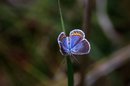
The upper surfaces of adult male Karner Blue wings are dark blue. On adult females the blue is much reduced by a black margin. The hindwing margins have partial orange bands that border several black spots. The undersides are whitish gray with black spots, and the hindwings have small silver spots capped with orange. The fringe on the wings is black. Females forewings range in size from 1.4 cm to 1.6 cm., with the males slightly smaller, ranging from 1.2 - 1.4 cm. Melissa Blues are very similar in coloration but have a black terminal line along the vertical hindwing margins. (Neilsen, 1999; Opler and Krizek, 1984; U.S. Fish and Wildlife Service, 2003)
Karner Blue eggs have been described as very small and radially symmetrical. They are pale green in color and slightly flattened in appearance, with fine geometric patterns that are deeply reticulated. ("Wisconsin Statewide Karner Blue Butterfly habitat Conservation Plan and Environmental Impact Statement", 2000)
The larvae of L. melissa have dorsally flattened bodies and are pubescent. Their head capsules are brown-black to brown and their bodies are a pea green color. As the larvae age, they develop light green to white lateral stripes and dark green dorsal stripes. Just before the larvae are ready to pupate, their color and lateral stripes begin to fade. The pupae are bright green and smooth, and just before emergence, change to a light tan color with hints of purple. Larvae have three glandular structures that secrete a liquid most likely containing carbohydrates and amino acids. This secretion is avidly harvested by ants. ("Wisconsin Statewide Karner Blue Butterfly habitat Conservation Plan and Environmental Impact Statement", 2000)
- Other Physical Features
- ectothermic
- heterothermic
- bilateral symmetry
- Sexual Dimorphism
- female larger
- sexes colored or patterned differently
Development
Eggs oviposited by first brood females hatch in 5-10 days in early June. Larvae go through four instars and pupate in late June - early July. After emerging in early to mid July, adults will mate and the females will oviposit eggs that will overwinter. During the following spring, these larvae will hatch in April and May and begin feeding. (Dirig, et al., 1994; Grundel, et al., 1998; "Wisconsin Statewide Karner Blue Butterfly habitat Conservation Plan and Environmental Impact Statement", 2000)
- Development - Life Cycle
- metamorphosis
Reproduction
During the daylight hours, male Karner Blues patrol near the lupines searching for females. Mating takes place primarily in open-canopied areas in the forests. (Opler and Krizek, 1984; "Wisconsin Statewide Karner Blue Butterfly habitat Conservation Plan and Environmental Impact Statement", 2000)
Karner Blue butterflies are bivoltine, the first brood emerging from late May to June, followed by the second brood from late July to August. The females emerge a few days later than the males. After mating, females will lay their eggs on various parts of the host plants (lupines) or on nearby sticks or pebbles. There is a difference in egg placement by first and second brood females. The majority of eggs in the first brood are placed on lupines, second brood females place the majority of their eggs on blades of grass. (Grundel, et al., 1998; Opler and Krizek, 1984; "Wisconsin Statewide Karner Blue Butterfly habitat Conservation Plan and Environmental Impact Statement", 2000)
- Key Reproductive Features
- semelparous
- seasonal breeding
- gonochoric/gonochoristic/dioecious (sexes separate)
- sexual
- fertilization
- oviparous
-
- Breeding interval
- These blues are bivoltine, having two broods per year.
-
- Breeding season
- 2-3 weeks
-
- Range gestation period
- 5 to 10 days
-
- Average gestation period
- 7 days
Lepidopteran species do not provide any care for their offspring after the eggs are laid.
- Parental Investment
-
pre-fertilization
- provisioning
-
protecting
- female
Lifespan/Longevity
Adult Karner Blues are known to live from 4-5 days up to 2-3 weeks. Total lifespan from egg through adult varies depending on the brood: eggs laid late in the season survive through winter and hatch the following year so the individuals live for about almost 12 months. Eggs laid early in May or June hatch, mature, reproduce and die in about two months. ("Wisconsin Statewide Karner Blue Butterfly habitat Conservation Plan and Environmental Impact Statement", 2000)
-
- Average lifespan
Status: wild - 11 months
- Average lifespan
-
- Typical lifespan
Status: wild - 9 to 12 months
- Typical lifespan
Behavior
Karner Blues are diurnal, flying primarily from early morning to early evening. When temperatures become very hot, they decrease their activities and spend more of their time resting in shade. Heavy rains, strong winds, and temperatures below 75° F will also cause Karner Blues to spend time in protected areas. Grasses appear to be their preferred roosting sites. ("Wisconsin Statewide Karner Blue Butterfly habitat Conservation Plan and Environmental Impact Statement", 2000)
Male Karner Blues fly more frequently than females, and tend to move more often and cover greater distances with their flights. Females spend more time nectaring than flying. Both sexes prefer to nectar in sunny openings in their forest habitat. (Grundel, et al., 1998)
Communication and Perception
Butterfly communication generally involves courtship flights and behaviors using visual cues. Some species are believed to emit pheremones to attract mates, but it is unknown if this true for Lycaeides melissa.
- Communication Channels
- visual
Food Habits
The larvae of the western populations of L. melissa eat a variety of legumes; Astralagus spp., Glycyrrhiza spp., Lotus spp., Lupinus spp., and Medicago spp. (Opler and Krizek, 1984)
The larvae of Karner Blue (L. mellisa samuelis) butterflies feed exclusively on wild lupine Lupinus perennis. Swengel (1995) found that the larvae seem to prefer lupine with larger leaves and longer, thicker stems. First and second instars chew tiny, circular holes in the leaves, and the third and fourth instars eat all but the upper or lower epidermis, leaving a window pane effect. (Opler and Krizek, 1984; Swengel, 1995)
Adult Karner Blues have been observed nectaring on over 50 different species of flowers. They seem to select the nectar species with the greatest total number of flowers or flowering heads, usually yellow or white. Nectar species include Rock cress Arabis lyrata, lance-leaved coreopsis Coreopsis lanceolata, flowering spurge Euphorbia corollata, sweet clover Melilotus alba, horsemint Monarda punctata, common cinquefoil Potentilla simplex, raspberry Rubus spp., showy goldenrod Solidago speciosa, butterflyweed Asclepias tuberosa, and woodland sunflower Helianthus divaricatus. Males and females exhibit mud puddling behavior (sipping at moist earth) to obtain salts and minerals, and will sip human perspiration. Males have been observed feeding on animal droppings. (Grundel, et al., 1999; Swengel, 1995)
- Primary Diet
- herbivore
- Plant Foods
- leaves
- nectar
Predation
Known predators of Karner Blue larvae are primarily insects such as stink bugs, ants, and some wasps. Common parasitoids include tachinid flies and braconid and ichneumonid wasps. Common predators of adults are spiders, robber flies, ambush bugs, assassin bugs, and dragonflies. Though not documented, the absence of any reports of vertebrate predators may indicate some sort of anti-predator defense such as noxious smells or tastes, or toxins that are not tolerated by predators such as birds or mice.
-
- Known Predators
-
- pentatomid stink bugs (Podisus maculiventris)
- paper wasps (Polistes metricus)
- ants (Formica incerta)
- tachinid flies (Aplomya theclarum)
- braconid wasps (Apanteles)
- ichneumonid wasps (Paranoia geniculate)
- spiders (Araneae)
- robber flies (Asilidae)
- ambush bugs (Phymatidae)
- assassin bugs (Reduviidae)
- dragonflies (Anisoptera)
Ecosystem Roles
Most butterfly species serve as pollinators to a variety of plant species upon which they nectar. Larvae of the Karner Blues have a mutualistic relationship with ants. Studies have shown that larvae tended by these ants have a higher survival rate, most likely due to protection by the ants against larval predators. ("Wisconsin Statewide Karner Blue Butterfly habitat Conservation Plan and Environmental Impact Statement", 2000)
- Ecosystem Impact
- pollinates
- Aphaeno gaster
- Camponotus spp.
- Creatogaster cerasi
- Dolichonderus plagiatus
- Formica spp.
- Lasius spp.
- Monomorium emarginatus
- Myrmica spp.
- Paratrechina parvula
- Tapinomo sessile
- Tetramorium caespitum
Economic Importance for Humans: Positive
Due to the rarity of Karner Blue butterflies, there are potential human benefits in the form of ecotourism. Additionally, restoration and habitat management activities for this species enhance and protect unique ecosystems valuable for their beauty and ecological function.
- Positive Impacts
- ecotourism
- research and education
Economic Importance for Humans: Negative
There are no known negative impacts to humans by Lycaeides melissa.
Conservation Status
Karner Blues were listed as federally endangered in 1992 due to losses in the eastern portions of their range. They are protected throughout their range, and many sites are actively managed. Karner blues are listed as threatened in the state of Michigan. (U.S. Fish and Wildlife Service, 2003; "Wisconsin Statewide Karner Blue Butterfly habitat Conservation Plan and Environmental Impact Statement", 2000)
-
- IUCN Red List
- Not Evaluated
-
- US Federal List
- Endangered
-
- CITES
- No special status
-
- State of Michigan List
- Threatened
Other Comments
There are many common names for the various sub-species of Lycaeides melissa. Karner Blues have been called Orange-bordered Blue, and Edward's Blue; Melissa Blue has been named Orange-banded Blue, Orange-margined Blue, Orange-bordered Blue, Karner Blue, and Edward's Blue. They have also been placed in the genus Plebejus. (Miller and Brown, 1981; Miller, 1992; Scott, 1986)
Contributors
Ashley Dowling (editor), University of Michigan-Ann Arbor, George Hammond (editor), Animal Diversity Web.
Barb Barton (author), Special Contributors.
Glossary
- Nearctic
-
living in the Nearctic biogeographic province, the northern part of the New World. This includes Greenland, the Canadian Arctic islands, and all of the North American as far south as the highlands of central Mexico.

- bilateral symmetry
-
having body symmetry such that the animal can be divided in one plane into two mirror-image halves. Animals with bilateral symmetry have dorsal and ventral sides, as well as anterior and posterior ends. Synapomorphy of the Bilateria.
- chemical
-
uses smells or other chemicals to communicate
- colonial
-
used loosely to describe any group of organisms living together or in close proximity to each other - for example nesting shorebirds that live in large colonies. More specifically refers to a group of organisms in which members act as specialized subunits (a continuous, modular society) - as in clonal organisms.
- diurnal
-
- active during the day, 2. lasting for one day.
- ecotourism
-
humans benefit economically by promoting tourism that focuses on the appreciation of natural areas or animals. Ecotourism implies that there are existing programs that profit from the appreciation of natural areas or animals.
- ectothermic
-
animals which must use heat acquired from the environment and behavioral adaptations to regulate body temperature
- fertilization
-
union of egg and spermatozoan
- folivore
-
an animal that mainly eats leaves.
- forest
-
forest biomes are dominated by trees, otherwise forest biomes can vary widely in amount of precipitation and seasonality.
- herbivore
-
An animal that eats mainly plants or parts of plants.
- heterothermic
-
having a body temperature that fluctuates with that of the immediate environment; having no mechanism or a poorly developed mechanism for regulating internal body temperature.
- internal fertilization
-
fertilization takes place within the female's body
- metamorphosis
-
A large change in the shape or structure of an animal that happens as the animal grows. In insects, "incomplete metamorphosis" is when young animals are similar to adults and change gradually into the adult form, and "complete metamorphosis" is when there is a profound change between larval and adult forms. Butterflies have complete metamorphosis, grasshoppers have incomplete metamorphosis.
- mountains
-
This terrestrial biome includes summits of high mountains, either without vegetation or covered by low, tundra-like vegetation.
- native range
-
the area in which the animal is naturally found, the region in which it is endemic.
- nectarivore
-
an animal that mainly eats nectar from flowers
- oviparous
-
reproduction in which eggs are released by the female; development of offspring occurs outside the mother's body.
- scrub forest
-
scrub forests develop in areas that experience dry seasons.
- seasonal breeding
-
breeding is confined to a particular season
- sedentary
-
remains in the same area
- semelparous
-
offspring are all produced in a single group (litter, clutch, etc.), after which the parent usually dies. Semelparous organisms often only live through a single season/year (or other periodic change in conditions) but may live for many seasons. In both cases reproduction occurs as a single investment of energy in offspring, with no future chance for investment in reproduction.
- sexual
-
reproduction that includes combining the genetic contribution of two individuals, a male and a female
- tactile
-
uses touch to communicate
- terrestrial
-
Living on the ground.
- tropical savanna and grassland
-
A terrestrial biome. Savannas are grasslands with scattered individual trees that do not form a closed canopy. Extensive savannas are found in parts of subtropical and tropical Africa and South America, and in Australia.
- savanna
-
A grassland with scattered trees or scattered clumps of trees, a type of community intermediate between grassland and forest. See also Tropical savanna and grassland biome.
- temperate grassland
-
A terrestrial biome found in temperate latitudes (>23.5° N or S latitude). Vegetation is made up mostly of grasses, the height and species diversity of which depend largely on the amount of moisture available. Fire and grazing are important in the long-term maintenance of grasslands.
- visual
-
uses sight to communicate
References
Wisconsin Statewide Karner Blue Butterfly habitat Conservation Plan and Environmental Impact Statement. PUBL-SS-947-00. Madison, WI: Wisconsin Department of Natural Resources. 2000.
Dirig, A., D. Andow, R. Baker, C. Lane. 1994. Historical Notes on Wild Lupine and the Karner Blue Butterfly at the Albany Pine Bush, NY. Pp. 23-36 in Karner Blue Butterfly: A Symbol of a Vanishing Landscape. St. Paul, MN: University of Minnesota.
Glassberg, J. 1999. Butterflies Through Binoculars: the East. NY: Oxford University Press.
Grundel, R., N. Pavlovic, C. Sulzman. 1998. Habitat use by the endangered Karner blue butterfly in oak woodlands: the influence of canopy cover. Biological Conservation, 85: 47-53.
Grundel, R., N. Pavlovic, C. Sulzman. 1999. Nectar plant selection by the Karner blue butterfly <<Lycaeides melissa samuelis>> at the Indiana Dunes National Lakeshore. American Midland Naturalist, 44(1): 1-10.
Holland, W. 1931. The Butterfly Book. Garden City, NY: Doubleday, Doran and Co..
Iftner, D., J. Shuey, J. Calhoun. 1992. Butterflies and Skippers of Ohio. OH: Ohio Biological Survey Bulletin 9(1).
Maynard, C. 1891. Manual of North American Butterflies. Boston, MA: DeWolfe, Fiske, and Co..
Miller, J. 1992. The Common Names of North American Butterflies. Washington DC: Smithsonian Institute.
Miller, L., F. Brown. 1981. A Catalogue/Checklist of the Butterflies of America North of Mexico. FL: Lepidopterists' Society Memoir No. 2.
Neilsen, M. 1999. Michigan Butterflies and Skippers. East Lansing, MI:
Opler, P., G. Krizek. 1984. Butterflies East of the Great Plains. John Hopkins University Press.
Rabe, M. "Karner Blue Butterfly" (On-line ). Michigan Natural Features Inventory. Accessed 04/17/03 at http://web4.msue.msu.edu/mnfi/abstracts/zoology/lycaeides_melissa_samuelis.pdf.
Savignana, D. 1990. Field Investigations of a Facultative Mutualism Between <<Lycaeides melissa samuelis>> Nabokov (Lycaenidae), the Karner Blue Butterfly and Attendant Ants - PhD. Thesis. University of Texas.
Savignano, D., D. Andow, R. Baker, C. Lane. 1994. The Distribution of the Karner blue butterfly in Saratoga County, New York. Pp. 73-80 in Karner Blue Butterfly: A Symbol of a Vanishing Landscape. St. Paul, MN: University of Minnesota.
Scott, J. 1986. The Butterflies of North American: A Natural History and Field Guide. Standford, CA: Stanford University Press.
Struttmann, J. "<<Lycaeides melissa>>" (On-line ). Butterflies of North America. Accessed 04/17/03 at http://www.npwrc.usgs.gov/resource/distr/lepid/bflyusa/usa/252.htm.
Swengel, A. 1995. Observations of spring larvae of <<Lycaeides melissa samuelis>>. Great Lakes Entomologist, 28(2): 155-170.
U.S. Fish and Wildlife Service, 2003. "Karner Blue Butterfly" (On-line ). United State Fish and Wildlife Service. Accessed 04/17/03 at http://ecos.fws.gov/species_profile/species_profile.html?spcode=I00F.
Zimmer, D. "Nabokov's Butterflies" (On-line ). Accessed 04/17/03 at http://www.libraries.psu.edu/iasweb/nabokov/dzbutt4.htm.