Lorisidaelorises and pottos
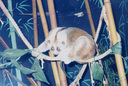


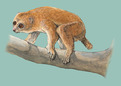

Lorises and pottos are small (85 g - 1.5 kg), arboreal primates of Africa and Asia. Six species placed in 4 genera make up the family (previously known as Loridae). They are small animals, stealthily stalking insects or seeking fruit at night and spending the day in hollow trees or clinging to branches. Lorises and pottos climb with deliberate, hand-over-hand movements, never leaping between branches. While their actions are usually slow and deliberate, they are capable of moving rapidly if necessary. The hands and feet of lorids are capable of powerful grasping, and these animals travel along the underside of branches as easily as along the top. Their tails are very short, seemingly absent in some species.
Lorises and pottos have thick, wooly pelage, darker on the back than the venter. Their eyes are large and directed forward.
Lorises and pottos are probably closely related to the the Galagidae, and sometimes that family is considered to be a subfamily within the Lorisidae. If so, the terms Lorisinae and Galaginae are used for these groups. Here, we follow current practice and report them as separate families.
Lorises and pottos have strongly constructed skulls with well-defined temporal ridges. The braincase is rounded and the anterior ( rostral) parts of the skull reduced. Their orbits are directed forward. Postorbital processes are present and wide, and the zygomatic arches are broad. The bullae are only moderately inflated, and the external auditory meatus is continuous with the zygomatic branch of the squamosal. The palate ends behind the last molar.


The teeth of lorises and pottos are diverse and variously specialized. As in other strepsirhines, the lower incisors and canines form a comb-like structure. The most anterior lower premolars are canine-like. Upper canines are long and well-developed, and the molars have three or four cusps. The dental formula is 2/2, 1/1, 3/3, 3/3 = 36.


The postcranial anatomy of lorises and pottos is also rather highly specialized. Their wrists appear modified for "armswinging" locomotion, similar to hominoids. Fore and hind limbs are approximately equal in length. On the feet, the hallux and pollex are well developed and strongly opposed to the remaining digits, more so than in the related galagos. All digits have nails except the second of the hind foot, which has a typical strepsirrhine " toilet claw." The arterial and venous circulation of the arms and legs is much subdivided to form networks of intertwining vessels (retia mirabilia), which facilitate the exchange of oxygen and waste materials and help the muscles remain contracted over long periods.
The fossil record of lorises and pottos extends back to the Early Miocene.
Literature and references cited
Feldhamer, G. A., L. C. Drickamer, S. H. Vessey, and J. F. Merritt. 1999. Mammalogy. Adaptation, Diversity, and Ecology. WCB McGraw-Hill, Boston. xii+563pp.
Groves, C. P. 1989. A Theory of Human and Primate Evolution. Oxford Science Publications, Clarendon Press, Oxford. xii+375 pp.
Nowak, R.M. and J.L. Paradiso. 1983. Walker's Mammals of the World, Fourth edition. John Hopkins University Press, Baltimore, London.
Rasmussen, D. T., and Nekaris, K. A. 1998. The evolutionary history of lorisiform primates. Pp. 250-285 in Harcourt, C. S., R. H. Crompton, and A. T. C. Feistner (eds.). Biology and Conservation of Prosimians. Folia Primatologica 69, supplement 1.
Szalay, F. S., and E. Dodson. 1979. Evolutionary History of the Primates. Academic Press, New York. xiv+580 pp.
Thorington, R. W., Jr., and S. Anderson. 1984. Primates. Pp. 187-216 in Anderson, S. and J. K. Jones, Jr. (eds). Orders and Families of Recent Mammals of the World. John Wiley and Sons, N.Y. xii+686 pp.
Vaughan, T. A., J. M. Ryan, N. J. Czaplewski. 2000. Mammalogy. Fourth Edition. Saunders College Publishing, Philadelphia. vii+565pp.
Wilson, D. E., and D. M. Reeder. 1993. Mammal Species of the World, A Taxonomic and Geographic Reference. 2nd edition. Smithsonian Institution Press, Washington. xviii+1206 pp.
Glossary
- bilateral symmetry
-
having body symmetry such that the animal can be divided in one plane into two mirror-image halves. Animals with bilateral symmetry have dorsal and ventral sides, as well as anterior and posterior ends. Synapomorphy of the Bilateria.
- chemical
-
uses smells or other chemicals to communicate
- endothermic
-
animals that use metabolically generated heat to regulate body temperature independently of ambient temperature. Endothermy is a synapomorphy of the Mammalia, although it may have arisen in a (now extinct) synapsid ancestor; the fossil record does not distinguish these possibilities. Convergent in birds.
- motile
-
having the capacity to move from one place to another.
- sexual
-
reproduction that includes combining the genetic contribution of two individuals, a male and a female
- tactile
-
uses touch to communicate