Lontra canadensisnorthern river otter



Geographic Range
North American river otters occur throughout Canada and the United States, except for areas of southern California, New Mexico, and Texas, and the Mohave desert of Nevada and Colorado. In Mexico they are found in the delta areas of the Rio Grande and Colorado river. Otters were locally extirpated from portions of their range but reintroduction and conservation efforts have helped stabilize populations. (NatureServe, 2008)
Habitat
North American river otters are found anywhere there is a permanent food supply and easy access to water. They can live in freshwater and coastal marine habitats, including rivers, lakes, marshes, swamps, and estuaries. River otters can tolerate a variety of environments, including cold and warmer latitudes and high elevations. North American river otters seem to be sensitive to pollution and disappear from areas with polluted waters.
North American river otters build dens in the burrows of other mammals, in natural hollows, such as under a log, or in river banks. Dens have underwater entrances and a tunnel leading to a nest chamber that is lined with leaves, grass, moss, bark, and hair.
- Habitat Regions
- temperate
- terrestrial
- Aquatic Biomes
- lakes and ponds
- rivers and streams
- coastal
Physical Description
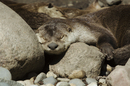
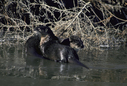
North American river otters are semi-aquatic mammals, with long, streamlined bodies, thick tapered tails, and short legs. They have wide, rounded heads, small ears, and nostrils that can be closed underwater. The vibrissae are long and thick, reflecting their importance in sensory perception. The fur is dark brown to almost black above and a lighter color ventrally. The throat and cheeks are usually a golden brown. The fur is dense and soft, effectively insulating these animals in water. The feet have claws and are completely webbed. Body length ranges from 889 to 1300 mm and tail length from 300 to 507 mm. Weight ranges from 5 to 14 kg. Males average larger than females in all measurements.
- Other Physical Features
- endothermic
- homoiothermic
- bilateral symmetry
- Sexual Dimorphism
- male larger
-
- Range mass
- 5 to 14 kg
- 11.01 to 30.84 lb
-
- Range length
- 889 to 1300 mm
- 35.00 to 51.18 in
Reproduction
Males and females do not associate except during the mating season. Males often breed with several females, probably those whose home ranges overlap with their own.
- Mating System
- polygynous
Males and females come together to breed in late winter or early spring. Gestation lasts two months, but the young may be born up to a year after mating because these otters employ delayed implantation of the fertilized egg in the uterus. Births occur from November to May, with a peak in March and April. Females give birth to from 1 to 6 young per litter, with an average of 2 to 3, in a den near the water. They are born with fur, but are otherwise helpless. They open their eyes at one month of age and are weaned at about 3 months old. They begin to leave their natal range at from 6 months to a year old. Sexual maturity is reached at 2 to 3 years of age.
- Key Reproductive Features
- iteroparous
- seasonal breeding
- gonochoric/gonochoristic/dioecious (sexes separate)
- sexual
- fertilization
- viviparous
- delayed implantation
-
- Breeding interval
- Breeding occurs once yearly.
-
- Breeding season
- Mating occurs in late winter and early spring.
-
- Range number of offspring
- 1 to 6
-
- Average number of offspring
- 2-3
-
- Average number of offspring
- 2.5
- AnAge
-
- Average gestation period
- 2 months
-
- Average gestation period
- 62 days
- AnAge
-
- Average weaning age
- 3 months
-
- Range time to independence
- 6 to 12 months
-
- Range age at sexual or reproductive maturity (female)
- 2 to 3 years
-
- Range age at sexual or reproductive maturity (male)
- 2 to 3 years
Females give birth to, nurse, and care for their young in a den near the water. The young are weaned at about 3 months old and begin to leave their mother at 6 months old.
- Parental Investment
- altricial
- female parental care
Lifespan/Longevity
North American river otters can live up to 21 years in captivity. They normally live about 8 to 9 years in the wild.
-
- Range lifespan
Status: captivity - 21 (high) years
- Range lifespan
-
- Typical lifespan
Status: wild - 8 to 9 years
- Typical lifespan
-
- Average lifespan
Status: wild - 8-9 years
- Average lifespan
Behavior
Lontra canadensis individuals live alone or in family groups, typically females and their young. They are known as playful animals, exhibiting behaviors such as mud/snow sliding, burrowing through the snow, and waterplay. Many "play" activities actually serve a purpose. Some are used to strengthen social bonds, to practice hunting techniques, and to scent mark. North American river otters get their boundless energy from their very high metabolism, which also requires them to eat a great deal during the day.
They are excellent swimmers and divers, able to stay underwater for up to 8 minutes. They are also fast on land, capable of running at up to 29 km/hr. These otters normally hunt at night, but can be seen at all times of day.
- Key Behaviors
- natatorial
- motile
- sedentary
- solitary
- territorial
- social
Home Range
River otters have large home ranges, between 2-78km of waterway, and are constantly on the move within this range. Home range sizes vary considerably and seem to depend on the richness of food resources and habitat quality. Despite these large ranges, river otters are only slightly territorial and generally practice mutual avoidance. Males generally have larger home ranges than females.
Communication and Perception
North American river otters communicate in a variety of ways. They vocalize with whistles, growls, chuckles, and screams. They also scent mark using paired scent glands near the base of their tails or by urinating/defecating on vegetation within their home range. These glands produce a very strong, musky odor. They also use touch and communicate through posture and other body signals.
North American river otters perceive their environment through vision, touch, smell, and hearing. Their large and abundant whiskers are very sensitive and are important in tactile sensation. These whiskers are used extensively in hunting, as smell, vision, and hearing are diminished in the water.
- Other Communication Modes
- scent marks
Food Habits
North American river otters eat mainly aquatic organisms such as amphibians, fish, turtles, crayfish, crabs, and other invertebrates. Birds, their eggs, and small terrestrial mammals are also eaten on occasion. They sometimes eat aquatic plants.
Prey is captured with the mouth, and mainly slow, non-game fish species are taken, e.g., suckers. The otter's long whiskers are used to detect organisms in the substrate and the dark water. Prey is eaten immediately after capture, usually in the water, although larger prey is eaten on land.
- Animal Foods
- birds
- mammals
- amphibians
- fish
- eggs
- insects
- terrestrial non-insect arthropods
- aquatic crustaceans
- Plant Foods
- leaves
- roots and tubers
- macroalgae
Predation
North American river otters are sometimes taken by bobcats, coyotes, birds of prey, alligators, and other large predators. They mainly escape predation through their agility in the water and on land, their vigilance, and their ability to fiercely defend themselves and their young.
-
- Known Predators
-
- bobcats (Lynx rufus)
- coyotes (Canis latrans)
- birds of prey (Falconiformes)
- American alligators (Alligator mississipiensis)
Ecosystem Roles
North American river otters are important predators of fish and aquatic invertebrates.
Economic Importance for Humans: Positive
North American river otters are important parts of healthy, aquatic ecosystems.
North American river otters have been hunted for many years for their attractive and durable fur. In the 1983-84 hunting season, 33,135 otters were taken with an average selling price of $18.71 per pelt. Otters are stll an important source of income for many people in Canada and the western United States. River otters also eat "trash fish" that compete with more economically desirable game fish.
- Positive Impacts
- body parts are source of valuable material
Economic Importance for Humans: Negative
North American river otters generally do not have adverse affects on humans.
Conservation Status
Northern river otters are listed in Appendix II of CITES. Populations were once extirpated through many parts of their range, especially around heavily populated areas in the midwestern and eastern United States. Population trends have stabilized in recent years and reintroduction and conservation efforts have resulted in recolonization of areas where they were previously extirpated. Northern river otter populations are still considered vulnerable or imperiled throughout much of their range in midwestern United States and the Appalachian mountains. They are presumed extirpated in New Mexico and population status in South Carolina and Florida has not yet been reviewed. (NatureServe, 2008)
-
- IUCN Red List
-
Least Concern
More information
-
- IUCN Red List
-
Least Concern
More information
-
- US Federal List
- No special status
-
- CITES
- Appendix II
-
- State of Michigan List
- No special status
Contributors
Tanya Dewey (author), Animal Diversity Web.
Eric J. Ellis (author), University of Michigan-Ann Arbor.
Glossary
- Nearctic
-
living in the Nearctic biogeographic province, the northern part of the New World. This includes Greenland, the Canadian Arctic islands, and all of the North American as far south as the highlands of central Mexico.

- acoustic
-
uses sound to communicate
- altricial
-
young are born in a relatively underdeveloped state; they are unable to feed or care for themselves or locomote independently for a period of time after birth/hatching. In birds, naked and helpless after hatching.
- bilateral symmetry
-
having body symmetry such that the animal can be divided in one plane into two mirror-image halves. Animals with bilateral symmetry have dorsal and ventral sides, as well as anterior and posterior ends. Synapomorphy of the Bilateria.
- bog
-
a wetland area rich in accumulated plant material and with acidic soils surrounding a body of open water. Bogs have a flora dominated by sedges, heaths, and sphagnum.
- carnivore
-
an animal that mainly eats meat
- chemical
-
uses smells or other chemicals to communicate
- coastal
-
the nearshore aquatic habitats near a coast, or shoreline.
- delayed implantation
-
in mammals, a condition in which a fertilized egg reaches the uterus but delays its implantation in the uterine lining, sometimes for several months.
- endothermic
-
animals that use metabolically generated heat to regulate body temperature independently of ambient temperature. Endothermy is a synapomorphy of the Mammalia, although it may have arisen in a (now extinct) synapsid ancestor; the fossil record does not distinguish these possibilities. Convergent in birds.
- estuarine
-
an area where a freshwater river meets the ocean and tidal influences result in fluctuations in salinity.
- female parental care
-
parental care is carried out by females
- fertilization
-
union of egg and spermatozoan
- internal fertilization
-
fertilization takes place within the female's body
- iteroparous
-
offspring are produced in more than one group (litters, clutches, etc.) and across multiple seasons (or other periods hospitable to reproduction). Iteroparous animals must, by definition, survive over multiple seasons (or periodic condition changes).
- macroalgae
-
seaweed. Algae that are large and photosynthetic.
- marsh
-
marshes are wetland areas often dominated by grasses and reeds.
- motile
-
having the capacity to move from one place to another.
- natatorial
-
specialized for swimming
- native range
-
the area in which the animal is naturally found, the region in which it is endemic.
- piscivore
-
an animal that mainly eats fish
- polygynous
-
having more than one female as a mate at one time
- riparian
-
Referring to something living or located adjacent to a waterbody (usually, but not always, a river or stream).
- scent marks
-
communicates by producing scents from special gland(s) and placing them on a surface whether others can smell or taste them
- seasonal breeding
-
breeding is confined to a particular season
- sedentary
-
remains in the same area
- sexual
-
reproduction that includes combining the genetic contribution of two individuals, a male and a female
- social
-
associates with others of its species; forms social groups.
- solitary
-
lives alone
- swamp
-
a wetland area that may be permanently or intermittently covered in water, often dominated by woody vegetation.
- tactile
-
uses touch to communicate
- temperate
-
that region of the Earth between 23.5 degrees North and 60 degrees North (between the Tropic of Cancer and the Arctic Circle) and between 23.5 degrees South and 60 degrees South (between the Tropic of Capricorn and the Antarctic Circle).
- terrestrial
-
Living on the ground.
- territorial
-
defends an area within the home range, occupied by a single animals or group of animals of the same species and held through overt defense, display, or advertisement
- visual
-
uses sight to communicate
- viviparous
-
reproduction in which fertilization and development take place within the female body and the developing embryo derives nourishment from the female.
References
Kruuk, Hans. 1995. Wild Otters: Predation and Populations. Oxford University Press. 240 pgs.
Macdonald, Dr. David. 1984. The Encyclopedia of Mammals. Equinox (Oxford) Ltd. Pgs 125-129.
Nowak, Ronald M. 1991. Walker's Mammals of the World, 5th ed, Vol II. The Johns Hopkins University Press. Pgs 1135-1137.
Ulrich, Tom J. 1990. Mammals of the Northern Rockies. Mountain Press Publishing Company. Pg. 68.
Wernert, Susan J [Editor]. 1982. Reader's Digest North American Wildlife. The Reader's Digest Association, Inc. pg. 61.
NatureServe, 2008. "NatureServe Explorer: An online encyclopedia of life version 7.0" (On-line). Accessed January 23, 2009 at http://www.natureserve.org/explorer.