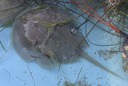
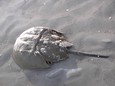
Limulus polyphemus



Geographic Range
Along the Atlantic Coast, from Nova Scotia to the Yucatan.
- Biogeographic Regions
- nearctic
- neotropical
- atlantic ocean
Habitat
The horseshoe crab can generally be found in shallow water, over sandy or muddy bottoms.
- Aquatic Biomes
- coastal
Reproduction
The first pair of the six, flap-like appendages on the underside of the abdomen acts as a cover for the genital pore. The egg or sperm are released through this pore during spawning.
Behavior
The horseshoe crab generally walks along the bottom of shallow water, but it can also swim awkwardly on its back by using its flap-like gills as paddles.
Food Habits
The horseshoe crab feeds at night on worms, small molluscs, and algae. Food is picked up by the chelicerae and passed back to the bristle bases, where it is "chewed." The food is then moved forward to the mouth.
Economic Importance for Humans: Positive
The study of a horseshoe crab's central nervous system processing functions provided the principles necessary to understand information processes in virtually every other organism investigated.
Conservation Status
The horseshoe crab is a "living relic" of the Merostomata, most of which went extinct millions of years ago.
-
- IUCN Red List
-
Lower Risk - Near Threatened
More information
Other Comments
Although the horseshoe crab appears to be and is named a crab, it is not. It is, in fact, related to Arachnids.
Contributors
Amanda Lamerato (author), University of Michigan-Ann Arbor.
Glossary
- Atlantic Ocean
-
the body of water between Africa, Europe, the southern ocean (above 60 degrees south latitude), and the western hemisphere. It is the second largest ocean in the world after the Pacific Ocean.

- Nearctic
-
living in the Nearctic biogeographic province, the northern part of the New World. This includes Greenland, the Canadian Arctic islands, and all of the North American as far south as the highlands of central Mexico.
- Neotropical
-
living in the southern part of the New World. In other words, Central and South America.
- coastal
-
the nearshore aquatic habitats near a coast, or shoreline.
- native range
-
the area in which the animal is naturally found, the region in which it is endemic.
References
Day, Cherie H. 1987. "Life on Intertidal Rocks." Nature Study Guild Publishers, Rochester, NY.
Gould, James L.; Keeton, William T. 1993. "Biological Science." W.W. Norton and Company, Inc. New York and London.
Hickman, Cleveland P.; Roberts, Larry S. 1995. "Animal Diversity." Wm. C. Brown Pubishers. Dubuque, Iowa.
Williams, Austin B. 1984. "Shrimps, Lobsters, and Crabs of the Atlantic Coast." Grolier Electronic Publishing, Inc.