Limenitis arthemis


Geographic Range
The White Admiral is found throughout the eastern United States and West into the Rocky Mountains.
Habitat
The White Admiral inhabits deciduous broad-leaf forests and mixed evergreen forests. It also prefers forest edges and clearings.
- Terrestrial Biomes
- forest
Physical Description
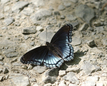
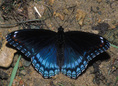
The White Admiral has a wingspan of 60-70 millimeters. The upperside of both wings are black and there is a broad white band across each dorsal wing. On the base of the wings are orange spots and marginal rows of white and bluish dashes.
- Other Physical Features
- ectothermic
- bilateral symmetry
Reproduction
The White Admiral will often hybridize with the red spotted purple, another member of the genus Limenitis.
Food Habits
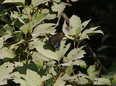
Foodplants of the White Admiral include wild cherry, poplar, aspens, and black oaks. The larval foodplant consisits of various trees such as the birch, willow, and poplar.
Economic Importance for Humans: Positive
No documented examples.
Economic Importance for Humans: Negative
No documented examples.
Conservation Status
White admirals are currently widespread and abundant and not listed as threatened.
-
- IUCN Red List
- No special status
-
- US Federal List
- No special status
-
- CITES
- No special status
-
- State of Michigan List
- No special status
Other Comments
The white Admiral has a distinct flap and glide flight.
Contributors
Marie S. Harris (author), University of Michigan-Ann Arbor.
Glossary
- Nearctic
-
living in the Nearctic biogeographic province, the northern part of the New World. This includes Greenland, the Canadian Arctic islands, and all of the North American as far south as the highlands of central Mexico.

- bilateral symmetry
-
having body symmetry such that the animal can be divided in one plane into two mirror-image halves. Animals with bilateral symmetry have dorsal and ventral sides, as well as anterior and posterior ends. Synapomorphy of the Bilateria.
- ectothermic
-
animals which must use heat acquired from the environment and behavioral adaptations to regulate body temperature
- forest
-
forest biomes are dominated by trees, otherwise forest biomes can vary widely in amount of precipitation and seasonality.
- native range
-
the area in which the animal is naturally found, the region in which it is endemic.
References
Opler, Paul A. A Field Guide to Eastern Butterflies. Houghton Mifflin Company, 1992.
Arnett, Ross H. and Jacques, Richard L.. Guide to Insects. Simon and Schuster, 1981.