Lepus californicusblack-tailed jackrabbit



Geographic Range
Lepus californicus is found throughout the southwestern United States into Mexico, as far east as Missouri, north into Washington, Idaho, Colorado and Nebraska, and west to California and Baja California.
Habitat
Black-tailed jackrabbits inhabit desert scrubland, prairies, farmlands, and dunes. They favor arid regions and areas of short grass rangeland from sea level to about 3,800 m. Many different vegetation types are used, including sagebrush-creosote bush, mesquite-snakeweed and juniper-big sagebrush. They also frequent agricultural areas where they can impact fruit and grain crops.
- Habitat Regions
- temperate
- terrestrial
- Terrestrial Biomes
- desert or dune
- savanna or grassland
- chaparral
- Other Habitat Features
- suburban
- agricultural
-
- Range elevation
- 3800 (high) m
- 12467.19 (high) ft
Physical Description
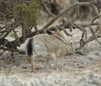
Black-tailed jackrabbits measure 47-63 cm from nose to rump, the tail is between 50-112 mm and the ears are 10-13 cm long. As they are true hares, black-tailed jackrabbits are lankier and leaner than rabbits, have longer ears and legs, and the leverets are born fully-furred and open-eyed. Black-tailed jackrabbits possess a characteristic black stripe down the center of the back, a black rump patch, and the tail is black dorsally. Both sexes look alike, but the female is the larger of the two sexes.
- Other Physical Features
- endothermic
- homoiothermic
- bilateral symmetry
- Sexual Dimorphism
- female larger
-
- Range mass
- 1.3 to 3.1 kg
- 2.86 to 6.83 lb
-
- Range length
- 47 to 63 cm
- 18.50 to 24.80 in
-
- Average basal metabolic rate
- 7.314 W
- AnAge
Reproduction
Black-tailed jackrabbit males and females leap after, chase, and behave aggressively towards each other during a brief courtship phase before mating.
- Mating System
- polygynandrous (promiscuous)
Breeding season for Lepus californicus extends from December through September in Arizona and from late January to August in California and Kansas. Females produce 3 or 4 litters annually with 1-6 leverets (generally 3 or 4) after a 41-47 day gestation period. The young are precocial; females only nurse their offspring for 2-3 days and are not seen with their young after that time. Lifespan in captivity is 5-6 years, but rabbits in the wild often die much sooner due to predation, disease or problems associated with overpopulation.
- Key Reproductive Features
- gonochoric/gonochoristic/dioecious (sexes separate)
- sexual
-
- Range number of offspring
- 1 to 8
-
- Average number of offspring
- 2.26
-
- Average number of offspring
- 1
- AnAge
-
- Range gestation period
- 41 to 47 days
-
- Average gestation period
- 43 days
-
- Range weaning age
- 14 to 21 days
-
- Average age at sexual or reproductive maturity (female)
Sex: female - 243 days
- AnAge
- Average age at sexual or reproductive maturity (female)
- Parental Investment
- precocial
Lifespan/Longevity
-
- Average lifespan
Status: captivity - 6.8 years
- Max Planck Institute for Demographic Research
- Average lifespan
Behavior
As with all hares, blacktails rely on speed and camouflage (along with the characteristic "freeze" behavior) for their defense. When flushed from cover, a blacktail can spring 20 feet at a bound and reach top speeds of 30-35 mph over a zigzag course. Black-tailed jackrabbits do not generally occupy burrows: rather, they dig shallow depressions in the earth in which to lay. Black-tailed jackrabbits are mainly unsociable but are driven to common food sources in periods of drought. They are inactive during the hot afternoon hours and are mainly nocturnal, resting under bushes by day. Home ranges in California average 20ha (dependent upon population density), with females having larger ranges than males.
- Key Behaviors
- motile
Communication and Perception
Food Habits
Grasses and herbaceous matter are the preferred foods of Lepus californicus, but twigs and young bark of woody plants are the staple food when other plants are not available. Sagebrush and cacti are also taken. Jackrabbits eat almost constantly and consume large quantities relative to their size; 15 jackrabbits eat as much as a large grazing cattle in one day. Black-tailed jackrabbits do not require much water and obtain nearly all the water they need from the plant material they consume.
- Plant Foods
- leaves
- roots and tubers
- wood, bark, or stems
- fruit
Economic Importance for Humans: Positive
As with many other Lepus species, L. californicus has been widely used as food for humans, especially by Native Americans. Their fur is not durable nor valuable, but it has been extensively used in the manufacture of felt and as trimming and lining for garments and gloves.
- Positive Impacts
- food
- body parts are source of valuable material
Economic Importance for Humans: Negative
Due to the removal of natural predators, such as coyote and kit fox, by European settlers, black-tailed jackrabbit populations have undergone incredible population explosions in which crops, orchards, and rangelands have suffered. They do considerable damange to farms, forest plantations, and young trees.
- Negative Impacts
- crop pest
Conservation Status
Population numbers of black-tailed jackrabbits are sometimes quite high despite attempts at culling their populations by ranchers and farmers. Population densities often reach 470 animals per square km, with densities as high as 1500 animals per square km being recorded. Large herding attempts have netted as much as 6,000 hares at a time. As with many hares, Lepus californicus populations undergo drastic fluctuations, with population numbers peaking every 6 to 10 years. In some years more then 90 per cent of western populations die from tularemia, which may or may not be related to the population cycling phenomenon. Because of their incredible fecundity, black-tailed jackrabbit numbers quickly recover from these kinds of die-offs.
Black-tailed jackrabbit populations are not threatened in general, though extensive habitat destruction may reduce suitable habitat. (Wilson and Ruff, 1999)
-
- IUCN Red List
-
Least Concern
More information
-
- IUCN Red List
-
Least Concern
More information
-
- US Federal List
- No special status
-
- CITES
- No special status
Other Comments
Jackrabbits obtained their name from early settlers of the Southwest who, noting the animal's extraordinarily long ears, dubbed it "jackass rabbit." This name was later shortened to jackrabbit. This species has 8 named subspecies. (Wilson and Ruff, 1999)
Contributors
Liz Ballenger (author), University of Michigan-Ann Arbor.
Glossary
- Nearctic
-
living in the Nearctic biogeographic province, the northern part of the New World. This includes Greenland, the Canadian Arctic islands, and all of the North American as far south as the highlands of central Mexico.

- agricultural
-
living in landscapes dominated by human agriculture.
- bilateral symmetry
-
having body symmetry such that the animal can be divided in one plane into two mirror-image halves. Animals with bilateral symmetry have dorsal and ventral sides, as well as anterior and posterior ends. Synapomorphy of the Bilateria.
- chaparral
-
Found in coastal areas between 30 and 40 degrees latitude, in areas with a Mediterranean climate. Vegetation is dominated by stands of dense, spiny shrubs with tough (hard or waxy) evergreen leaves. May be maintained by periodic fire. In South America it includes the scrub ecotone between forest and paramo.
- chemical
-
uses smells or other chemicals to communicate
- desert or dunes
-
in deserts low (less than 30 cm per year) and unpredictable rainfall results in landscapes dominated by plants and animals adapted to aridity. Vegetation is typically sparse, though spectacular blooms may occur following rain. Deserts can be cold or warm and daily temperates typically fluctuate. In dune areas vegetation is also sparse and conditions are dry. This is because sand does not hold water well so little is available to plants. In dunes near seas and oceans this is compounded by the influence of salt in the air and soil. Salt limits the ability of plants to take up water through their roots.
- endothermic
-
animals that use metabolically generated heat to regulate body temperature independently of ambient temperature. Endothermy is a synapomorphy of the Mammalia, although it may have arisen in a (now extinct) synapsid ancestor; the fossil record does not distinguish these possibilities. Convergent in birds.
- folivore
-
an animal that mainly eats leaves.
- food
-
A substance that provides both nutrients and energy to a living thing.
- herbivore
-
An animal that eats mainly plants or parts of plants.
- motile
-
having the capacity to move from one place to another.
- native range
-
the area in which the animal is naturally found, the region in which it is endemic.
- polygynandrous
-
the kind of polygamy in which a female pairs with several males, each of which also pairs with several different females.
- sexual
-
reproduction that includes combining the genetic contribution of two individuals, a male and a female
- suburban
-
living in residential areas on the outskirts of large cities or towns.
- tactile
-
uses touch to communicate
- temperate
-
that region of the Earth between 23.5 degrees North and 60 degrees North (between the Tropic of Cancer and the Arctic Circle) and between 23.5 degrees South and 60 degrees South (between the Tropic of Capricorn and the Antarctic Circle).
- terrestrial
-
Living on the ground.
- tropical savanna and grassland
-
A terrestrial biome. Savannas are grasslands with scattered individual trees that do not form a closed canopy. Extensive savannas are found in parts of subtropical and tropical Africa and South America, and in Australia.
- savanna
-
A grassland with scattered trees or scattered clumps of trees, a type of community intermediate between grassland and forest. See also Tropical savanna and grassland biome.
- temperate grassland
-
A terrestrial biome found in temperate latitudes (>23.5° N or S latitude). Vegetation is made up mostly of grasses, the height and species diversity of which depend largely on the amount of moisture available. Fire and grazing are important in the long-term maintenance of grasslands.
- young precocial
-
young are relatively well-developed when born
References
Flux, J.E.C. and R. Angermann. 1990. The hares and jackrabbits. In: Rabbits, Hares and Pikas: Status Survey and Conservation Action Plan. (J.A. Chapman and J.E.C. Flux, eds.) Information Press, Oxford, U.K.
Grzimek's Encyclopedia of Mammals.
Nowak, R.M. and J.L Paradiso. 1983. Walker's Mammals of the World. 4th edition. John Hopkins University Press, Baltimore, MD.
Rue, L.L. 1967. Pictorial guide to the mammals of North America. Thomas Y. Crowell Company, New York.
Wilson, D., S. Ruff. 1999. The Smithsonian Book of North American Mammals. Washington: Smithsonian Institution Press.