Leptoptilos crumeniferusmarabou(Also: marabou stork)


Geographic Range
The Marabou stork is found throughout Africa. However, it usually resides somewhere between the Sahara Desert and South Africa. ( Dinsmore, 1997; Deignan, 1982)
Habitat
The habitat of the Marabou stork includes aquatic, arid areas of Africa. The bird is also frequently found near landfills or fishing villages. (Lincoln Park Zoo, 1999)
- Terrestrial Biomes
- desert or dune
- savanna or grassland
Physical Description
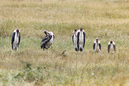
Leptoptilos crumeniferus is a large, unusual looking bird. It stands on long, grey legs at about 1.5 meters tall. The bird's upper body and wings are black or dark grey, and its underparts are white. Its soft, white tail feathers are known as marabou. Its neck and head contain no feathers. The Marabou stork has a long, reddish pouch hanging from its neck. This pouch is used in courtship rituals. (Dinsmore, 1997)
- Other Physical Features
- endothermic
- bilateral symmetry
-
- Average mass
- 9000 g
- 317.18 oz
-
- Average mass
- 8000 g
- 281.94 oz
- AnAge
Reproduction
Leptoptilos crumeniferus is known as a colonial breeder. It reaches sexual maturity when it is approximately four years old and usually mates for life. The stork lays its eggs in small nests made of sticks that hold two or three of its eggs. The Marabou breeds during the dry season because at this time the water levels are low, which make it easier to catch frogs and fish to feed the young. This stork may live up to 25 years. (Microsoft Encarta, 1999; Campbell, 1972)
- Key Reproductive Features
- iteroparous
- gonochoric/gonochoristic/dioecious (sexes separate)
- sexual
- oviparous
Lifespan/Longevity
-
- Average lifespan
Status: wild - 25.0 years
- Max Planck Institute for Demographic Research
- Average lifespan
-
- Average lifespan
Status: captivity - 41.0 years
- Max Planck Institute for Demographic Research
- Average lifespan
Behavior
Leptoptilos crumeniferus is a communal animal. They often gather in groups, usually near lakes or rivers. Although it is usually silent, the Marabou stork occasionally grunts, croaks, or rattles its bill. The stork will use its throat pouch to make these noises, especially during courtship. (Campbell, 1972)
- Key Behaviors
- flies
- motile
Communication and Perception
Food Habits
The Marabou stork is a scavenger. It primarily relies on the carcasses of dead animals as their source of food. However, they also eat live prey, such as fish, reptiles, and locusts. (Campbell, 1974; Dinsmore, 1997)
Economic Importance for Humans: Positive
The Marabou stork reduces the spread of disease by cleaning up animal carcasses. (National Zoo, 2000)
Economic Importance for Humans: Negative
The Marabou stork does not appear to have any negative effects on humans or the environment.
Conservation Status
Due to its ability to adjust to human activity, the population of Marabou storks may actually be increasing. (National Zoo, 2000)
-
- IUCN Red List
-
Least Concern
More information
-
- IUCN Red List
-
Least Concern
More information
-
- US Federal List
- No special status
-
- CITES
- No special status
Other Comments
The tail feathers of the Marabou stork, called marabou, were once used to trim hats and gowns and to make scarves. (Dinsmore, 1997)
Contributors
Andrea Muckley (author), Milford High School, George Campbell (editor), Milford High School.
Glossary
- Ethiopian
-
living in sub-Saharan Africa (south of 30 degrees north) and Madagascar.

- acoustic
-
uses sound to communicate
- bilateral symmetry
-
having body symmetry such that the animal can be divided in one plane into two mirror-image halves. Animals with bilateral symmetry have dorsal and ventral sides, as well as anterior and posterior ends. Synapomorphy of the Bilateria.
- chemical
-
uses smells or other chemicals to communicate
- desert or dunes
-
in deserts low (less than 30 cm per year) and unpredictable rainfall results in landscapes dominated by plants and animals adapted to aridity. Vegetation is typically sparse, though spectacular blooms may occur following rain. Deserts can be cold or warm and daily temperates typically fluctuate. In dune areas vegetation is also sparse and conditions are dry. This is because sand does not hold water well so little is available to plants. In dunes near seas and oceans this is compounded by the influence of salt in the air and soil. Salt limits the ability of plants to take up water through their roots.
- endothermic
-
animals that use metabolically generated heat to regulate body temperature independently of ambient temperature. Endothermy is a synapomorphy of the Mammalia, although it may have arisen in a (now extinct) synapsid ancestor; the fossil record does not distinguish these possibilities. Convergent in birds.
- iteroparous
-
offspring are produced in more than one group (litters, clutches, etc.) and across multiple seasons (or other periods hospitable to reproduction). Iteroparous animals must, by definition, survive over multiple seasons (or periodic condition changes).
- motile
-
having the capacity to move from one place to another.
- native range
-
the area in which the animal is naturally found, the region in which it is endemic.
- oviparous
-
reproduction in which eggs are released by the female; development of offspring occurs outside the mother's body.
- sexual
-
reproduction that includes combining the genetic contribution of two individuals, a male and a female
- tactile
-
uses touch to communicate
- tropical savanna and grassland
-
A terrestrial biome. Savannas are grasslands with scattered individual trees that do not form a closed canopy. Extensive savannas are found in parts of subtropical and tropical Africa and South America, and in Australia.
- savanna
-
A grassland with scattered trees or scattered clumps of trees, a type of community intermediate between grassland and forest. See also Tropical savanna and grassland biome.
- temperate grassland
-
A terrestrial biome found in temperate latitudes (>23.5° N or S latitude). Vegetation is made up mostly of grasses, the height and species diversity of which depend largely on the amount of moisture available. Fire and grazing are important in the long-term maintenance of grasslands.
- visual
-
uses sight to communicate
References
1999. Marabou. Microsoft Encarta. Microsoft.
Campbell, B. 1974. The Dictionary of Birds in Color. The Viking Press.
Deignan, H. 1982. Marabou. Pp. 375 in Colliers Encyclopedia Volume 13. Macmillan Educational Company.
Dinsmore, J. 1997. Marabou. Pp. 190 in World Book Encyclopedia. World Book Inc..
Lincoln Park Zoo, 1999. "Marabou Stork" (On-line). Accessed (Date Unknown) at http://www.lpzoo.com/tour/factsheets/birds/marabou.html.
National Zoological Park, June 1, 2000. "Marabou Stork" (On-line). Accessed December 17, 2000 at http://web2.si.edu/natzoo/zooview/exhibits/birdhs/marstork.htm.