Lepomis microlophusRedear sunfish

Geographic Range
Redear sunfish are native to the central and southern United States and can be found in the St. Lawrence-Great Lakes and Mississippi River drainages, as well as the Atlantic and Gulf Slope drainages. Redear sunfish have been introduced as game fish throughout the United States, as well as in Morocco, South Africa, Panama, and Puerto Rico. (Fuller and Jacobs, 2007; Moyle, 2002; Page and Burr, 1991; Whittier and Hartel, 1997)
- Biogeographic Regions
- nearctic
- palearctic
- ethiopian
- neotropical
Habitat
Redear sunfish prefer warm and calm or stagnant waters. As a result, preferred habitat is restricted to ponds, lakes, river backwaters, and reservoirs. The riverine habitats in which they are found, tend to be large and slow flowing with moderate amounts of aquatic vegetation. Redear sunfish are mainly found in water that is at least 2 m deep. They commonly live in low salinity waters (less than 4 ppt) but have been found in waters with salinities as high as 12 ppt. (State of California, 2004; Twomey, et al., 1984)
- Habitat Regions
- temperate
- tropical
- freshwater
- Aquatic Biomes
- lakes and ponds
- rivers and streams
- Wetlands
- marsh
-
- Average depth
- 2 m
- 6.56 ft
Physical Description
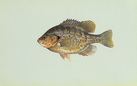
Redear sunfish have laterally compressed bodies that are green, grey, or black. They can be distinguished from other sunfish via 3 different characteristics: 1) the red or orange margin on the opercular flap, 2) cheeks without conspicuous orange and blue streaks, and 3) pectoral fins that are greater than a third of the length typically found in sunfish. They often have small green specks on their heads and grey or black specks covering their bodies. Their pectoral fins have 13 to 14 pectoral rays, which taper to a terminal point. Their dorsal fin has 10 to 11 spines, and the anal fin has 3 spines. The terminal end of the opercular flap is marked by a large black spot, accompanied by two smaller white spots. The brightly colored terminal margin on the opercular flap is red in males and orange in females. At sexual maturity they are approximately 224 mm and can weigh as much as 454 g. (Jenkins and Burkhead, 1993; Page and Burr, 1991; Ross and Brenneman, 2001; Twomey, et al., 1984)
Redear sunfish are similar in appearance to their close relative, pumpkinseed sunfish (Lepomis gibbosus). As a result, the two species are often confused for one another. However, pumpkinseed sunfish have a number of wavy iridescent lines along the check and opercular flap that are not present in redear sunfish. (Page and Burr, 1991)
- Other Physical Features
- ectothermic
- heterothermic
- bilateral symmetry
- Sexual Dimorphism
- sexes colored or patterned differently
-
- Range mass
- 1.3 (high) kg
- 2.86 (high) lb
-
- Range length
- 35.5 (high) cm
- 13.98 (high) in
-
- Average length
- 22.4 cm
- 8.82 in
Development
Optimal incubation temperatures for redear sunfish eggs range from 22°C to 24°C. Incubation normally lasts 50 hours. After hatching, fry hide in gravel nests until about 3 days after hatching. Juveniles stay close to aquatic plants for protection and at 1 year old, leave the protective cover of aquatic plants to prey on open-water snails. (Moyle, 2002; Simon and Wallus, 2008; State of California, 2004; Trautman, 1981)
Growth rates appear to be dependent on turbidity as redear sunfish grow more rapidly in less turbid water. Different age classes can be identified according to size. First year fish range from 50 to 100 mm in total length (TL), and second year fish range from 110 to 140 mm TL. Fish that are 5 to 6 years old range from 200 to 250 mm TL. (Moyle, 2002; Simon and Wallus, 2008; State of California, 2004; Trautman, 1981)
- Development - Life Cycle
- indeterminate growth
Reproduction
During mating season, male redear sunfish make popping sounds while in close proximity to females, which are used to gain the attention of potential mates. During courtship, males repeatedly surge toward potential mates while making popping sounds, which are made by clapping the jaws shut. Males also gain the attention of females via chemical and visual cues. (Gerald, 1971; Gothreaux, 2008; Schloemer, 1947; Simon and Wallus, 2008; State of California, 2004; Twomey, et al., 1984)
Male redear sunfish construct nests made from sand, gravel, and mud. Nests are typically found near aquatic plants, which provide cover for juveniles prior to maturation. Nests are approximately 25 to 61 cm wide and occur anywhere from 1 to 6 m deep. After fertilization, males do not leave the nest until all their eggs have hatched. Female sunfish lay their eggs in several nests each mating period. (Gerald, 1971; Gothreaux, 2008; Schloemer, 1947; Simon and Wallus, 2008; State of California, 2004; Twomey, et al., 1984)
- Mating System
- polyandrous
Redear sunfish mate once per year. The start of spawning season depends on water temperature, with warmer temperatures resulting in earlier spawning. Spawning typically occurs in shallow water at temperatures between 21°C and 24°C. Spawning begins in early spring and ends in mid-summer but may extend into early October in warmer climates. Maturation rates are also dependent on climate, as individuals start to spawn at 1 year old in warmer climates and at 2 years old in colder climates. Finally, female sunfish produce between 9,000 and 80,000 eggs per mating season. (Gerald, 1971; Gothreaux, 2008; Moyle, 2002; Schloemer, 1947; Simon and Wallus, 2008; State of California, 2004; Twomey, et al., 1984)
- Key Reproductive Features
- iteroparous
- seasonal breeding
- sexual
- fertilization
- oviparous
-
- Breeding interval
- Redear sunfish breed once yearly.
-
- Breeding season
- Redear sunfish breed from early spring to mid-summer.
-
- Range number of offspring
- 9000 to 80000
-
- Average time to hatching
- 50 hours
-
- Average time to independence
- 3 days
-
- Range age at sexual or reproductive maturity (female)
- 1 to 2 years
-
- Range age at sexual or reproductive maturity (male)
- 1 to 2 years
Male redear sunfish build nests prior to spawning and protect their nest for up to 3 days after spawning. (Gothreaux, 2008; Ross and Brenneman, 2001; Schloemer, 1947; Simon and Wallus, 2008)
- Parental Investment
- male parental care
-
pre-fertilization
-
protecting
- male
-
protecting
-
pre-hatching/birth
-
protecting
- male
-
protecting
-
pre-weaning/fledging
-
protecting
- male
-
protecting
-
pre-independence
-
protecting
- male
-
protecting
Lifespan/Longevity
Redear sunfish have an average lifespan of 6 years. The oldest wild-caught redear sunfish was 8 years old at time of capture. In captivity they can live to be 7 years old. (Schloemer, 1947; State of California, 2004; Twomey, et al., 1984)
-
- Range lifespan
Status: wild - 8 (high) years
- Range lifespan
-
- Range lifespan
Status: captivity - 7 (high) years
- Range lifespan
-
- Average lifespan
Status: wild - 6 years
- Average lifespan
Behavior
Redear sunfish that share habitat with largemouth bass (Micropterus salmoides) and bluegill (Lepomis macrochirus) are forced to compete for food as fry and juveniles. They eat insect larvae until their jaws are strong enough to crush the shells of their primary prey, aquatic snails. Once their jaws are strong enough, competition for food decreases due to an abundance of snails. Redear sunfish are crepuscular and tend to rest during the day. (Gothreaux, 2008; Moyle, 2002; Page and Burr, 1991; Wang, 1986)
- Key Behaviors
- natatorial
- crepuscular
- motile
- sedentary
- territorial
- social
Home Range
Little is known about the home range of redear sunfish. However, their close relatives, bluegill and pumpkinseed sunfish, have home ranges of about 0.5 ha and 1 ha, respectively. (Gothreaux, 2008; Moyle, 2002; Wang, 1986)
Communication and Perception
Redear sunfish use several modes of communication. It has been suggested that Lepomis species use chemical cues during nest building. During spawning, redear sunfish swim in a circular pattern around their mates. Males produce a popping sound to induce egg laying in females, which they produce by clapping the jaws shut. Finally, females select mates, at least in part, based on the pattern and intensity of a potential mate's coloration. (Schloemer, 1947; Simon and Wallus, 2008)
Food Habits
Redear sunfish are mainly bottom feeders. Fry stay in benthic waters and feed on algae and microcrustaceans. Juveniles eat insects, insect larvae, and small snails. Once their jaws fully develop, usually at about 1 year old, they begin to feed exclusively on snails. Adults feed on snails, aquatic insects, copepods, and organisms with hard shells, such as crustaceans. Evidence suggests that redear sunfish prefer snails with moderate shell thickness, as opposed to thin or thick shelled snails. (State of California, 2004; Stauffer, et al., 1995; Stein, et al., 1984; Trautman, 1981; Twomey, et al., 1984; Whittier and Hartel, 1997)
- Primary Diet
- carnivore
- Animal Foods
- insects
- mollusks
- aquatic or marine worms
- aquatic crustaceans
- zooplankton
- Plant Foods
- algae
Predation
Redear sunfish have several predators, including humans (Homo sapiens). They are considered a sport-fish species and are stocked in many lakes and streams. Humans commonly consume them and their larvae are prey to many other sport-fish species, including largemouth bass (Micropterus salmoides) and catfish (Genus: Ictalurus). Redear sunfish avoid predation by retreating to shaded areas and deeper waters. Redear sunfish carcasses are often scavenged by birds and raccoons (Procyon lotor). (Gothreaux, 2008; Ross and Brenneman, 2001; Stein, et al., 1984; Trautman, 1981)
- Anti-predator Adaptations
- cryptic
-
- Known Predators
-
- largemouth bass (Micropterus salmoides)
- catfish (Ictalurus)
- humans (Homo sapiens)
Ecosystem Roles
Introduced redear sunfish have significantly impacted native fish populations. For example, when introduced into habitats occupied by pumpkinseed sunfish (Lepomis gibbosus), pumpkinseed populations significantly declined. Redear sunfish have strong jaws, which allow them to crack mollusk shells more easily than pumpkinseed sunfish can. As a result, redear sunfish likely decrease food availability for pumpkinseeds. (Fuller and Jacobs, 2007)
Redear sunfish are host to the non-native parasitic copepod, Neoergasilus japonicus. Neoergasilus japonicus attaches to the outer surface of its host, likely feeding on the dermal tissue underlying the scales. Gut content analysis, however, shows that the primary diet of free-swimming N. japonicus consists primarily of blue-green algae. (Hudson and Bowen, 2002)
- Parasitic copepod (Neoergasilus japonicus)
Economic Importance for Humans: Positive
Redear sunfish are considered a sport fish and are regularly consumed throughout United States. (Fuller and Jacobs, 2007; Gothreaux, 2008)
- Positive Impacts
- food
Economic Importance for Humans: Negative
There are no known adverse effects of redear sunfish on humans. However, when redear sunfish populations are introduced to non-native waters, they may negatively affect the ecosystem and out-compete native fish species. This may affect the fishing industry and overall health of ecosystems that humans depend on for food and water.
Conservation Status
Redear sunfish exhibit stable population trends throughout its range and are in no danger of decline. (Gothreaux, 2008; Ross and Brenneman, 2001)
-
- IUCN Red List
- Not Evaluated
-
- US Federal List
- No special status
-
- CITES
- No special status
-
- State of Michigan List
- No special status
Contributors
Jacob Barbee (author), Radford University, Karen Powers (editor), Radford University, John Berini (editor), Animal Diversity Web Staff, Tanya Dewey (editor), University of Michigan-Ann Arbor, Renee Mulcrone (editor), Special Projects, Rachelle Sterling (editor), Special Projects.
Glossary
- Ethiopian
-
living in sub-Saharan Africa (south of 30 degrees north) and Madagascar.

- Nearctic
-
living in the Nearctic biogeographic province, the northern part of the New World. This includes Greenland, the Canadian Arctic islands, and all of the North American as far south as the highlands of central Mexico.
- Neotropical
-
living in the southern part of the New World. In other words, Central and South America.
- Palearctic
-
living in the northern part of the Old World. In otherwords, Europe and Asia and northern Africa.
- acoustic
-
uses sound to communicate
- bilateral symmetry
-
having body symmetry such that the animal can be divided in one plane into two mirror-image halves. Animals with bilateral symmetry have dorsal and ventral sides, as well as anterior and posterior ends. Synapomorphy of the Bilateria.
- carnivore
-
an animal that mainly eats meat
- chemical
-
uses smells or other chemicals to communicate
- crepuscular
-
active at dawn and dusk
- cryptic
-
having markings, coloration, shapes, or other features that cause an animal to be camouflaged in its natural environment; being difficult to see or otherwise detect.
- ectothermic
-
animals which must use heat acquired from the environment and behavioral adaptations to regulate body temperature
- external fertilization
-
fertilization takes place outside the female's body
- fertilization
-
union of egg and spermatozoan
- food
-
A substance that provides both nutrients and energy to a living thing.
- freshwater
-
mainly lives in water that is not salty.
- heterothermic
-
having a body temperature that fluctuates with that of the immediate environment; having no mechanism or a poorly developed mechanism for regulating internal body temperature.
- indeterminate growth
-
Animals with indeterminate growth continue to grow throughout their lives.
- introduced
-
referring to animal species that have been transported to and established populations in regions outside of their natural range, usually through human action.
- iteroparous
-
offspring are produced in more than one group (litters, clutches, etc.) and across multiple seasons (or other periods hospitable to reproduction). Iteroparous animals must, by definition, survive over multiple seasons (or periodic condition changes).
- male parental care
-
parental care is carried out by males
- marsh
-
marshes are wetland areas often dominated by grasses and reeds.
- molluscivore
-
eats mollusks, members of Phylum Mollusca
- motile
-
having the capacity to move from one place to another.
- natatorial
-
specialized for swimming
- native range
-
the area in which the animal is naturally found, the region in which it is endemic.
- oviparous
-
reproduction in which eggs are released by the female; development of offspring occurs outside the mother's body.
- polyandrous
-
Referring to a mating system in which a female mates with several males during one breeding season (compare polygynous).
- seasonal breeding
-
breeding is confined to a particular season
- sedentary
-
remains in the same area
- sexual
-
reproduction that includes combining the genetic contribution of two individuals, a male and a female
- social
-
associates with others of its species; forms social groups.
- tactile
-
uses touch to communicate
- temperate
-
that region of the Earth between 23.5 degrees North and 60 degrees North (between the Tropic of Cancer and the Arctic Circle) and between 23.5 degrees South and 60 degrees South (between the Tropic of Capricorn and the Antarctic Circle).
- territorial
-
defends an area within the home range, occupied by a single animals or group of animals of the same species and held through overt defense, display, or advertisement
- tropical
-
the region of the earth that surrounds the equator, from 23.5 degrees north to 23.5 degrees south.
- visual
-
uses sight to communicate
- zooplankton
-
animal constituent of plankton; mainly small crustaceans and fish larvae. (Compare to phytoplankton.)
References
Fish, P., J. Savitz. 1983. Variations in Home Ranges of Largemouth Bass, Yellow Perch, Bluegills, and Pumpkinseeds in an Illinois Lake. American Fisheries Society, 112/2a: 147-153.
Fuller, P., G. Jacobs. 2007. "Lepomis microlophus" (On-line). USGS Nonindigenous Aquatic Species Database, Gainesville, FL. Accessed December 08, 2010 at http://nas.er.usgs.gov/queries/FactSheet.aspx?speciesID=390.
Gerald, J. 1971. Sound Production During Courtship in Six Species of Sunfish (Centrarchidae). Evolution, 25/1: 75-87.
Gothreaux, 2008. Family Profile: Centrarchidae - Sunfishes: Part 3 - The Longear and the Redear. Lagniappe, 32/2: 3-5. Accessed December 08, 2010 at http://www.seagrantfish.lsu.edu/pdfs/lagniappe/2008/02-01-2008.pdf.
Hudson, P., C. Bowen. 2002. First Record of Neoergasilus japonicus (Poecilostomatoida: Ergasilidae), a Parasitic Copepod New to the Laurentian Great Lakes. Journal of Parasitology, 88/4: 657-663. Accessed December 08, 2010 at http://www.bioone.org/doi/full/10.1645/0022-3395%282002%29088%5B0657%3AFRONJP%5D2.0.CO%3B2?prevSearch=%255Bfulltext%253A%2BLepomis%2Bmicrolophus%2B%255D%2BAND%2B%255Bpublisher%253A%2Bbioone%255D&searchHistoryKey=.
Jenkins, R., N. Burkhead. 1993. Freshwater Fishes of Virginia. American Fisheries Society.
Jennings, M., D. Philipp. 2002. Alternative Mating Tactics in Sunfishes (Centrarchidae): A Mechanism for Hybridization?. Copeia, 2002(4): 1102-1105. Accessed December 08, 2010 at http://www.bioone.org/doi/full/10.1643/0045-8511%282002%29002%5B1102%3AAMTISC%5D2.0.CO%3B2?prevSearch=%255Bfulltext%253A%2BLepomis%2Bmicrolophus%2B%255D%2BAND%2B%255Bpublisher%253A%2Bbioone%255D&searchHistoryKey=&cookieSet=1.
Kipp, R. 2010. "USGS Nonindigenous Aquatic Species Database" (On-line). Neoergasilus japonicus Harada, 1930. Accessed December 08, 2010 at http://nas.er.usgs.gov/queries/FactSheet.aspx?speciesID=2595.
Moyle, P. 2002. Inland Fishes of California. London, England: University of California Press.
Page, L., B. Burr. 1991. A field guide to freshwater fishes of North America north of Mexico. Boston: Houghton Mifflin Company.
Ross, S., W. Brenneman. 2001. The Inland Fishes of Mississippi. Mississippi: University Press of Mississippi.
Schloemer, C. 1947. Reproductive Cycles of Five Spiecies of Texas Centrarchids. Science, 106/2743: 85-86.
Simon, T., R. Wallus. 2008. Reproductive Biology and Early Life History of Fishes in the Ohio River Drainage: Elassomatidae and Centrarchidae. CRC Press.
State of California, 2004. Matrix of Life History and Habitat Rrequirements for Feather River Fish Species SP-F3.2 Task 2: Redear Sunfish. Oroville Facilities Relicensing, FERC Project No. 2100: 1-10. Accessed December 08, 2010 at http://portal2.water.ca.gov/orovillerelicensing/docs/wg_study_reports_and_docs/EWG/040528a/04-28-04_fish_redear_sunfish.pdf.
Stauffer, J., J. Boltz, L. White. 1995. The Fishes of West Virginia. Academy of Natural Sciences, 146: 277-279.
Stein, R., C. Goodman, E. Marschall. 1984. Using Time and Energetic Measures of Cost in Estimating Prey Value for Fish Predators. Ecology, 65/3: 702-715. Accessed December 08, 2010 at http://www.jstor.org/stable/pdfplus/1938042.pdf?cookieSet=1.
Trautman, M. 1981. The Fishes of Ohio. Ohio: Ohio State University Press in Collaboration with the Ohio Sea Grant Program Center for Lake Erie Area Research.
Twomey, K., G. Gebhart, O. Maughan, P. Nelson. 1984. Habitat suitability index models and instream flow suitability curves: Redear sunfish. U.S. Fish Wildl. Serv., FWS/OBS-82/10.79: 29 pp. Accessed December 08, 2010 at http://www.nwrc.usgs.gov/wdb/pub/hsi/hsi-079.pdf.
Wang, J. 1986. Fishes of the Sacramento-San Joaquin Estuary and Adjacent Waters, California: A Guide to the Early Life Histories. California: The Program.
Whittier, T., K. Hartel. 1997. First Records of Redear Sunfish (Lepomis microlophus) in New England. Northeastern Naturalist, 4/4: 237-240. Accessed December 08, 2010 at http://www.jstor.org/stable/3858609.