Lepomis gibbosusPond perch(Also: Pumpkinseed; Punky; Sun bass; Sunny)
Geographic Range
Pumpkinseeds, Lepomis gibbosus, are found natively in the Atlantic Slope drainages from New Brunswick to the Edisto River in South Carolina and also in the Great Lakes, Hudson Bay, and upper Mississippi basins from Quebec and New York west to southeastern Manitoba and North Dakota, and south to northern Kentucky and Missouri. (Fuller, 2004)
This species has also been widely introduced in Europe, Africa, and South America, as well as other areas of North America. (Froese and Pauly, 2005)
- Biogeographic Regions
- nearctic
- palearctic
- ethiopian
- neotropical
Habitat
Pumpkinseeds are freshwater fishes, like other members of the sunfish family, Centrarchidae. They prefer cool to moderately warm, clear water that is 1 to 2 m deep in areas with lots of vegetation for cover. The ideal water temperature for pumpkinseeds ranges from 21 to 24 degrees Celsius. (Paulson and Hatch, 2002; Wang, 1996)
- Habitat Regions
- temperate
- freshwater
- Aquatic Biomes
- lakes and ponds
- rivers and streams
- Wetlands
- marsh
-
- Average depth
- 1 to 2 m
- ft
Physical Description
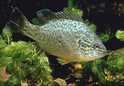
Pumpkinseeds are deep-bodied and laterally compressed. They have brassy yellow to olive green sides that are densely covered with spots of bright copper or gold. The opercle flap has a distinctive crimson spot in a half-moon shape on the rear edge in adults. In young pumpkinseeds a pale spot on the opercle flap distinguishes them from other Centrarchidae.
Etnier and Starnes (1993) describe pumpkinseeds as having: lateral line scales 35 to 43, dorsal fin with 10 (10 to 11) soft rays, anal fin soft rays 9 to 10, pectoral fin rays 13 (12 to 14). (Downs, et al., 2002; Etnier and Starnes, 1993; Paulson and Hatch, 2002; Smith, 1979)
Young pumpkinseeds also have vertical chainlike bands down their sides with dark vertical bars between the primary bands. These help to differentiate them from other sunfishes. Lepomis gibbosus are most easily confused with redear sunfish, L. microlophus and bluegills, L. macrochirus. (Smith, 1979)
- Other Physical Features
- ectothermic
- heterothermic
- bilateral symmetry
- Sexual Dimorphism
- sexes alike
-
- Range mass
- 620 (high) g
- 21.85 (high) oz
-
- Average mass
- 171-286 g
- oz
-
- Range length
- 254 (high) mm
- 10.00 (high) in
-
- Average length
- 152-203 mm
- in
Development
At 28 degrees Celsius the eggs of pumpkinseeds hatch in as little as three days. The normal range for eggs to hatch is 3 to 10 days. The newly hatched larvae are tiny and transparent. The eyes do not have any pigment in the first 48 hours after the larvae have hatched. They remain at the bottom of the nest for a short time. Male pumpkinseeds continue to guard larvae against predators for around 11 days when they become free-swimming. When they leave the nest the juvenile fish stay in or near the breeding area and can grow to around 50.8 mm in the first year of life. Pumpkinseeds usually reach sexual maturity at age 2. (Downs, et al., 2002; Wang, 1996)
Reproduction
Male pumpkinseeds will defend their nests agressively against other fish by spreading their opercula, charging, biting, chasing, and on occasion, they will mouth-fight. Females come in from deeper waters and at first appear to be chased away from the nest but, after a considerable amount of chasing, the male attempts to drive her into his nest and the female will approach the nest. (Downs, et al., 2002; Paulson and Hatch, 2002)
When the male pumpkinseed gets the female in his nest they will swim in a circular path above the nest with their bellies touching. The male releases milt and the female releases her eggs at intervals and fertilization occurs. Female pumpkinseeds can spawn in more than one nest. Also more than one female can use the same nest. Occasionally two females will spawn with a male at the same time. (Downs, et al., 2002; Froese and Pauly, 2005)
- Mating System
- polygynandrous (promiscuous)
Spawning occurs when water is between 13 to 28 degrees Celsius, during late spring to late summer, depending on location. A female between 2 to 5 years of age can produce anywhere from 4000 to 7000 eggs in a single season and a male will breed several times (every 11 days or so) through the season. (Paulson and Hatch, 2002; Wang, 1996)
Male pumpkinseeds build a nest in very shallow weedy bays of lakes or near the shore of runs and pools of streams in colonies of 3 to 15 nest sites. Pumpkinseeds maintain larger territories than bluegill but they will sometimes build their nests among bluegill and other sunfish nests and the different species will interbreed. Average pumpkinseed nests are around 30 cm in diameter and 5 to 7 cm deep. (Downs, et al., 2002; Froese and Pauly, 2005; Paulson and Hatch, 2002; Wheeler, 1975)
Eggs can hatch in 3 days at 28 degrees Celsius. After hatching, the larvae will stay around 5 days in the nest, getting their nutrients from the yolk sac. When the larvae are able to self-feed they have a fully developed mouth and partially developed fins. The pelvic fins are the last to complete development. Pumpkinseeds reach sexual maturity at 2 years of age. (Paulson and Hatch, 2002; Wang, 1996)
- Key Reproductive Features
- iteroparous
- seasonal breeding
- gonochoric/gonochoristic/dioecious (sexes separate)
- sexual
- fertilization
- broadcast (group) spawning
- oviparous
-
- Breeding interval
- The male will continue to spawn every 11 days or so through the breeding season.
-
- Breeding season
- Spawning and nesting occurs anywhere from April to August depending on location.
-
- Average number of offspring
- 600 to 3000 eggs
-
- Average time to hatching
- 3 - 10 days
-
- Average time to independence
- 10 - 11 days
-
- Average age at sexual or reproductive maturity (female)
- 2 years
-
- Average age at sexual or reproductive maturity (male)
- 2 years
Male pumpkinseeds guard and defend the nest until the fry have hatched and dispersed. Sometimes one male will guard two nests by moving back and forth between them. He will fan the nest with his fins to keep it clean and well-oxygenated until the larvae are able to feed on their own (usually around 10 to 11 days). Male pumpkinseeds will even return the fry to the nest in his mouth if they stray. (Downs, et al., 2002; Etnier and Starnes, 1993; Paulson and Hatch, 2002; Wang, 1996)
- Parental Investment
-
pre-fertilization
-
protecting
- male
- female
-
protecting
-
pre-hatching/birth
-
protecting
- male
-
protecting
-
pre-weaning/fledging
-
protecting
- male
-
protecting
-
pre-independence
-
protecting
- male
-
protecting
Lifespan/Longevity
Pumpkinseeds typically live 5 to 6 years but have reached 12 years old in captivity. In the wild, however, most do not exceed 8 years old. (Downs, et al., 2002; Paulson and Hatch, 2002)
-
- Average lifespan
Status: wild - 8 years
- Average lifespan
-
- Range lifespan
Status: captivity - 12 (high) years
- Range lifespan
-
- Typical lifespan
Status: wild - 5 to 6 years
- Typical lifespan
-
- Average lifespan
Status: wild - 5-6 years
- Average lifespan
-
- Average lifespan
Status: captivity - 13.0 years
- Max Planck Institute for Demographic Research
- Average lifespan
Behavior
Pumpkinseeds are active during the day and rest at night near the bottom or in protected areas in dense vegetation, near rocks or submerged logs. (Downs, et al., 2002; Fish and Savitz, 1983)
- Key Behaviors
- natatorial
- diurnal
- motile
- sedentary
Home Range
Pumpkinseeds have a home range around 0.23 to 1.12 hectares. (Downs, et al., 2002; Fish and Savitz, 1983)
Communication and Perception
Male pumpkinseeds change color during breeding season so it would appear that visual cues are important to either other males or females.
Food Habits
Pumpkinseeds consume a diverse diet of small prey including insects, insect larvae, mollusks, snails, crustaceans, leeches, and small fish. They are effective at destroying mosquito larvae and also consume detritus and small amounts of aquatic vegetation.
L. gibbosus feed at all water levels throughout the day, with their heaviest feeding occurring during the afternoon. (Downs, et al., 2002; Froese and Pauly, 2005; Paulson and Hatch, 2002)
- Primary Diet
- carnivore
- Animal Foods
- fish
- eggs
- insects
- mollusks
- terrestrial worms
- aquatic crustaceans
- zooplankton
- Plant Foods
- leaves
- algae
- Other Foods
- detritus
Predation
Pumpkinseeds inhabit dense vegetation to remain hidden from predators. Spines of the dorsal fins and anal fins on pumpkinseeds are spread out when they perceive danger, thus making them harder to swallow.
Known predators of pumpkinseeds include Sander vitreus (walleye), Micropterus salmoides (largemouth bass), Perca flavescens (yellow perch), Esox lucius (northern pike), Esox masquinongy (muskellunge), Amia calva (bowfin), Anguilla rostrata (American eel), other muskies (Esox), other sunfish (Centrarchidae), including other pumpkinseeds, mergansers (Lophodytes and Mergus), cormorants (Phalacrocorax), herons (Ardeidae), and humans (Homo sapiens). (Downs, et al., 2002; Paulson and Hatch, 2002)
-
- Known Predators
-
- Sander vitreus (walleye)
- Micropterus salmoides (largemouth bass)
- Perca flavescens (yellow perch)
- Esox lucius (northern pike)
- Esox masquinongy (muskellunge)
- other muskies (Esox)
- Amia calva (bowfin)
- Anguilla rostrata (American eel)
- other sunfish (Centrarchidae), including other pumpkinseeds
- mergansers (Lophodytes and Mergus)
- cormorants (Phalacrocorax)
- herons (Ardeidae)
- humans (Homo sapiens)
Ecosystem Roles
Pumpkinseeds are a vital intermediate link in the food chain. They are an important prey species for birds and larger fish predators. They also impact the insect populations through consumption.
Pumpkinseeds are considered a pest in many areas where they have been introduced. Several countries have reported an adverse ecological impact after their introduction. Pumpkinseeds hybridize readily with most other Lepomis, especially with bluegill and green sunfish. The result is hybrids that are fast-growing, sterile males. This causes overcrowding and stunted growth in endemic species. (Fuller, 2004)
Economic Importance for Humans: Positive
Pumpkinseeds have little economic importance. They are aggressive feeders and readily bite at most bait. This, paired with their excellent flavor, causes people to consider them a good 'panfish.' However, experienced anglers often throw them back due to their small size.
The species can be successfully kept in aquariums and may, therefore, be kept as pets or used for lab experiments as well. (Downs, et al., 2002; Paulson and Hatch, 2002)
Economic Importance for Humans: Negative
Pumpkinseeds cause no known negative economic impact.
Conservation Status
Pumpkinseeds are common and abundant in suitable habitat, populations are not considered at risk.
-
- IUCN Red List
- No special status
-
- US Federal List
- No special status
-
- CITES
- No special status
Contributors
Tanya Dewey (editor), Animal Diversity Web.
Dana Bullock (author), Eastern Kentucky University, Sherry Harrel (editor, instructor), Eastern Kentucky University.
Glossary
- Ethiopian
-
living in sub-Saharan Africa (south of 30 degrees north) and Madagascar.

- Nearctic
-
living in the Nearctic biogeographic province, the northern part of the New World. This includes Greenland, the Canadian Arctic islands, and all of the North American as far south as the highlands of central Mexico.
- Neotropical
-
living in the southern part of the New World. In other words, Central and South America.
- Palearctic
-
living in the northern part of the Old World. In otherwords, Europe and Asia and northern Africa.
- bilateral symmetry
-
having body symmetry such that the animal can be divided in one plane into two mirror-image halves. Animals with bilateral symmetry have dorsal and ventral sides, as well as anterior and posterior ends. Synapomorphy of the Bilateria.
- carnivore
-
an animal that mainly eats meat
- chemical
-
uses smells or other chemicals to communicate
- detritus
-
particles of organic material from dead and decomposing organisms. Detritus is the result of the activity of decomposers (organisms that decompose organic material).
- diurnal
-
- active during the day, 2. lasting for one day.
- ectothermic
-
animals which must use heat acquired from the environment and behavioral adaptations to regulate body temperature
- external fertilization
-
fertilization takes place outside the female's body
- fertilization
-
union of egg and spermatozoan
- food
-
A substance that provides both nutrients and energy to a living thing.
- freshwater
-
mainly lives in water that is not salty.
- heterothermic
-
having a body temperature that fluctuates with that of the immediate environment; having no mechanism or a poorly developed mechanism for regulating internal body temperature.
- insectivore
-
An animal that eats mainly insects or spiders.
- introduced
-
referring to animal species that have been transported to and established populations in regions outside of their natural range, usually through human action.
- iteroparous
-
offspring are produced in more than one group (litters, clutches, etc.) and across multiple seasons (or other periods hospitable to reproduction). Iteroparous animals must, by definition, survive over multiple seasons (or periodic condition changes).
- marsh
-
marshes are wetland areas often dominated by grasses and reeds.
- molluscivore
-
eats mollusks, members of Phylum Mollusca
- motile
-
having the capacity to move from one place to another.
- natatorial
-
specialized for swimming
- native range
-
the area in which the animal is naturally found, the region in which it is endemic.
- oviparous
-
reproduction in which eggs are released by the female; development of offspring occurs outside the mother's body.
- pet trade
-
the business of buying and selling animals for people to keep in their homes as pets.
- polygynandrous
-
the kind of polygamy in which a female pairs with several males, each of which also pairs with several different females.
- seasonal breeding
-
breeding is confined to a particular season
- sedentary
-
remains in the same area
- sexual
-
reproduction that includes combining the genetic contribution of two individuals, a male and a female
- tactile
-
uses touch to communicate
- temperate
-
that region of the Earth between 23.5 degrees North and 60 degrees North (between the Tropic of Cancer and the Arctic Circle) and between 23.5 degrees South and 60 degrees South (between the Tropic of Capricorn and the Antarctic Circle).
- visual
-
uses sight to communicate
- zooplankton
-
animal constituent of plankton; mainly small crustaceans and fish larvae. (Compare to phytoplankton.)
References
Downs, W., L. Wiland, E. White, S. Wittman. 2002. "University of Wisconsin Sea Grant Institute Fish of the Great Lakes" (On-line). Accessed October 26, 2005 at http://www.seagrant.wisc.edu/greatlakesfish/fpumpkinseed.html.
Etnier, D., W. Starnes. 1993. The Fishes of Tennessee. Knoxville: The University of Tennesse Press.
Fish, P., J. Savitz. 1983. Variations in Home Ranges of Largemouth Bass, Yellow Perch, Bluegills, and Pumpkinseeds in an Illinois Lake. Transactions of the American Fisheries Society, 112/2a: 147–153. Accessed October 30, 2005 at http://afs.allenpress.com/perlserv/?request=get-abstract&doi=10.1577%2F1548-8659(1983)112%3C147%3AVIHROL%3E2.0.CO%3B2.
Froese, R., D. Pauly. 2005. "FishBase" (On-line). Accessed October 26, 2005 at http://www.fishbase.org/Summary/speciesSummary.php?ID=3372&genusname=Lepomis&speciesname=gibbosus.
Fuller, P. 2004. "USGS Nonindigenous Aquatic Species Database" (On-line). Accessed October 26, 2005 at http://nas.er.usgs.gov/queries/FactSheet.asp?speciesID=382.
Paulson, N., J. Hatch. 2002. "Fishes of Minnesota" (On-line). Accessed October 26, 2005 at http://www.gen.umn.edu/research/fish/fishes/pumpkinseed.html.
Smith, P. 1979. The Fishes of Illinois. Urbana & Chicago: University of Illinois Press.
Wang, J. 1996. "Fishes of the Sacramento-San Joaquin Estuary and Adjacent Waters, California: A Guide to the Early Life Histories" (On-line). Berkeley Digital Library Project. Accessed October 30, 2005 at http://elib.cs.berkeley.edu/kopec/tr9/html/sp-pumpkinseed.html.
Wheeler, A. 1975. Fishes of the World: An Illustrated Dictionary. New York, NY: Macmillan Publishing Co., Inc..