Lepidosiren paradoxaSouth American lungfish
Geographic Range
Lepidosiren paradoxa is found in the neotropics of South America, including Argentina, Bolivia, Brazil, Colombia, French Guiana, Paraguay, Peru, and Venezuela (Planquette et al., 1996). (Planquette, et al., 1996)
Details of the range of L. paradoxa are difficult to establish (Alves-Gomes et al., 2003). There has not been a lot of research on this species and the specimens that have been identified lack information on their origin. (Bemis, et al., 2003)
- Biogeographic Regions
- neotropical
Habitat
Lepidosiren paradoxa live in a subtropical climate with temperatures ranging from 24 to 28°C (Planquette et al., 1996). This species lives in South America, primarily in the Amazon river basin. They prefer stagnant water where there is little current, such as a swamp or lake. These fish typically stay very close to the surface of the water. In times of drought, they can burrow in the mud up to 50 cm to avoid drying out (Berra, 2001). Lepidosiren paradoxa are primarily freshwater fish and are physiologically unable to cross large expanses of saltwater (Alves-Gomes et al., 2003). (Bemis, et al., 2003; Berra, 2001; Planquette, et al., 1996)
- Habitat Regions
- tropical
- freshwater
- Aquatic Biomes
- lakes and ponds
- rivers and streams
- Wetlands
- swamp
-
- Range depth
- 0 to .50 m
- 0.00 to 1.64 ft
Physical Description
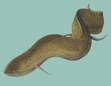
Lepidosiren paradoxa juveniles have a pattern of bright yellow spots which fade away as the fish matures (Alves-Gomes et al., 2003). Adult South American lungfish have a black or grey coloration. Lungfish have solid toothplates instead of individual teeth. Bodies are long and slender, somewhat like salamanders, with a diphycercal tail. These fish can grow up to 125 cm in length (Baensch et al., 1985).
Lepidosiren paradoxa young look a bit like amphibian larvae, with four external gills that they use for breathing until about seven weeks in age. After this time, they become obligate air breathers and regression of the external gills begins (Berra, 2001). They have a reduced bronchial apparatus which allows them to survive during times when oxygen levels are low. During drought, they can burrow into mud to 50 cm below the surface and become dormant until the environment becomes more hospitable (2001). (Bemis, et al., 2003; Baensch and Riehl, 1985; Berra, 2001)
Surfactant composition of South American lungfish resembles that of amphibians. In contrast, the more primitive Australian lungfish, Neoceratodus fosteri, possesses surfactant that is almost identical to primitive air-breathing actinopterygiian fish (Orgeig, 1995). This could be one reason why L. paradoxa must breathe air as an adult, while other lungfish can breathe air or water. (Orgeig and Daniels, 1995)
- Other Physical Features
- ectothermic
- heterothermic
- bilateral symmetry
- Sexual Dimorphism
- sexes alike
-
- Range length
- 125 (high) cm
- 49.21 (high) in
-
- Range wingspan
- N/A to N/A mm
- to in
-
- Average wingspan
- N/A mm
- in
Development
Newly hatched Lepidosiren paradoxa resemble amphibian tadpoles. The have four external gills which they use to breathe for the first seven weeks of their lives (Berra, 2001). After this time, they become strictly air breathers and their gills begin to regress (2001). During the breeding season, the males develop gill-like structures that allow them to release oxygen into their burrows for their developing young (2001). These structures disappear after the breeding season is over. (Berra, 2001)
- Development - Life Cycle
- metamorphosis
Reproduction
There is very little information on the mating systems of Lepidosiren paradoxa.
Lepidosiren paradoxa breed during the rainy months when adults are able to move into areas that have been flooded and build nests (Alves-Gomes et al., 2003). Other information, including egg development, the number of offspring per breeding season, and gestation periods is unknown. (Bemis, et al., 2003)
- Key Reproductive Features
- iteroparous
- seasonal breeding
- sexual
- fertilization
- oviparous
-
- Breeding interval
- Unknown; minimum population doubling time is greater than 14 years.
-
- Breeding season
- Breeding occurs during the rainy months of the year.
Both parents gather debris to make a nest. The nest is then guarded by the male parent. The males can increase oxygen levels for their developing young by using gill-like structures formed during the breeding season. These gill-like structures are highly vascularized, feathery structures developed from the pelvic fin (Berra, 2001). These structures allow the male to release oxygen from his blood into the surrounding nest and remove carbon dioxide (2001). (Berra, 2001)
- Parental Investment
-
pre-fertilization
- provisioning
-
protecting
- female
-
pre-hatching/birth
-
protecting
- male
-
protecting
Lifespan/Longevity
Lepidosiren paradoxa has not been well studied in terms of life span, but the studies that have been conducted show that the average lifespan of this species is a little more that eight years, both in the wild and in captivity. (Max Planck Institute for Demographic Research, 2005)
-
- Average lifespan
Status: wild - 8.3 years
- Average lifespan
-
- Average lifespan
Status: captivity - 8.25 years
- Average lifespan
-
- Average lifespan
Status: wild - 8.3 years
- Max Planck Institute for Demographic Research
- Average lifespan
-
- Average lifespan
Status: captivity - 8.25 years
- Max Planck Institute for Demographic Research
- Average lifespan
Behavior
Lepidosiren paradoxa is a solitary species. They live by themselves in burrows that they construct in swamps or lakes (Alves-Gomes et al., 2003). They are mostly inactive, laying in the muddy or shallow water close to the surface in order to breathe. Other behaviors, such as social structures and interaction with other species are largely unknown due to the lack of research on this species. (Bemis, et al., 2003)
- Key Behaviors
- natatorial
- motile
- sedentary
- solitary
Home Range
The home range of Lepidosiren paradoxa is likely small because of its inactive nature. (Bemis, et al., 2003)
Communication and Perception
There is not a lot known about communication and perception in Lepidosiren paradoxa. They have small eyes which suggests that L. paradoxa relies on other senses to detect prey and potential predators.
- Communication Channels
- visual
- Perception Channels
- visual
Food Habits
Lepidosiren paradoxa eat a variety of food items including some bony fish, algae and weeds, terrestrial plants (stems), shrimp, insects, clams, and snails (Berra, 2001). They are primarily carnivorous. Juveniles, which are strictly aquatic, feed on larval insects and snails. (Berra, 2001)
South American lungfish capture prey by suction feeding. They use tooth plates, an enlarged cranial rib (which serves as the site for the origin of the muscle that depresses the hyoid apparatus), and a depressor mandibulae to manipulate and chew food prior to swallowing. Hydraulic transport achieved by movements of the hyoid apparatus is used to position prey within the mouth. This is parallel to the function of a tongue (Bemis, 1986). (Bemis and Lauder, 1986)
- Primary Diet
-
carnivore
- insectivore
- eats non-insect arthropods
- Animal Foods
- fish
- insects
- mollusks
- aquatic crustaceans
- Plant Foods
- wood, bark, or stems
- algae
- macroalgae
Predation
Information on the predators of Lepidosiren paradoxa, as well as any predator/anti-predator adaptations are largely unknown due to lack of research on this species.
-
- Known Predators
-
- There is no information on known predators.
Ecosystem Roles
This species influences the neotropical ecosystem of the Amazon Basin. Lepidosiren paradoxa prey on some small bony fish, shrimp, clams, snails, and insects (Berra, 2001). Any role that they play as a prey item is largely unknown. (Berra, 2001)
Economic Importance for Humans: Positive
This species does not provide direct economic benefits to humans. It does provide intellectual benefits; lungfish represent an important step in vertebrate evolution and their origin provide insights into the origin of tetrapods (Alves-Gomes et al., 2003). (Bemis, et al., 2003)
- Positive Impacts
- research and education
Economic Importance for Humans: Negative
There are no known adverse effects of Lepidosiren paradoxa on humans.
Conservation Status
Lepidosiren paradoxa is not listed on the IUCN Red List, CITES appendices, or the U.S. Endangered Species List. The abundance of this fish is largely unknown (Alves-Gomes et al., 2003). (Bemis, et al., 2003)
-
- IUCN Red List
- No special status
-
- US Federal List
- No special status
-
- CITES
- No special status
Other Comments
Lepidosiren paradoxa was the first living species of lungfish to be formally named (Alves-Gomes et al., 2003). There are three living genera of lungfish, Neoceratodus, Lepidosiren, and Protopterus.
Fossil evidence has placed some Devonian lungfish in fully marine habitats as well as freshwater deposits (2003). Lepidosirenids show a clear vicariance pattern that is consistent with the separation of the African and South American continents during the Cretaceous (2003).
Because of their relationship with both fish and tetrapods, lungfish are a very important evolutionary step. More research should be done so that they can be more fully understood. (Bemis, et al., 2003)
Contributors
Tanya Dewey (editor), Animal Diversity Web.
Stephanie Elliott (author), University of Michigan-Ann Arbor, Kevin Wehrly (editor, instructor), University of Michigan-Ann Arbor.
Glossary
- Neotropical
-
living in the southern part of the New World. In other words, Central and South America.

- bilateral symmetry
-
having body symmetry such that the animal can be divided in one plane into two mirror-image halves. Animals with bilateral symmetry have dorsal and ventral sides, as well as anterior and posterior ends. Synapomorphy of the Bilateria.
- carnivore
-
an animal that mainly eats meat
- ectothermic
-
animals which must use heat acquired from the environment and behavioral adaptations to regulate body temperature
- external fertilization
-
fertilization takes place outside the female's body
- fertilization
-
union of egg and spermatozoan
- freshwater
-
mainly lives in water that is not salty.
- heterothermic
-
having a body temperature that fluctuates with that of the immediate environment; having no mechanism or a poorly developed mechanism for regulating internal body temperature.
- insectivore
-
An animal that eats mainly insects or spiders.
- iteroparous
-
offspring are produced in more than one group (litters, clutches, etc.) and across multiple seasons (or other periods hospitable to reproduction). Iteroparous animals must, by definition, survive over multiple seasons (or periodic condition changes).
- macroalgae
-
seaweed. Algae that are large and photosynthetic.
- metamorphosis
-
A large change in the shape or structure of an animal that happens as the animal grows. In insects, "incomplete metamorphosis" is when young animals are similar to adults and change gradually into the adult form, and "complete metamorphosis" is when there is a profound change between larval and adult forms. Butterflies have complete metamorphosis, grasshoppers have incomplete metamorphosis.
- motile
-
having the capacity to move from one place to another.
- natatorial
-
specialized for swimming
- native range
-
the area in which the animal is naturally found, the region in which it is endemic.
- oviparous
-
reproduction in which eggs are released by the female; development of offspring occurs outside the mother's body.
- seasonal breeding
-
breeding is confined to a particular season
- sedentary
-
remains in the same area
- sexual
-
reproduction that includes combining the genetic contribution of two individuals, a male and a female
- solitary
-
lives alone
- swamp
-
a wetland area that may be permanently or intermittently covered in water, often dominated by woody vegetation.
- tropical
-
the region of the earth that surrounds the equator, from 23.5 degrees north to 23.5 degrees south.
- visual
-
uses sight to communicate
References
Baensch, H., R. Riehl. 1985. Aquarien atlas. Germany: Verlag fur Natur-und Heimtierkunde GmbH.
Bemis, W., G. Lauder. 1986. "Morphology and function of the feeding apparatus of the lungfish, Lepidosiren paradoxa (Dipnoi)." (On-line). Accessed September 26, 2005 at http://www.ncbi.nlm.nih.gov/entrez/query.fcgi?cmd=Retrieve&db=pubmed&dopt=Abstract&list_uids=3950967&query_hl=1.
Bemis, W., C. Fernandes, R. e Castro, J. Zuanon, L. Py-Daniel, J. Alves-Gomes, G. dos Santos, F. Machado, L. Malabarba. 2003. "Notes on the Systematics, Distribution and Natural History of the South American Lungfishes in the genus Lepidosiren Fitzinger 1837 (Dipnoi: Lepidosirenidae)" (On-line pdf). Accessed October 08, 2005 at www.bio.umass.edu/biology/bemis/Lungfish_ms.pdf.
Berra, T. 2001. Freshwater fish distribution. San Diego, CA, USA: Academic Press.
Boujard, T., M. Pascal, J. Meunier, P. Le Bail. 1997. Poissons de Guyane. Paris: Institut National de la Recherche Agronomique.
Fishman, A., R. DeLaney, P. Laurent. 1985. "Circulatory adaptation to bimodal respiration in the dipnoan lungfish" (On-line). Accessed September 26, 2005 at http://www.ncbi.nlm.nih.gov/entrez/query.fcgi?cmd=Retrieve&db=pubmed&dopt=Abstract&list_uids=4030580&query_hl=1.
Max Planck Institute for Demographic Research, 2005. "Longevity Records: Life Spans of Mammals, Birds, Amphibians, Reptiles, and Fish" (On-line). Index Search. Accessed October 08, 2005 at http://www.demogr.mpg.de/?http://www.demogr.mpg.de/longevityrecords/.
Orgeig, S., C. Daniels. 1995. "The evolutionary significance of pulmonary surfactant in lungfish (Dipnoi)." (On-line). Accessed September 26, 2005 at http://www.ncbi.nlm.nih.gov/entrez/query.fcgi?cmd=Retrieve&db=pubmed&dopt=Abstract&list_uids=7626285&query_hl=1.
Planquette, P., P. Keith, P. Le Bail. 1996. Atlas des poissons d'eau douce de Guyane. Paris: IEGB-M.N.H.N.,INRA,CSP.