Leopardus pardalisocelot



Geographic Range
Ocelots are most populous in Central America but can be found in all countries between southeastern United States (Texas, Arizona) and northern Argentina. They are found in higher density clusters in northern Central America, northwestern South America, northeastern South America, and central southern South America. ("Cats (Felidae)", 2004; "The IUCN Red List of Threatened Species", 2008; "IUCN/SSC Cat Specialist Group", 1996; Wozencraft, 2005)
- Biogeographic Regions
- neotropical
Habitat
Ocelots are found in a variety of habitats, including tropical forests, savannah grasslands, mangrove forests and marshes, and thorn scrub regions. They generally live at elevations below 1,200 m, but have been sighted at 3,800 m as well. Their primary habitat requirement is dense vegetative cover. Ocelots are found in open areas only when it's cloudy or at night when there is a new moon. ("Carnivora: Felidae", 1999; "Cats (Felidae)", 2004; Flynn and Wesley-Hunt, 2005; "IUCN/SSC Cat Specialist Group", 1996)
- Habitat Regions
- tropical
- Terrestrial Biomes
- savanna or grassland
- chaparral
- forest
- rainforest
- scrub forest
- Wetlands
- marsh
-
- Range elevation
- <1200 to 3800 m
- to 12467.19 ft
Physical Description
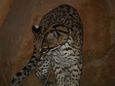
Ocelots are the largest member of the genus Leopardus. They weigh between 8.5 and 16 kg, are between 65 and 97 cm long, and males are considerably larger than females. Their pelage is shorter and less soft and thick than their close relative, the margay (Leopardus wiedii). Their ventral pelage is white and their dorsal pelage ranges from off-white to tawny-yellow to reddish-gray. Pelage coloration varies with habitat, as ocelots from arid scrub regions have grayer coats than those found in tropical forests. Entirely black individuals have been seen but are rare. Usually, ocelots have dark streaks, blotches, or rosettes arranged in small clusters around dark-colored areas that tend to run in parallel, horizontal chains. Rosettes and blotches are bordered with black and have a lighter-colored center. Ocelots have two black stripes on their cheeks, black ears with a central yellow spot, and one or two black transverse bars on the insides of the legs. Facial patterns are very distinct, permitting easy recognition of individuals. Their long tail is typically ringed, but may only be marked with dark bars on the dorsal surface. Relative to body-size, they have large paws, which is why their Spanish name is "manigordo", meaning big feet. Additionally, their fore paws are broader than their hind paws. Like other members of the suborder Feliformia, ocelots lack a third molar, have an absent or reduced postglenoid foramen at the base of the skulls, and an anterior palatine canal that passes through the maxilla. They have a concave muzzle and the dental formula is 3/3, 1/1, 3/2, 1/1 for a total of 30 teeth. Their basal metabolic rate is approximately 0.298 cm^3 oxygen/hour. ("Carnivora: Felidae", 1999; "Cats (Felidae)", 2004; Flynn and Wesley-Hunt, 2005; Kitchener, 1991; McNab, 2000; "IUCN/SSC Cat Specialist Group", 1996)
- Other Physical Features
- endothermic
- homoiothermic
- bilateral symmetry
- Sexual Dimorphism
- male larger
-
- Range mass
- 8.5 to 16 kg
- 18.72 to 35.24 lb
-
- Range length
- 65 to 97 cm
- 25.59 to 38.19 in
-
- Average basal metabolic rate
- .298 cm3.O2/g/hr
-
- Average basal metabolic rate
- 17.368 W
- AnAge
Reproduction
Ocelots are solitary and polygynous, with a single male home range overlapping those of several females. During estrus, females attract potential mates by making loud yowls, similar to those made by domestic cats (Felis catus). After mating pairs are formed, ocelots copulate between 5 and 10 times daily. The likelihood of conception per estrus, which lasts approximately 5 days, is 0.6. ("Carnivora: Felidae", 1999; "Cats (Felidae)", 2004; De la Rosa and Nocke, 2000; "IUCN/SSC Cat Specialist Group", 1996)
- Mating System
- polygynous
Ocelots are year-round breeders in the tropics, but autumn and winter birthing peaks reportedly occur in the northern parts of their range (e.g., Mexico and Texas). Estrus lasts 4.63 days on average, and their estrus cycle lasts 25.11 days on average. Once pregnant, females create a den in thick brush where parturition occurs. Gestation lasts 79 to 85 days, and litter sizes range from 1 to 3 kittens, with an average of 1.63 kittens/litter. Young weigh between 200 and 340 g at birth. Females are thought to have 1 litter every 2 years. ("Carnivora: Felidae", 1999; "Cats (Felidae)", 2004; De la Rosa and Nocke, 2000; Flynn and Wesley-Hunt, 2005; "IUCN/SSC Cat Specialist Group", 1996)
Ocelots are weaned by 6 weeks old and reach adult size at about 8 to 10 months old. Females reach sexual maturity at 18 to 22 months old and may breed until they are 13 years old. Males may become sexually mature as early as 15 months; however, spermatogenesis typically begins around 30 months. Evidence suggests that sexual maturation in males is related to territory acquisition. ("Carnivora: Felidae", 1999; "Cats (Felidae)", 2004; De la Rosa and Nocke, 2000; Flynn and Wesley-Hunt, 2005; "IUCN/SSC Cat Specialist Group", 1996)
- Key Reproductive Features
- iteroparous
- year-round breeding
- gonochoric/gonochoristic/dioecious (sexes separate)
- sexual
- viviparous
-
- Breeding interval
- Ocelots typically have one to two young every two years.
-
- Range number of offspring
- 1 to 3
-
- Average number of offspring
- 1.63
-
- Average number of offspring
- 2
- AnAge
-
- Range gestation period
- 79 to 85 days
-
- Average weaning age
- 6 weeks
-
- Average time to independence
- 12 months
-
- Range age at sexual or reproductive maturity (female)
- 18 to 22 months
-
- Range age at sexual or reproductive maturity (male)
- 15 (low) months
-
- Average age at sexual or reproductive maturity (male)
- 30 months
Females alone provide parental care to their young. Juvenile ocelots are weaned by 6 weeks old and begin to observe their mother during hunts a few months after birth. They are independent at approximately 1 year, but may be tolerated in their mother's home range until about 2 years old. After dispersing, juveniles must find their own territories. ("Carnivora: Felidae", 1999; "Cats (Felidae)", 2004; Kitchener, 1991; "IUCN/SSC Cat Specialist Group", 1996)
- Parental Investment
- altricial
- female parental care
-
pre-weaning/fledging
-
provisioning
- female
-
protecting
- female
-
provisioning
-
pre-independence
-
provisioning
- female
-
protecting
- female
-
provisioning
Lifespan/Longevity
In the wild, ocelots live between 7 and 10 years. The oldest known captive ocelot lived to be 21.5 years old in the Phoenix Zoo. ("Carnivora: Felidae", 1999)
-
- Range lifespan
Status: wild - 7 to 10 years
- Range lifespan
-
- Range lifespan
Status: captivity - 21.5 (high) years
- Range lifespan
-
- Average lifespan
Status: captivity - 20.3 years
- Max Planck Institute for Demographic Research
- Average lifespan
Behavior
Like many cats, Leopardus pardalis is solitary. It generally travels alone, but may form loose associations with conspecifics in adjacent territories. It communicates by mewing and attracts potential mates via yowling. Leopardus pardalis, which is nocturnal and crepuscular, can be found sleeping during the day, likely in hollow trees, amidst thick vegetation, or on branches. Although terrestrial, L. pardalis is also adept at climbing, jumping, and swimming. It is active for over 12 hours/day, during which time it can travel between 1.8 and 6.7 km, with males traveling nearly twice as far as females. ("Carnivora: Felidae", 1999; "Cats (Felidae)", 2004; Flynn and Wesley-Hunt, 2005; Kitchener, 1991; "IUCN/SSC Cat Specialist Group", 1996)
- Key Behaviors
- scansorial
- cursorial
- terricolous
- nocturnal
- crepuscular
- motile
- solitary
- territorial
-
- Range territory size
- 2 to 31 km^2
Home Range
Ocelots are highly territorial. Their home ranges are between 2 and 31 km^2, depending on habitat. Male ranges are larger than females and do not over lap with those of other males. However, as in many other mammalian species male ranges tend to overlap with those of several females. Population densities average 4 individuals per every 5 km^2 in lowland tropical forests and 2 to 5 individuals per every 5 km^2 in more open regions, including nonbreeding transients. ("Carnivora: Felidae", 1999; "Cats (Felidae)", 2004; Flynn and Wesley-Hunt, 2005; Kitchener, 1991; "IUCN/SSC Cat Specialist Group", 1996)
Communication and Perception
Leopardus pardalis has keen senses of smell and vision. It uses its sense of smell to locate, track, and approach prey as well as to determine territorial boundaries. They have acute binocular vision that is well-developed for hunting at night. Leopardus pardalis communicates with conspecifics using chemical signals to demarcate territorial boundaries and vocalizations (e.g., mews and yowls) to attract and communicate with potential mates. ("Carnivora: Felidae", 1999; "Cats (Felidae)", 2004; Kitchener, 1991)
- Other Communication Modes
- pheromones
- scent marks
Food Habits
Ocelots are highly skilled hunters, tracking prey by odor trails, and have an average of 0.9 prey captures per kilometer traveled. Once a prey item is captured, they eat at the kill site and cover the remains when they are finished. Similar to other felids, ocelots are well-adapted to their carnivorous diet, shearing ingested tissue from carcasses with their carnassials, while depending on strong digestive enzymes to help break down ingested proteins. ("Carnivora: Felidae", 1999; "Cats (Felidae)", 2004; Flynn and Wesley-Hunt, 2005; Kitchener, 1991; "IUCN/SSC Cat Specialist Group", 1996)
The diet of ocelots consists of 65 to 66% small rodents, 12 to 18% reptiles, 6 to 10% medium-sized mammals, 4 to 11% birds, and 2 to 7% crustaceans and fish. Their primary prey consists of nocturnal species, including cane mice (Zygodontomys), spiny rats (Echimyidae), common agoutis (Dasyprocta), opossums (Didelphimorphia), and armadillos (Cingulata). Although most prey weighs less than 1 to 3% of their body weight, ocelots also take larger prey, including lesser anteaters (Tamandua tetradactyla), red brocket deer Mazama americana, squirrel monkeys (Saimiri sciureus), and land tortoises (Testudinidae). ("Carnivora: Felidae", 1999; "Cats (Felidae)", 2004; Flynn and Wesley-Hunt, 2005; Kitchener, 1991; Redford, et al., 1992; "IUCN/SSC Cat Specialist Group", 1996)
- Primary Diet
-
carnivore
- eats terrestrial vertebrates
- Animal Foods
- birds
- mammals
- reptiles
- fish
- mollusks
- aquatic crustaceans
Predation
Although predators themselves, ocelots occasionally become the prey of harpy eagles (Harpia harpyja), pumas (Puma concolor), jaguars (Panthera onca), and anacondas (Eunectes murinus). Many of the characteristics that make them great predators may be useful as antipredator defense mechanisms (e.g., camouflage, keen senses, etc.). (Redford and Eisenberg, 1989; Redford and Eisenberg, 1989)
- Anti-predator Adaptations
- cryptic
-
- Known Predators
-
- harpy eagle (Harpia harpyja)
- puma (Puma concolor)
- jaguar (Panthera onca)
- anaconda (Eunectes murinus)
Ecosystem Roles
Ocelots significantly impact their environment as predators. Although they feed primarily on terrestrial vertebrates, ocelots are opportunistic hunters and prey upon many types of animals. Occasionally, they serve as prey for larger carnivores (e.g., jaguar, Panthera onca) and are host to numerous parasites. (Patton, et al., 1986; Redford, et al., 1992)
- Paragonimus
- Taeniidae
- Strongylida
- Toxocara cati
- Capillaria
- Spiruridae
- Aelurostrongylus
- Oncicola
- Hammondia pardalis
- Isospora
Economic Importance for Humans: Positive
From the early 1960's to the mid 1980's, there was high demand for spotted-cat furs in Western society. During this time, a coat made of ocelot fur could sell for $40,000 (U.S.) in western Germany. Ocelots were also popular as exotic pets, costing as much as $800 per individual. After the 1975 Convention on International Trade in Endangered Species of Wild Fauna and Flora (CITES), the international trade of ocelots and their by-products (e.g., fur) became illegal in most countries. However, one can still buy such items at the Managua International Airport in Nicaragua or illegally on the black market. ("Carnivora: Felidae", 1999; "Cats (Felidae)", 2004; De la Rosa and Nocke, 2000; "IUCN/SSC Cat Specialist Group", 1996)
Ocelots may be beneficial to humans by controlling rodent populations that could be considered agricultural pests. ("Carnivora: Felidae", 1999; "IUCN/SSC Cat Specialist Group", 1996)
- Positive Impacts
- pet trade
- body parts are source of valuable material
- controls pest population
Economic Importance for Humans: Negative
In regions where natural prey abundances have been significantly reduced, ocelots may kill and eat domestic fowl. ("Cats (Felidae)", 2004; De la Rosa and Nocke, 2000)
Conservation Status
Due to their abundance and broad distribution, ocelots are list as a species of "least concern" according to the IUCN Red List of Threatened Species. Major threats to their persistence include habitat loss and fragmentation, illegal trade as pets and pelts, and retaliatory killings by poultry farmers. Despite this, ocelots have made a strong recovery and it was estimated that there were between 1.5 and 3 million ocelots living in 1996. ("Carnivora: Felidae", 1999; "Cats (Felidae)", 2004; De la Rosa and Nocke, 2000; "IUCN/SSC Cat Specialist Group", 1996)
Due to their popularity in Western fur trade, ocelots were nearly extinct by the mid 1980's. Concern over their potential extinction contributed to the formation of the 1975 Convention on International Trade in Endangered Species of Wild Fauna and Flora (CITES). The selling of ocelot fur significantly decreased in the 1980's and is no longer considered a threat to their survival. ("Carnivora: Felidae", 1999; "Cats (Felidae)", 2004; "IUCN/SSC Cat Specialist Group", 1996)
Once found as far east as Louisiana and Arkansas and now found only in southernmost Texas, Leopardus pardalis albescens is the only subspecies that is classified as endangered. This subspecies' declining numbers are likely the result of habitat loss, which is forcing individuals to have larger home ranges in order to support their daily prey requirements. However, larger home ranges may decrease mating opportunities. ("Carnivora: Felidae", 1999; "Cats (Felidae)", 2004; De la Rosa and Nocke, 2000; "IUCN/SSC Cat Specialist Group", 1996)
-
- IUCN Red List
-
Least Concern
More information
-
- IUCN Red List
-
Least Concern
More information
-
- US Federal List
- Endangered
-
- CITES
- Appendix I
-
- State of Michigan List
- No special status
Other Comments
Leopardus pardalis has multiple common names throughout its range, including "gato maracaja" in Brazil and Paraguay, "gato onza" in Argentina, Bolivia, and Peru, and "manigordo" in Costa Rica, Nicaragua, Panama, and Venezuela. ("IUCN/SSC Cat Specialist Group", 1996)
Contributors
Jessi Kittel (author), University of Michigan-Ann Arbor, Phil Myers (editor, instructor), University of Michigan-Ann Arbor, John Berini (editor), Animal Diversity Web Staff.
Glossary
- Neotropical
-
living in the southern part of the New World. In other words, Central and South America.

- acoustic
-
uses sound to communicate
- altricial
-
young are born in a relatively underdeveloped state; they are unable to feed or care for themselves or locomote independently for a period of time after birth/hatching. In birds, naked and helpless after hatching.
- bilateral symmetry
-
having body symmetry such that the animal can be divided in one plane into two mirror-image halves. Animals with bilateral symmetry have dorsal and ventral sides, as well as anterior and posterior ends. Synapomorphy of the Bilateria.
- carnivore
-
an animal that mainly eats meat
- chaparral
-
Found in coastal areas between 30 and 40 degrees latitude, in areas with a Mediterranean climate. Vegetation is dominated by stands of dense, spiny shrubs with tough (hard or waxy) evergreen leaves. May be maintained by periodic fire. In South America it includes the scrub ecotone between forest and paramo.
- chemical
-
uses smells or other chemicals to communicate
- crepuscular
-
active at dawn and dusk
- cryptic
-
having markings, coloration, shapes, or other features that cause an animal to be camouflaged in its natural environment; being difficult to see or otherwise detect.
- endothermic
-
animals that use metabolically generated heat to regulate body temperature independently of ambient temperature. Endothermy is a synapomorphy of the Mammalia, although it may have arisen in a (now extinct) synapsid ancestor; the fossil record does not distinguish these possibilities. Convergent in birds.
- female parental care
-
parental care is carried out by females
- forest
-
forest biomes are dominated by trees, otherwise forest biomes can vary widely in amount of precipitation and seasonality.
- iteroparous
-
offspring are produced in more than one group (litters, clutches, etc.) and across multiple seasons (or other periods hospitable to reproduction). Iteroparous animals must, by definition, survive over multiple seasons (or periodic condition changes).
- marsh
-
marshes are wetland areas often dominated by grasses and reeds.
- motile
-
having the capacity to move from one place to another.
- native range
-
the area in which the animal is naturally found, the region in which it is endemic.
- nocturnal
-
active during the night
- pet trade
-
the business of buying and selling animals for people to keep in their homes as pets.
- pheromones
-
chemicals released into air or water that are detected by and responded to by other animals of the same species
- polygynous
-
having more than one female as a mate at one time
- rainforest
-
rainforests, both temperate and tropical, are dominated by trees often forming a closed canopy with little light reaching the ground. Epiphytes and climbing plants are also abundant. Precipitation is typically not limiting, but may be somewhat seasonal.
- scent marks
-
communicates by producing scents from special gland(s) and placing them on a surface whether others can smell or taste them
- scrub forest
-
scrub forests develop in areas that experience dry seasons.
- sexual
-
reproduction that includes combining the genetic contribution of two individuals, a male and a female
- solitary
-
lives alone
- tactile
-
uses touch to communicate
- territorial
-
defends an area within the home range, occupied by a single animals or group of animals of the same species and held through overt defense, display, or advertisement
- tropical
-
the region of the earth that surrounds the equator, from 23.5 degrees north to 23.5 degrees south.
- tropical savanna and grassland
-
A terrestrial biome. Savannas are grasslands with scattered individual trees that do not form a closed canopy. Extensive savannas are found in parts of subtropical and tropical Africa and South America, and in Australia.
- savanna
-
A grassland with scattered trees or scattered clumps of trees, a type of community intermediate between grassland and forest. See also Tropical savanna and grassland biome.
- temperate grassland
-
A terrestrial biome found in temperate latitudes (>23.5° N or S latitude). Vegetation is made up mostly of grasses, the height and species diversity of which depend largely on the amount of moisture available. Fire and grazing are important in the long-term maintenance of grasslands.
- visual
-
uses sight to communicate
- viviparous
-
reproduction in which fertilization and development take place within the female body and the developing embryo derives nourishment from the female.
- year-round breeding
-
breeding takes place throughout the year
References
1999. Carnivora: Felidae. Pp. 816-817 in R Nowak, ed. Walker's Mammals of the World, Vol. Vol. 1, Sixth Ed. Edition. Baltimore and London: The John Hopkins University Press.
2004. Cats (Felidae). Pp. 369-383 in M Hutchins, D Kleiman, V Geist, eds. Grzimek's Animal Life Encyclopedia, Vol. Vol. 14, Third Ed. Edition. Farmington Hills, MI: Gale Group.
The World Conservation Union. 1996. "IUCN/SSC Cat Specialist Group" (On-line). Cat Species Information - Ocelot (Leopardus pardalis). Accessed April 08, 2009 at http://www.catsg.org.
2008. "The IUCN Red List of Threatened Species" (On-line). Leopardus pardalis. Accessed April 11, 2009 at http://www.iucnredlist.org.
De la Rosa, C., C. Nocke. 2000. A Guide to the Carnivores of Central America. Austin: University of Texas Press.
Flynn, J., G. Wesley-Hunt. 2005. Carnivora. Pp. 175-179 in K Rose, J Archibald, eds. The Rise of Placental Mammals. Baltimore and London: The John Hopkins University Press.
Kitchener, A. 1991. The Natural History of the Wild Cats. Ithaca, New Yor: Cornell University Press.
McNab, B. 2000. The standard energetics of mammalian carnivores: Felidae and Hyaenidae. Canadian Journal of Zoology, 63(1): 25-54.
Patton, S., A. Rabinowitz, S. Johnson. 1986. A coprological study of parasites of wild neotropical felidae.. The Journal of Parasitology, Vol. 72, No. 4: 517-520.
Redford, K., J. Eisenberg. 1989. Advances in Neotropical Mammalogy. University of Texas: Sandhill Crane Press.
Redford, K., J. Eisenberg, F. Reid. 1992. Mammals of the Neotropics: the Southern Core. Chicago: University of Chicago Press.
Wozencraft, W. 2005. Order Carnivora. Pp. 532-539 in D Wilson, D Reeder, eds. Mammal Species of the World, Vol. Vol. 1, Third Ed. Edition. Baltimore: The John Hopkins University Press.