Lemuridaetrue lemurs
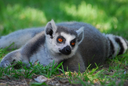


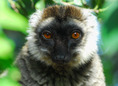
Lemurs are found only in Madagascar and the Comoro Islands. There, however, they are a diverse group of 10 species placed in 4 genera. These small to medium-sized primates are herbivorous or omnivorous, arboreal, and diurnal. Members of the group vary considerably, however, in diet and habit. Some species, are frugivorous, some eat foliage, others include some insects in their diets, and some are even specialized to feed on the leaves of bamboo. All lemurs are at least partly arboreal, but a few spend considerable time on the ground. Lemurs move through the trees both by running along branches and by leaping from vertical stems or trunks ("vertical clingers and leapers").
Some lemurs are brightly colored, with contrasting patches of black, white, brown, gray or rufous. Color patterns are sexually dimorphic in some members of the family. Lemurs have long, heavily furred tails, and slender bodies and limbs. The fur is soft and wooly. Their external ears are short or moderately long, and they are at least partially covered with fur. All species have tufts of fur on the tips of their ears. Both pollex and hallux are enlarged and opposable. Lemurs have relatively small eyes compared to other strepsirhines, and their rostrum is relatively long.
As strepsirhines, lemurs have the dental comb made up of lower incisors and canines that is typical of that group of primates. The second digit of the hind feet of most lemurs also has another general strepsirhine feature, an enlarged " toilet claw" used in grooming.

The skulls of lemurs are hard to diagnose. The cranium is usually elongate due largely to a long rostrum, but there is a good deal of variation among species. The bullae and carotid circulatory patterns are characteristic, but these characters are difficult to use. The frontal and palatine bones are in contact in the orbit. Crests for the origin of temporal muscles are not well developed. The foramen magnum is directed more-or-less downward. The dental formula is 2/2, 1/1, 3/3, 3/3 = 36. The upper first incisors are separated from each other by a wide space, and the first lower premolars are canine-like. Molars are tritubercular.


Some species of lemurs are social creatures, living in groups of up to 18 or 20 individuals. Others are usually solitary. Lemurs use scents from a variety of sources for marking their territories and each other, including urine and arm and anal glands.
The fossil record of lemurs extends to the Eocene.
Literature and references cited
Feldhamer, G. A., L. C. Drickamer, S. H. Vessey, and J. F. Merritt. 1999. Mammalogy. Adaptation, Diversity, and Ecology. WCB McGraw-Hill, Boston. xii+563pp.
Groves, C. P. 1989. A Theory of Human and Primate Evolution. Oxford Science Publications, Clarendon Press, Oxford. xii+375 pp.
Nowak, R.M. and J.L. Paradiso. 1983. Walker's Mammals of the World, Fourth edition. John Hopkins University Press, Baltimore, London.
Szalay, F. S., and E. Dodson. 1979. Evolutionary History of the Primates. Academic Press, New York. xiv+580 pp.
Thorington, R. W., Jr., and S. Anderson. 1984. Primates. Pp. 187-216 in Anderson, S. and J. K. Jones, Jr. (eds). Orders and Families of Recent Mammals of the World. John Wiley and Sons, N.Y. xii+686 pp.
Vaughan, T. A., J. M. Ryan, N. J. Czaplewski. 2000. Mammalogy. Fourth Edition. Saunders College Publishing, Philadelphia. vii+565pp.
Wilson, D. E., and D. M. Reeder. 1993. Mammal Species of the World, A Taxonomic and Geographic Reference. 2nd edition. Smithsonian Institution Press, Washington. xviii+1206 pp.
Contributors
Phil Myers (author), Museum of Zoology, University of Michigan-Ann Arbor.
Glossary
- bilateral symmetry
-
having body symmetry such that the animal can be divided in one plane into two mirror-image halves. Animals with bilateral symmetry have dorsal and ventral sides, as well as anterior and posterior ends. Synapomorphy of the Bilateria.
- chemical
-
uses smells or other chemicals to communicate
- endothermic
-
animals that use metabolically generated heat to regulate body temperature independently of ambient temperature. Endothermy is a synapomorphy of the Mammalia, although it may have arisen in a (now extinct) synapsid ancestor; the fossil record does not distinguish these possibilities. Convergent in birds.
- motile
-
having the capacity to move from one place to another.
- sexual
-
reproduction that includes combining the genetic contribution of two individuals, a male and a female
- tactile
-
uses touch to communicate