Lemur cattaring-tailed lemur



Geographic Range
Ring-tailed lemurs are found only in southern and southwestern Madagascar. They prefer gallery forests, forests near and following the riverbanks, but can be found in dry scrub, montane humid forests, and deciduous forests. They tolerate a temperature range of -12 to 48 Celsius. (Gould, et al., 2003; Sauther, 2012; Sussman, 1991; Wilson and Hanlon, 2010)
- Other Geographic Terms
- island endemic
Habitat
Ring-tailed lemurs are found in three distinct habitats in south and southwestern Madagascar: continuous canopy forest, brush and scrub forests, and mixed forests. Continuous canopy forests in this region are dominated by Tamarind trees (Tamarindas indica) and other large trees reaching 20-25 meters in height. Brush and scrub forests are drier than open forests and lower in height. Although ring-tailed lemurs are found in all tree habitats, they are most commonly found in the continuous canopy forests. (Budnitz and Dainis, 1975; Gould, et al., 2003; Sauther, 1991; Sauther, 2012; Wilson and Hanlon, 2010)
- Habitat Regions
- terrestrial
- Terrestrial Biomes
- forest
- rainforest
- scrub forest
-
- Range elevation
- 2,600 (high) m
- ft
Physical Description
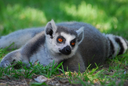
Ring-tailed lemurs have a body length ranging from 39 to 46 cm in length with a tail ranging in length from 56 to 63cm and an average body weight of 2.2 kg. The body, covered in a thick, dense fur, is a solid color ranging from gray to brown, with a long, thick tail. The tail has thick, well defined, black and white rings from stem to tip. Typically, individuals have a white face mask, with black outlining the eyes and nose. They have a lighter colored underbelly ranging from light gray or brown, to white. Ring-Tailed Lemurs have four thin fingers and a thumb on their upper and lower appendages, each ending in a dark colored nail. The thumbs on the upper appendages are not opposable as the joint is fixed. The first toe on the lower appendage is opposable, is used while climbing trees in the mid and upper level canopy. (Cawthon lang, 2005; Gould, et al., 2003; Sussman, 1991; Wilson and Hanlon, 2010)
- Other Physical Features
- endothermic
- bilateral symmetry
- Sexual Dimorphism
- sexes alike
- female larger
-
- Average mass
- 2.2 kg
- 4.85 lb
-
- Average mass
- 2555 g
- 90.04 oz
- AnAge
-
- Range length
- 39 to 46 mm
- 1.54 to 1.81 in
Reproduction
Ring-tailed lemurs begin mating in April, with a gestation period of 130 to 144 days, giving birth beginning in August and finishing in September. Females are not reproductively active until 2.5 years of age, and females of 3 to 4 years of age have a higher chance of success conceiving and giving birth to healthy offspring than younger females. Females typically give birth to one or two offspring, more commonly females will only have one. Females typically mate with more than one male during estrous. Males will compete amongst themselves for the right to mate with the females. (Cawthon lang, 2005; Gould, et al., 2003; Sauther, 2012; Wilson and Hanlon, 2010)
- Mating System
- polygynandrous (promiscuous)
Females typically give birth to one or two offspring, more commonly females will only have one. Offspring are completely cared for by the mother. Newborns spend their first two weeks of life riding on the underbellies of their mothers. After the first two weeks the young ride on the backs of their mothers and begin to explore their surroundings. The males in the troops do very little for the young. The young are weaned starting at eight weeks of age, until they are fully weaned at five months, all nutrition is obtained from the mother. There is a high infant mortality rate; 30 to 50% of infants do not make it through their first year of life. This mortality rate decreases if the mother is older in age, or has previously given birth. (Cawthon lang, 2005; Sauther, 2012; Wilson and Hanlon, 2010)
- Key Reproductive Features
- iteroparous
- seasonal breeding
- gonochoric/gonochoristic/dioecious (sexes separate)
- sexual
- viviparous
-
- Breeding interval
- Ring-tailed lemurs breed once yearly
-
- Breeding season
- The breeding season is from April to May.
-
- Range number of offspring
- 1 to 2
-
- Average number of offspring
- 1
-
- Average number of offspring
- 1.1
- AnAge
-
- Range gestation period
- 130 to 144 days
-
- Average weaning age
- 5 months
-
- Average time to independence
- 1 years
-
- Average age at sexual or reproductive maturity (female)
- 595 days
-
- Average age at sexual or reproductive maturity (female)
Sex: female - 595 days
- AnAge
- Average age at sexual or reproductive maturity (female)
-
- Average age at sexual or reproductive maturity (male)
- 912 days
-
- Average age at sexual or reproductive maturity (male)
Sex: male - 912 days
- AnAge
- Average age at sexual or reproductive maturity (male)
Care of the young lies solely with the mother, with males in the group have little to no impact on raising young. Females are responsible for grooming, feeding, weaning, and teaching their young. Females in the troop have been frequently observed caring for other female's offspring as well as babysitting, feeding and grooming. (Cawthon lang, 2005; Gould, et al., 2003; Sauther, 2012; Wilson and Hanlon, 2010)
- Parental Investment
- altricial
- female parental care
-
pre-fertilization
- provisioning
-
protecting
- female
-
pre-hatching/birth
-
provisioning
- female
-
protecting
- female
-
provisioning
-
pre-weaning/fledging
-
provisioning
- female
-
protecting
- female
-
provisioning
-
pre-independence
-
provisioning
- female
-
protecting
- female
-
provisioning
- post-independence association with parents
- extended period of juvenile learning
- inherits maternal/paternal territory
Lifespan/Longevity
Ring-tailed lemurs typically live to be 16 years old, with the oldest known ring-tailed lemur living to be 33 years old in captivity. Limits to lifespan in the wild include habitat loss and limited resources. (Cawthon lang, 2005; Gould, et al., 2003; Sauther, 2012)
-
- Range lifespan
Status: wild - 33 (high) years
- Range lifespan
-
- Average lifespan
Status: wild - 27 years
- Average lifespan
-
- Range lifespan
Status: captivity - 33 (high) years
- Range lifespan
-
- Average lifespan
Status: captivity - 30 years
- Average lifespan
-
- Typical lifespan
Status: wild - 30 (high) years
- Typical lifespan
-
- Average lifespan
Status: wild - 27 years
- Average lifespan
-
- Typical lifespan
Status: captivity - 33 (high) years
- Typical lifespan
-
- Average lifespan
Status: captivity - 30 years
- Average lifespan
Behavior
Ring-tailed lemurs live in groups of 15 to 20 individuals called troops. Females stay with the same troop they were born into, while the males will typically move between troops every 2 to 5 years. These troops are highly social with complex interactions. Hierarchy is typically established in their youth through rough and tumble play. All females are dominant over all males. The lowest ranking female is still higher in the social hierarchy than the highest ranking male. (Gould, et al., 2003; Sauther, 2012; Wilson and Hanlon, 2010)
- Key Behaviors
- arboreal
- scansorial
- saltatorial
- motile
- sedentary
- social
-
- Range territory size
- 0.06 to 0.23 km^2
Home Range
Ring-tailed lemurs have a daily home range of 1000 meters from where they woke up. The troop will slowly meander from just before dawn until dusk looking for food. Troops will have a larger home range if their habitat has more sparse resources. (Gould, et al., 2003)
Communication and Perception
Ring-tailed lemur communication is complex. Visual communication signals, such as body postures and facial expressions are used, in addition to vocal communication. Ring tailed lemurs are known to use scent marking, and even to engage in "stink battles" with one another, where secretions from scent glands are rubbed onto the tail, then wafted at opposing animals. Tactile communication is important between mothers and their young, as well as between mates. This includes grooming, play, and mating. (Gould, et al., 2003; Sauther, 2012; Wilson and Hanlon, 2010)
- Other Communication Modes
- pheromones
- scent marks
Food Habits
Ring-tailed lemurs are opportunistic omnivores. They can and will eat whatever is easily available to them including fruits, leaves, stems, flowers, exudates (resin, latex, sap), spiders, spider webs, chameleons, caterpillars insects, small birds, and termite mounds. The most important food source in the fruit from the Tamarind tree. The Tamarind is found in all three habits where lemurs are known to live. (Budnitz and Dainis, 1975; Gould, et al., 2003; Sauther, 2012; Wilson and Hanlon, 2010)
- Primary Diet
- omnivore
- Animal Foods
- birds
- mammals
- reptiles
- eggs
- insects
- terrestrial non-insect arthropods
- terrestrial worms
- Plant Foods
- leaves
- roots and tubers
- wood, bark, or stems
- seeds, grains, and nuts
- fruit
- nectar
- flowers
- sap or other plant fluids
- Other Foods
- detritus
Predation
Ring-tailed lemurs travel in groups, known as troops, to deter predators that hunt singular prey. Predatory pressure can come from raptor birds, fossas (Cryptoprocta ferox), civets (Civettictis civetta), domestic cats (Felis catus), snakes, and brown lemurs (Eulemur fulvus). (Cawthon lang, 2005; Sauther, 2012; Wilson and Hanlon, 2010)
-
- Known Predators
-
- fossas (Cryptoprocta ferox)
- civets (Civettictis civetta)
- domestic cats (Felis catus)
- brown lemurs (Eulemur fulvus).
- snakes (Serpentes)
- raptors (Falconiformes)
Ecosystem Roles
Ring-tailed lemurs contribute to the ecosystem by spreading seeds through their feces. Along with the other species of lemurs they are responsible for several wildlife reserves being put into place. These reserves help preserve the environment all other plant and animal species in the area. They also contribute to other food webs as a food source for fossas and civets. (Sauther, 2012; Wilson and Hanlon, 2010)
- Ecosystem Impact
- disperses seeds
- creates habitat
Economic Importance for Humans: Positive
Ring-tailed lemurs have already improved the economy of Madagascar. Ring-tailed lemurs are a common draw for ecotourism in the southern and southwestern portion of the island country. (Cawthon lang, 2005; Gould, et al., 2003; Sauther, 2012)
- Positive Impacts
- ecotourism
- research and education
- controls pest population
Economic Importance for Humans: Negative
There are no negative impacts of ring-tailed lemurs on humans. (Sauther, 2012; Wilson and Hanlon, 2010)
Conservation Status
Ring-tailed lemurs are classified as Near Threatened (NT) on the IUCN Red List in Appendix I of CITES.
-
- IUCN Red List
-
Near Threatened
More information
-
- IUCN Red List
-
Near Threatened
More information
-
- US Federal List
- No special status
-
- CITES
- Appendix I
-
- State of Michigan List
- No special status
Contributors
Emma Baumhofer (author), University of Wisconsin Stevens Point, Christopher Yahnke (editor), University of Wisconsin-Stevens Point, Tanya Dewey (editor), University of Michigan-Ann Arbor.
Glossary
- Ethiopian
-
living in sub-Saharan Africa (south of 30 degrees north) and Madagascar.

- acoustic
-
uses sound to communicate
- altricial
-
young are born in a relatively underdeveloped state; they are unable to feed or care for themselves or locomote independently for a period of time after birth/hatching. In birds, naked and helpless after hatching.
- arboreal
-
Referring to an animal that lives in trees; tree-climbing.
- bilateral symmetry
-
having body symmetry such that the animal can be divided in one plane into two mirror-image halves. Animals with bilateral symmetry have dorsal and ventral sides, as well as anterior and posterior ends. Synapomorphy of the Bilateria.
- chemical
-
uses smells or other chemicals to communicate
- detritus
-
particles of organic material from dead and decomposing organisms. Detritus is the result of the activity of decomposers (organisms that decompose organic material).
- ecotourism
-
humans benefit economically by promoting tourism that focuses on the appreciation of natural areas or animals. Ecotourism implies that there are existing programs that profit from the appreciation of natural areas or animals.
- endothermic
-
animals that use metabolically generated heat to regulate body temperature independently of ambient temperature. Endothermy is a synapomorphy of the Mammalia, although it may have arisen in a (now extinct) synapsid ancestor; the fossil record does not distinguish these possibilities. Convergent in birds.
- female parental care
-
parental care is carried out by females
- forest
-
forest biomes are dominated by trees, otherwise forest biomes can vary widely in amount of precipitation and seasonality.
- island endemic
-
animals that live only on an island or set of islands.
- iteroparous
-
offspring are produced in more than one group (litters, clutches, etc.) and across multiple seasons (or other periods hospitable to reproduction). Iteroparous animals must, by definition, survive over multiple seasons (or periodic condition changes).
- motile
-
having the capacity to move from one place to another.
- native range
-
the area in which the animal is naturally found, the region in which it is endemic.
- omnivore
-
an animal that mainly eats all kinds of things, including plants and animals
- pheromones
-
chemicals released into air or water that are detected by and responded to by other animals of the same species
- polygynandrous
-
the kind of polygamy in which a female pairs with several males, each of which also pairs with several different females.
- rainforest
-
rainforests, both temperate and tropical, are dominated by trees often forming a closed canopy with little light reaching the ground. Epiphytes and climbing plants are also abundant. Precipitation is typically not limiting, but may be somewhat seasonal.
- saltatorial
-
specialized for leaping or bounding locomotion; jumps or hops.
- scent marks
-
communicates by producing scents from special gland(s) and placing them on a surface whether others can smell or taste them
- scrub forest
-
scrub forests develop in areas that experience dry seasons.
- seasonal breeding
-
breeding is confined to a particular season
- sedentary
-
remains in the same area
- sexual
-
reproduction that includes combining the genetic contribution of two individuals, a male and a female
- social
-
associates with others of its species; forms social groups.
- tactile
-
uses touch to communicate
- terrestrial
-
Living on the ground.
- visual
-
uses sight to communicate
- viviparous
-
reproduction in which fertilization and development take place within the female body and the developing embryo derives nourishment from the female.
References
Budnitz, N., K. Dainis. 1975. Lemur catta: Ecology and Behavior. London: Plenum Press.
Cawthon lang, K. 2005. "Ring-tailed lemur (Lemur catta) Taxonomy, Morphology, & Ecology" (On-line). Primate Info Net. Accessed March 10, 2015 at http://pin.primate.wisc.edu/factsheets/entry/ring-tailed_lemur.
Gould, L., R. Sussman, M. Sauther. 2003. Demographic and life-history patterns in a population of ring-tailed lemurs (Lemur catta) at Beza Mahafaly Reserve, Madagascar: A 15-year perspective. American Journal of Physical Anthropology, 120 (2): 182-194. Accessed February 27, 2015 at http://onlinelibrary.wiley.com/doi/10.1002/ajpa.10151/full.
Grzimek, B. 1990. Mammals. Pp. 540-545 in B Grzimek, ed. Animal Life Encyclopedia, Vol. I-IV, I-IV Edition. New York: McGraw Hill Publishing Company.
Sauther, M. 1991. Reproductive Behavior of Free-Ranging Lemur catta at Beza Mahafaly Special Reserve, Madagascar. American Journal of Physical Anthropology, 84: 463-477.
Sauther, M. 2012. "Ring-tailed Lemur (Lemur catta)" (On-line). Wildscreen Arkive. Accessed March 07, 2015 at http://www.arkive.org/ring-tailed-lemur/lemur-catta/.
Sussman, R. 1991. Demography and Social Organization of Free-Ranging Lemur catta in the Beza Mahafaly Reserve, Madagascar. American Journal of Physical Anthropology, 84: 43-58.
Wilson, D., E. Hanlon. 2010. Lemur Catta (Primates: Lemuridae). Mammalian Species, 42 (854): 58-74. Accessed February 27, 2015 at http://www.mammalsociety.org/uploads/Wilson%20and%20Hanlon%202010.pdf.