Lagorchestes hirsutusrufous hare-wallaby
Geographic Range
Rufous hare-wallabies historically had a widespread distribution throughout the arid and semi-arid parts of western Australia and southern Northern Territory until the 1930’s. Currently, they are only found on the islands of Dorre and Bernier in Shark Bay off the coast of Western Australia. They occur throughout each island, but are more abundant in the southern ends of both. A few small populations exist on the mainland in captive settings and in experimental reintroduction sites in the Tanami Desert and southern Shark Bay. Small wild populations did exist in the Tanami Desert, Northern Territory; however, bush fires and introduced red fox (Vulpes vulpes) predation wiped them out in the 1990’s. ("Australian Wildlife Conservancy", 2006; Short and Turner, 1992; "ARKive", 2006)
- Biogeographic Regions
- australian
Habitat
Mainland habitats for rufous hare-wallabies were primarily in the Tanami Desert, which has a warm, dry monsoonal climate and is semi-arid. Drought is a common feature which makes rainfall the main factor in primary productivity. In comparison, current island habitats have a warm, dry Mediterranean climate. ("Australian Wildlife Conservancy", 2006; "Rufous Hare-Wallaby or Mala", 2006; Langford, 2006; Lundie-Jenkins, 1993a; Short and Turner, 1992; "ARKive", 2006)
Rufous hare-wallabies required mosaics of burnt and unburnt patches of spinifex grassland to survive in the Tanami Desert. The dominant species are mature Triodia pungens and Plectrachne schinzii. The various stages of fire succession, and the ecotones they created, provided adequate shelter and food supply. Patchiness, degree of senescence, diversity of food and vegetation, hummock size, and habitat structure were important factors influencing suitable and unsuitable areas. The degree of connectivity and accessibility of each of these aspects was important as well. ("Australian Wildlife Conservancy", 2006; "Rufous Hare-Wallaby or Mala", 2006; Langford, 2006; Lundie-Jenkins, 1993a; Short and Turner, 1992; "ARKive", 2006)
Bernier and Dorre islands have four main types of habitat: sand plain (Triodia species) grasslands, sand plain heath, consolidated dunes, unconsolidated dune/beach, and travertine heath. Rufous hare-wallabies occur throughout these habitats, but favor consolidated dunes, beaches, and both heath habitats. They shelter in scrapes, often under Triodia plurinervata or Thryptomene micrantha, or in single opening burrows. They will run out and escape in a zig zag pattern if flushed. ("Australian Wildlife Conservancy", 2006; "Rufous Hare-Wallaby or Mala", 2006; Langford, 2006; Lundie-Jenkins, 1993a; Short and Turner, 1992; "ARKive", 2006)
- Habitat Regions
- temperate
- terrestrial
- Terrestrial Biomes
- desert or dune
- savanna or grassland
Physical Description
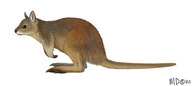
The name Lagorchestes means “dancing hare.” Hare-wallabies do resemble hares in appearance and behavior. However, like all wallabies, they have larger hind legs than hares, a thinner, hunched body, smaller forelimbs, and a long, thin tail. They are both quadripedal and bipedal, hopping on strong hind legs or maneuvering on all fours. Their fur is long, soft, and thick. Their ventrum and hindquarters are a sandy, buff color while the back and head are grey-rufous. They have long pointed ears, large black eyes, short whiskers, and darker colored paws. The species name hirsutus refers to the fact that their fur gets longer towards their back, giving them a shaggy appearance. ("Australian Wildlife Conservancy", 2006; "Rufous Hare-Wallaby or Mala", 2006; Gibson, et al., 1994; Lundie-Jenkins, 1993b; "ARKive", 2006)
Males and females are identical in color, with females generally being larger in size. Females range from 0.78 to 1.9 kg while males range from 1.24 to 1.8 kg. The length from tip of nose to base of tail for females is 36 to 39 cm, and tail length is 24 to 30.5 cm. Male head/body length is 31 to 36 cm, and tail length is 26 to 27 cm. They both stand roughly 30 cm high. ("Australian Wildlife Conservancy", 2006; "Rufous Hare-Wallaby or Mala", 2006; Gibson, et al., 1994; Lundie-Jenkins, 1993b; "ARKive", 2006)
There are four recognized sub-species, L. h. bernieri, L. h. dorreae, L. h. hirsutus, and an unnamed subspecies. Lagorchestes hirsutus bernieri is the Bernier Island sub-species, it has noticeably paler fur and shorter ears. Lagorchestes hirsutus dorreae is the Dorre Island sub-species, its fur is far redder than the mainland species and its skull is narrower between the orbits. Lagorchestes hirsutus hirsutus is extinct, and the unnamed subspecies is extinct in the wild and critically endangered. ("Australian Wildlife Conservancy", 2006; "Rufous Hare-Wallaby or Mala", 2006; Gibson, et al., 1994; Lundie-Jenkins, 1993b; "ARKive", 2006)
- Other Physical Features
- endothermic
- homoiothermic
- bilateral symmetry
- Sexual Dimorphism
- female larger
-
- Range mass
- 0.78 to 1.9 kg
- 1.72 to 4.19 lb
-
- Range length
- 31 to 39 cm
- 12.20 to 15.35 in
Reproduction
Rufous hare-wallabies are solitary creatures. When they meet, a male will sexually inspect a female. If she is unresponsive, she will move away or kick. Responsive females will lay prone and accept mating. In the wild, males may guard their mates, and often times a single ovulating female will attract many males, giving rise to a mating chase. In captivity, lack of additional males in the pen and limited space remove the necessity for mate defense. Future research needs to be done on effectiveness of mate guarding and length of female receptivity in the wild. (Lundie-Jenkins, 1993b; McLean, et al., 1993)
- Mating System
- polygynous
Like other macropodids, rufous hare-wallabies exhibit embryonic diapause. This allows the female to decrease the interval between litters if conditions are favorable and food is plentiful, or put an embryo on hold, or even abort, if a drought occurs. This is exceedingly important in the unstable environments most hare-wallabies live in. There is no evidence that lactating female wallabies occupy different habitats while pregnant so they are just as susceptible to changes in food availability and nutritional content. ("Rufous Hare-Wallaby or Mala", 2006; Langford, 2006; Lundie-Jenkins, 1993b; Lundie-Jenkins, 1993c; McLean, et al., 1993)
Rufous hare-wallabies are receptive at, or slightly before, the time when they wean their young in the pouch. This, combined with their relatively short gestation and shortened pouch-life (124 days), allows them to have up to three offspring per year. They are monovular and polyestrous. ("Rufous Hare-Wallaby or Mala", 2006; Langford, 2006; Lundie-Jenkins, 1993b; Lundie-Jenkins, 1993c; McLean, et al., 1993)
Time to weaning is 5 months and females can be sexually mature anywhere from 5 to 23 months old. Males are sexually mature at 14 to 20 months. ("Rufous Hare-Wallaby or Mala", 2006; Langford, 2006; Lundie-Jenkins, 1993b; Lundie-Jenkins, 1993c; McLean, et al., 1993)
- Key Reproductive Features
- iteroparous
- year-round breeding
- gonochoric/gonochoristic/dioecious (sexes separate)
- sexual
- viviparous
- embryonic diapause
-
- Breeding interval
- In captivity, rufous hare-wallabies breed continuously throughout the year.
-
- Breeding season
- Rufous hare-wallabies in captive settings have no set breeding season- they breed year round. In the wild however, most successful births coincide with months of heavy rainfall, when more high quality food is available.
-
- Average number of offspring
- 1
-
- Average number of offspring
- 1
- AnAge
-
- Average weaning age
- 124 days
-
- Range age at sexual or reproductive maturity (female)
- 5 to 23 months
-
- Range age at sexual or reproductive maturity (male)
- 14 to 20 months
Females care for, feed, and protect the young. Once weaned, mothers and other mature adults often act aggressively towards juveniles. This causes the juvenile to disperse, decreasing the chances of inbreeding and reducing local competition for scarce resources. (Lundie-Jenkins, 1993b; Lundie-Jenkins, 1993c; McLean, et al., 1993)
- Parental Investment
- altricial
-
pre-fertilization
- provisioning
-
protecting
- female
-
pre-hatching/birth
-
provisioning
- female
-
protecting
- female
-
provisioning
-
pre-weaning/fledging
-
provisioning
- female
-
protecting
- female
-
provisioning
Lifespan/Longevity
There is little known about lifespan in rufous hare-wallabies.
-
- Average lifespan
Status: captivity - 13.2 years
- AnAge
- Average lifespan
Behavior
Rufous hare-wallabies are nocturnal. They emerge from their burrows and scrapes after sunset, with males emerging earlier than females. The majority of activities, feeding, interacting, grooming, etc. occur early in the night. ("Australian Wildlife Conservancy", 2006; "Rufous Hare-Wallaby or Mala", 2006; Lundie-Jenkins, 1993a; Lundie-Jenkins, 1993c; McLean, et al., 1993)
Rufous wallabies are solitary and tend to avoid confrontation. When they do interact, it is generally non-aggressive. In captivity, there is some evidence of a social hierarchy in both males and females, with the male hierarchy involving access to females and food. In the wild however, densities are so low that hierarchies are unlikely to be important. ("Australian Wildlife Conservancy", 2006; "Rufous Hare-Wallaby or Mala", 2006; Lundie-Jenkins, 1993a; Lundie-Jenkins, 1993c; McLean, et al., 1993)
- Key Behaviors
- terricolous
- saltatorial
- nocturnal
- motile
- sedentary
- solitary
Home Range
Limited field data suggests males have a large home range that includes the smaller home ranges of many females. In the Tanami Desert the wallabies home range included dense spinifex cover of T. pungens, open caliche areas, and fire boundaries between mature spinifex and recently burnt areas. Most activity occurs in the boundary areas. The dense spinifex is used for cover while moving and daytime shelters (squats). The open areas are more intensively used for feeding because they have more diversity and abundance of food. Patterns of habitat use are seasonal and based on rainfall. ("Australian Wildlife Conservancy", 2006; "Rufous Hare-Wallaby or Mala", 2006; Lundie-Jenkins, 1993a; Lundie-Jenkins, 1993c; McLean, et al., 1993)
Communication and Perception
Rufous hare-wallabies primarily use body language and vocalizations to communicate with each other. They are generally non-aggressive and avoid confrontation. Two females will often sniff each other then leave, a male may mark his territory by spraying a tree with urine, alarmed wallabies will give a loud squeak and then hiss as they run for cover. Even though they are nocturnal, they can still use posture and movements for visual communication, especially during female and male interaction. (Lundie-Jenkins, 1993c; McLean, et al., 1993)
Food Habits
Rufous hare-wallabies are granivorous and herbivorous. They eat mainly seeds, fruits, grasses, sedges, and succulent shrubs and herbs. They alter their feeding habits and diet in response to changes in their environment, primarily seasonal changes in rainfall. ("Australian Wildlife Conservancy", 2006; "Rufous Hare-Wallaby or Mala", 2006; Lundie-Jenkins, 1993a; Lundie-Jenkins, 1993d; Pearson, 1989; "ARKive", 2006)
Monocots are their staple diet (44 to 65%), along with seeds and succulent fruits when they are available. Rufous hare-wallabies prefer the stems and leaves of perennial grasses such as Eragrostis falcata, E. speciosa and Aristida browniana, and the seeds from T. pungens, E. falcata, and Aristida holathera. The plant material of T. pungens was avoided unless conditions were very poor. Leaves and stems from sedges like Cyperus conicus, C. bulbosus, C. concinnus, Fimbristylis caespitosa, and Bulbostylis species were a less favored alternative, comprising 15 to 32% of the diet. ("Australian Wildlife Conservancy", 2006; "Rufous Hare-Wallaby or Mala", 2006; Lundie-Jenkins, 1993a; Lundie-Jenkins, 1993d; Pearson, 1989; "ARKive", 2006)
Dicots, hardy perennials, and occasional insects are chosen in drier, poorer conditions. The plant material of Goodenia virgata, Neobassia astrocarpa, and Stackhousia intermedia, and the seeds and fruit of Cassytha filiformis were extensively used as a secondary diet. They are flexible enough to utilize the nectar rich flowers of Grevillea juncifolia if necessary. ("Australian Wildlife Conservancy", 2006; "Rufous Hare-Wallaby or Mala", 2006; Lundie-Jenkins, 1993a; Lundie-Jenkins, 1993d; Pearson, 1989; "ARKive", 2006)
- Animal Foods
- insects
- Plant Foods
- leaves
- wood, bark, or stems
- seeds, grains, and nuts
- fruit
- nectar
Predation
The sandy buff and grey-rufous pelt colorations of rufous hare-wallabies allows them to blend in well with their arid, desert like climates. Short burrows, with an average length of 105 m and depth of 30 m, are dug for protection from heat and predators during the day. They also shelter in small scrapes hidden by spinifex clumps or other bushes. The major threat to Lagorchestes hirsutus comes from feral cats and introduced red foxes. Dingos (Canis familiaris dingo) prey on these wallabies, but to a lesser extent. (Gibson, et al., 1994; Langford, 2006; Lundie-Jenkins, 1993a; Lundie-Jenkins, et al., 1993; Short and Turner, 1992)
- Anti-predator Adaptations
- cryptic
-
- Known Predators
-
- red foxes (Vulpes vulpes)
- feral cats (Felis silvestris)
- dingos (Canis familiaris dingo)
Ecosystem Roles
Rufous hare-wallabies are herbivores, feeding on a wide variety of plant species, and may play a role in altering the distribution and abundance of such species by grazing, browsing, and digging burrows. There is competition between hare wallabies and introduced rabbits (Oryctolagus cuniculus) because of similar size, metabolic requirements, and overlaps in habitat and diet. Diet overlap and competition is highest when conditions are poorest. Rufous hare-wallabies are also prey to co-occurring carnivores, such as dingos, red foxes, and domestic cats. (Lundie-Jenkins, et al., 1993; Pearson, 1989)
Economic Importance for Humans: Positive
Lagorchestes hirsutus were once so abundant that they were an important food source for aboriginal people in Australia. Current populations are too low to sustain any type of harvest. (Langford, 2006; "ARKive", 2006)
- Positive Impacts
- food
Economic Importance for Humans: Negative
There are no known adverse effects of Lagorchestes hirsutus on humans.
Conservation Status
Small yearly fires by aborigines promoted regeneration of plants fed upon by hare wallabies and created a patchwork of habitats for them to live in. The absence of these fires causes a build up of brush, which feeds uncontrollable summer bush fires. Livestock grazing, competition with introduced rabbits, predation by exotic feral cats and red foxes, and loss of habitat due to fragmentation and clearing has decimated rufous hare-wallaby populations on the mainland. Island populations are relatively stable, but susceptible to catastrophic events and population fluctuations. ("Australian Wildlife Conservancy", 2006; "Rufous Hare-Wallaby or Mala", 2006; Langford, 2006; Lundie-Jenkins, et al., 1993; Short and Turner, 1992; "ARKive", 2006)
Rufous hare-wallabies are classified as vulnerable by the IUCN, listed in Appendix 1 of CITES, and endangered in Endangered Species Protection Act. Conservation measures are being taken to maintain current wild populations and to breed the ones in captivity. The Mala Recovery Plan was designed to maintain the status of island populations and to improve the status of the mainland population to vulnerable within 10 years. It also hopes to maintain existing captive populations, create three self-sustaining wild populations on the mainland with predator control, or make them predator free, secure island populations with appropriate management techniques, raise public awareness and support for the plight of this species, clarify taxonomy, and develop effective management and translocation prescriptions. ("Australian Wildlife Conservancy", 2006; "Rufous Hare-Wallaby or Mala", 2006; Langford, 2006; Lundie-Jenkins, et al., 1993; Short and Turner, 1992; "ARKive", 2006)
-
- IUCN Red List
-
Vulnerable
More information
-
- IUCN Red List
-
Vulnerable
More information
-
- US Federal List
- Endangered
-
- CITES
- Appendix I
-
- State of Michigan List
- No special status
Other Comments
Common names for Lagorchestes hirsutus include rufous hare-wallaby, mala, western hare-wallaby, and spinifex rat. Prior to the 1930’s this was one of the most abundant and wide spread macropodids in Australia. Now it is one of the rarest and most limited in its distribution. ("Australian Wildlife Conservancy", 2006; "Rufous Hare-Wallaby or Mala", 2006; Langford, 2006; "ARKive", 2006)
Contributors
Tanya Dewey (editor), Animal Diversity Web.
Jennifer Adkins (author), University of Wisconsin-Stevens Point, Chris Yahnke (editor, instructor), University of Wisconsin-Stevens Point.
Glossary
- Australian
-
Living in Australia, New Zealand, Tasmania, New Guinea and associated islands.

- acoustic
-
uses sound to communicate
- altricial
-
young are born in a relatively underdeveloped state; they are unable to feed or care for themselves or locomote independently for a period of time after birth/hatching. In birds, naked and helpless after hatching.
- bilateral symmetry
-
having body symmetry such that the animal can be divided in one plane into two mirror-image halves. Animals with bilateral symmetry have dorsal and ventral sides, as well as anterior and posterior ends. Synapomorphy of the Bilateria.
- chemical
-
uses smells or other chemicals to communicate
- cryptic
-
having markings, coloration, shapes, or other features that cause an animal to be camouflaged in its natural environment; being difficult to see or otherwise detect.
- desert or dunes
-
in deserts low (less than 30 cm per year) and unpredictable rainfall results in landscapes dominated by plants and animals adapted to aridity. Vegetation is typically sparse, though spectacular blooms may occur following rain. Deserts can be cold or warm and daily temperates typically fluctuate. In dune areas vegetation is also sparse and conditions are dry. This is because sand does not hold water well so little is available to plants. In dunes near seas and oceans this is compounded by the influence of salt in the air and soil. Salt limits the ability of plants to take up water through their roots.
- embryonic diapause
-
At about the time a female gives birth (e.g. in most kangaroo species), she also becomes receptive and mates. Embryos produced at this mating develop only as far as a hollow ball of cells (the blastocyst) and then become quiescent, entering a state of suspended animation or embryonic diapause. The hormonal signal (prolactin) which blocks further development of the blastocyst is produced in response to the sucking stimulus from the young in the pouch. When sucking decreases as the young begins to eat other food and to leave the pouch, or if the young is lost from the pouch, the quiescent blastocyst resumes development, the embryo is born, and the cycle begins again. (Macdonald 1984)
- endothermic
-
animals that use metabolically generated heat to regulate body temperature independently of ambient temperature. Endothermy is a synapomorphy of the Mammalia, although it may have arisen in a (now extinct) synapsid ancestor; the fossil record does not distinguish these possibilities. Convergent in birds.
- folivore
-
an animal that mainly eats leaves.
- food
-
A substance that provides both nutrients and energy to a living thing.
- granivore
-
an animal that mainly eats seeds
- herbivore
-
An animal that eats mainly plants or parts of plants.
- iteroparous
-
offspring are produced in more than one group (litters, clutches, etc.) and across multiple seasons (or other periods hospitable to reproduction). Iteroparous animals must, by definition, survive over multiple seasons (or periodic condition changes).
- motile
-
having the capacity to move from one place to another.
- native range
-
the area in which the animal is naturally found, the region in which it is endemic.
- nocturnal
-
active during the night
- polygynous
-
having more than one female as a mate at one time
- saltatorial
-
specialized for leaping or bounding locomotion; jumps or hops.
- sedentary
-
remains in the same area
- sexual
-
reproduction that includes combining the genetic contribution of two individuals, a male and a female
- solitary
-
lives alone
- tactile
-
uses touch to communicate
- temperate
-
that region of the Earth between 23.5 degrees North and 60 degrees North (between the Tropic of Cancer and the Arctic Circle) and between 23.5 degrees South and 60 degrees South (between the Tropic of Capricorn and the Antarctic Circle).
- terrestrial
-
Living on the ground.
- tropical savanna and grassland
-
A terrestrial biome. Savannas are grasslands with scattered individual trees that do not form a closed canopy. Extensive savannas are found in parts of subtropical and tropical Africa and South America, and in Australia.
- savanna
-
A grassland with scattered trees or scattered clumps of trees, a type of community intermediate between grassland and forest. See also Tropical savanna and grassland biome.
- temperate grassland
-
A terrestrial biome found in temperate latitudes (>23.5° N or S latitude). Vegetation is made up mostly of grasses, the height and species diversity of which depend largely on the amount of moisture available. Fire and grazing are important in the long-term maintenance of grasslands.
- visual
-
uses sight to communicate
- viviparous
-
reproduction in which fertilization and development take place within the female body and the developing embryo derives nourishment from the female.
- year-round breeding
-
breeding takes place throughout the year
References
Wildscreen. 2006. "ARKive" (On-line). Accessed October 15, 2006 at http://www.arkive.org/species/GES/mammals/Lagorchestes_hirsutus/more_info.html.
2006. "Australian Wildlife Conservancy" (On-line). Accessed November 06, 2006 at http://www.australianwildlife.org/wildlifeprofiles.asp?WID=571.
Dept. of Conservation and Land Management. 2006. "Rufous Hare-Wallaby or Mala" (On-line). NatureBase. Accessed October 20, 2006 at http://www.calm.wa.gov.au/plants_animals/pdf_files/sp_mala.pdf.
Gibson, D., G. Lundie-Jenkins, D. Langford, J. Cole, D. Clarke, K. Johnson. 1994. Predation by feral cats, Felis catus, on the rufous hare-wallaby, Lagorchestes hirsutus, in the Tanami Desert. Aust. Mamm, 17: 103-106.
Langford, D. 2006. "The Mala (Lagorchestes hirsutus) Recovery Plan" (On-line). Accessed November 12, 2006 at http://www.deh.gov.au/biodiversity/threatened/publications/recovery/mala/index.html.
Lundie-Jenkins, G. 1993. Ecology of the rufous hare-wallaby, Lagorchestes hirsutus Gould (Marsupialia : Macropodidae), in the Tanami Desert, Northern Territory. I. Patterns of habitat use. Wildl. Res, 20: 457-476.
Lundie-Jenkins, G. 1993. Ecology of the rufous hare-wallaby, Lagorchestes hirsutus Gould (Marsupialia: Macropodidae) in the Tanami Desert, Northern Territory. II. Diet and feeding strategy. Wildlife Research, 20: 477-494.
Lundie-Jenkins, G. 1993. Observations on the behaviour of the Rufous Hare-wallaby, Lagorchestes hirsutus Gould (Macropodidae: Marsupialia) in captivity. Australian Mammalogy, 16: 29-34.
Lundie-Jenkins, G. 1993. Reproduction and growth to sexual maturity in the Rufous Harewallaby Lagorchestes hirsutus Gould (Macropodidae: Marsupialia) in captivity. Australian Mammalogy, 16: 45-49.
Lundie-Jenkins, G., L. Corbett, C. Phillips. 1993. Ecology of the rufous hare-wallaby, Lagorchestes hirsutus Gould (Marsupialia : Macropodidae), in the Tanami Desert, Northern Territory. III. Interactions with introduced mammal species. Wildl. Res, 20: 495-511.
McLean, I., G. Lundie-Jenkins, P. Jarman, L. Kean. 1993. Copulation and associated behaviour in the Rufous Hare-wallaby, Lagorchestes hirsutus. Australian Mammalogy, 16: 77-79.
Pearson, D. 1989. The diet of the rufous hare-wallaby (Marsupialia: Macropodidae) in the Tanami Desert. Aust. Wildl. Res, 16: 527-535.
Short, J., B. Turner. 1992. The distribution and abundance of the banded and rufous hare-wallabies, Lagostrophus fasciatus and Lagorchestes hirsutus. Biol. Cons, 60: 157-166.