Kinosternon flavescensYellow Mud Turtle
Geographic Range
Yellow mud turtles range throughout the midwest United States, from the northern parts of Mexico to as far north as Nebraska. Yellow mud turtles are also found in eastern New Mexico, Oklahoma, southeast Arizona and western Kansas. There are disjunct populations in northeast Missouri and central Illinois. (Bartlett, 2006; Carr, 1952; Conant, et al., 1998)
Habitat
Yellow mud turtles are found in freshwater habitats. They are found in small permanent and temporary ponds. Yellow mud turtles are found mainly in smaller ponds with muddy bottoms with little or no vegetation. In arid regions yellow mud turtles can be found in cattle tanks, ditches, and sewer drains. When their small pools and ditches start drying up, yellow mud turtles can be found buried beneath the mud. (Bartlett, 2006; Carr, 1952; Conant, et al., 1998; Pope, 1946; Webster, 1986)
- Habitat Regions
- temperate
- terrestrial
- freshwater
- Terrestrial Biomes
- savanna or grassland
- Aquatic Biomes
- lakes and ponds
- temporary pools
- Other Habitat Features
- agricultural
- riparian
Physical Description
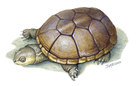
Yellow mud turtles have high-domed carapaces. The scutes are rounded and smooth, but the ninth and tenth scutes are larger than the others. The carapace can be olive green, brown, or tan with the borders of each scute bordered in black. Males are slightly larger than females. Males have larger heads than females, but they are more flattened on top. The head, neck, and limbs are the same color as the shell, but the chin and cheeks are yellowish. Yellow mud turtles range from 10.2 to 15.2 cm in body length. Female yellow mud turtles have an average size of 11.4 cm, males are slightly larger with an average size of 14 cm. Average mass is 391 g. (Bartlett, 2006; Carr, 1952; Conant, et al., 1998; Iverson, 1991; Pope, 1946; Webster, 1986)
- Other Physical Features
- ectothermic
- heterothermic
- bilateral symmetry
- Sexual Dimorphism
- male larger
- sexes shaped differently
-
- Average mass
- 391 g
- 13.78 oz
-
- Range length
- 10.2 to 15.2 cm
- 4.02 to 5.98 in
-
- Average length
- 11.4 cm
- 4.49 in
Development
As soon as yellow mud turtles have hatched the new young are nearly independent. Some female turtles stay with the young for a few days, but others abandon the eggs. Once hatched, these turtles begin looking for food. (Bartlett, 2006; Carr, 1952; Ernst and Barbour, 1972)
Reproduction
There are three phases of courtship in mating: tactile, mounting, and intromission (biting and rubbing). The tactile stage involves a male turtle approaching another turtle with head extended to smell the tail to determine the sex. If the turtle is male, the courtship ends; if female, the male will nudge the area of her nose around the musk glands. The female will usually move away at this point and the male turtle will either follow her or go elsewhere. If followed the male turtle will attempt to bite and nip the female around her head. The male turtle will then mount the female, which can occur on land, in the water, or along the shoreline. This stage lasts from a few seconds to 3 minutes. The second stage of mounting then begins, with the male mounting on all fours and using its tail to grab and move the female's tail, after which copulation occurs. (Christiansen and Dunham, 1972; Ernst and Barbour, 1972; Frazer and Klemens, 2000)
- Mating System
- polygynandrous (promiscuous)
Yellow mud turtles mate in April and May, a second period of mating occurs in September. Most nesting occurs during the springtime and hatching during the fall. Young turtles hatch and either spend the winter in a pond or bury themselves in the mud until spring. Yellow mud turtles usually have one clutch a year, but sometimes have a second clutch. The clutch size is typically 4 to 6 eggs. Female turtles become sexually mature at 5 to 8 years of age, males mature at 4 to 7 years old. (Christiansen and Dunham, 1972; Frazer and Klemens, 2000)
- Key Reproductive Features
- iteroparous
- seasonal breeding
- gonochoric/gonochoristic/dioecious (sexes separate)
- sexual
- oviparous
-
- Breeding interval
- Yellow mud turtles breed once a year.
-
- Breeding season
- Breeding occurs from July through September.
-
- Range number of offspring
- 3 to 6
-
- Average number of offspring
- 4
-
- Range gestation period
- 2 to 3 months
-
- Range time to independence
- 0 to 40 days
-
- Average time to independence
- 10-15 days
-
- Range age at sexual or reproductive maturity (female)
- 5 to 8 years
-
- Range age at sexual or reproductive maturity (male)
- 4 to 7 years
Female yellow mud turtles lay eggs on the surface of the ground or dig a shallow hole in which they lay the eggs. Once laid, females will often stay with their eggs for forty days, but some will leave after laying the egg. Most females only stay for ten to fifteen days with their eggs. After hatching, young turtles are entirely independent. Hatchlings either stay in a pond over the winter months or bury themselves in mud to overwinter. (Carr, 1952; Christiansen and Dunham, 1972; Ernst and Barbour, 1972)
- Parental Investment
- no parental involvement
-
pre-fertilization
- provisioning
-
protecting
- female
-
pre-hatching/birth
-
provisioning
- female
-
protecting
- female
-
provisioning
-
pre-weaning/fledging
-
protecting
- female
-
protecting
Lifespan/Longevity
Yellow mud turtles have a lifespan of about fifteen years in the wild. Turtles in captivity have a lifespan of roughly ten years. (Ernst and Barbour, 1972; Iverson, 1991)
-
- Average lifespan
Status: wild - 15 years
- Average lifespan
-
- Average lifespan
Status: captivity - 10 years
- Average lifespan
Behavior
Yellow mud turtles are seasonally diurnal. During the winter months they bury themselves underground and hibernate. They use their stout legs and claws to swim and to bury themselves in mud. When encountering other yellow mud turtles, male makes contact to determine the sex of the other turtle. (Ernst and Barbour, 1972; Tuma, 2006)
- Key Behaviors
- fossorial
- natatorial
- diurnal
- motile
- sedentary
- hibernation
- aestivation
- solitary
Home Range
Yellow mud turtle home ranges are limited by pond size. Yellow mud turtles co-occur in ponds and are not aggressive among themselves. Yellow mud turtles wander from ponds in search of mates or in search of other water sources if food is scarce. On average, adult turtles will wander from 190 m to 220 m. Juveniles venture only about 180 m from the water. (Bartlett, 2006; Harless and Morlock, 1979; Pope, 1946; Tuma, 2006)
Communication and Perception
Yellow mud turtles use touch to communicate with other yellow mud turtles. They use scent for social communication and to detect prey. Yellow mud turtles emit a strong musky odor when threatened by a predator. (Christiansen and Dunham, 1972; Schmidt and Inger, 1982)
- Other Communication Modes
- scent marks
Food Habits
Yellow mud turtles are omnivores with a broad diet. Animals consumed range from small insects to amphibians and reptiles, as long as they are smaller than the turtle. Yellow mud turtles generally forage in the water, but sometimes find food on the surface of the water or on land. Their sense of smell and taste enable these turtles to locate food easily under water. Yellow mud turtles eat vegetation, carrion, fish, shrimp, crayfish, snails, and small clams. Yellow mud turtles also prey on the eggs of other turtles and fish. During dry seasons, yellow mud turtles bury themselves in mud or dirt and prey on earthworms, insects, spiders, and ticks. (Carr, 1952; Ernst and Barbour, 1972; Pope, 1946; Webster, 1986)
- Primary Diet
- omnivore
- Animal Foods
- amphibians
- reptiles
- fish
- eggs
- carrion
- insects
- terrestrial non-insect arthropods
- mollusks
- terrestrial worms
- aquatic crustaceans
- Plant Foods
- leaves
- algae
- Other Foods
- detritus
Predation
Yellow mud turtles have few natural predators as adults. As eggs and young they are preyed on by skunks, raccoons, other turtles, water snakes, and large predatory fish. When yellow mud turtles are threatened they release a potent smell from their bodies which may repel predators. (Ernst and Barbour, 1972; Iverson, 1991)
- Anti-predator Adaptations
- cryptic
-
- Known Predators
-
- striped skunks (Mephitis mephitis)
- raccoons (Procyon lotor)
- water snakes (Nerodia)
- other turtles (Testudines)
- large, predatory fish (Actinopterygii)
Ecosystem Roles
Feces from Kinosternon flavescens helps with soil fertilization. Yellow mud turtles help regulate population size of small fishes and amphibians by feeding on the eggs of many species. Yellow mud turtles are parasitized by leeches, Macrobdella decora, which attach themselves to the skin of their legs and tails. Algae are also found on the shells of yellow mud turtles, including Basicladia chelonum and Basicladia crassa. Algae typically had no harmful effect on the turtle but, in rare cases the algae harmed the strength of the shell. (Ernst and Barbour, 1972; Kofron and Schreiber, 1985)
- leeches (Macrobdella decora)
- algae (Basicladia chelonum and Basicladia crassa)
Economic Importance for Humans: Positive
Yellow mud turtles are important predators of fishes, snakes, and other turtles in their native ecosystems. (Ernst and Barbour, 1972; Pope, 1946)
Economic Importance for Humans: Negative
Kinosternon flavescens flavescens was introduced to portions of Arizona and may have become an aquatic nuisance species there. (Fitzsimmons, 2001)
Conservation Status
Yellow mud turtle populations are stable throughout most of their range. Yellow mud turtles are not endangered or threatened in northern Nebraska through Texas and into Mexico. In Missouri K. f. flavescens is listed as state endangered. Kinosternon flavescens flavescens is on the state-endangered list in Illinois. (Bickham, et al., 1984; Kofron and Schreiber, 1985)
-
- IUCN Red List
-
No special status
More information
-
- IUCN Red List
-
No special status
More information
-
- US Federal List
- No special status
-
- CITES
- No special status
-
- State of Michigan List
- No special status
Contributors
Tanya Dewey (editor), Animal Diversity Web.
Bradley Weiss (author), Radford University, Karen Powers (editor, instructor), Radford University.
Glossary
- Nearctic
-
living in the Nearctic biogeographic province, the northern part of the New World. This includes Greenland, the Canadian Arctic islands, and all of the North American as far south as the highlands of central Mexico.

- agricultural
-
living in landscapes dominated by human agriculture.
- bilateral symmetry
-
having body symmetry such that the animal can be divided in one plane into two mirror-image halves. Animals with bilateral symmetry have dorsal and ventral sides, as well as anterior and posterior ends. Synapomorphy of the Bilateria.
- carrion
-
flesh of dead animals.
- chemical
-
uses smells or other chemicals to communicate
- cryptic
-
having markings, coloration, shapes, or other features that cause an animal to be camouflaged in its natural environment; being difficult to see or otherwise detect.
- detritus
-
particles of organic material from dead and decomposing organisms. Detritus is the result of the activity of decomposers (organisms that decompose organic material).
- diurnal
-
- active during the day, 2. lasting for one day.
- ectothermic
-
animals which must use heat acquired from the environment and behavioral adaptations to regulate body temperature
- fossorial
-
Referring to a burrowing life-style or behavior, specialized for digging or burrowing.
- freshwater
-
mainly lives in water that is not salty.
- heterothermic
-
having a body temperature that fluctuates with that of the immediate environment; having no mechanism or a poorly developed mechanism for regulating internal body temperature.
- hibernation
-
the state that some animals enter during winter in which normal physiological processes are significantly reduced, thus lowering the animal's energy requirements. The act or condition of passing winter in a torpid or resting state, typically involving the abandonment of homoiothermy in mammals.
- iteroparous
-
offspring are produced in more than one group (litters, clutches, etc.) and across multiple seasons (or other periods hospitable to reproduction). Iteroparous animals must, by definition, survive over multiple seasons (or periodic condition changes).
- motile
-
having the capacity to move from one place to another.
- natatorial
-
specialized for swimming
- native range
-
the area in which the animal is naturally found, the region in which it is endemic.
- omnivore
-
an animal that mainly eats all kinds of things, including plants and animals
- oviparous
-
reproduction in which eggs are released by the female; development of offspring occurs outside the mother's body.
- polygynandrous
-
the kind of polygamy in which a female pairs with several males, each of which also pairs with several different females.
- riparian
-
Referring to something living or located adjacent to a waterbody (usually, but not always, a river or stream).
- scent marks
-
communicates by producing scents from special gland(s) and placing them on a surface whether others can smell or taste them
- seasonal breeding
-
breeding is confined to a particular season
- sedentary
-
remains in the same area
- sexual
-
reproduction that includes combining the genetic contribution of two individuals, a male and a female
- solitary
-
lives alone
- tactile
-
uses touch to communicate
- temperate
-
that region of the Earth between 23.5 degrees North and 60 degrees North (between the Tropic of Cancer and the Arctic Circle) and between 23.5 degrees South and 60 degrees South (between the Tropic of Capricorn and the Antarctic Circle).
- terrestrial
-
Living on the ground.
- tropical savanna and grassland
-
A terrestrial biome. Savannas are grasslands with scattered individual trees that do not form a closed canopy. Extensive savannas are found in parts of subtropical and tropical Africa and South America, and in Australia.
- savanna
-
A grassland with scattered trees or scattered clumps of trees, a type of community intermediate between grassland and forest. See also Tropical savanna and grassland biome.
- temperate grassland
-
A terrestrial biome found in temperate latitudes (>23.5° N or S latitude). Vegetation is made up mostly of grasses, the height and species diversity of which depend largely on the amount of moisture available. Fire and grazing are important in the long-term maintenance of grasslands.
- visual
-
uses sight to communicate
References
Alderton, D. 1988. Turtles & Tortoises of the World. New York, New York: Facts on File.
Bartlett, R. 2006. Guide and Reference to the Crocodilians, Turtles, and Lizards: Of Eastern and Central North America (North of Mexico). New York: University Press of Florida.
Bellairs, A. 1970. The Life of Reptiles. New York City, New York: Universe Books.
Bertin, L. 1967. Reptiles. Pp. 295 in M Burton, ed. The Larousse Encyclopedia of Animal Life. New York: McGraw- Hill Book Company.
Bickham, J., M. Springer, B. Gallaway. 1984. Distributional Survey of the Yellow Mud Turtle (Kinosternon flavescens) in Iowa, Illinois, and Missouri: A Proposed Endangered Species. Southwestern Association of Naturalists, 29: 123-132.
Carr, A. 1952. Handbook of Turles. Ithaca, New York: Comstock Publishing Associates.
Christiansen, J., J. Bickham. 1989. Possible Historic Effects of Pond Drying and Winterkill on the Behavior of Kinosternon flavescens and Chrysemys picta. Journal of Herpetology, Vol. 23, No. 1: 91-94.
Christiansen, J., A. Dunham. 1972. Reproduction of the Yellow Mud Turtle (Kinosternon flavescens flavescens) in New Mexico. Herpetologica, Vol. 28, No. 2: 130-137.
Conant, R., J. Collins, I. Conant. 1998. A Field Guide to Reptiles and Amphibians: Eastern and Central North America. Boston: Houghton Mifflin Company.
Ernst, C., R. Barbour. 1972. Turtles of the United States. Lexington, Kentucky: The University Press of Kentucky.
Fitzsimmons, K. 2001. "Arizona State Aquatic Nuisance Species Management Plan" (On-line). Accessed December 03, 2008 at http://ag.arizona.edu/azaqua/extension/ANS/ArizonaPlan.htm.
Frazer, N., M. Klemens. 2000. Turtle Conservation. New York: Smithsonian Institution Press.
Harless, M., H. Morlock. 1979. Turtles: Perspectives and Research. New York: John Wiley & Sons, Inc..
Iverson, J. 1991. Life History and Demography of the Yellow Mud Turtle, Kinosternon flavescens. Herpetologica, Vol. 47, No. 4: 373-395.
Kofron, C., A. Schreiber. 1985. Ecology of Two Endangered Aquatic Turtles in Missouri: Kinosternon flavescens and Emydoidea blandingii. Journal of Herpetology, Vol. 19, No. 1: 27-40.
Pope, C. 1946. Turtles of the United States & Canada. New York: Alfred A. Knopf, Inc..
Schmidt, K., R. Inger. 1982. Reptiles: Mud Turtles. Pp. 202 in R Buchsbaum, ed. The Audobon Society Encyclopedia of Animal Life. New York: Clarkson N. Potter, Inc..
Tuma, M. 2006. Range, Habitat Use, and Seasonal Activity of the Yellow Mud Turtle (Kinosternon flaversens) in Northwestern Illinois: Implications for Site-Specific Conservation and Management. Chelonian Conservation & Biology, Vol. 5, Issue 1: 108-120.
Webster, C. 1986. Substrate Preference and Activity in the Turtle, Kinosternon flavescens flavescens. Journal of Herpetology, Vol. 20/ No. 4: pp. 477-482.