Kerodon rupestrisrock cavy

Geographic Range
Kerodon rupestris is endemic to the semi-arid region of northeastern Brazil known as the Caatinga. (Eisenberg and Redford, 1999; Lacher, 1981)
- Biogeographic Regions
- neotropical
Habitat
Within the Caatinga region, K. rupestris is confined to rocky terrain characterized by large granitic boulder outcroppings. In these outcroppings, rifts and hollows create space for K. rupestris to dwell and avoid predation. Environmental conditions are unpredictable; annual rainfall varies between 1000 and 400 mm, and flooding and drought can occur throughout the year. (Eisenberg and Redford, 1999; Lacher, 1981)
- Habitat Regions
- tropical
- terrestrial
- Terrestrial Biomes
- savanna or grassland
- scrub forest
Physical Description
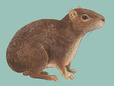
Kerodon rupestris is a hystricomorph rodent very similar in appearance to Cavia species. The tail is absent or vestigial, adult weight is around 1000 g, and the ears are short. Adult length is between 200 to 400 mm and is occasionally longer. Rock cavies have whitish throats, while other upper parts are generally grayish, and the stomach is yellowish brown. The rostrum is longer than other caviids and the incisor to premolar diastema is proportionally greater. Unlike other caviids, K. rupestris has blunted nails on all digits excepting a small grooming claw on the outermost digit of the foot, and the hands and feet are additionally padded with a leather-like surface. Other than size differences, day-old highly precocial young appear very similar to adults. (Arends and McNab, 2001; Eisenberg and Redford, 1999; Lacher, 1981; Nowak, 1999; Roberts, et al., 1984)
- Other Physical Features
- endothermic
- homoiothermic
- bilateral symmetry
- Sexual Dimorphism
- sexes alike
-
- Range mass
- 900 to 1000 g
- 31.72 to 35.24 oz
-
- Range length
- 200 to 400 mm
- 7.87 to 15.75 in
-
- Range basal metabolic rate
- .41 to .59 cm3.O2/g/hr
Reproduction
Male rock cavies defend hollows and dens made by the surrounding granitic boulders. Females seek refuge in these dens and a system of resource-defense polygyny emerges as a result. Mates are easy to find, therefore, a well established dominance hierarchy exists among males. Dominant males defend prized rock piles with large harems and are able to mate more frequently than subordinates. During mating, multiple males encircle one female in order to prevent her escape. Often these males include the dominant male and his progeny, as all others are treated aggressively. After encircling, the dominant male mounts the female to copulate. (Kleiman, et al., 1979; Lacher, 1981; Roberts, et al., 1984; Tasse, 1986)
- Mating System
- polygynous
Rock cavies breed year round and give birth to 1 to 3 highly precocial young per pregnancy, although singleton births are most common. They have a gestation period of 76 days which is notably longer than other caviids. Infants are weaned at 35 days, and juveniles reach sexual maturity around 133 days. Small litter size, comparatively long gestation period, and other reproductive parameters (i.e. low birth mass: maternal mass ratio) are considered specialist adaptations to rigid maternal energy constraints and a highly unpredictable environment. (Lacher, 1981; Oliviera, et al., 2006; Roberts, et al., 1984)
- Key Reproductive Features
- iteroparous
- year-round breeding
- gonochoric/gonochoristic/dioecious (sexes separate)
- sexual
- fertilization
- viviparous
- post-partum estrous
-
- Breeding interval
- Female rock cavies have post-partum estrous and give birth up to three times a year.
-
- Breeding season
- Rock cavies breed year round.
-
- Range number of offspring
- 1 to 3
-
- Average number of offspring
- 1.5
-
- Range gestation period
- 75.36 to 76.33 days
-
- Average gestation period
- 76 days
-
- Average weaning age
- 35.17 days
-
- Average age at sexual or reproductive maturity (female)
- 133 days
-
- Average age at sexual or reproductive maturity (male)
- 133 days
Rock cavies exhibit well developed parental care. Both sexes engage in grooming, huddling, and indirect social behaviors which rear the young until independence. Weaning occurs at 35 days, yet young have been observed foraging and eating vegetation as early as 2 days after birth. Early consumption of whole food suggests that suckling behavior may involve socialization as well as nourishment. After weaning, juveniles live in their fathers' den. Males born to the dominant male are not treated aggressively by their father. Living among his harem allows for increased socialization and a potential chance to become dominant in the future. Females born to dominant males live in the harem as potential mates, yet aggression from other females, including the mother, is common. Young females may leave the den as a result. (Lacher, 1981; Tasse, 1986; Lacher, 1981; Tasse, 1986; Lacher, 1981; Tasse, 1986)
- Parental Investment
- precocial
- male parental care
- female parental care
-
pre-fertilization
- provisioning
-
protecting
- female
-
pre-hatching/birth
-
provisioning
- female
-
protecting
- female
-
provisioning
-
pre-weaning/fledging
-
provisioning
- female
-
provisioning
- post-independence association with parents
Lifespan/Longevity
Rock cavies are relatively long lived for inhabiting such an unpredictable environment. In captivity, individuals live as many as 11 years. In the wild, the probability of an individual living to 3 years of age is 91%. (Kleiman, et al., 1979; Kleiman, et al., 1979)
-
- Average lifespan
Status: captivity - 11 years
- Average lifespan
-
- Average lifespan
Status: wild - 5 years
- Average lifespan
Behavior
Rock cavies are highly social and exhibit many behaviors attributed to habitat specialization. Both males and females adhere to social hierarchies dictated by agonistic interactions. Dominant individuals are better able to “win” these interactions. Subordinate individuals remain in their role until new members arrive at the colony. Agonistic interactions between females are most frequent and female hierarchies are highly linear. Pregnant females are most aggressive, especially toward juveniles, many of which are fatally wounded by female aggression. Male hierarchies are not linear but there is a social hierarchy among males. Social grooming is common among males, and the dominant male is most often groomed. Intersexual grooming and female grooming are infrequent. A number of other behaviors, including face nuzzling and crawling over one another, are used to enhance and maintain social relationships. Most activity outside rock dens involves foraging in trees and is crepuscular. (Eisenberg and Redford, 1999; Lacher, 1981; Tasse, 1986)
- Key Behaviors
- scansorial
- crepuscular
- motile
- sedentary
- territorial
- social
- colonial
- dominance hierarchies
Home Range
No information was found.
Communication and Perception
Rock cavies produce a variety of vocalizations, many of which are thought to represent anxiety or fear. Five distinct vocalizations are described, yet few are thought to directly communicate information to other individuals. Although scent marking is common among other caviids, rock cavies are not known to regularly scent mark. Rather, posturing and tactile interactions allow rock cavies to communicate, as individuals are often in close proximity around rock pile colonies. Social rank is continually communicated through allogrooming and agonistic interactions which include head thrusts and chases. (Lacher, 1981)
Food Habits
Although known as a habitat specialist, rock cavies are generalist folivores where diet is concerned. In their unpredictable Caatinga environment, drought often leaves trees leafless. During dry periods, vegetation continues to grow in the rock piles where rock cavies live, allowing colonies to live through periods of low productivity. During periods of high productivity, rock cavies feed on leaves, buds, flowers, and bark, most often foraging from the ground or on tree branches. In captivity, rock cavies eat a variety of fruits and vegetables. (Lacher, 1981; Tasse, 1986; Willig and Lacher, 1991)
- Primary Diet
- herbivore
- coprophage
- Plant Foods
- leaves
- wood, bark, or stems
- flowers
- Other Foods
- dung
Predation
Using sound or smell, rock cavies are able to detect predators approaching from a distance. The confines of surrounding rock hollows provide predator protection, and "alarm whistle" vocalizations are used to alert the colony to take refuge when needed. Once the repeated high pitch whistle is heard, surrounding individuals echo the call. When predators are seen approaching, individuals flee into surrounding rocks. This decreases the chance of any one individual indiscriminately running toward the approaching predator. The predator avoidance strategy employed by rock cavies is presumably a specialist adaptation to their rocky habitat which limits field of view and visual predator detection. (Lacher, 1981)
- Anti-predator Adaptations
- aposematic
Ecosystem Roles
Rock cavies are the only mammal endemic to the Caatinga region of Brazil. Because of their specializations towards living in such an unpredictable environment, few other mammals continually interact with rock cavies. Dry periods drive out many other mammals, and no specific predators are mentioned in the literature. Presumably, however, local avian and mammalian carnivores prey on rock cavies. As generalist folivores, rock cavies impact a variety of local flora through consumption of leaves, bark, and flowers. Parasitic nematodes are also found in the large intestines of rock cavies. (Lacher, 1981; Rodrigues, et al., 1985; Willig and Lacher, 1991)
- nematodes (Nematoda)
Economic Importance for Humans: Positive
Humans native to northeastern Brazil regularly hunt rock cavies for meat. Efforts have even been made to domesticate them as a reliable food source in areas afflicted by drought and poverty. Although not common, rock cavies can be kept as pets as well. Medicinal uses of K. rupestris include rubbing rock cavy fat under the eyes to ease "tired eyes" and mixing rock cavy manure with coffee to treat effusion. (Alves, et al., 2008; Oliviera, et al., 2006)
- Positive Impacts
- pet trade
- food
- source of medicine or drug
Economic Importance for Humans: Negative
There are no known adverse affects of K. rupestris on humans.
Conservation Status
Although habitat destruction and hunting have threatened rock cavies in the past, K. rupestris is currently listed as "least concern". Numerous protected areas currently provide refuge from hunting and habitat loss. (Catzeflis, et al., 2008)
-
- IUCN Red List
-
Least Concern
More information
-
- IUCN Red List
-
Least Concern
More information
-
- US Federal List
- No special status
-
- CITES
- No special status
-
- State of Michigan List
- No special status
Contributors
Alex White (author), University of Michigan-Ann Arbor, Phil Myers (editor, instructor), Museum of Zoology, University of Michigan-Ann Arbor, Tanya Dewey (editor), Animal Diversity Web.
Glossary
- Neotropical
-
living in the southern part of the New World. In other words, Central and South America.

- acoustic
-
uses sound to communicate
- aposematic
-
having coloration that serves a protective function for the animal, usually used to refer to animals with colors that warn predators of their toxicity. For example: animals with bright red or yellow coloration are often toxic or distasteful.
- bilateral symmetry
-
having body symmetry such that the animal can be divided in one plane into two mirror-image halves. Animals with bilateral symmetry have dorsal and ventral sides, as well as anterior and posterior ends. Synapomorphy of the Bilateria.
- chemical
-
uses smells or other chemicals to communicate
- colonial
-
used loosely to describe any group of organisms living together or in close proximity to each other - for example nesting shorebirds that live in large colonies. More specifically refers to a group of organisms in which members act as specialized subunits (a continuous, modular society) - as in clonal organisms.
- coprophage
-
an animal that mainly eats the dung of other animals
- crepuscular
-
active at dawn and dusk
- dominance hierarchies
-
ranking system or pecking order among members of a long-term social group, where dominance status affects access to resources or mates
- drug
-
a substance used for the diagnosis, cure, mitigation, treatment, or prevention of disease
- endothermic
-
animals that use metabolically generated heat to regulate body temperature independently of ambient temperature. Endothermy is a synapomorphy of the Mammalia, although it may have arisen in a (now extinct) synapsid ancestor; the fossil record does not distinguish these possibilities. Convergent in birds.
- female parental care
-
parental care is carried out by females
- fertilization
-
union of egg and spermatozoan
- folivore
-
an animal that mainly eats leaves.
- food
-
A substance that provides both nutrients and energy to a living thing.
- herbivore
-
An animal that eats mainly plants or parts of plants.
- iteroparous
-
offspring are produced in more than one group (litters, clutches, etc.) and across multiple seasons (or other periods hospitable to reproduction). Iteroparous animals must, by definition, survive over multiple seasons (or periodic condition changes).
- male parental care
-
parental care is carried out by males
- motile
-
having the capacity to move from one place to another.
- native range
-
the area in which the animal is naturally found, the region in which it is endemic.
- pet trade
-
the business of buying and selling animals for people to keep in their homes as pets.
- polygynous
-
having more than one female as a mate at one time
- scrub forest
-
scrub forests develop in areas that experience dry seasons.
- sedentary
-
remains in the same area
- sexual
-
reproduction that includes combining the genetic contribution of two individuals, a male and a female
- social
-
associates with others of its species; forms social groups.
- tactile
-
uses touch to communicate
- terrestrial
-
Living on the ground.
- territorial
-
defends an area within the home range, occupied by a single animals or group of animals of the same species and held through overt defense, display, or advertisement
- tropical
-
the region of the earth that surrounds the equator, from 23.5 degrees north to 23.5 degrees south.
- tropical savanna and grassland
-
A terrestrial biome. Savannas are grasslands with scattered individual trees that do not form a closed canopy. Extensive savannas are found in parts of subtropical and tropical Africa and South America, and in Australia.
- savanna
-
A grassland with scattered trees or scattered clumps of trees, a type of community intermediate between grassland and forest. See also Tropical savanna and grassland biome.
- temperate grassland
-
A terrestrial biome found in temperate latitudes (>23.5° N or S latitude). Vegetation is made up mostly of grasses, the height and species diversity of which depend largely on the amount of moisture available. Fire and grazing are important in the long-term maintenance of grasslands.
- visual
-
uses sight to communicate
- viviparous
-
reproduction in which fertilization and development take place within the female body and the developing embryo derives nourishment from the female.
- year-round breeding
-
breeding takes place throughout the year
- young precocial
-
young are relatively well-developed when born
References
Alves, R., H. Lima, M. Tavares, W. Souto, R. Barboza, A. Vasconcellos. 2008. Animal-based remedies as complementary medicines in Santa Cruz do Capibaribe, Brazil. BMC Complementary and Alternative Medicine, 8: 1-9.
Arends, A., B. McNab. 2001. The comparative energetics of ‘caviomorph’ rodents. Comparative Biochemistry and Physiology - Part A: Molecular and Integrative Physiology, 130: 105-122.
Catzeflis, F., J. Patton, A. Percequillo, C. Bonvicino, M. Weksler. 2008. "Kerodon rupestris" (On-line). 2008 IUCN Red List of Threatened Species. Accessed April 05, 2009 at http://www.iucnredlist.org/details/10988.
Eisenberg, J., K. Redford. 1999. Mammals of the Neotropics. Chicago, IL: The University of Chicago.
Kleiman, D., J. Eisenberg, E. Maliniak. 1979. Reproductive Parameters and Productivity of Caviomorph Rodents. Pp. 173-183 in J Eisenberg, ed. Vertebrate Ecology in the Northern Neotropics. Washington D.C.: Smithsonian Institution Press.
Lacher, T. 1979. Rates of growth in Kerodon rupestris and an assessment of its potential as a dometicated food source. Papeis Avulsos de Zoologia, Mus Zoo Univ Sao Paulo, 33: 67-76.
Lacher, T. 1981. The comparitive social behavior of Kerodon rupestris and Galea spixii and the evolution of behavior in the Caviidae. Bulletin of Carnegie Museum of Natural History, 17: 1-71.
Nowak, R. 1999. Walker's Mammals of the World. Baltimore: The Johns Hopkins University Press.
Oliviera, M., A. Carter, M. Bonatelli, C. Ambrosio, M. Miglino. 2006. Placentation in the Rock Cavy, Kerodon rupestris (Wied). Placenta, 27: 87-97.
Roberts, M., E. Maliniak, M. Deal. 1984. The reproductive biology of the rock cavy, Kerodon rupestris, in captivity: A study of reproductive adaptation in a trophic specialist. Mammalia, 48/2: 253-265.
Rodrigues, H., J. Vicente, D. Gomes. 1985. Stronglyoides ferrierai New Species Nematoda Rhabdiasoidea from the rodent Kerodon rupestris in Brazil. Memorias do Instituto Oswaldo Cruz, 80: 407-410.
Tasse, J. 1986. Maternal and Parental Care in the Rock Cavy, Kerdon rupestris, a South American Hystricomorph Rodent. Zoo Biology, 5: 27-43.
Willig, M., T. Lacher. 1991. Food Selection of a Tropical Mammalian Folivore in Relation to Leaf-Nutrient Content. Journal of Mammology, 72: 314-321.