Katsuwonus pelamisArctic bonito(Also: Mushmouth; Ocean bonito; Oceanic bonito; Skippy)

Geographic Range
Skipjack tuna, Katsuwonus pelamis, are marine fishes found in most waters all over the world but are rarely seen in the North Sea and have never been caught in the Black Sea. Skipjacks are confined to waters with temperatures above 15 degrees C.
Distribution map. (Muus and Nielsen, 1999)
- Biogeographic Regions
- indian ocean
- atlantic ocean
- pacific ocean
Habitat
An epipelagic fish, skipjacks are distributed in water with temperatures ranging from 14.7 and 30 C. Larvae are mostly restricted to areas with temperatures of at least 25 C. Skipjacks tend to be associated with regions of upwelling, or areas where cold, nutrient-rich waters are brought up from the bottom of the ocean to the surface, as well as regions where cold and warm water mix. These are areas with high productivity. Rarely are they found at depths greater than 260 m. (Collette and Nauen, 1983)
- Habitat Regions
- temperate
- tropical
- saltwater or marine
Physical Description
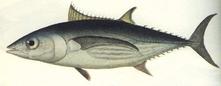
Katsuwonus pelamis have a typical tuna fish shape, possessing a fusiform, elongate body. They possess two dorsal fins, the first of which consists of 14-16 spines. The second dorsal fin is set directly behind the first with a small space separating the two. Following the second dorsal fin are 7-9 finlets. The anal fin is also followed by about 7-8 finlets. The pectoral fins are short and consist of 26 or 27 rays. Skipjacks are scaleless, except along the lateral line and the corselet. Dark purplish-blue dorsally, skipjacks camouflage themselves from predators below by maintaining a silvery hue both laterally and ventrally. There are also 4-6 dark bands along the side of the fish extending to the tail which, in live fish, may appear as a discontinuous lines of dark blotches. The maximum length is about 108 cm fork-length with a maximum weight of 32.5 to 34.5 kg. However, the more common maximum size is 80 cm fork-length and 8-10 kg in weight. Teeth are small and conical in shape. Skipjacks also lack a swim bladder. (Collette and Nauen, 1983)
- Other Physical Features
- endothermic
- ectothermic
- homoiothermic
- bilateral symmetry
- Sexual Dimorphism
- sexes alike
-
- Range mass
- 34.5 (high) kg
- 75.99 (high) lb
-
- Average mass
- 8-10 kg
- lb
Reproduction
Skipjack tuna spawn throughout the year, although they limit spawning from early fall to spring in regions near the equator (Collette and Nauen 1983). Fecundity is related to size. In one study (Stequert and Ramcharrun 1995) it was found that a 44 cm female carrried 80000 eggs while a larger female (75cm long) possessed 1.25 million eggs. Based on these two estimates, it was determined that the relative batch fecundity varies from 40 to 130 eggs/g body weight. These authors estimate four successive spawning periods per year for the skipjack. Stequert and Ramcharrun (1996) also looked at other aspects of reproduction in the skipjack tuna. They found that females mature at 41-42 cm fork-length while males mature at a slightly larger size, 42-43 cm fork-length. Both of these are equivalent to approximately 1.5 years of age. In their study, 70% of the females during any given month had ovaries in the terminal stages of maturation, providing more evidence that reproduction is not allocated to a particular time of year. Exactly how skipjacks reproduce is not known, but the breeding area of this species is thought to be limited to tropical regions of the world's oceans. (Collette and Nauen, 1983; Stequert and Ramcharrun, 1995; Stequert and Ramcharrun, 1996)
- Key Reproductive Features
- iteroparous
- seasonal breeding
- gonochoric/gonochoristic/dioecious (sexes separate)
- sexual
- fertilization
- oviparous
-
- Average age at sexual or reproductive maturity (female)
- 1.5 years
-
- Average age at sexual or reproductive maturity (female)
Sex: female - 1095 days
- AnAge
- Average age at sexual or reproductive maturity (female)
-
- Average age at sexual or reproductive maturity (male)
- 1.5 years
Lifespan/Longevity
The maximum age of skipjack tunas is not known but is estimated to be around 8-12 years.
-
- Average lifespan
Status: wild - 8-12 years
- Average lifespan
-
- Average lifespan
Status: captivity - 12 years
- AnAge
- Average lifespan
Behavior
Skipjack tuna are schooling migratory fishes (Collette and Nauen 1983). They tend to school with each other, other tuna, whales or sharks. They also tend to shoal under objects floating on the surface of the water (World Wide Fund For Nature 1996). Skipjacks are thought to have a north to south migratory seasonal pattern but there is still some question as to whether or not these tuna migrate with a purpose or use advective movements (Gauldie and Sharp 1996). Joseph et al. (1988) found that Pacific populations are more migratory than populations in the Atlantic, although they do suggest that this may be due to the fact that Pacific populations have been studied more. Small fish (less than 45cm fork-length) will make nightly journeys of 25 to 106 km away from banks, but will return to safety by daylight. Larger fish move more independently and are not restricted to the banks, although they do spend most of their time within the continental shelf (Collette and Nauen 2000). Katsuwonus pelamis exhibit a variety of characteristic behaviors, including jumping, feeding and foaming while in schools (Fishbase 2000). Breeding behavior is not known. ("Species Summary for Katsuwonus pelamis Skipjack tuna", 10-12-2000; Collette and Nauen, 1983; Gauldie and Sharp, June 1996; Joseph, et al., 1988; World Wide Fund For Nature, 1996)
- Key Behaviors
- natatorial
- diurnal
- motile
- migratory
- social
Communication and Perception
Food Habits
Katsuwonus pelamis feed predominantly on fishes, crustaceans and mollusks. The wide variety of food items consumed suggests that the skipjack is a highly opportunistic feeder. Feeding activities peak in the early morning and again in the late afternoon (Collette and Nauen 1983). Blackburn and Serventy (1981) found that the major food items in stomachs of skipjacks in Australian waters were euphausids, with various fishes and squid making up a smaller percentage of the stomach contents. Ankenbrandt (1985) also studied the food habits of skipjack tuna. She found that Euphausia similis had the highest % IRI (index of relative importance) while the gonostomid Maurolicus muelleri made up the highest MVRM (mean volumetric ratio measurement) during all time periods. Other fish like mackerel (Scomber) and Thyrsitops lepidoides were also common. Crustaceans other than E. similis occurred frequently but were not a major part of the total volume of the stomach. Cephalopods occurred infrequently. Skipjacks were also found to consume pteropods, siphonophores, and beetles. There is still some debate as to whether or not this species is cannibalistic. Ankenbrandt (1985) did not find evidence for cannibalism, but Collette and Nauen (1983) list skipjacks as cannibalistic. This discrepancy could be due to the fact that, as opportunistic feeders, skipjacks will consume their young only when they are prevalent. (Ankenbrandt, 1985; Blackburn and Serventy, 1981; Collette and Nauen, 1983)
- Primary Diet
-
carnivore
- piscivore
- eats non-insect arthropods
- molluscivore
- Animal Foods
- fish
- insects
- mollusks
- aquatic crustaceans
- other marine invertebrates
Economic Importance for Humans: Positive
Katsuwonus pelamis has become more important in the tuna fishing industry in recent years. In 1950, less than 300,000 metric tons were taken. In 1991, 1,674,970 metric tons were caught. This level has not been reached since (Collette and Nauen 2000). Currently, Katsuwonus pelamis comprise 40 percent by weight of the world tuna catch despite being the smallest of the tunas subject to the large-scale commercial fishing operations. Americans alone consume more than 400000 metric tons of tuna (all species) each year, and it is doubtful that this number will decrease any time soon (World Wide Fund For Nature 1996).
The tendency of skipjacks to group underneath objects floating on the surface of the water is taken advantage of by fisheries, which use Fish Aggregating Devices to attract them (World Wide Fund For Nature 1996). However, they are usually captured at the surface using purse seines or pole-and-line gear.
- Positive Impacts
- food
Conservation Status
Skipjacks are currently not threatened, although catches fluctuate widely from year to year, providing scientists with little information as to how long the populations can withstand increased fishing pressure (World Wide Fund For Nature 1996). Scientists have been studying both natural and fishing mortality within these populations, as well as other tuna populations, to obtain a better understanding of their biology. In one such study, conducted in the western Pacific tuna fishery, natural mortality (M) and fishing mortality (F) were studied over a range of sizes for skipjack and other tunas. Skipjacks displayed a u-shaped natural mortality rate, where smaller size classes had higher mortality rates than those in the middle. At size classes above 70cm, the mortality rate increased yet again, indicating the natural age at which these fish die. Fishing mortality was high for the smallest subclasses studied (21-30 cm, 31-40 cm) and decreased steadily for the larger size categories. If these numbers are correct, the high M values under natural conditions for young skipjack tuna would dampen the effect of the high F for this age group. In other words, the high mortality rate sustained by skipjacks at a young age due to fishing would not necessarily alter the population numbers as these fish tend to have low survival rates anyway (Hampton 2000).
There are several groups dedicated to the study and protection of tuna. One such group, the Inter-American Tropical Tuna Commission (IATTC), works with fisheries and governments of member nations to protect these species. The IATTC was established in the 1950s and consists of two main programs, the Tuna-Billfish and the Tuna-Dolphin programs. Both of these programs are designed to investigate yellowfin and skipjack tuna in the eastern Pacific, examine the effects of natural and human activities on the populations of these fishes, and recommend action to member governments to maintain populations at maximum sustained catches (Joseph 1994). This commission (and others like it) is operating to understand more fully the biology of skipjack tunas, and, as a result, make better management decisions. Due to its global distribution, this is a difficult species to manage effectively.
-
- IUCN Red List
-
No special status
More information
-
- IUCN Red List
-
No special status
More information
-
- US Federal List
- No special status
-
- CITES
- No special status
Other Comments
Other common names for skipjacks include skipjack tuna, striped tuna, bonito, and striped bonito. Also, there are several sources that still use an old species name for skipjacks, Euthynnus pelamis (Collette and Nauen 2000).
Contributors
William Fink (editor), University of Michigan-Ann Arbor.
Lori Ivan (author), University of Michigan-Ann Arbor.
Glossary
- Atlantic Ocean
-
the body of water between Africa, Europe, the southern ocean (above 60 degrees south latitude), and the western hemisphere. It is the second largest ocean in the world after the Pacific Ocean.

- Pacific Ocean
-
body of water between the southern ocean (above 60 degrees south latitude), Australia, Asia, and the western hemisphere. This is the world's largest ocean, covering about 28% of the world's surface.
- bilateral symmetry
-
having body symmetry such that the animal can be divided in one plane into two mirror-image halves. Animals with bilateral symmetry have dorsal and ventral sides, as well as anterior and posterior ends. Synapomorphy of the Bilateria.
- carnivore
-
an animal that mainly eats meat
- chemical
-
uses smells or other chemicals to communicate
- coastal
-
the nearshore aquatic habitats near a coast, or shoreline.
- diurnal
-
- active during the day, 2. lasting for one day.
- ectothermic
-
animals which must use heat acquired from the environment and behavioral adaptations to regulate body temperature
- endothermic
-
animals that use metabolically generated heat to regulate body temperature independently of ambient temperature. Endothermy is a synapomorphy of the Mammalia, although it may have arisen in a (now extinct) synapsid ancestor; the fossil record does not distinguish these possibilities. Convergent in birds.
- external fertilization
-
fertilization takes place outside the female's body
- fertilization
-
union of egg and spermatozoan
- food
-
A substance that provides both nutrients and energy to a living thing.
- iteroparous
-
offspring are produced in more than one group (litters, clutches, etc.) and across multiple seasons (or other periods hospitable to reproduction). Iteroparous animals must, by definition, survive over multiple seasons (or periodic condition changes).
- migratory
-
makes seasonal movements between breeding and wintering grounds
- molluscivore
-
eats mollusks, members of Phylum Mollusca
- motile
-
having the capacity to move from one place to another.
- natatorial
-
specialized for swimming
- native range
-
the area in which the animal is naturally found, the region in which it is endemic.
- oviparous
-
reproduction in which eggs are released by the female; development of offspring occurs outside the mother's body.
- pelagic
-
An aquatic biome consisting of the open ocean, far from land, does not include sea bottom (benthic zone).
- piscivore
-
an animal that mainly eats fish
- saltwater or marine
-
mainly lives in oceans, seas, or other bodies of salt water.
- seasonal breeding
-
breeding is confined to a particular season
- sexual
-
reproduction that includes combining the genetic contribution of two individuals, a male and a female
- social
-
associates with others of its species; forms social groups.
- tactile
-
uses touch to communicate
- temperate
-
that region of the Earth between 23.5 degrees North and 60 degrees North (between the Tropic of Cancer and the Arctic Circle) and between 23.5 degrees South and 60 degrees South (between the Tropic of Capricorn and the Antarctic Circle).
- tropical
-
the region of the earth that surrounds the equator, from 23.5 degrees north to 23.5 degrees south.
References
10-12-2000. "Species Summary for Katsuwonus pelamis Skipjack tuna" (On-line). Accessed October 28, 2000 at http://www.fishbase.org/Summary/SpeciesSummary.cfm?genusname=Katsuwonus&speciesname=pelamis.
Ankenbrandt, L. 1985. Food Habits of bait-Caught Skipjack Tuna, Katsuwonus pelamis, From the Southwestern Atlantic Ocean. Fishery Bulletin, 83: 379-386.
Blackburn, M., D. Serventy. 1981. Observations on distribution and life history of skipjack tuna, Katsuwonus pelamis, in Australian waters. Fishery Bulletin, 79: 85-94.
Collette, B., C. Nauen. 1983. FAO Species Catalogue. Rome: United Nations Development Programme.
Collette, B., C. Nauen. "Katsuwonus pelamis (Linnaeus, 1758)" (On-line). Accessed October 28, 2000 at http://www.fao.org/fi/sidp/htmls/species/ka_pe_ht.htm.
Gauldie, R., G. Sharp. June 1996. Skipjack velocity, dwell time and migration. Fisheries Oceanography, 5: 100-113.
Hampton, J. May 2000. Natural mortality rates in tropical tunas: size really does matter. Canadian Journal of Fisheries and Aquatic Sciences, 57: 1002-1010.
Joseph, J. 1994. The Inter-American Tropical Tuna Commission. Fisheries, 19: 42.
Joseph, J., W. Klawe, P. Murphy. 1988. Tuna and Billfish. La Jolla, CA: Inter-American Tropical Tuna Commission.
Muus, B., J. Nielsen. 1999. Sea Fish. Denmark: Scandanavian Fishing Year Book.
Stequert, B., B. Ramcharrun. 1996. Reproduction of skipjack tuna (Katsuwonus pelamis) from the Western Indian Ocean. Aquatic Living Resources, 9: 235-247.
Stequert, B., B. Ramcharrun. 1995. The fecundity of skipjack tuna (Katsuwonus-pelamis) from the western Indian Ocean. Aquatic Living Resources, 8: 79-89.
World Wide Fund For Nature, 1996. "The Large Pelagic Fishes" (On-line). Accessed October 28, 2000 at http://www.panda.org/resources/publications/water/fishfile2/fish43.htm.