Katharina tunicataBlack Katy Chiton
Geographic Range
Common along Pacific Northwest Coast. Especially common in the San Jaun Islands and Strait of Jaun de Fuca (Niesen 1997).
Habitat
Katharina tunicata is found in the middle and upper zones of the rocky intertidal, and can withstand hard wave action. This chiton is often seen near the borders of mussel clumps. (Niesen 1997; Mohler 1997)
- Aquatic Biomes
- coastal
Physical Description
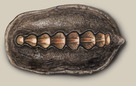
Katharina tunicata is a medium sized chiton, with an average length of 7 cm. Its black girdle almost completely covers the eight whitish plates, leaving a diamond shaped pattern down the dorsal side. The plates are sometimes overgrown with algae, so they will appear green (Mohler 1997). Like most chitons, K. tunicata is oval shaped, but when removed from the rock it will ball up (Karleskint 1998). The underside of K. tunicata is commonly peach colored,and houses the gills and mouth. The foot is surrounded by mantle and is usually darker orange.
- Other Physical Features
- ectothermic
- bilateral symmetry
Reproduction
Kathrina tunicata, like all chitons, has seperate sexes. Katharina tunicata spawns March through July. Chitons do not copulate; instead, the male release sperm and fertilzation occurs in the sea or in the mantle trough of the female, depending upon the species. After fertilization, eggs can be shed, or are brooded in the mantle cavity of the female. This is also species-dependent. Chitons have a free swimming (trochophore) larvae which develops into the adult(Dorit 1991).
Behavior
Katharina tunicata crawls around with its foot, like a snail, while in the water, but when the tide goes out it adheres to the substrate until the water returns. The mantle margin and foot hold K. tunicata firmly to the rocks, even in areas of high wave action. Chitons feed by scraping their tongue or radula across the rocks for algae (Dorit 1991). Katharina tunicata is preyed upon by the common sea star, Pisaster ochraceus (Morris 1983).
Food Habits
Katharina tunicata is an herbivore. Its main food sources are brown (Phaeophyta) and red (Rhodophyta) algae (Mohler 1997).
Conservation Status
-
- IUCN Red List
- No special status
-
- US Federal List
- No special status
-
- CITES
- No special status
Contributors
Bobbi Doyle (author), Western Oregon University, Karen Haberman (editor), Western Oregon University.
Glossary
- Nearctic
-
living in the Nearctic biogeographic province, the northern part of the New World. This includes Greenland, the Canadian Arctic islands, and all of the North American as far south as the highlands of central Mexico.

- bilateral symmetry
-
having body symmetry such that the animal can be divided in one plane into two mirror-image halves. Animals with bilateral symmetry have dorsal and ventral sides, as well as anterior and posterior ends. Synapomorphy of the Bilateria.
- coastal
-
the nearshore aquatic habitats near a coast, or shoreline.
- ectothermic
-
animals which must use heat acquired from the environment and behavioral adaptations to regulate body temperature
- native range
-
the area in which the animal is naturally found, the region in which it is endemic.
References
Dorit, R., W. Walker, R. Barnes. 1991. Zoology. United States of America: Saunders College Publishing.
Karleskint, G. 1998. Introduction to Marine Biology. USA: Saunders College Publishing.
Mohler, J., D. Fox, B. Hastie. 1997. Guide to Oregons's Rocky Intertidal Habitats. Newport, OR: Oregon Department of Fish and Wildlife.
Morris, R., D. Abbott, E. Haderlie. 1983. Intertidal Invertebrates of California. Stanford, CA: Stanford University Press.
Niesen, T. 1997. Marine Life of the Pacific Northwest. Houston, TX: Gulf Publishing Company.