Idiurus zenkeripygmy scaly-tailed flying squirrel
Geographic Range
Idiurus zenkeri is found throughout Upper Cameroon to Rio Muni and Northwest Gabon. The range extends from the northeast and east portion of Zaire, east of the Lualaga to Lake Kivu, eastern Nigeria, the Gold Coast, Gabon, Liberia, and west Uganda. (Booth, 1958; Haltenorth and Diller, 1977)
Pygmy scaly-tailed flying squirrels are found in the following countries: Cameroon, Central African Republic, Congo, the Democratic Republic of the Equatorial Guinea, and Uganda. (Jones, 1971; Kingdon, 1974; Thorington, 2003)
Habitat
Pygmy scaly-tailed flying squirrels are found in moist tropical and subtropical climates. They are arboreal, occurring mainly in forests composed of the following tree taxa: Klainedoxa species, Pseudoprosopis species, Paramacrolobium species, Gilbertiodendron species, and Pentaclethra species. (Jones, 1971; Kingdon, 1974; Thorington, 2003)
- Habitat Regions
- tropical
- terrestrial
- Terrestrial Biomes
- forest
- rainforest
-
- Range elevation
- Primarily high forests (high) m
- ft
Physical Description
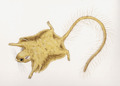
Pygmy scaly-tailed flying squirrels have a body length from 63 to 75 mm, tail length of 83 to 104 mm, hind foot length of 14 to 17 mm, ear length of 11 to 15 mm, and greatest length of skull of 22 mm. They are the smallest of the scaly-tailed squirrels. They have a feathery tail. Dorsal fur color is grey to brown and ventral fur color is whitish. A gliding membrane is located between the fore and hind limbs. Scaly-tailed squirrels have silky fur, long whiskers, and two rows of pine cone like scales on the underside of their tails. The top of the tail is covered with sparse, 2 cm long hairs. The tail has a row of short (2 to 3 mm), stiff hairs along both sides. The entire underside of the tail is hairless, with a 1.5 to 2.5 cm long rough, scaly patch that extends from the tail base. These scales typically act as anti-skid devices that also provide extra grip while climbing or support when resting. Sharp claws also provide extra grip. The fur is fine, although less dense on the gliding membrane. The elbow has a cartilaginous extension that allows for greater freedom of movement in the upper limbs. (Barnet, 2006; Haltenorth and Diller, 1977; Kingdon, 1974; Thorington, 2003)
- Other Physical Features
- endothermic
- homoiothermic
- bilateral symmetry
- Sexual Dimorphism
- sexes alike
-
- Average mass
- 17.4 g
- 0.61 oz
-
- Range length
- 63 to 75 mm
- 2.48 to 2.95 in
Reproduction
The mating system of Idiurus zenkeri is not reported. (Jones, 1971)
There is little information on reproduction in Idiurus zenkeri. It is believed to be similar to Idiurus macrotis and other anomalurids. Young are precocial and born in litters of up to three young. Parents will finely chew food in their cheeks and then pass it on to their young during the weaning process. No pregnant females have been observed. It is thought that females may give birth to their young away from the colony. (Barnet, 2006; Booth, 1958; Kingdon, 1974; Thorington, 2003)
- Key Reproductive Features
- iteroparous
- gonochoric/gonochoristic/dioecious (sexes separate)
- sexual
- fertilization
- viviparous
-
- Breeding interval
- Breeding intervals are not known.
-
- Breeding season
- The breeding season of I. zenkeri is not reported.
-
- Range number of offspring
- 3 (high)
Like all mammals, females I. zenkeri nurse and care for their young until they are weaned. Otherwise, little is known about the investment of male and female parents and length of dependence.
- Parental Investment
-
pre-fertilization
- provisioning
-
protecting
- female
-
pre-hatching/birth
-
provisioning
- female
-
protecting
- female
-
provisioning
-
pre-weaning/fledging
-
provisioning
- female
-
provisioning
Lifespan/Longevity
There is no information known about the longevity of I. zenkeri.
Behavior
Pygmy scaly-tailed flying squirrels are nocturnal, gregarious species that rest in tree hollows or behind peeling bark with other flying squirrels in groups of up to 100 individuals consisting of both sexes and all ages. They climb with agility on smooth tree trunks and jump or glide between tree branches. They can glide up to 3 meters between trees without losing height. ("Flying Mouse", 2006; Barnet, 2006; Corbin and Cordeiro, 2006; Haltenorth and Diller, 1977; Kingdon, 1974; Thorington, 2003)
Home Range
Home range size of I. zenkeri is not reported. (Jones, 1971)
Communication and Perception
Pygmy scaly-tailed flying squirrels emit a mouse-like squeak that is heard when individuals are disturbed. Communication by scent is important in anomularids. Large groin glands produce strong smelling secretions. (Barnet, 2006; Haltenorth and Diller, 1977)
Pygmy scaly-tailed flying squirrels have large, forward facing eyes that provide excellent binocular vision and relatively large ears that support acute hearing that could include ultrasonic frequencies.
- Perception Channels
- visual
- tactile
- ultrasound
- chemical
Food Habits
Pygmy scaly-tailed flying squirrels are capable of traveling several kilometers in search of food. Foraging behaviors are probably similar to that of Idiurus macrotis. Pygmy scaly-tailed flying squirrels eat fruit, nuts, tree gums, and bark, including oil palm fruits. Anomalurids have relatively long digestive tracts, which allows for the maximum absorption of nutrients. (Barnet, 2006; Haltenorth and Diller, 1977; Thorington, 2003)
- Plant Foods
- wood, bark, or stems
- seeds, grains, and nuts
- fruit
- sap or other plant fluids
Predation
There is little information on predators of pygmy scaly-tailed flying squirrels. Eagles have been known to prey on other scaly-tailed squirrel species and it is likely that birds of prey and arboreal snakes prey on scaly-tailed squirrels. (Barnet, 2006; Thorington, 2003)
-
- Known Predators
-
- eagles and other birds of prey (Falconiformes)
Ecosystem Roles
Anomularids will chew off the tops of young, non-food tree species, resulting in a reduction of competition for their favored trees species and a change in the composition of forest trees. Pygmy scaly-tailed flying squirrels may also contribute to the dispersal of forest tree seeds when they eat fruit. (Barnet, 2006)
In 1968, four individuals of I. zenkeri were found nesting in a tree on Dipikar Island with two individuals of Anomalurus derbianus. (Jones, 1971)
- Lord Derby's scaly-tailed squirrels (Anomalurus derbianus)
Economic Importance for Humans: Positive
Pygmy scaly-tailed flying squirrels are important members of their native ecosystems.
Economic Importance for Humans: Negative
Scaly-tailed squirrel species will occasionally steal oil palm nuts, but they are not generally considered pest species. (Barnet, 2006)
Conservation Status
In 1996, I. zenkeri was listed as lower risk/near threatened by the IUCN. This species is poorly known and has since been re-categorized as data deficient. Idiurus zenkeri populations are negatively impacted by timber harvesting and destruction of habitat for agriculture. (Jones, 1971; Thorington, 2003)
In order for informed conservation planning, information regarding a number of life history characteristics is required, including: population numbers, distribution, ecological interactions, and reproductive characters.
-
- IUCN Red List
-
Least Concern
More information
-
- IUCN Red List
-
Least Concern
More information
-
- US Federal List
- No special status
-
- CITES
- No special status
Other Comments
Studying anomularid species in the field is difficult, not only because they are nocturnal, but also because they are sensitive to the red lights that biologists use at night. Anomularids are not rare; they are only very difficult to study and observe.
Idiurus zenkeri and feather-tailed gliders (Acrobates pygmaeus) are a remarkable example of convergence. (Barnet, 2006; Jones, 1971; Kingdon, 1974)
Contributors
Tanya Dewey (editor), Animal Diversity Web.
Mandie Cyr (author), University of Wisconsin-Stevens Point, Chris Yahnke (editor, instructor), University of Wisconsin-Stevens Point.
Glossary
- Ethiopian
-
living in sub-Saharan Africa (south of 30 degrees north) and Madagascar.

- acoustic
-
uses sound to communicate
- arboreal
-
Referring to an animal that lives in trees; tree-climbing.
- bilateral symmetry
-
having body symmetry such that the animal can be divided in one plane into two mirror-image halves. Animals with bilateral symmetry have dorsal and ventral sides, as well as anterior and posterior ends. Synapomorphy of the Bilateria.
- chemical
-
uses smells or other chemicals to communicate
- colonial
-
used loosely to describe any group of organisms living together or in close proximity to each other - for example nesting shorebirds that live in large colonies. More specifically refers to a group of organisms in which members act as specialized subunits (a continuous, modular society) - as in clonal organisms.
- endothermic
-
animals that use metabolically generated heat to regulate body temperature independently of ambient temperature. Endothermy is a synapomorphy of the Mammalia, although it may have arisen in a (now extinct) synapsid ancestor; the fossil record does not distinguish these possibilities. Convergent in birds.
- fertilization
-
union of egg and spermatozoan
- forest
-
forest biomes are dominated by trees, otherwise forest biomes can vary widely in amount of precipitation and seasonality.
- frugivore
-
an animal that mainly eats fruit
- granivore
-
an animal that mainly eats seeds
- herbivore
-
An animal that eats mainly plants or parts of plants.
- iteroparous
-
offspring are produced in more than one group (litters, clutches, etc.) and across multiple seasons (or other periods hospitable to reproduction). Iteroparous animals must, by definition, survive over multiple seasons (or periodic condition changes).
- motile
-
having the capacity to move from one place to another.
- native range
-
the area in which the animal is naturally found, the region in which it is endemic.
- nocturnal
-
active during the night
- rainforest
-
rainforests, both temperate and tropical, are dominated by trees often forming a closed canopy with little light reaching the ground. Epiphytes and climbing plants are also abundant. Precipitation is typically not limiting, but may be somewhat seasonal.
- sedentary
-
remains in the same area
- sexual
-
reproduction that includes combining the genetic contribution of two individuals, a male and a female
- social
-
associates with others of its species; forms social groups.
- tactile
-
uses touch to communicate
- terrestrial
-
Living on the ground.
- tropical
-
the region of the earth that surrounds the equator, from 23.5 degrees north to 23.5 degrees south.
- ultrasound
-
uses sound above the range of human hearing for either navigation or communication or both
- visual
-
uses sight to communicate
- viviparous
-
reproduction in which fertilization and development take place within the female body and the developing embryo derives nourishment from the female.
References
2006. "Flying Mouse" (On-line). Accessed October 10, 2006 at http://en.wikipedia.org/wiki/Flying_mouse.
Barnet, A. 2006. "Scaly-tailed squirrels" (On-line). Accessed October 10, 2006 at http://www.answers.com/topic/scaly-tailed-squirrels-anomaluridae-biological-family.
Booth, A. 1958. The Niger, the Volta and the Dahoney Gap as Geographic Barriers. Evolution, 12/1: 48-62.
Corbin, C., N. Cordeiro. 2006. Gliding characteristics of Lord Derby's Anomalure (Anomalurus derbianus) in Tanzania. African Journal of Ecology, 44: 106-108.
Haltenorth, T., H. Diller. 1977. The Collins Field Guide to the Mammals of Africa including Madagascar. Massachusetts: The Stephen Green Press.
Jones, C. 1971. Notes on the Anomalurids of Rio Muni and Adjacent Areas. Journal of Mammalogy, 52/3: 568-572.
Kingdon, J. 1974. East African Mammals. London: Academic Press.
Thorington, R. 2003. Idiurus zenkeri.