Hystrix africaeaustralisCape porcupine



Geographic Range
Hystrix africaeaustralis is found only in sub-saharan Africa, excluding the coastal desert of the southwest. ("The South African Porcupine Page", 1999; Smithers, 1983)
Habitat
South African porcupines are found from sea level to 2000 m above sea level in most areas with vegetation. They prefer rocky hills and outcrops, as they must have shelter during the day. They often take shelter in caves or antbear (Orycteropus afer) holes. They also build dens which can be up to 20m long with a 2m deep living chamber. (Nowak, 1999; Smithers, 1983; Storch, 1990)
- Habitat Regions
- temperate
- tropical
- terrestrial
- Terrestrial Biomes
- savanna or grassland
- forest
- scrub forest
Physical Description
South African porcupines are the largest rodent in their region. Females are, on average, about one kilogram heavier than males and both sexes are larger than half a meter long.
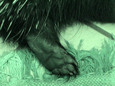
These porcupines are covered with flat, bristly hairs and have quills and spines on the posterior back and flanks. The difference between quills and spines is largely one of length and thickness, with spines up to 50 cm long and quills up to 30 cm long. The white and black crest of spines and quills can be erected at will to make the animal look enormous and threatening. Some spines on the tail are hollow and make a rattling sound when shaken. The very sharp spines and quills come off when touched by a predator or shaken off, but they grow back rapidly. South African porcupines also have very long mobile whiskers. (Nowak, 1999; Smithers, 1983; Storch, 1990)
- Other Physical Features
- endothermic
- homoiothermic
- bilateral symmetry
- Sexual Dimorphism
- female larger
-
- Range mass
- 18 to 30 kg
- 39.65 to 66.08 lb
-
- Average basal metabolic rate
- 13.175 W
- AnAge
Reproduction
Because of their dangerous anatomy, females initiate copulation by presenting to the males. (Nowak, 1999; Smithers, 1983; Storch, 1990)
Male porcupines reach sexual maturity between eight and eighteen months, while females reach sexual maturity between nine and sixteen months. Gestation lasts for three months.
The young are born in litters of one to four into a grass-lined chamber in the parents' den during the wet months of August to March. The average litter size is 1.5 and the average newborn mass is 311g.
Young porcupines nurse for three to four months, at which point they will weigh four to five kilograms. After the weaning of their young, female porcupines can not conceive for another three to five months. (Nowak, 1999; Smithers, 1983; Storch, 1990)
- Key Reproductive Features
- iteroparous
- year-round breeding
- gonochoric/gonochoristic/dioecious (sexes separate)
- sexual
- viviparous
-
- Breeding interval
- Female porcupines usually breed once yearly, although more often is possible.
-
- Breeding season
- Breeding occurs from May through December.
-
- Range number of offspring
- 1 to 4
-
- Average number of offspring
- 1.5
-
- Average number of offspring
- 2.1
- AnAge
-
- Average gestation period
- 3 months
-
- Average gestation period
- 94 days
- AnAge
-
- Range weaning age
- 3 to 4 months
-
- Range age at sexual or reproductive maturity (female)
- 9 to 16 months
-
- Range age at sexual or reproductive maturity (male)
- 8 to 18 months
Young are born relatively well-developed, with their eyes open and teeth present. They have soft quills and spines at birth (most likely to ease the birthing process) but they quickly harden in the air. The young grow rapidly, reaching full size in about a year. (Nowak, 1999; Smithers, 1983; Storch, 1990)
- Parental Investment
- precocial
-
pre-fertilization
- provisioning
-
protecting
- female
-
pre-hatching/birth
-
provisioning
- female
-
protecting
- female
-
provisioning
-
pre-weaning/fledging
-
provisioning
- female
-
protecting
- female
-
provisioning
Lifespan/Longevity
These porcupines are long-lived for rodents, surviving 12 to 15 years in the wild.
-
- Typical lifespan
Status: wild - 12 to 15 years
- Typical lifespan
-
- Range lifespan
Status: wild - 15 (high) years
- AnAge
- Range lifespan
Behavior
South African porcupines are primarily nocturnal, although they may be seen during the day.
South African Porcupines are described as either solitary creatures or living in small family groups. Storch (1990) portrays them as living in clans of up to six family members in which both parents give long-term care to young. They have also been reported to be intraspecifically aggressive, although the exact situation was not mentioned. (Smithers, 1983; Storch, 1990)
Communication and Perception
Food Habits
South African porcupines are mostly vegetarian, using their strong digging claws to get roots, tubers, and bulbs. They are also fond of fallen fruits and will sometimes gnaw on bark. Their anterior large intestine and enlarged appendix contain microorganisms that break down undigested plant fibers.
They have also been reported to eat carrion in some instances. In areas deficient in phosphorous they practice osteophagia, or gnawing on bones. These porcupines will often accumulate large piles of bones in their dens. (Nowak, 1999; Storch, 1990)
- Primary Diet
-
herbivore
- lignivore
- eats sap or other plant foods
- Plant Foods
- leaves
- roots and tubers
- wood, bark, or stems
- flowers
Predation
Hystrix africaeaustralis have interesting defensive behaviors. They have quite acute hearing and will freeze when approached by predators, such as big cats, large predatory birds, or hyaenas. When cornered, these porcupines can be aggressive, running sideways or backwards to embed their sharp quills in an attacker. Contrary to myth, they can not throw their quills, but they may become dislodged when they shake their hollow rattling quills. Another defensive behavior is to hide in their holes facing in and erect their spines so that they can not be dislodged. (Smithers, 1983; Storch, 1990)
- Anti-predator Adaptations
- aposematic
Ecosystem Roles
Porcupine foraging has important impacts on the plant communities in which they live.
Economic Importance for Humans: Positive
Porcupines are important members of healthy ecosystems.
- Positive Impacts
- food
Economic Importance for Humans: Negative
Porcupines eat vegetable crops and are destructive feeders. That is, they dig up and destroy much more food than they eat. (Smithers, 1983)
- Negative Impacts
- crop pest
Conservation Status
South African porcupines are not considered threatened currently.
-
- IUCN Red List
-
Least Concern
More information
-
- IUCN Red List
-
Least Concern
More information
-
- US Federal List
- No special status
-
- CITES
- No special status
Contributors
Tanya Dewey (editor), Animal Diversity Web.
Lisa DeBruine (author), University of Michigan-Ann Arbor, Phil Myers (editor), Museum of Zoology, University of Michigan-Ann Arbor.
Glossary
- Ethiopian
-
living in sub-Saharan Africa (south of 30 degrees north) and Madagascar.

- aposematic
-
having coloration that serves a protective function for the animal, usually used to refer to animals with colors that warn predators of their toxicity. For example: animals with bright red or yellow coloration are often toxic or distasteful.
- bilateral symmetry
-
having body symmetry such that the animal can be divided in one plane into two mirror-image halves. Animals with bilateral symmetry have dorsal and ventral sides, as well as anterior and posterior ends. Synapomorphy of the Bilateria.
- chemical
-
uses smells or other chemicals to communicate
- endothermic
-
animals that use metabolically generated heat to regulate body temperature independently of ambient temperature. Endothermy is a synapomorphy of the Mammalia, although it may have arisen in a (now extinct) synapsid ancestor; the fossil record does not distinguish these possibilities. Convergent in birds.
- food
-
A substance that provides both nutrients and energy to a living thing.
- forest
-
forest biomes are dominated by trees, otherwise forest biomes can vary widely in amount of precipitation and seasonality.
- herbivore
-
An animal that eats mainly plants or parts of plants.
- iteroparous
-
offspring are produced in more than one group (litters, clutches, etc.) and across multiple seasons (or other periods hospitable to reproduction). Iteroparous animals must, by definition, survive over multiple seasons (or periodic condition changes).
- motile
-
having the capacity to move from one place to another.
- native range
-
the area in which the animal is naturally found, the region in which it is endemic.
- nocturnal
-
active during the night
- scrub forest
-
scrub forests develop in areas that experience dry seasons.
- sedentary
-
remains in the same area
- sexual
-
reproduction that includes combining the genetic contribution of two individuals, a male and a female
- social
-
associates with others of its species; forms social groups.
- solitary
-
lives alone
- tactile
-
uses touch to communicate
- temperate
-
that region of the Earth between 23.5 degrees North and 60 degrees North (between the Tropic of Cancer and the Arctic Circle) and between 23.5 degrees South and 60 degrees South (between the Tropic of Capricorn and the Antarctic Circle).
- terrestrial
-
Living on the ground.
- tropical
-
the region of the earth that surrounds the equator, from 23.5 degrees north to 23.5 degrees south.
- tropical savanna and grassland
-
A terrestrial biome. Savannas are grasslands with scattered individual trees that do not form a closed canopy. Extensive savannas are found in parts of subtropical and tropical Africa and South America, and in Australia.
- savanna
-
A grassland with scattered trees or scattered clumps of trees, a type of community intermediate between grassland and forest. See also Tropical savanna and grassland biome.
- temperate grassland
-
A terrestrial biome found in temperate latitudes (>23.5° N or S latitude). Vegetation is made up mostly of grasses, the height and species diversity of which depend largely on the amount of moisture available. Fire and grazing are important in the long-term maintenance of grasslands.
- viviparous
-
reproduction in which fertilization and development take place within the female body and the developing embryo derives nourishment from the female.
- year-round breeding
-
breeding takes place throughout the year
- young precocial
-
young are relatively well-developed when born
References
1999. "The South African Porcupine Page" (On-line). Accessed November 28, 1999 at http://garnet.fsu.edu/~jbm4162/porc.htm.
Nowak, R. 1999. Walker's Mammals of the World v. III. Baltimore: The Johns Hopkins University Press.
Smithers, R. 1983. The Mammals of the Southern African Subregion. Pretoria, South Africa: University of Pretoria.
Storch, G. 1990. Porcupines. S Parker, ed. Grizimek's Encyclopedia of Mammals v.4. New York: McGraw-Hill.