Hypogeomys antimenaMalagasy giant rat
Geographic Range
Malagasy giant rats are found within a 20x40 km area on the western coast of the island of Madagascar. Hypogeomys antimena is found north of the city of Morondava and between the rivers Tomitsy and Tsiribihina. (Sommer and Tichy, 1999)
- Other Geographic Terms
- island endemic
Habitat
Hypogeomys antimena is found in sandy coastal areas and dry deciduous forests on the western coast of Madagascar. It lives in long deep burrows that are about 5 meters in length and have 1 to 6 holes. (Nowak, 1999)
- Habitat Regions
- temperate
- terrestrial
- Terrestrial Biomes
- forest
Physical Description
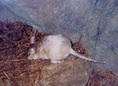
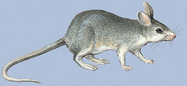
Both males and females are the same size, weighing 1.2 kg and measuring 30 to 35 cm in length. The tail is an additional 21 to 25 cm. Hypogeomys antimena has large ears, about 50 to 60 mm. (Nowak, 1999; Sommer, 2000)
Malagasy giant rats have harsh pelage, with its upper parts gray, grayish-brown, or reddish. The head is the darkest part of the fur. The limbs, hands, feet, and under parts are white. The dark tail is covered with stiff, short hairs. These rats possess a long hind foot with relatively well developed claws. (Nowak, 1999; Sommer, 2000)
- Other Physical Features
- endothermic
- bilateral symmetry
- Sexual Dimorphism
- sexes alike
-
- Range mass
- 1000 to 1500 g
- 35.24 to 52.86 oz
-
- Average mass
- 1200 g
- 42.29 oz
-
- Range length
- 300 to 350 mm
- 11.81 to 13.78 in
-
- Average length
- 300 mm
- 11.81 in
Reproduction
Hypogeomys antimena is monogamous until one mate dies. The male is sexually mature after one year and the female is sexually mature at two years. It is thought that males of this species are monogamous due to high predation. Males will defend their offspring from predators, putting themselves at higher predation risk than females. Pairs defend an exclusive territory throughout the year. Males rarely ever go into a neighboring territory. (Sommer, 2000)
- Mating System
- monogamous
Females of this species give birth during the rainy season, between December and April. An average litter contains one or two young. The average gestation period is from 102 to 138 days. The young stay in the burrow for the first 4 to 6 weeks of their lives, but regularly leave it after 4 weeks. Males leave the parental burrow and territory after one year and are able to breed immediately. Females are not sexually mature until two years of age, and they will usually stay with the parents through the next breeding season (until April) before they disperse. (Nowak, 1999; Sommer, 2001)
- Key Reproductive Features
- iteroparous
- seasonal breeding
- gonochoric/gonochoristic/dioecious (sexes separate)
- sexual
- fertilization
- viviparous
-
- Breeding interval
- Malagasy giant rats breed once yearly.
-
- Breeding season
- Malagasy giant rats breed during the rainy season, December to April.
-
- Range number of offspring
- 1 to 2
-
- Average number of offspring
- 1
-
- Average number of offspring
- 1
- AnAge
-
- Range gestation period
- 102 to 138 days
-
- Range weaning age
- 4 to 6 weeks
-
- Average weaning age
- 4 weeks
-
- Range time to independence
- 12 to 24 months
-
- Average age at sexual or reproductive maturity (female)
- 2 years
-
- Average age at sexual or reproductive maturity (female)
Sex: female - 730 days
- AnAge
- Average age at sexual or reproductive maturity (female)
-
- Average age at sexual or reproductive maturity (male)
- 1 years
-
- Average age at sexual or reproductive maturity (male)
Sex: male - 365 days
- AnAge
- Average age at sexual or reproductive maturity (male)
Females have obvious roles in parental care in all mammalian species. The female nurses the young, grooms them, and protects them from harm. Because the young are altricial, it takes some time before they are developed enough to leave the nest. The duration of lactation is approximtely 4 to 6 weeks in this species. (Nowak, 1999; Sommer, 2000)
Malagasy giant rats are intereting because of the level of male parental care they exhibit. Adults and juveniles have the same predators, and males increase their own predation risk to protect their young. Juvenile and adult males tend to wander farther away from the burrow than the females, increasing the male predation levels. Adult males will often follow their male offspring in order to protect them from predators.
Because it takes females two years to reach reproductive maturity, they often stay at home with their parents during this time. This is an extended period of interaction between female young and their parents. (Sommer, 2000)
- Parental Investment
- no parental involvement
- altricial
-
pre-fertilization
-
protecting
- female
-
protecting
-
pre-hatching/birth
-
provisioning
- female
-
protecting
- female
-
provisioning
-
pre-weaning/fledging
-
provisioning
- female
-
protecting
- male
- female
-
provisioning
-
pre-independence
-
protecting
- male
- female
-
protecting
- post-independence association with parents
Lifespan/Longevity
There is little information available information on the lifespan of H. antimena. The species likely has a relatively long lifespan because of high parental care and the long time to maturity.
-
- Range lifespan
Status: captivity - 12.6 (high) years
- AnAge
- Range lifespan
Behavior
Malagasy giant rats live in social family groups consisting of a male, female, their current offspring, and their offspring from the previous year. Young females stay close to the burrow site, whereas males travel farther to find a new territory. Males and females mate for life, and generally return to the same burrow year after year. Malagasy giant rats rarely leave their territories or enter another territory. They are primarily nocturnal. (Sommer, 2000)
- Key Behaviors
- terricolous
- fossorial
- saltatorial
- nocturnal
- motile
- sedentary
- territorial
- social
-
- Average territory size
- 3500 m^2
Home Range
Each monogamous couple defends a home range of about 3.5 ha. During the dry season, before the offspring are born, home ranges are larger than during the rainy season. Malagasy giant rats with young have a smaller range than those without young. (Sommer, 1997)
Communication and Perception
There is little available information on communication in H. antimena. However, they are mammals, and so it is likely that they use some visual signals, some vocalizations, and some scent cues in their communication. Tactile communication is probably important between mates and within the family.
Food Habits
Hypogeomys antimena is herbivorous. These rats are thought to feed mainly on fallen fruit, though some have been observed eating vegetation and invertebrates in captivity. (Nowak, 1999)
- Animal Foods
- insects
- Plant Foods
- leaves
- seeds, grains, and nuts
- fruit
Predation
There are two main predators that feed on H. antimena. These are a small herpestid found only on Madagascar, Cryptoprocta ferox (fossa), and the snake, Acrantophis dumerili (Dumeril's ground boa). One study found that 64.7% of the Malagasy giant rats killed during the dry season were taken by fossas, with the remaining 35.5% killed by Dumeril's ground boa.
It is thought that monogamy in H. antimena may be an antipredator adaptation, allowing greater protection of the young while they are waiting to reach maturity. (Sommer, 2000)
-
- Known Predators
-
- fossae (Cryptoprocta ferox)
- Dumeril's ground boas (Acrantophis dumerili)
Ecosystem Roles
Malagasy giant rats are an important prey species for both fossas and boas. They also help to aerate the soil through their fossorial behavior. (Sommer, 2000)
- Ecosystem Impact
- soil aeration
Economic Importance for Humans: Positive
There is no information of the benefits of Malagasy giant rats to humans. It is the largest endemic rodent of the island of Madagascar and is the only living species within the genus. It is monogamous, which makes this species of scientific interest. (Sommer and Tichy, 1999)
- Positive Impacts
- research and education
Economic Importance for Humans: Negative
There are no known adverse affects of Malagasy giant rats on humans.
Conservation Status
Hypogeomys antimena is among the most endangered mammal species of Madagascar. The habitat of Malagasy giant rats is threatened by slash and burn agriculture and logging. There is little information available on what is being done to help the species. (Sommer and Tichy, 1999)
-
- IUCN Red List
-
Endangered
More information
-
- IUCN Red List
-
Endangered
More information
-
- US Federal List
- No special status
-
- CITES
- No special status
Contributors
Nancy Shefferly (editor), Animal Diversity Web.
Jessica Cates (author), University of Wisconsin-Stevens Point, Chris Yahnke (editor, instructor), University of Wisconsin-Stevens Point.
Glossary
- Ethiopian
-
living in sub-Saharan Africa (south of 30 degrees north) and Madagascar.

- acoustic
-
uses sound to communicate
- altricial
-
young are born in a relatively underdeveloped state; they are unable to feed or care for themselves or locomote independently for a period of time after birth/hatching. In birds, naked and helpless after hatching.
- bilateral symmetry
-
having body symmetry such that the animal can be divided in one plane into two mirror-image halves. Animals with bilateral symmetry have dorsal and ventral sides, as well as anterior and posterior ends. Synapomorphy of the Bilateria.
- chemical
-
uses smells or other chemicals to communicate
- endothermic
-
animals that use metabolically generated heat to regulate body temperature independently of ambient temperature. Endothermy is a synapomorphy of the Mammalia, although it may have arisen in a (now extinct) synapsid ancestor; the fossil record does not distinguish these possibilities. Convergent in birds.
- fertilization
-
union of egg and spermatozoan
- forest
-
forest biomes are dominated by trees, otherwise forest biomes can vary widely in amount of precipitation and seasonality.
- fossorial
-
Referring to a burrowing life-style or behavior, specialized for digging or burrowing.
- frugivore
-
an animal that mainly eats fruit
- herbivore
-
An animal that eats mainly plants or parts of plants.
- island endemic
-
animals that live only on an island or set of islands.
- iteroparous
-
offspring are produced in more than one group (litters, clutches, etc.) and across multiple seasons (or other periods hospitable to reproduction). Iteroparous animals must, by definition, survive over multiple seasons (or periodic condition changes).
- monogamous
-
Having one mate at a time.
- motile
-
having the capacity to move from one place to another.
- native range
-
the area in which the animal is naturally found, the region in which it is endemic.
- nocturnal
-
active during the night
- saltatorial
-
specialized for leaping or bounding locomotion; jumps or hops.
- seasonal breeding
-
breeding is confined to a particular season
- sedentary
-
remains in the same area
- sexual
-
reproduction that includes combining the genetic contribution of two individuals, a male and a female
- social
-
associates with others of its species; forms social groups.
- soil aeration
-
digs and breaks up soil so air and water can get in
- tactile
-
uses touch to communicate
- temperate
-
that region of the Earth between 23.5 degrees North and 60 degrees North (between the Tropic of Cancer and the Arctic Circle) and between 23.5 degrees South and 60 degrees South (between the Tropic of Capricorn and the Antarctic Circle).
- terrestrial
-
Living on the ground.
- territorial
-
defends an area within the home range, occupied by a single animals or group of animals of the same species and held through overt defense, display, or advertisement
- visual
-
uses sight to communicate
- viviparous
-
reproduction in which fertilization and development take place within the female body and the developing embryo derives nourishment from the female.
References
Nowak, R. 1999. Walker's Mammals of the World. Baltimore and London: The John Hopkins University Press.
Sommer, S. 1997. Monogamy in Hypogeomys antimena, an endemic rodent of the deciduous dry forest in western Madagascar. Journal of Zoology-London, 241/2: 301-314.
Sommer, S. 2001. Reproductive ecology of the endangered monogamous Malagasy giant jumping rat, *Hypogeomys antimena*. Mammalian Biology, 66/2: 111-115.
Sommer, S. 2000. Sex-specific predation on a monogamous rat, *Hypogeomys antimena*. Animal Behavior, 59: 1087-1094.
Sommer, S., H. Tichy. 1999. Major histocompatibility complex (MHC) class II polymorphism and paternity in the monogamous *Hypogeomys antimena*, the endangered, largest endemic Malagasy rodent. Molecular Ecology, 8/8: 1259-1272.