Hyperolius viridiflavus

Geographic Range
Hyperolius viridiflavus, or African reed frogs, are a widespread species that occupy most suitable habitats (ponds and lakes) throughout northwestern Ethiopia, through Southern Sudan to western Kenya, Rwanda, Uganda, Burundi, northwestern Tanzania, northeastern Democratic Republic of Congo, and most likely eastern Central African Republic. (Schiøtz, et al., 2004)
Habitat
Hyperolius viridiflavus lives in the tropical African savanna. It is associated with emerging vegetation in savanna, grasslands, and at the margins of forests, lakes, rivers, and swamps, where these frogs may live in high densities. Hyperolius viridiflavus also lives in areas associated with humans, like cultivated land and gardens. This species breeds in a variety of aquatic habitats from very small to large ponds that may be permanent but are usually temporary. It ranges from low altitudes to 2,400 m in Ethiopia. (Schiøtz, et al., 2004; Schiøtz, 1999)
- Habitat Regions
- tropical
- terrestrial
- freshwater
- Terrestrial Biomes
- savanna or grassland
- rainforest
- Aquatic Biomes
- lakes and ponds
- rivers and streams
- temporary pools
- Other Habitat Features
- agricultural
- riparian
-
- Range elevation
- 2,400 (high) m
- ft
Physical Description
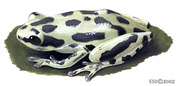
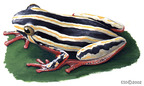
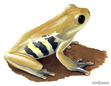
Hyperolius viridiflavus is a highly variable species that exhibits considerable polymorphism in color pattern. Some populations contain distinct morphs while in others there is gradation among extremes. It is widely regarded as a superspecies with more than fifty subspecies recognized. The subspecies are divided into two subgroups, parallelus and viridiflavus, based on variation in geographic range and coloration. There is some controversy about the taxonomy of H. viridiflavus that is discussed further in the other comments section.
Hyperolius viridiflavus is a small to medium sized frog species with an average mass of 2 g and body length of 15 to 30 mm, depending on the subspecies.
This species exhibits sexual dimorphism with males slightly smaller than females. Females are more colorful than males; their adult pattern is referred to as Phase F which is highly variable and contains several distinct morphs. Mature males frequently remain in the juvenile phase (Phase J), which ranges from brownish to green with paired light dorsolateral lines.
Members of this species have horizontal pupils, extensive webbing of the feet, a brief snout, and a very large, shagreened, gular flap. They lack an external metatarsal tubercle. Males have a large dilatable vocal sac. Females have a tranverse gular flap All subspecies have a subdermal dark bluish lateral streak caused by black pigmentation of the musculus obliquus abdominal muscle. This band is sometimes difficult to see if the sides of the frog are heavily pigmented. The band differs in placement between the sexes.
The subspecies have different coloration ranging from solid light green in the H. viridiflavus mwanzae to light brown in H. viridiflavus pantherinus to very brightly spotted and striped in H. viridiflavus tauniatus. The feet are frequently brightly colored. (Grafe, et al., 1992; Schiøtz, et al., 2004; Schiøtz, 1999)
- Other Physical Features
- ectothermic
- heterothermic
- bilateral symmetry
- polymorphic
- Sexual Dimorphism
- female larger
- sexes colored or patterned differently
- female more colorful
-
- Average mass
- 2 g
- 0.07 oz
-
- Range length
- 14 to 33 mm
- 0.55 to 1.30 in
Development
Hyperolius viridiflavus eggs hatch into tadpoles two to five days after laying, depending on the temperature of the water. Tadpoles take eight weeks to metamorphose into juveniles. Juveniles mature sexually in three to twelve months depending on the climate. Juvenile H. viridiflavus have a different coloration than adults, referred to as Phase J, which is light brown to green in color. Sexually mature males frequently maintain the juvenile coloration throughout adulthood. Phase F, the adult phase, is a highly variable color pattern with distinct morphs. (Bubac, 2009; Grafe and Lisenmair, 1989; Schiøtz, 1999)
- Development - Life Cycle
- metamorphosis
Reproduction
Hyperolius viridiflavus breeds during the wet season. The length of the breeding activity varies among subspecies but typically lasts several months. This species is polygynandrous. At the beginning of the breeding season, males migrate to bodies of water such as shallow ponds and form calling choruses to attract mates. Males maintain an individual calling space through combat. Males typically call at dusk and expend considerable energy trying to attract a mate. Females H. viridiflavus may select larger males as mates. Females approach males and initiate amplexus. Amplexus is axillary (the male holds the female around the armpits). The eggs are laid on vegetation under the water in ponds, lakes, and slow-moving streams. Female H. viridiflavus produce multiple clutches during the breeding season. (Bubac, 2009; Grafe and Lisenmair, 1989; Grafe, et al., 1992)
- Mating System
- polygynandrous (promiscuous)
Hyperolius viridiflavus breeds during the wet season. The length of the breeding activity varies among subspecies but typically lasts several months. Females have multiple clutches over the course of the breeding season. The average size of a clutch is 330 eggs. Eggs hatch after 2 to 5 days, and have metamorphosed into juveniles by 8 weeks of age. Juveniles of both sexes become sexually mature at 4 to 12 months old.
Hyperolius viridiflavus has been shown to experience protogyny, or female to male sex change, in the laboratory. The new males were able to fertilize the eggs of females. This likely occurs when the sex ratio within a population is heavily weighted towards males.
Hyperolius viridiflavus is semelparous, but may breed multiple times in its one breeding season. This reproductive strategy is largely due to climatic factors, as no adults have been documented surviving the annual, harsh dry season. Even in laboratory settings, individuals will senesce shortly after the breeding season. (Grafe and Lisenmair, 1989)
- Key Reproductive Features
- semelparous
- seasonal breeding
- gonochoric/gonochoristic/dioecious (sexes separate)
- sexual
- fertilization
- oviparous
-
- Breeding interval
- Female Hyperolius viridiflavus produce a new clutch every 10 to 20 days during the breeding season.
-
- Breeding season
- Hyperolius viridiflavus breed during the wet season which typically lasts several months.
-
- Range number of offspring
- 94 to 800
-
- Range time to hatching
- 2 to 5 days
-
- Range age at sexual or reproductive maturity (female)
- 4 to 12 months
-
- Range age at sexual or reproductive maturity (male)
- 4 to 12 months
Hyperolius viridiflavus provides no parental investment other than yolk and sperm for the eggs. (Bubac, 2009)
- Parental Investment
- no parental involvement
-
pre-fertilization
- provisioning
-
protecting
- female
Lifespan/Longevity
Hyperolius viridiflavus lives in an environment with widely fluctuating weather conditions. Shortly after the breeding season, these frogs face a severe dry season when they must rely on stored water. Adults do not handle this water shortage as well as juveniles. Adults do not generally survive the dry season, and in areas with prolonged dry seasons adults are probably annual. Linsenmair has never found an adult H. viridiflavus nitidulus that has survived the dry season in West Africa. Even under laboratory conditions, adult H. viridiflavus senesce quickly after the end of breeding activity. Males also experience high mortality because they are highly vocal and are therefore more susceptible to predation by acoustically-hunting predators. (Geise and Linsenmair, 1988; Grafe and Lisenmair, 1989)
-
- Typical lifespan
Status: wild - 1 (high) years
- Typical lifespan
Behavior
These frogs utilize exposed calling sites and males exhibit territorial behavior during the breeding season at these sites. In order to maintain an individual calling site, males engage in intense and prolonged combat. During the dry season, H. viridiflavus aestivates. Juveniles estivate on dry vegetation in exposed positions, instead of burrowing in the ground. This behavior is unique among frogs. Only juveniles are able to survive the dry season; they do so by reducing metabolism and adjusting water economy. Adults are not able to make these changes and generally do not survive the dry season. Juveniles do not move, eat, urinate, or defecate during the dry season. Juveniles must rely on stored water for several months during the dry season so they must minimize evaporative water loss. The dorsal and ventral skin of H. viridiflavus is differentiated in order to maximize water conservation and uptake. During the dry season the skin turns white because of built-up purine crystals in the skin. (Geise and Linsenmair, 1988; Grafe and Lisenmair, 1989)
- Key Behaviors
- saltatorial
- natatorial
- diurnal
- motile
- sedentary
- aestivation
- territorial
Home Range
There is no information on home range for this species.
Communication and Perception
Hyperolius viridiflavus has a melodic call like a xylophone that is more tonal than that of other species in this genus. Their calls are a characteristic part of the African night sounds. Males have an exposed calling site and form choruses in order to attract mates.
Hyperolius viridiflavus nitidulus males have two distinct calls, a mating call and a territorial call. The territorial call is longer and deeper than the mating call, and lasts from 0.28 to 0.36 seconds and has a frequency of 0.98 to 2.6 kHz. The mating call is a short metallic click that lasts between 0.10 to 0.24 s and has a frequency of 2.04 to 3.43 kHz, depending on the size of the frog. Female H. viridiflavus cannot make sounds.
Members of this species use keen visual perception in order to capture insects. They have bulging eyes and horizontal pupils. (Bubac, 2009; Grafe and Lisenmair, 1989; Schiøtz, et al., 2004; Schiøtz, 1999)
- Communication Channels
- acoustic
- Other Communication Modes
- choruses
Food Habits
Hyperolius viridiflavus are insectivores that feed on many different types of insects including flies in the genera Drosophila, Musca, Phormia, Lucilia, and Calliphora. The free-living tadpoles of Hyperolius viridiflavus nitidulus eat algae. (Bubac, 2009)
- Primary Diet
- carnivore
- Animal Foods
- insects
- Plant Foods
- algae
Predation
Hyperolius viridiflavus has a bright warning coloration that wards off predators. Dragonfly larvae, beetle larvae, turtles, ray-finned fish and water snakes eat the tadpoles of H. viridiflavus. (Bubac, 2009)
- Anti-predator Adaptations
- aposematic
-
- Known Predators
-
- Dragonfly larvae (Order Odonata)
- Beetle larvae (Order Coleoptera)
- Turtles (Order Testudines)
- Fish (Class Actinopterygii)
- Water snakes (Lycodonomorphus refutus)
Ecosystem Roles
Hyperolius viridiflavus is a predator of insects in the African savanna. It is also the prey of several species of animals. (Grafe and Lisenmair, 1989)
Economic Importance for Humans: Positive
This species is a part of the international pet trade although not at high levels. (Schiøtz, et al., 2004)
- Positive Impacts
- pet trade
Economic Importance for Humans: Negative
There are no known adverse effects of Hyperolius viridiflavus on humans. However, the Masai of East Africa have a superstition that their cattle will die if they eat these frogs because of their bright warning coloration. (Schiøtz, 1999)
Conservation Status
Hyperolius viridiflavus is listed as least concern by the International Union for Conservation of Nature because of its very wide distribution and tolerance of a broad range of habitats. It also likely has a large population size with no significant threats. This species is occasionally found in the international pet trade, but not at a high enough level to pose a threat to it. (Schiøtz, et al., 2004)
-
- IUCN Red List
-
Least Concern
More information
-
- IUCN Red List
-
Least Concern
More information
-
- CITES
- No special status
Other Comments
The taxonomy of Hyperolius viridiflavus is complex and has been the subject of much debate. Much of the difficulty has come from the dependence on dorsal color patterns as taxonomic characters. Schiøtz argues that H. viridiflavus is a superspecies with many subspecies that can be divided into two subgroups, parallelus and viridiflavus based on coloration and geographic range. Wieczorek has broken up the various subspecies of H. viridiflavus into ten full species based on mitochondrial DNA. Adult H. viridiflavus are unique because they can regenerate fully functional digits after amputation. (Richards, et al., 1975; Schiøtz, 1975; Wieczorek, et al., 2001)
Contributors
Jennifer Brady (author), University of Michigan-Ann Arbor, Phil Myers (editor), University of Michigan-Ann Arbor, Rachelle Sterling (editor), Special Projects.
Glossary
- Ethiopian
-
living in sub-Saharan Africa (south of 30 degrees north) and Madagascar.

- acoustic
-
uses sound to communicate
- agricultural
-
living in landscapes dominated by human agriculture.
- aposematic
-
having coloration that serves a protective function for the animal, usually used to refer to animals with colors that warn predators of their toxicity. For example: animals with bright red or yellow coloration are often toxic or distasteful.
- bilateral symmetry
-
having body symmetry such that the animal can be divided in one plane into two mirror-image halves. Animals with bilateral symmetry have dorsal and ventral sides, as well as anterior and posterior ends. Synapomorphy of the Bilateria.
- carnivore
-
an animal that mainly eats meat
- choruses
-
to jointly display, usually with sounds, at the same time as two or more other individuals of the same or different species
- diurnal
-
- active during the day, 2. lasting for one day.
- ectothermic
-
animals which must use heat acquired from the environment and behavioral adaptations to regulate body temperature
- external fertilization
-
fertilization takes place outside the female's body
- fertilization
-
union of egg and spermatozoan
- freshwater
-
mainly lives in water that is not salty.
- heterothermic
-
having a body temperature that fluctuates with that of the immediate environment; having no mechanism or a poorly developed mechanism for regulating internal body temperature.
- insectivore
-
An animal that eats mainly insects or spiders.
- marsh
-
marshes are wetland areas often dominated by grasses and reeds.
- metamorphosis
-
A large change in the shape or structure of an animal that happens as the animal grows. In insects, "incomplete metamorphosis" is when young animals are similar to adults and change gradually into the adult form, and "complete metamorphosis" is when there is a profound change between larval and adult forms. Butterflies have complete metamorphosis, grasshoppers have incomplete metamorphosis.
- motile
-
having the capacity to move from one place to another.
- natatorial
-
specialized for swimming
- native range
-
the area in which the animal is naturally found, the region in which it is endemic.
- oviparous
-
reproduction in which eggs are released by the female; development of offspring occurs outside the mother's body.
- pet trade
-
the business of buying and selling animals for people to keep in their homes as pets.
- polygynandrous
-
the kind of polygamy in which a female pairs with several males, each of which also pairs with several different females.
- polymorphic
-
"many forms." A species is polymorphic if its individuals can be divided into two or more easily recognized groups, based on structure, color, or other similar characteristics. The term only applies when the distinct groups can be found in the same area; graded or clinal variation throughout the range of a species (e.g. a north-to-south decrease in size) is not polymorphism. Polymorphic characteristics may be inherited because the differences have a genetic basis, or they may be the result of environmental influences. We do not consider sexual differences (i.e. sexual dimorphism), seasonal changes (e.g. change in fur color), or age-related changes to be polymorphic. Polymorphism in a local population can be an adaptation to prevent density-dependent predation, where predators preferentially prey on the most common morph.
- rainforest
-
rainforests, both temperate and tropical, are dominated by trees often forming a closed canopy with little light reaching the ground. Epiphytes and climbing plants are also abundant. Precipitation is typically not limiting, but may be somewhat seasonal.
- riparian
-
Referring to something living or located adjacent to a waterbody (usually, but not always, a river or stream).
- saltatorial
-
specialized for leaping or bounding locomotion; jumps or hops.
- seasonal breeding
-
breeding is confined to a particular season
- sedentary
-
remains in the same area
- semelparous
-
offspring are all produced in a single group (litter, clutch, etc.), after which the parent usually dies. Semelparous organisms often only live through a single season/year (or other periodic change in conditions) but may live for many seasons. In both cases reproduction occurs as a single investment of energy in offspring, with no future chance for investment in reproduction.
- sexual
-
reproduction that includes combining the genetic contribution of two individuals, a male and a female
- swamp
-
a wetland area that may be permanently or intermittently covered in water, often dominated by woody vegetation.
- terrestrial
-
Living on the ground.
- territorial
-
defends an area within the home range, occupied by a single animals or group of animals of the same species and held through overt defense, display, or advertisement
- tropical
-
the region of the earth that surrounds the equator, from 23.5 degrees north to 23.5 degrees south.
- tropical savanna and grassland
-
A terrestrial biome. Savannas are grasslands with scattered individual trees that do not form a closed canopy. Extensive savannas are found in parts of subtropical and tropical Africa and South America, and in Australia.
- savanna
-
A grassland with scattered trees or scattered clumps of trees, a type of community intermediate between grassland and forest. See also Tropical savanna and grassland biome.
- temperate grassland
-
A terrestrial biome found in temperate latitudes (>23.5° N or S latitude). Vegetation is made up mostly of grasses, the height and species diversity of which depend largely on the amount of moisture available. Fire and grazing are important in the long-term maintenance of grasslands.
- visual
-
uses sight to communicate
References
Bubac, C. 2009. "Hyperolius nitidulus" (On-line). AmphibiaWeb. Accessed April 05, 2010 at http://amphibiaweb.org/cgi/amphib_query?where-genus=Hyperolius&where-species=nitidulus.
Drewes, R. 1984. A phylogenetic analysis of the Hyperoliidae (Anura) : treefrogs of Africa, Madagascar, and the Seychelles Islands. San Francisco: California Academy of Sciences.
Geise, W., K. Linsenmair. 1988. Adaptations of the Reed Frog Hyperolius viridiflavis (Amphibia, Anura, Hyperoliidae) to Its Arid Environment. IV. Ecological significance of Water Economy with Comments on Thermoregulation and Energy Allocation. Oecologia, 77, No. 3: 327-338. Accessed April 05, 2010 at http://www.jstor.org/stable/4218784.
Grafe, T., R. Schmuckt, K. Lisenmair. 1992. Reproductive Energetics of the African Reed Frogs, Hyperolius viridiflavus and Hyperolius marmoratus. Physiological Zoology, 65: 153-171. Accessed February 20, 2010 at http://www.opus-bayern.de/uni-wuerzburg/volltexte/2009/3118/pdf/Linsenmair_Reproductive.pdf.
Grafe, T., K. Lisenmair. 1989. Protogynous Sex Change in the Reed Frog Hyperolius viridiflavus. Copeia, 4: 1024-1029. Accessed February 20, 2010 at http://www.jstor.org/pss/1445989.
Richards, C., B. Carlson, S. Rogers. 1975. Regeneration of digits and forelimbs in the Kenyan reed frog Hyperolius viridiflavus ferniquei Contribution number 52 from the Amphibian Facility. Supported in part by grants from the Muscular Dystrophy Associations of America and NIH Grant No. 1 PO6 RR 00572 to George W. Nace.. Journal of Morphology, 146: 431-445. Accessed February 21, 2010 at <http://hdl.handle.net/2027.42/50260>.
Schiøtz, A. 1975. The Treefrogs of Eastern Africa. Copenhagen: Steenstrupia.
Schiøtz, A. 1999. Treefrogs of Africa. Frankfurt am Main: Edition Chimaira.
Schiøtz, A. 2008. "Hyperolius viridiflavus" (On-line). AmphibiaWeb. Accessed February 20, 2010 at http://amphibiaweb.org/cgi/amphib_query?query_src=aw_lists_soundInclude_&where-genus=Hyperolius&where-species=viridiflavus.
Schiøtz, A., A. Channing, J. Poynton, M. Largen. 2004. "Hyperolius viridiflavus" (On-line). IUCN Red List of Threatened Species. Accessed February 20, 2010 at http://www.iucnredlist.org/apps/redlist/details/56219/0.
Schmuckt, R., K. Lisenmair. 1988. Adaptations of the reed frog Hyperolius viridiflavus (Amphibia, Anura, Hyperoliidae) to its arid environment. Oecologia, 75: 354-361. Accessed February 21, 2010 at http://www.jstor.org/pss/4218582.
Wieczorek, A., R. Drewes, A. Channing. 2001. Phylogenetic relationships within the Hyperolius viridiflavus complex (Anura: Hyperoliidae), and comments on taxonomic status. Amphibia-Reptilia, 22: 155-166. Accessed February 19, 2010 at http://www.ingentaconnect.com/content/brill/amre/2001/00000022/00000002/art00002.