HylidaeHylid Frogs, hylidés, hylidés arboricoles, Hylids, New World Tree Frogs, Treefrogs
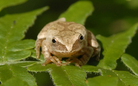


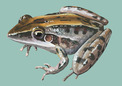
This extremely large, diverse family of tree frogs contains four subfamilies, in approximately 38 genera, with more than 700 species. Distribution is widespread, with hylids occurring throughout temperate North America and the neotropics, including the Caribbean islands. Hylids are also prevalent in Australia and Papua New Guinea. The genus Hyla is known from temperate Eurasia, Japan, and the northern tip of Africa.
The single known synapomorphy for Hylidae is claw-shaped terminal phalanges, which all hylids except Allophryne have. Like centrolenids and pseudids, hylids have an intercalary element between the last and second to last phalanges (which may be cartilaginous, ossified, or absent in Cyclorana). Being arboreal, toe pads are usually present. Within Hylidae, there are exceptions to almost every common morphological character. Most, but not all, hylids have a cartilaginous omosternum, a tooth-bearing maxilla and premaxilla, palatines but no parahyoid, horizontal pupils, webbed feet, and type IV tadpoles with denticles. One species (Gastrotheca guentheri) is the only frog known to have teeth on its lower jaw. Diploid number ranges from 22-30; size ranges from 17-140 mm.
Diversity of life histories is the rule in hylids. Though most hylids are arboreal, with strong jumping skills, aquatic and fossorial forms are also known in this group. During dry periods, fossorial hylids may form lipid cocoons around themselves to prevent desiccation. Some Australian treefrogs (Pelodryadinae) are fully terrestrial. Among the leaf frogs (Phyllomedusinae), eggs are usually deposited on leaves above ponds, where mothers keep them wet by urinating on them. Hatchlings fall into the water below. Tadpoles tend to school, and be filter-feeders. Hemiphractine hylid mothers carry eggs on their backs or in highly vascularized pouches. Most species exhibit direct development, while others go through a non-feeding tadpole stage. Frogs of the subfamily Hylinae exhibit the broadest range of life histories. Members of some genera lay eggs in bromeliads, in which the young develop through metamorphosis. In rare cases, mothers feed trophic eggs to their tadpoles. Tadpoles of some species are brightly colored, a rare trait among anurans. Other hyline genera have elaborate skull bones that form a kind of helmet. These casque-headed frogs use their bony heads to seal burrow entrances, thus reducing evaporative water loss.
Though common in much of their range, hylids are only rarely used by local people. One exception is the use of phyllomedusine skin toxins by aboriginal populations in South America. Although extensive glandular development is not typical among hylids, Phyllomedusa bicolor produces peptides that are used by hunters to induce euphoria, which is thought to improve hunting skills.
Hylids are unambiguously placed in the Neobatrachia, but relationships among the families of these "advanced" frogs is controversial at best. Most authors identify a superfamily, alternately called Bufonoidea or Hyloidea, which includes all the neobatrachians that are not Ranoids or Microhyloids. The group Bufonoidea is thus sketchy at best. Several researchers have presented evidence that Hylidae, Pseudidae, and Centrolenidae are a monophyletic group, based largely on the shared presence of intercalary elements. Separate research has proposed a hylid - centrolenid relationship (excluding Pseudidae), and others have proposed a hylid - centrolenid - bufonid clade. Furthermore, Hylidae itself is probably not a monophyletic group. Three of four subfamilies are well-diagnosed, but the fourth, Hylinae, is not. The hyline Allophryne has sometimes been placed in a separate family (Savage 1973), which might make Hylidae monophyletic. The Australian subfamily Pelodryadinae's relationship to the other hylids is also questionable.
Several fossil hylids are known. Miocene and Pliocene fossils are known from the Pelodryadinae subfamily in Australia, and Hylinae fossils are known from as far back as the Oligocene in North America. Additional fossils are known from Europe and South America. No fossils are known from the other two subfamilies.
Adler, K., and T. R. Halliday, editors. 1986. Reptiles and Amphibians. Torstar Books Inc., New York.
Cannatella, D. 1996. Hylidae: Tree of Life. (Website.) http://tolweb.org/tree?group=Hylidae&contgroup=Neobatrachia
Cannatella, D., L. Ford, and L. Bockstanz. 1996. Neobatrachia: Tree of Life. (Website.) http://tolweb.org/tree?group=Neobatrachia&contgroup=Salientia
Cogger, H. G., and R. G. Zweifel, editors. 1998. Encyclopedia of Reptiles and Amphibians, 2nd edition. Academic Press, San Diego.
Duellman, W. E., and L. Trueb. 1986. Biology of Amphibians. Johns Hopkins University Press, Baltimore, MD.
Pough, F. H., R. M. Andrews, J. E. Cadle, M. L. Crump, A. H. Savitzky, and K. D. Wells. 1998. Herpetology. Prentice-Hall, Inc., Upper Saddle River, NJ.
Savage, J. 1973. The geographic distribution of frogs: patterns and predictions. Pages 352-445 in J. L. Vial, editor. Evolutionary Biology of the Anurans: Contemporary Research on Major Problems. University of Missouri Press, Columbia.
Stebbins, R. C., and N. W. Cohen. 1995. A natural history of amphibians. Princeton University Press, Princeton.
Zug, G. R. 1993. Herpetology: an introductory biology of amphibians and reptiles. Academic Press, San Diego.
Contributors
Heather Heying (author).
Glossary
- bilateral symmetry
-
having body symmetry such that the animal can be divided in one plane into two mirror-image halves. Animals with bilateral symmetry have dorsal and ventral sides, as well as anterior and posterior ends. Synapomorphy of the Bilateria.
- ectothermic
-
animals which must use heat acquired from the environment and behavioral adaptations to regulate body temperature
- metamorphosis
-
A large change in the shape or structure of an animal that happens as the animal grows. In insects, "incomplete metamorphosis" is when young animals are similar to adults and change gradually into the adult form, and "complete metamorphosis" is when there is a profound change between larval and adult forms. Butterflies have complete metamorphosis, grasshoppers have incomplete metamorphosis.
- motile
-
having the capacity to move from one place to another.