Hyla squirellaSquirrel Treefrog

Geographic Range
Squirrel treefrogs (Hyla squirella) are native to the Atlantic Coastal Plain region of the southeastern United States, including parts of Texas, Louisiana, Mississippi, Alabama, Georgia, Florida, South and North Carolina, and Virginia. Squirrel treefrogs range as far north as southeastern Virginia, as far south as Florida, and as far west as eastern Texas. There is a disjunct population in northern Virginia, near Washington, D.C.
Squirrel treefrogs are non-native to parts of the Bahamas, where they were introduced by humans. (Hammerson and Hedges, 2004; Hether and Hoffman, 2012)
- Biogeographic Regions
- nearctic
Habitat
Squirrel treefrogs are partially arboreal, terrestrial, and aquatic, depending on the habitat, time of year, and life stage. They use a variety of terrestrial habitats including fields, urbanized areas, pine and oak groves, and open wooded areas. They also use freshwater habitats such as coastal swamps, wetlands, temporary pools, ponds, rivers, and streams. Squirrel treefrogs select habitats that have suitable shelter, food sources, and moisture levels. They seek shelter in bark grooves or other crevices on the exterior or interior of trees. Squirrel treefrogs are ectothermic, with body temperatures ranging from 19 to 25 °C outside of water.
Squirrel treefrogs hatch from eggs in ponds or other bodies of freshwater. They begin as tadpoles and undergo metamorphosis to become terrestrial adults. Adults typically live in forests or fields, but return to bodies of water to breed and lay eggs; this habit is known as philopatry. Squirrel treefrogs typically lay their eggs in areas with aquatic vegetation to help conceal eggs and hatched tadpoles from predators. (Babbitt and Tanner, 1997; Binckley and Resetarits, 2002; Binckley and Resetarits, 2007; Hether and Hoffman, 2012; Lannoo, 2005)
- Habitat Regions
- terrestrial
- freshwater
- Terrestrial Biomes
- savanna or grassland
- forest
- Aquatic Biomes
- lakes and ponds
- rivers and streams
- temporary pools
- coastal
Physical Description
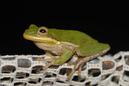
Squirrel treefrogs range in color from solid green to brown. Some individuals also have splotches of darker coloration in the same color range. One of the key features that distinguishes squirrel treefrogs from related species is the presence of a light stripe on their upper jaws. This stripe is typically bright yellow, but varies between individuals, with some squirrel treefrogs having white or orange stripes. Squirrel treefrog individuals can also change color, typically between lighter and darker shades of green or brown, depending on temperature, time of day, and other environmental factors.
Males and females look the same throughout most of the year. However, during mating season, male frogs have a prominent, dark green or brown vocal sac.
Adult squirrel treefrogs weigh 1.80 to 2.82 g, with water accounting for over 80% of their total body mass. They lack tails and have an average snout-vent length (SVL) of 30 mm. Juvenile squirrel treefrogs or recently hatched tadpoles are generally no more than 20 mm in length. (Buchanan, 1992; Buchanan, 1994; Farrell and MacMahon, 1969; John-Adler, et al., 1988)
- Other Physical Features
- ectothermic
- bilateral symmetry
- Sexual Dimorphism
- male more colorful
-
- Range mass
- 1.80 to 2.82 g
- 0.06 to 0.10 oz
-
- Average mass
- 3.125 g
- 0.11 oz
-
- Average length
- 30 mm
- 1.18 in
Development
Female squirrel treefrogs lay approximately 1,000 eggs in each clutch. After eggs hatch, it takes about 40 to 50 days for squirrel treefrog tadpoles to undergo complete metamorphosis. The duration of metamorphosis depends on the amount of resources available in their habitat; with more food, metamorphosis proceeds more rapidly. Based on the amount of resources available, treefrogs gain an average of 0.25 to 0.50 g in mass during metamorphosis.
After they undergo metamorphosis, squirrel treefrogs enter a juvenile phase, where they migrate from the bodies of water in which where they were born to terrestrial habitats. Squirrel treefrogs reach sexual maturity around 3 years of age. They exhibit indeterminate growth, meaning they continue to grow in size throughout their life. (Beck, 1997; Lannoo, 2005)
- Development - Life Cycle
- metamorphosis
- indeterminate growth
Reproduction
Male squirrel treefrogs return to breeding areas first and begin to produce mating calls to attract females. Female squirrel treefrogs choose mates based on visual and auditory cues; they are more likely to mate with males that have faster mating call rates. Females are also more likely to mate with males who have larger stripes along their sides, known as lateral stripes. However, faster call rates are generally sufficient to attract females regardless of lateral stripe size.
Female squirrel treefrogs generally only produce one clutch of eggs per year. Depending on the success of their calls and lateral stripe size, males may mate with multiple females during one breeding season. Conversely, since females generally only produce one clutch per year, they only mate with one male in a given breeding season. (Lannoo, 2005; Taylor, et al., 2007; Taylor, et al., 2011)
- Mating System
- polygynous
Squirrel treefrogs breed on warm, rainy nights in temporary pools, such as flooded woodlands or roadside ditches. Their breeding season lasts from April to August. Males perch on short vegetation, around 30 to 60 cm above the water, and produce mating calls to attract mates.
Females lay clutches of 900 to 1,200 eggs, which hatch after 1 to 2 days. Often, females lay their eggs in clusters in highly vegetated areas of temporary pools. By laying their eggs in vegetative cover, squirrel treefrogs reduce the chances of predators detecting eggs before they hatch. Survival rates of the egg clutches are often dependent on predation rates. Females will generally only reproduce once a year.
After hatching, it takes 40 to 50 days before squirrel treefrog tadpoles begin to metamorphose. At the time of metamorphosis, squirrel treefrogs weigh 0.25 to 0.52 g. Squirrel treefrogs reach sexual maturity after 3 years, on average. (Binckley and Resetarits, 2002; Lannoo, 2005; Taylor, et al., 2007; Taylor, et al., 2011)
- Key Reproductive Features
- seasonal breeding
- gonochoric/gonochoristic/dioecious (sexes separate)
- sexual
- fertilization
- oviparous
-
- Breeding interval
- Squirrel treefrogs breed seasonally during rainy periods.
-
- Breeding season
- On average, squirrel treefrogs breed from April to August.
-
- Range number of offspring
- 900 to 1,200
-
- Range time to hatching
- 24 to 48 hours
-
- Average time to independence
- 0 minutes
-
- Average age at sexual or reproductive maturity (female)
- 3 years
-
- Average age at sexual or reproductive maturity (male)
- 3 years
Squirrel treefrogs do not exhibit any parental investment beyond the acts of mating and egg-laying. Once females release their eggs, they leave their eggs to develop without further support. To maximize chances of survival for their eggs, females often choose bodies of water covered with vegetation and free from predators. (Binckley and Resetarits, 2002; Lannoo, 2005; Taylor, et al., 2007; Taylor, et al., 2011)
- Parental Investment
- no parental involvement
-
pre-hatching/birth
-
provisioning
- female
-
protecting
- female
-
provisioning
Lifespan/Longevity
There is limited information regarding lifespans of squirrel treefrogs in the wild. The longest known lifespan of a squirrel treefrog in captivity was 8.5 years. (Lannoo, 2005)
-
- Range lifespan
Status: captivity - 8.5 (high) years
- Range lifespan
-
- Average lifespan
Status: captivity - 8.5 years
- AnAge
- Average lifespan
Behavior
Squirrel treefrogs are mobile throughout their life. As tadpoles, they use their tails to swim. As adults, they are saltatorial, but can also swim, propelling themselves with their hind legs. Squirrel treefrogs are primarily arboreal as adults. Squirrel treefrogs are nocturnal, with highest activity rates occurring at times when there is less than 0.003 lux of illumination available. Once environmental illumination is greater than 0.003 lux, squirrel treefrogs enter daily torpor, which lasts from dawn until dusk. Squirrel treefrogs are more active in rainy conditions.
Squirrel treefrogs migrate to temporary breeding pools for breeding purposes only. During breeding season, they are social with members of their own species and other frog species. Squirrel treefrogs occasionally mate with other species in the genus Hyla, but these hybrid mating efforts produce no viable offspring. (Binckley and Resetarits, 2002; Hether and Hoffman, 2012; Lannoo, 2005; Marsh and John-Alder, 1994)
- Key Behaviors
- arboreal
- saltatorial
- natatorial
- nocturnal
- motile
- daily torpor
- social
Home Range
There is limited information regarding home range sizes or territory sizes of squirrel treefrogs. However, a study in 2005 proposed that squirrel treefrogs develop temporary home ranges, which they occupy for several weeks at a time. (Buchanan, 1992; Lannoo, 2005)
Communication and Perception
Squirrel treefrogs are nocturnal and have large eyes that are sensitive to large amounts of light. They are most active when environmental illuminance is less than 0.0003 lux. They are most active right after dusk and just before dawn, when light levels are just below this threshold.
Squirrel treefrogs communicate with each other by means of visual stimuli even though they are active at times when there is little light. In particular, they use visual stimuli to communicate with prospective mates. Males have lateral stripes that get larger with total body size. Females are more likely to mate with males that have larger stripes. Other forms of visual communication in squirrel treefrogs include limb motions, abdominal inflation, the display of certain color patterns, and the presence or absence of vocal sacs.
Squirrel treefrogs also use auditory stimuli to communicate. Females select mates based on the quality of their mating calls, which males produce using a vocal sac in their throats. Mating calls are important for females to locate males and play a role in sexual selection. Females are more likely to select mates that produce more rapid mating calls. Males aggregate in large groups, called choruses, at temporary pools where mating occurs. Their mating calls sound like a croak that progressively increases in frequency. Typically, the acoustic characteristics of their calls, such as frequency or duration, change as their sexual excitement changes. On average, the smaller the snout-vent length (SVL) of an individual male, the lower the frequency of its call. Call frequency ranges from 1.2 to 3.6 kHz. (Blair, 1958; Buchanan, 1992; Taylor, et al., 2007; Taylor, et al., 2011)
- Other Communication Modes
- choruses
Food Habits
Squirrel treefrogs are insectivores as adults, eating a range of arthropods such as flies (order Diptera), beetles (order Coleoptera), grasshoppers and crickets (order Orthoptera), and spiders (order Araneae). Specific diets likely vary depending on their habitat and geographic location.
Squirrel treefrog tadpoles have a more complex method of feeding. They are suspension feeders, eating algae, zooplankton, and detritus suspended in water or on substrates such as submerged rocks and tree branches. (Babbitt and Tanner, 1997; Lannoo, 2005; Taylor, et al., 2007)
- Primary Diet
- carnivore
- Animal Foods
- insects
Predation
Predators of adult squirrel treefrogs include eastern ribbon snakes (Thamnophis sauritus) as well as other reptiles, amphibians, small mammals, and birds. Squirrel treefrogs are small in size and capable of changing color, often between shades of green, brown, or grey. The combination of small size and cryptic camouflage helps squirrel treefrogs avoid detection by predators.
Squirrel treefrog tadpoles serve as prey for giant water bugs (Lethocerus americanus), larval green darners (Anax junius) and other larval dragonflies (order Odonata), tadpoles of other frog species, and predatory fish. Although squirrel treefrog tadpoles not have any specific defense mechanisms against predators, they develop in temporary pools that are often covered with vegetation. Tadpoles can avoid predators by hiding in vegetative clutter or by swimming away, although the limited size of most breeding pools limits their ability to escape if detected. (Babbitt and Tanner, 1997; Binckley and Resetarits, 2002; Lannoo, 2005)
- Anti-predator Adaptations
- cryptic
-
- Known Predators
-
- Eastern ribbon snakes (Thamnophis sauritus)
- Green darners (Anax junius)
- Giant water bugs (Lethocerus americanus)
Ecosystem Roles
Squirrel treefrogs consume a variety of insects and potentially play a role in controlling their populations. Squirrel treefrog tadpoles serve as prey for aquatic insect larvae, predatory fishes, and potentially other amphibians. Adults serve as prey for terrestrial vertebrates, such as snakes, birds, and small mammals.
Parasites in squirrel treefrogs are rarely reported. However, a study in 1951 reported at least 2 known parasitic oligochaete: Schmardaella lutzi was found in their ureters and Nais bauchiensis was found in their eyes. THe same study also reported the discovery of a new parasitic oligochaete in the ureters of squirrel treefrogs, originally named Schmardaella hylae but currently classified as Dero hylae. These parasites can affect the reproductive success of squirrel treefrogs. (Goodchild, 1951; Lannoo, 2005)
- Parasitic oligochaetes (Schmardaella lutzi)
- Parasitic oligochaetes (Nais bauchiensis)
- Parasitic oligochaetes (Dero hylae)
Economic Importance for Humans: Positive
Squirrel treefrogs are not known to provide any economic benefits to humans. Because they consume insects, they may play a role in controlling populations of horticultural pests. However, more research is needed to assess their contribution to insect population control.
Economic Importance for Humans: Negative
Squirrel treefrogs are not known to have any negative economic impacts on humans.
Conservation Status
Squirrel treefrogs are relatively abundant throughout their geographic range. They are considered a species of "Least Concern" on the IUCN Red List. They have no special status on the United States Endangered Species List or in the CITES appendices, and are not listed on any other federal or state conservation lists.
Squirrel treefrogs are well-adapted to moderate habitat changes, such as the development of new temporary pools. There are no immediate range-wide threats to their populations. There are reports of areas in Virginia where squirrel treefrog populations have become locally extinct, though the reason is unknown. It is possible that urbanization negatively impacts their populations, since urban development leads to natural habitat loss and increased road mortality. There are no known studies that have estimated the population size of squirrel treefrogs. (Hammerson and Hedges, 2004; Lannoo, 2005)
-
- IUCN Red List
-
Least Concern
More information
-
- IUCN Red List
-
Least Concern
More information
-
- US Federal List
- No special status
-
- CITES
- No special status
-
- State of Michigan List
- No special status
Contributors
Buzz Custer (author), Radford University, Karen Powers (editor), Radford University, April Tingle (editor), Radford University, Emily Clark (editor), Radford University, Cari Mcgregor (editor), Radford University, Jacob Vaught (editor), Radford University, Genevieve Barnett (editor), Colorado State University, Galen Burrell (editor), Special Projects.
Glossary
- Nearctic
-
living in the Nearctic biogeographic province, the northern part of the New World. This includes Greenland, the Canadian Arctic islands, and all of the North American as far south as the highlands of central Mexico.

- acoustic
-
uses sound to communicate
- arboreal
-
Referring to an animal that lives in trees; tree-climbing.
- bilateral symmetry
-
having body symmetry such that the animal can be divided in one plane into two mirror-image halves. Animals with bilateral symmetry have dorsal and ventral sides, as well as anterior and posterior ends. Synapomorphy of the Bilateria.
- carnivore
-
an animal that mainly eats meat
- choruses
-
to jointly display, usually with sounds, at the same time as two or more other individuals of the same or different species
- coastal
-
the nearshore aquatic habitats near a coast, or shoreline.
- cryptic
-
having markings, coloration, shapes, or other features that cause an animal to be camouflaged in its natural environment; being difficult to see or otherwise detect.
- ectothermic
-
animals which must use heat acquired from the environment and behavioral adaptations to regulate body temperature
- external fertilization
-
fertilization takes place outside the female's body
- fertilization
-
union of egg and spermatozoan
- forest
-
forest biomes are dominated by trees, otherwise forest biomes can vary widely in amount of precipitation and seasonality.
- freshwater
-
mainly lives in water that is not salty.
- indeterminate growth
-
Animals with indeterminate growth continue to grow throughout their lives.
- insectivore
-
An animal that eats mainly insects or spiders.
- introduced
-
referring to animal species that have been transported to and established populations in regions outside of their natural range, usually through human action.
- marsh
-
marshes are wetland areas often dominated by grasses and reeds.
- metamorphosis
-
A large change in the shape or structure of an animal that happens as the animal grows. In insects, "incomplete metamorphosis" is when young animals are similar to adults and change gradually into the adult form, and "complete metamorphosis" is when there is a profound change between larval and adult forms. Butterflies have complete metamorphosis, grasshoppers have incomplete metamorphosis.
- motile
-
having the capacity to move from one place to another.
- natatorial
-
specialized for swimming
- native range
-
the area in which the animal is naturally found, the region in which it is endemic.
- nocturnal
-
active during the night
- oviparous
-
reproduction in which eggs are released by the female; development of offspring occurs outside the mother's body.
- polygynous
-
having more than one female as a mate at one time
- saltatorial
-
specialized for leaping or bounding locomotion; jumps or hops.
- seasonal breeding
-
breeding is confined to a particular season
- sexual
-
reproduction that includes combining the genetic contribution of two individuals, a male and a female
- social
-
associates with others of its species; forms social groups.
- suburban
-
living in residential areas on the outskirts of large cities or towns.
- swamp
-
a wetland area that may be permanently or intermittently covered in water, often dominated by woody vegetation.
- tactile
-
uses touch to communicate
- terrestrial
-
Living on the ground.
- tropical savanna and grassland
-
A terrestrial biome. Savannas are grasslands with scattered individual trees that do not form a closed canopy. Extensive savannas are found in parts of subtropical and tropical Africa and South America, and in Australia.
- savanna
-
A grassland with scattered trees or scattered clumps of trees, a type of community intermediate between grassland and forest. See also Tropical savanna and grassland biome.
- temperate grassland
-
A terrestrial biome found in temperate latitudes (>23.5° N or S latitude). Vegetation is made up mostly of grasses, the height and species diversity of which depend largely on the amount of moisture available. Fire and grazing are important in the long-term maintenance of grasslands.
- urban
-
living in cities and large towns, landscapes dominated by human structures and activity.
- visual
-
uses sight to communicate
References
Babbitt, K., G. Tanner. 1997. Effects of cover and predator identity on predation of Hyla squirella tadpoles. Journal of Herpetology, 31/1: 128-130.
Baber, M., K. Babbitt. 2003. The relative impacts of native and introduced predatory fish on a temporary wetland tadpole assemblage. Oecologia, 136/2: 289-295.
Beck, C. 1997. Effect of changes in resource level on age and size at metamorphosis in Hyla squirella. Oecologia, 112/2: 187-192.
Binckley, C., W. Resetarits. 2002. Reproductive decisions under threat of predation: Squirrel treefrog (Hyla squirella) responses to banded sunfish (Enneacanthus obesus). Oecologia, 130/1: 157-161.
Binckley, C., W. Resetarits. 2007. Effects of forest canopy on habitat selection in treefrogs and aquatic insects: Implications for communities and metacommunities. Oecologia, 153/4: 951-958.
Blair, W. 1958. Mating call in the speciation of anuran amphibians. The American Naturalist, 92/862: 27-51.
Buchanan, B. 1992. Bimodal nocturnal activity pattern of Hyla squirella. Journal of Herpetology, 26/4: 521-522.
Buchanan, B. 1994. Sexual dimorphism in Hyla squirella: Chromatic and pattern variation between the sexes. Copeia, 1994/3: 797-802.
Farrell, M., J. MacMahon. 1969. An eco-physiological study of water economy in eight species of tree frogs (Hylidae). Herpetologica, 25/4: 279-294.
Goodchild, C. 1951. A new endoparasitic oligochaete (Naididae) from a North American tree-toad, Hyla squirella lateral, 1802. The Journal of Parasitology, 37/2: 205-211.
Hammerson, G., B. Hedges. 2004. "Hyla squirella" (On-line). The IUCN Red List of Threatened Species. Version 2014.3. Accessed February 05, 2012 at www.iucnredlist.org/details/summary/55662/0.
Hether, T., E. Hoffman. 2012. Machine learning identifies specific habitats associated with genetic connectivity in Hyla squirella. Evolutionary Biology, 25/6: 1039-1052.
John-Adler, H., P. Morin, S. Lawler. 1988. Thermal physiology, phenology, and distribution of tree frogs. The American Naturalist, 132/4: 506-520.
Lannoo, M. 2005. Amphibian Declines: The Conservation Status of United States Species. Los Angeles, California: University of California Press.
Marsh, R., H. John-Alder. 1994. Jumping performance of Hylid frogs measured with high-speed cine film. The Journal of Experimental Biology, 188: 131-141.
McCoy, M., B. Bolker. 2008. Trait-mediated interactions: Influence of prey size, density and experience. Journal of Animal Ecology, 77/3: 478-486.
Nigrelli, R. 2012. Section of biology: Some longevity records of vertebrates. Transactions of the New York Academy of Sciences, 16/6: 296-299.
Rice, K., J. Waddle, M. Miller, M. Crockett, F. Mazzotti, H. Percival. 2011. Recovery of native tree frogs after removal of non indigenous Cuban tree frogs, Osteopilus septentrionalis. Herpetologica, 67/2: 105-117.
Taylor, R., B. Klein, M. Ryan. 2011. Inter-signal interaction and uncertain information in anuran multimodal signals. Current Zoology, 57/2: 153-161.
Taylor, R., B. Buchanan, J. Doherty. 2007. Sexual selection in the squirrel treefrog Hyla squirella: The role of multimodal cue assessment in female choice. Animal Behaviour, 74/6: 1753-1763.