Hyla chrysoscelisCope's Gray Treefrog

Geographic Range
Both gray treefrog species, Hyla versicolor and Hyla chrysoscelis, are native to North America. Because they are physically indistinguishable (see below), only their shared range has so far been fully determined. Together they inhabit a roughly rectangular range from southern Ontario and Maine, westward to central Texas, northwest to Manitoba, and northern Florida. More studies are necessary to delineate where the two species overlap. (Collins and Conant, 1998)
Generally, Cope’s gray treefrog (H. chrysoscelis) is more common in the western and southern quadrants of the shared range. However, gray treefrog species are extremely variable in their distribution pattern. For instance, eastern gray treefrogs (H. versicolor) are common in the eastern Great Lakes region, including southern Michigan; however, both species share the same breeding ponds in Wisconsin and northern Michigan. (Harding, 1997)
Habitat
Cope's gray treefrogs inhabit all elevations of wooded areas near temporary and permanent waters in such diverse surroundings as swamps, ponds, lakes, old fields, thickly wooded suburban neighborhoods, farm woodlots, and mixed or deciduous forests. During the summer months, they rest in damp rotten logs or hollow trees emerging to feed. In winter, Cope's gray treefrogs hibernate on land, and maybe found under woody debris logs, roots and leaf litter. (Harding, 1997)
- Habitat Regions
- temperate
- terrestrial
- freshwater
- Terrestrial Biomes
- forest
- Aquatic Biomes
- lakes and ponds
- temporary pools
- Wetlands
- swamp
- Other Habitat Features
- suburban
- agricultural
- riparian
Physical Description
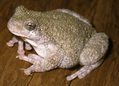
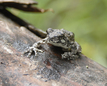
Cope's gray treefrogs typically measure 3.2 to 5.1 cm long. The largest gray treefrog holds a record of 6 cm. There is no sexual dimorphism. The dorsal surface of gray treefrogs is rough and lightly sprinkled with warts, although smoother than most toads. The large toepads produce mucous to adhere to surfaces, including smooth bark or man-made structures, and are characteristic of the family Hylidae.
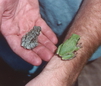
The color of gray treefrogs varies. Factors affecting coloration are substrate, season, and humidity. Shades of gray are most common, with black blotches on the back. Variations of brown, green, and pearl-gray colors have been noted. Green colors are more prominent during the breeding season and in yearling frogs. Usually, there is a white mark beneath the eye. In the region of the groin, the ventral skin on the hind legs may appear orange to golden-yellow with black speckles. The remainder of the belly is white. If the coloration is in question, place the treefrog in a box, allow it to sit quietly, and later re-examine the specimen.
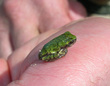
Yearling frogs are about half the size of the older H. chrysoscelis, but otherwize have the same physical characteristics. Gray treefrogs continue to grow each year until they achieve the physical limit of the species. (Collins and Conant, 1998; Harding, 1997)
Both gray treefrog species possess the same larval traits, but H. versicolor was used to exemplify the tadpole stage in A Field Guide to Reptiles and Amphibians of East Central North America (Collins and Conant 1998). These data, therefore, although applicable to both species, are technically derived from H. versicolor.
The tadpoles are small, but colorful, measuring 3.2 cm to 3.8 cm. The tip of the tail is well-defined with a 5 mm narrow tip. The oral disc is comprised of 2 upper and 3 lower labial tooth rows, serrated jaws, and an overhanging upper jaw. The intestinal coil is also visible. The background color is light green to yellow. The tallest section of the tail fin is the middle, and heavy black dots are scattered along the margin on a red or orange background. (Collins and Conant, 1998; Harding, 1997)
- Other Physical Features
- ectothermic
- heterothermic
- bilateral symmetry
- Sexual Dimorphism
- sexes alike
-
- Range length
- 3.2 to 6 cm
- 1.26 to 2.36 in
Development
Depending upon the water temperature, Hyla chrysoscelis larvae (tadpoles) hatch from eggs in three to seven days. They transform into froglets after growing for six to eight weeks. The young frogs are approximately 1.5 cm in snout to vent length. The larval and adult rate of growth is dependent upon the availability of food, and on stress induced by the presence of predators.
Sex determination in amphibians is genetic. However, if larvae are treated with estrogen, then hormonal sex reversal is possible after metamorphosis. Hyla chrysoscelis follow the XX/XY pattern of heterogamety. (Harding, 1997; Skelly, 1992; Wallace, et al., 1999; Harding, 1997; Skelly, 1992; Wallace, et al., 1999)
- Development - Life Cycle
- metamorphosis
Reproduction
In the Great Lakes region, breeding choruses of gray treefrogs begin in late April to early May, after the evening air temperature rises above 15°C. Because of this temperature dependence, timing of breeding choruses varies throughout the range. Interludes of cold weather may temporarily halt male gray treefrog calls. Although these frogs end their hibernation in the early months of spring, they do not have the energy reserves to call yet. Warm, cloudy nights, from dusk to midnight, produce the most intense choruses.
Generally, the breeding chorus lasts for several weeks. Sometimes, the breeding calls are continued into late June or early July, depending upon local temperatures and unusual weather phenomena.
The two gray treefrog species, although sympatric in many areas and physically similar, do not hybridize due to the different pulse rate and pitch between the two calls. This creates a mating barrier, as females do not approach males with species inappropriate calls. (Harding, 1997)
Mating in this species is polygynous. Female choice dominates the mating scheme of gray treefrogs, since the female approaches the male with the most prolonged and frequent calls. If the male detects a nearby female, he will also further entice her with a “courtship call.” This call is longer and more emphatic than the usual advertisement call. Successful calling results in amplexus, the male mounting the female and releasing sperm to fertilize the female's eggs as she releases them into the pond. (Harding, 1997)
Cope's gray treefrogs employ their unique call from the safety of vegetation next to the shallow breeding sites, preferably in tree branches that overhang the water. Males aggressively defend their territories, using vocalizations to outline territorial boundaries. Satellite males, often in their first breeding season or otherwise disadvantaged, do not call to save energy. Instead, they lie in wait near a calling male and try to intercept females by claiming the caller’s position after he moves away. Each female only visits the breeding site once per season to lay her eggs.
During the last weeks of the breeding season, occasional calls may still be heard as the males slowly retreat from the shoreline and disappear into the foliage. Rare calls may still be heard in the trees in late summer or fall, yet they are unrelated to mating, and occur more often during rain showers. Normally, there is an unequal sex ratio among treefrog populations. Since calling males are more likely to be located by predators, treefrog populations show a female bias. (Harding, 1997)
- Mating System
- polygynous
Females lay eggs once per year. Males, if successful, may fertilize multiple clutches. A single egg mass may contain 1,000 to 2,000 eggs. Almost immediately upon laying, the large egg mass breaks into small, loose egg clusters of 10 to 40 eggs. These attach to plants or other structures within the pond. Depending upon the water temperature, the tadpoles hatch in three to seven days. Tadpoles are independent from the time of hatching. Metamorphosis occurs at about 6 weeks of age. Sexual maturity is reached by the age of 2 years. (Harding, 1997)
- Key Reproductive Features
- iteroparous
- seasonal breeding
- gonochoric/gonochoristic/dioecious (sexes separate)
- sexual
- fertilization
- oviparous
-
- Breeding interval
- Treeforgs breed once yearly.
-
- Breeding season
- Late April to May or when the temperature rises above 15°C
-
- Range number of offspring
- 1000 to 2000
-
- Range time to hatching
- 3 to 7 days
-
- Average age at sexual or reproductive maturity (female)
- 2 years
-
- Average age at sexual or reproductive maturity (female)
Sex: female - 730 days
- AnAge
- Average age at sexual or reproductive maturity (female)
-
- Average age at sexual or reproductive maturity (male)
- 2 years
-
- Average age at sexual or reproductive maturity (male)
Sex: male - 547 days
- AnAge
- Average age at sexual or reproductive maturity (male)
Parental investment is limited. Females provide the eggs with yolk before fertilization. They also choose an egg-laying site in shallow permanent ponds or lakes where egg predation is less likely. (Collins and Conant, 1998; Skelly, 1992)
- Parental Investment
-
pre-fertilization
- provisioning
-
protecting
- female
-
pre-hatching/birth
-
protecting
- female
-
protecting
Lifespan/Longevity
The lifespan of the gray treefrogs varies due to predation. One captive gray treefrog lived for over seven years in captivity. Unfotunately, it was not distinguished as H. chrysoscelis or H. versicolor. The potential lifespan in captivity and the wild is unknown. (Harding, 1997)
-
- Range lifespan
Status: captivity - 7 (high) years
- Range lifespan
-
- Average lifespan
Sex: male
Status: captivity - 2.5 years
- Max Planck Institute for Demographic Research
- Average lifespan
Behavior
Cope's gray treefrogs are territorial when they call during the mating season. When not breeding, they are mostly tolerant of each other, though may cannibalize conspecifics that are small enough to eat. (Duellman and Trueb, 1986)
As a member of the genus Hyla, H. chrysoscelis possesses advanced toe pads to adhere more strongly to vertical surfaces of glass, metal, and primarily tree bark. A very low angle between the toe pads and substrate with a combination of mucous glands and surface moisture create surface tension to support the body mass. The toe tips are able to be flexible and grip more firmly due to small bone or cartilage between two terminal toe bones that support the toe pad. These specialized adhesion abilities are disrupted if a detergent is applied to the pad; however, the adhesion will return with the removal of the detergent. Climbing ability is an important adaptive trait of this species and it is central to their survival. (Stebbins and Cohen, 1995)
When gray treefrogs hibernate, they appear rigid, and have a high freezing tolerance due to glycerol in the blood. During hibernation, 80% of the body freezes and the eye becomes opaque as breathing and heartbeat are temporarily suspended. Their high tolerance for freezing temperatures enabled the gray treefrogs to expand their territory northward and towards higher elevations. (Duellman and Trueb, 1986)
- Key Behaviors
- arboreal
- scansorial
- saltatorial
- nocturnal
- crepuscular
- motile
- sedentary
- hibernation
- solitary
- territorial
Home Range
The terrain and food resources vary throughout the eastern United States, and consequently the home range of the Cope's gray treefrog varies considerably. Due to their small size, several frogs may inhabit one tree if there is a sufficient food supply. (Harding, 1997)
Communication and Perception
The male's advertisement call is the main trait to distinguish the eastern gray treefrog (H. versicolor) from Cope's gray treefrog (H. chrysoscelis). In general, the sound is comprised of a resonant musical trill. The eastern gray treefrog has a slower trill than Cope’s, which is faster and higher pitched. An increase in air temperature raises the rate of the trill and tape recordings may be necessary for positive identification, especially if only a single species is present. (Collins and Conant, 1998)
In comparison to other frog species in the range, the gray treefrogs calls are shorter, only 0.5 to 3 seconds, yet similar to the call of the American toad (Anaxyrus americanus). The spring peeper (Pseudacris crucifer) also uses a similar call, but several ‘peeps’ can be heard before and after the trill. (Harding, 1997)
In the larval state, Hyla chrysoscelis uses chemoreception as its primary method of communication and defense against predators. Predatory fish and salamander larvae are detected via chemoreception. Injured tadpoles also release an "alarm substance" to warn their conspecifics. (Duellman and Trueb, 1986; Skelly, 1992)
Adult gray treefrogs are very sensitive to ground vibrations and possess excellent hearing. However, during hibernation they are unresponsive to most external stimuli. (Duellman and Trueb, 1986)
- Other Communication Modes
- choruses
- Perception Channels
- visual
- tactile
- acoustic
- vibrations
- chemical
Food Habits
As tadpoles, Cope's gray treefrogs begin life by scavenging excess plant material. They consume algae or underwater plants and filter-feed to clean the water in bottom substrate. Mainly, they are herbivorous. (Harding, 1997)
After metamorphosis, H. chrysoscelis prey upon most types of insects and their larvae. Moths, mites, spiders, plant lice, harvestmen, and snails are also eaten. Gray treefrogs mostly hunt insects in the understory of wooded areas in small trees and shrubs, where they may rely upon their camouflage with less risk of predation. However, like most frogs, H. chrysoscelis is opportunitistic and may also eat smaller frogs, including other tree frogs. (Collins and Conant, 1998)
- Animal Foods
- amphibians
- insects
- terrestrial non-insect arthropods
- mollusks
- terrestrial worms
- Plant Foods
- algae
Predation
Many assorted species of birds, snakes, other frogs, and small mammals eat gray treefrogs. These frogs are arboreal to avoid predators, and exploit new food resources. They also avoid the attention of predators by calling after dusk and being most active in the evening and night. They use cryptic coloration and rarely leave the trees until the breeding season. Their skin is able to assume most natural colors in which it comes into contact.
Larger frogs, such as the bullfrog (Lithobates catesbeianus) and green frog (Lithobates clamitans clamitans), have been observed to consume gray treefrogs by stalking calling males. In the water, giant waterbugs (Belostomatidae) also attack Cope's gray treefrog. (Collins and Conant, 1998; Harding, 1997)
In the larval state, gray treefrogs are subject to predation by fish and larger amphibian larvae, such as the tiger salamander (Ambystomma tigrinum). When aquatic predators are abundant, gray treefrog tadpoles reduce their activity and feeding. They grow more slowly, and metamorphose at a smaller size. (Skelly, 1992)
- Anti-predator Adaptations
- cryptic
-
- Known Predators
-
- bullfrog (Lithobates catesbeianus)
- green frog (Lithobates clamitans clamitans)
- giant waterbugs (Belostomatidae)
- tiger salamander (Ambystoma tigrinum)
- shrews (Soricidae)
- birds (Aves)
- small mammals
- snakes (Serpentes)
Ecosystem Roles
Cope's gray treefrogs can play a critical role in the foodweb of their ecosystems. As tadpoles they may graze enough algae to change the community of algal species in their ponds. Later, local pest populations of mosquito, gnats, and flies are reduced in the territory of a single gray treefrog. In turn, Cope's gray treefrogs are the prey of larger frogs, carnivorous birds, and small mammals. H. chrysoscelis are a significant link to support the survival of other animals in the ecosystem. (Harding, 1997)
Like just about all animals, this species is host to parasitic species. Among others, Polytoma nearcticum is a flatworm that lives in the gills of tadpoles and the bladder of adults. Nematodes in the genus Strongyloides are found in the digestive systems of these frogs.
- gastrointestinal nematodes in the genus Strongyloides
- a monogenean flatworm, Polytoma nearcticum
Economic Importance for Humans: Positive
People benefit from the substantial amount of insect pests that are eaten by H. chrysoscelis. The spring breeding chorus also provides evening entertainment to re-affirm our connection with nature. We also use the presence of Cope's gray treefrogs as a scientific tool to indicate the overall biodiversity and the level of contaminants in a region. Overall, Cope's gray frog plays an important role in the ecological balance of wooded farmlands and residential areas and contributes to our own well-being.
- Positive Impacts
- controls pest population
Economic Importance for Humans: Negative
There are no known adverse effects of H. chrysoscelis on humans.
Conservation Status
Hyla chrysoscelis is not currently classified as endangered or of special concern. However, habitat destruction and human pollutants are contributing to the overall decline of amphibians, including frog and toad species. Public support of habitat areas in state parks, nature reserves, and private property continues to promote the survival of amphibian species. Ongoing scientific research also improves our understanding of this dynamic species. (Harding, 1997)
-
- IUCN Red List
-
Least Concern
More information
-
- IUCN Red List
-
Least Concern
More information
-
- US Federal List
- No special status
-
- CITES
- No special status
-
- State of Michigan List
- No special status
Other Comments
Cope's gray treefrog (H. chrysoscelis) and the Eastern gray treefrog (H. versicolor) are a unique example of speciation in action. The two species have very similar genes, and appear identical; however, the eastern gray treefrog possesses a second chromosome set, twice the number of chromosomes as Cope's gray treefrog. Cope's (H. chrysoscelis) is called a diploid, and the eastern (H. versicolor) is called a tetraploid. The only reliable ways to distinguish between the species are by the calls of the males or by microscopic examination of their chromosomes. (Collins and Conant, 1998)
H. versicolor is thought to have evolved from H. chrysoscelis when an extra chromosomal set was passed to several surviving egg masses sometime early in the Pleistocene epoch, commonly known as the "Ice Age." At this time, populations of H. chrysoscelis were isolated by intervening areas of extreme low tempoeratures. By the time the climate warmed and the glaciers retreated, the two populations had evolved in different directions, and though they now occur together, they no longer interbreed and are different species. (Gerhardt, et al., 1994; Harding, 1997)
The western fox snake (Pantherophis vulpinus) and eastern fox snake (Pantherophis gloydi) of the Great Lakes Basin in North America are another example of this pattern of speciation. The habitats and prey vary greatly between these two species, yet except for minimal variation of their scale patterns they almost appear identical. (Harding, 1997)
Contributors
George Hammond (editor), Animal Diversity Web.
Nancy Shefferly (editor), Animal Diversity Web.
Lee A. Mueller (author), Michigan State University, James Harding (editor, instructor), Michigan State University.
Glossary
- Nearctic
-
living in the Nearctic biogeographic province, the northern part of the New World. This includes Greenland, the Canadian Arctic islands, and all of the North American as far south as the highlands of central Mexico.

- acoustic
-
uses sound to communicate
- agricultural
-
living in landscapes dominated by human agriculture.
- arboreal
-
Referring to an animal that lives in trees; tree-climbing.
- bilateral symmetry
-
having body symmetry such that the animal can be divided in one plane into two mirror-image halves. Animals with bilateral symmetry have dorsal and ventral sides, as well as anterior and posterior ends. Synapomorphy of the Bilateria.
- carnivore
-
an animal that mainly eats meat
- chemical
-
uses smells or other chemicals to communicate
- choruses
-
to jointly display, usually with sounds, at the same time as two or more other individuals of the same or different species
- crepuscular
-
active at dawn and dusk
- cryptic
-
having markings, coloration, shapes, or other features that cause an animal to be camouflaged in its natural environment; being difficult to see or otherwise detect.
- ectothermic
-
animals which must use heat acquired from the environment and behavioral adaptations to regulate body temperature
- external fertilization
-
fertilization takes place outside the female's body
- fertilization
-
union of egg and spermatozoan
- forest
-
forest biomes are dominated by trees, otherwise forest biomes can vary widely in amount of precipitation and seasonality.
- freshwater
-
mainly lives in water that is not salty.
- herbivore
-
An animal that eats mainly plants or parts of plants.
- heterothermic
-
having a body temperature that fluctuates with that of the immediate environment; having no mechanism or a poorly developed mechanism for regulating internal body temperature.
- hibernation
-
the state that some animals enter during winter in which normal physiological processes are significantly reduced, thus lowering the animal's energy requirements. The act or condition of passing winter in a torpid or resting state, typically involving the abandonment of homoiothermy in mammals.
- insectivore
-
An animal that eats mainly insects or spiders.
- iteroparous
-
offspring are produced in more than one group (litters, clutches, etc.) and across multiple seasons (or other periods hospitable to reproduction). Iteroparous animals must, by definition, survive over multiple seasons (or periodic condition changes).
- metamorphosis
-
A large change in the shape or structure of an animal that happens as the animal grows. In insects, "incomplete metamorphosis" is when young animals are similar to adults and change gradually into the adult form, and "complete metamorphosis" is when there is a profound change between larval and adult forms. Butterflies have complete metamorphosis, grasshoppers have incomplete metamorphosis.
- motile
-
having the capacity to move from one place to another.
- native range
-
the area in which the animal is naturally found, the region in which it is endemic.
- nocturnal
-
active during the night
- oviparous
-
reproduction in which eggs are released by the female; development of offspring occurs outside the mother's body.
- polygynous
-
having more than one female as a mate at one time
- riparian
-
Referring to something living or located adjacent to a waterbody (usually, but not always, a river or stream).
- saltatorial
-
specialized for leaping or bounding locomotion; jumps or hops.
- seasonal breeding
-
breeding is confined to a particular season
- sedentary
-
remains in the same area
- sexual
-
reproduction that includes combining the genetic contribution of two individuals, a male and a female
- solitary
-
lives alone
- suburban
-
living in residential areas on the outskirts of large cities or towns.
- swamp
-
a wetland area that may be permanently or intermittently covered in water, often dominated by woody vegetation.
- tactile
-
uses touch to communicate
- temperate
-
that region of the Earth between 23.5 degrees North and 60 degrees North (between the Tropic of Cancer and the Arctic Circle) and between 23.5 degrees South and 60 degrees South (between the Tropic of Capricorn and the Antarctic Circle).
- terrestrial
-
Living on the ground.
- territorial
-
defends an area within the home range, occupied by a single animals or group of animals of the same species and held through overt defense, display, or advertisement
- vibrations
-
movements of a hard surface that are produced by animals as signals to others
- visual
-
uses sight to communicate
References
Collins, J., R. Conant. 1998. A Field Guide to Reptiles and Amphibians of East Central North America. 3rd edition, expanded. New York: Houghton Mifflin Co.
Duellman, W., L. Trueb. 1986. Biology of Amphibians. New York: McGraw-Hill Book Company.
Gerhardt, H., M. Ptacek, R. Sage. 1994. Speciation by polypoidy in treefrogs: multiple origins of the tetraploid, Hyla versicolor . Evolution, 48: 898-908.
Harding, J. 1997. Amphibians and Reptiles of the Great Lakes Region. Ann Arbor, Michigan: University of Michigan Press.
Hausfater, G., C. Gerhardt, G. Klump. 1990. Parasites and mate choice in Gray Treefrogs, Hyla versicolor . American Zoology, 30: 299-331.
Skelly, D. 1992. Field evidence for a cost of behavioral antipredator response in a larval amphibian. Ecology, 73/2: 704-708.
Stebbins, R., N. Cohen. 1995. A Natural History of Amphibians. Princeton, New Jersey USA: Princeton University Press.
Wallace, H., G. Badaway, B. Wallace. 1999. Amphibian sex deterimination and sex reversal. Cellular and Molecular Life Sciences, 55/6-7: 901-909.