Hydrochoerus hydrochaeriscapybara


Geographic Range
Hydrochoerus hydrochaeris is a strictly South American rodent species. Its range extends throughout most of Brazil, Uruguay, Venezuela, and Columbia, south into the Argentinian pampas, and west to the Andes. ("Capybara", 2001; "Capybara", 2002; "Capybara", 2009)
- Biogeographic Regions
- neotropical
Habitat
Capybaras are found only in areas where water is easily accessible: flooded grasslands are a favored habitat, as are marsh edges and lowland forests where grazing is good and there is water year-round. However, they occupy a range of habitats, including dry forest, scrub, and grasslands throughout South America. ("Capybara", 2001; "Capybara", 2009; Dunston and Gorman, 1998; Wolff and Sherman, 2007)
- Habitat Regions
- temperate
- tropical
- terrestrial
- Terrestrial Biomes
- savanna or grassland
- forest
- rainforest
- scrub forest
- Other Habitat Features
- riparian
Physical Description
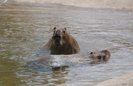
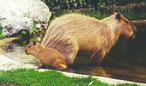
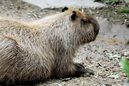
Capybaras are the largest of rodents, weighing from 35 to 66 kg and standing up to 0.6 meters at the shoulder, with a length of about 1.2 meters. Females of this species are slightly larger than males. Their fur is coarse and thin, and is reddish brown over most of the body, turning yellowish brown on the belly and sometimes black on the face. The body is barrel-shaped, sturdy, and tailless. The front legs are slightly shorter than the hind legs, and the feet are partially webbed. This, in addition to the location of the eyes, ears, and nostrils on top of the head, make capybaras well-suited to semi-aquatic life. ("Capybara", 2001; "Capybara", 2002; "Capybara", 2009; Dunston and Gorman, 1998; Wolff and Sherman, 2007)
- Other Physical Features
- endothermic
- homoiothermic
- bilateral symmetry
- Sexual Dimorphism
- female larger
-
- Range mass
- 35 to 66 kg
- 77.09 to 145.37 lb
-
- Range length
- 106 to 134 cm
- 41.73 to 52.76 in
Reproduction
Capybaras are polygynous to promiscuous. Dominant males in social groups try to monopolize mating activity, but this can be nearly impossible, especially in larger groups. Little research has been done on female mate choice in capybaras, but females have been observed mating with both dominant and subordinate males. ("Capybara", 2002; Herrera and Macdonald, 1993)
- Mating System
- polygynous
- polygynandrous (promiscuous)
- cooperative breeder
Capybaras breed throughout the year, with a peak in breeding activity at the beginning of the rainy season. When a female comes into estrus, a male will begin to follow her closely, sometimes for long periods of time, before mating occurs. During this time, the male is often driven off by a more dominant male, who then takes his place. Copulation occurs in the water and typically lasts only a few seconds, but a female usually copulates several times per estrus period. Young are born after 150 days, in litters ranging in size from 2 to 8.The young are precocial, beginning to stand and walk shortly after birth, and can graze within a week of being born. They are weaned at about 3 months old, during which time they suckle both from their own mother and the other females in the group, who are usually closely related. ("Capybara", 2001; "Capybara", 2002; "Capybara", 2009; Dunston and Gorman, 1998; Herrera and Macdonald, 1993; Ojasti, 1968; Wolff and Sherman, 2007)
- Key Reproductive Features
- iteroparous
- year-round breeding
- gonochoric/gonochoristic/dioecious (sexes separate)
- sexual
- viviparous
-
- Breeding interval
- Capybaras produce one litter of young per year.
-
- Breeding season
- Breeding occurs year-round with a peak in May and June, the beginning of the rainy season.
-
- Range number of offspring
- 2 to 8
-
- Average number of offspring
- 4
-
- Average gestation period
- 150 days
-
- Average weaning age
- 3 months
-
- Average time to independence
- 1 years
-
- Average age at sexual or reproductive maturity (female)
- 18 months
-
- Average age at sexual or reproductive maturity (male)
- 18 months
Young capybaras stay with their parents' group until they are about a year old. They nurse for the first three months of this time. Both before and after weaning, the young move around together in a creche, and some of the work of parenting (such as suckling and watching for danger) is shared among all adults in the group. During much of their first year of life, the young are small, slow, and easily tired, making them especially vulnerable to predators. The protection of their natal group is essential to staying alive. Little is known about individual parental care in capybaras, but it seems that, because of the precocial state of the young and the system of cooperative parenting, the time and resources spent by each parent after birth are minimal. ("Capybara", 2002; "Capybara", 2009; Wolff and Sherman, 2007)
- Parental Investment
- precocial
-
pre-fertilization
- provisioning
-
protecting
- female
-
pre-hatching/birth
-
provisioning
- female
-
protecting
- female
-
provisioning
-
pre-weaning/fledging
-
provisioning
- female
-
protecting
- male
- female
-
provisioning
-
pre-independence
-
protecting
- male
- female
-
protecting
Lifespan/Longevity
Capybaras live about 6 years on average (and as many as 10 years) in the wild and up to 12 years in captivity. ("Capybara", 2001; "Capybara", 2002)
-
- Range lifespan
Status: wild - 10 (high) years
- Range lifespan
-
- Average lifespan
Status: wild - 6 years
- Average lifespan
-
- Range lifespan
Status: captivity - 12 (high) years
- Range lifespan
Behavior
Capybaras live in groups of around 10 adults of both sexes, although groups can range in size from 3 to 30 and larger aggregations often form around water resources during the dry season. Each group maintains and defends a territory that encompasses feeding and wallowing sites. Among males, there is a strict dominance hierarchy enforced by chasing and, rarely, fights. Group living appears to be extremely important to capybara survival—without a group, an individual is excluded from most grazing habitat and has no chance of finding a mate, so solitary capybaras are seldom found. Capybara society is relatively stable over the course of time: group membership changes rarely and a territory can be maintained by one group for over 3 years. Because of their large body size, capybaras are susceptible to heat stress. Activity is primarily crepuscular and the hottest part of the day is spent in the water. Capybaras are strong swimmers, helped by the fact that their bodies are only slightly denser than water. They seem to be just as at home in the water as on land. ("Capybara", 2001; "Capybara", 2002; Dunston and Gorman, 1998; Herrera and Macdonald, 1989; Herrera and Macdonald, 1993; Maldonado-Chaparro and Blumstein, 2008; Wolff and Sherman, 2007)
- Key Behaviors
- terricolous
- natatorial
- crepuscular
- motile
- sedentary
- territorial
- social
- dominance hierarchies
Home Range
No information was found on home range sizes in capybaras.
Communication and Perception
Vocalization appears to be very important in capybara groups, but the purpose of many of the sounds made is unknown. However, young vocalize almost constantly and vocal communication among adults is also common. Individuals bark to warn the group of danger, this often results in the whole group rushing into the relative safety of the water. Scent is also important, especially in mating and establishing dominance. Male capybaras have a bare lump on the top of the snout, known as the morillo gland, which secretes a white liquid. The scent of this liquid acts as an olfactory “fingerprint”, signaling the status of the individual. It is rubbed on trees or shrubs to mark territory, or smeared on the male’s body to advertise his status and willingness to mate. Both males and females have two glands on either side of the anus. The combination of chemicals in the liquid they secrete is also highly individualized and seems to be used to recognize group members and mark territory. ("Capybara", 2001; "Capybara", 2002; Herrera and Macdonald, 1993; Maldonado-Chaparro and Blumstein, 2008)
- Other Communication Modes
- pheromones
- scent marks
Food Habits
Capybaras are grazers, feeding mainly on grasses and aquatic plants. Bark and fruit are consumed occasionally. They are also cophrophagous and spend part of each morning re-ingesting the previous day’s food. ("Capybara", 2002; Dunston and Gorman, 1998; Herrera and Macdonald, 1989)
- Primary Diet
-
herbivore
- folivore
- lignivore
- coprophage
- Plant Foods
- leaves
- wood, bark, or stems
- seeds, grains, and nuts
- fruit
- Other Foods
- dung
Predation
Especially while young, capybaras are an important food source for many large predators, including anacondas, caimans, jaguars, and humans. While grazing, they are constantly on the lookout for predators and give an alarm bark when one is spotted. They often hide in the water, with just their nostrils and eyes exposed, and can stay completely submerged for up to five minutes. ("Capybara", 2001; "Capybara", 2009; Herrera and Macdonald, 1989; Wolff and Sherman, 2007)
-
- Known Predators
-
- jaguars (Panthera onca)
- green anacondas (Eunectes murinus)
- spectacled caimans (Caiman crocodilus)
- humans (Homo sapiens)
Ecosystem Roles
In many parts of South America capybaras are the only large grazing species and can have a dramatic effect on the vegetation in an area. They are also mutualists or commensals with several types of birds which pick parasitic insects out of capybara fur or follow grazing capybaras and eat the insects they stir up from the grass. In addition, they are an important prey species for many different animals, as mentioned above. ("Capybara", 2001; "Capybara", 2009; Dunston and Gorman, 1998; Herrera and Macdonald, 1989; Tomazzoni, et al., 2005; Wolff and Sherman, 2007)
- Ecosystem Impact
- creates habitat
- southern caracaras (Caracara plancus)
- rufous horneros (Furnarius rufus)
- yellow-headed caracaras (Milvago chimachima)
- cattle tyrants (Machetornis rixosa)
- shiny cowbirds (Molothrus bonariensis)
Economic Importance for Humans: Positive
Capybaras are hunted for their meat and leather, both of which are said to be very high-quality. Capybara meat is especially popular during Lent, the 40-day period prior to Easter, because it is approved by the Catholic church as an alternative to beef or pork. (Presumably, the semiaquatic habit of the capybara convinced early priests that it was similar to fish.) Large-scale ranching of capybaras has been proposed to curtail illegal hunting and the animals have proved easy to domesticate, at least in small numbers. In fact, capybaras are more efficient grazers than cattle or other introduced livestock and are already an important source of food for many local people. ("Capybara", 2001; "Capybara", 2002; Grant, 2009)
- Positive Impacts
- food
- body parts are source of valuable material
Economic Importance for Humans: Negative
Capybaras sometimes raid gardens or farms in search of food, such as melons, squashes, or grains. It has also been hypothesized that they are carriers of certain livestock diseases. ("Capybara", 2001; Maldonado-Chaparro and Blumstein, 2008)
- Negative Impacts
- crop pest
- causes or carries domestic animal disease
Conservation Status
The IUCN lists capybaras as a species of least concern, citing its large population, large distribution, and frequent occurrence within protected areas. However, some local populations are in decline due to over-hunting. ("Capybara", 2001; "IUCN Red List", 2008; Grant, 2009)
-
- IUCN Red List
-
Least Concern
More information
-
- IUCN Red List
-
Least Concern
More information
-
- US Federal List
- No special status
-
- CITES
- No special status
Contributors
Kathryn Frens (author), University of Michigan-Ann Arbor, Phil Myers (editor, instructor), Museum of Zoology, University of Michigan-Ann Arbor, Tanya Dewey (editor), Animal Diversity Web.
Glossary
- Neotropical
-
living in the southern part of the New World. In other words, Central and South America.

- acoustic
-
uses sound to communicate
- bilateral symmetry
-
having body symmetry such that the animal can be divided in one plane into two mirror-image halves. Animals with bilateral symmetry have dorsal and ventral sides, as well as anterior and posterior ends. Synapomorphy of the Bilateria.
- causes or carries domestic animal disease
-
either directly causes, or indirectly transmits, a disease to a domestic animal
- chemical
-
uses smells or other chemicals to communicate
- cooperative breeder
-
helpers provide assistance in raising young that are not their own
- coprophage
-
an animal that mainly eats the dung of other animals
- crepuscular
-
active at dawn and dusk
- dominance hierarchies
-
ranking system or pecking order among members of a long-term social group, where dominance status affects access to resources or mates
- endothermic
-
animals that use metabolically generated heat to regulate body temperature independently of ambient temperature. Endothermy is a synapomorphy of the Mammalia, although it may have arisen in a (now extinct) synapsid ancestor; the fossil record does not distinguish these possibilities. Convergent in birds.
- folivore
-
an animal that mainly eats leaves.
- food
-
A substance that provides both nutrients and energy to a living thing.
- forest
-
forest biomes are dominated by trees, otherwise forest biomes can vary widely in amount of precipitation and seasonality.
- herbivore
-
An animal that eats mainly plants or parts of plants.
- iteroparous
-
offspring are produced in more than one group (litters, clutches, etc.) and across multiple seasons (or other periods hospitable to reproduction). Iteroparous animals must, by definition, survive over multiple seasons (or periodic condition changes).
- marsh
-
marshes are wetland areas often dominated by grasses and reeds.
- motile
-
having the capacity to move from one place to another.
- natatorial
-
specialized for swimming
- native range
-
the area in which the animal is naturally found, the region in which it is endemic.
- pheromones
-
chemicals released into air or water that are detected by and responded to by other animals of the same species
- polygynandrous
-
the kind of polygamy in which a female pairs with several males, each of which also pairs with several different females.
- polygynous
-
having more than one female as a mate at one time
- rainforest
-
rainforests, both temperate and tropical, are dominated by trees often forming a closed canopy with little light reaching the ground. Epiphytes and climbing plants are also abundant. Precipitation is typically not limiting, but may be somewhat seasonal.
- riparian
-
Referring to something living or located adjacent to a waterbody (usually, but not always, a river or stream).
- scent marks
-
communicates by producing scents from special gland(s) and placing them on a surface whether others can smell or taste them
- scrub forest
-
scrub forests develop in areas that experience dry seasons.
- sedentary
-
remains in the same area
- sexual
-
reproduction that includes combining the genetic contribution of two individuals, a male and a female
- social
-
associates with others of its species; forms social groups.
- swamp
-
a wetland area that may be permanently or intermittently covered in water, often dominated by woody vegetation.
- tactile
-
uses touch to communicate
- temperate
-
that region of the Earth between 23.5 degrees North and 60 degrees North (between the Tropic of Cancer and the Arctic Circle) and between 23.5 degrees South and 60 degrees South (between the Tropic of Capricorn and the Antarctic Circle).
- terrestrial
-
Living on the ground.
- territorial
-
defends an area within the home range, occupied by a single animals or group of animals of the same species and held through overt defense, display, or advertisement
- tropical
-
the region of the earth that surrounds the equator, from 23.5 degrees north to 23.5 degrees south.
- tropical savanna and grassland
-
A terrestrial biome. Savannas are grasslands with scattered individual trees that do not form a closed canopy. Extensive savannas are found in parts of subtropical and tropical Africa and South America, and in Australia.
- savanna
-
A grassland with scattered trees or scattered clumps of trees, a type of community intermediate between grassland and forest. See also Tropical savanna and grassland biome.
- temperate grassland
-
A terrestrial biome found in temperate latitudes (>23.5° N or S latitude). Vegetation is made up mostly of grasses, the height and species diversity of which depend largely on the amount of moisture available. Fire and grazing are important in the long-term maintenance of grasslands.
- visual
-
uses sight to communicate
- viviparous
-
reproduction in which fertilization and development take place within the female body and the developing embryo derives nourishment from the female.
- year-round breeding
-
breeding takes place throughout the year
- young precocial
-
young are relatively well-developed when born
References
2009. "Capybara" (On-line). Bristol Zoo Gardens. Accessed April 12, 2009 at http://www.bristolzoo.org.uk/learning/animals/mammals/capybara.
2002. Capybara. Pp. 382-384 in M Burton, R Burton, eds. International Wildlife Encyclopedia, Vol. 1, 3 Edition. Tarrytown, New York: Marshall Cavendish.
2001. Capybara. Pp. 678-681 in D Macdonald, S Norris, eds. The Encyclopedia of Mammals, Vol. 1, 3 Edition. London: The Brown Reference Group.
2008. "IUCN Red List" (On-line). Accessed April 09, 2009 at http://www.iucnredlist.org/.
Dunston, N., M. Gorman. 1998. Behavior and Ecology of Riparian Mammals. Cambridge: Cambridge University Press.
Grant, W. 2009. "Venezuela's Giant Rodent Cuisine" (On-line). BBC News. Accessed April 12, 2009 at http://news.bbc.co.uk/2/hi/americas/7987587.stm.
Herrera, E., D. Macdonald. 1993. Aggression, dominance, and mating success among capybara males. Behavior Ecology, 4: 2: 114-119.
Herrera, E., D. Macdonald. 1989. Resource Utilization and Territoriality in Group-Living Capybaras (Hydrochoerus hydrochaeris). Journal of Animal Ecology, 58:2: 667-679.
Maldonado-Chaparro, A., D. Blumstein. 2008. Management implications of capybara social behavior. Biological Conservation, 141: 8: 1945-1952.
Ojasti, J. 1968. Notes on the mating behavior of the capybara. Journal of Mammalogy, 49: 3: 534-535.
Tomazzoni, A., E. Pedo, S. Hartz. 2005. Feeding associations between capybaras and birds in the Lami Biological Reserve. Revista Brasileira de Zoologia, 22:3: 712-716.
Wolff, J., P. Sherman. 2007. Rodent Societies: An Ecological Monograph. Chicago: University of Chicago Press.