Homarus americanusAmerican lobster
Geographic Range
Homarus americanus, the American lobster, is found along the Atlantic coast of North America in the region from Labrador, Canada to North Carolina, United States. They are most prevalent along the New England coast. The American lobster is found in shallow waters but is more abundant in deeper waters and can live as far deep as 365 m. (Author unknown, 2003; Walsh, July-August 2000)
- Biogeographic Regions
- atlantic ocean
Habitat
The American Lobster lives on the bottom of the ocean. They can be found in sandy and muddy areas, but prefer rocky bottoms with more places to hide. Young lobsters seem to prefer settling in areas with cobble. The lobster spends most of the day inside its burrow and will only leave it if food is nearby. At night it wanders the ocean floor, and may venture into the intertidal zone when tides are high. If a predator approaches, it quickly retreats back into the safe cover of its burrow. (Author unknown, 2001; Gulf of Maine Aquarium, 1999)
- Habitat Regions
- temperate
- saltwater or marine
- Other Habitat Features
- intertidal or littoral
-
- Range depth
- 365 (high) m
- 1197.51 (high) ft
Physical Description
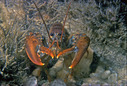
Homarus americanus is the largest species of lobster and can reach a length of up to 1.1 m and a weight of 20 kg. However, the size of a lobster which is commonly caught is approximately 25 cm in length and weighs about 0.5 kg.
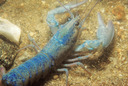
A lobster's body is divided into twenty-one segments: six segments from the head region, eight segments compose the thorax (mid-section), and seven segments make up the abdomen (often called the tail). Commonly thought of as being red, the body is really blackish-green or brownish-green. The red color results when a lobster is boiled and is a result of pigments in the shell breaking down.
The eyes are on the first segment of the head and are stalked. They can only detect motion in dim light. The second segment of the head has anntenules with delicate hairs that have more than 400 types of chemoreceptors. The lobsters can detect other species, potential mates, prey and predators with the receptors.
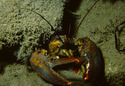
Being in the Order Decapoda (meaning "ten feet"), the lobster has ten legs. Five pairs of jointed legs extend from the thorax region. The first pair of these legs extends towards the head and has claws (chela) on the end. One claw is usually larger than the other and has thick teeth which are used to crush objects. The other claw usually is smaller and has sharp teeth used for cutting.
Lobsters go through exceptional growth during their lifetime. When they first hatch, a lobster weighs less than one tenth of a gram. By the time they are full adults, they can reach a weight of up to 10 kilograms. This growth is an increase of 100,000 times. Lobsters achieve this growth by going through periods called molts. When a lobster is ready to molt, its body absorbs the mineral salts that had hardened its shell, drawing the salts further into its skin. When the shell softens, the lobster is able to break it and slide out. The lobster takes in more water and thus swells in size. The new shell is already covering its body but takes a few days to harden. During this period the lobster stays in seclusion to avoid predators. Each time a lobster molts its body can grow 10-15% in size. Newly hatched lobsters molt for the first time within the first week, and three more times within the first month. (Author unknown, 2001; Author unknown, 2003; Gulf of Maine Aquarium, 1999; Romanowsky, 2000a; Whale, July 1993)
- Other Physical Features
- ectothermic
- heterothermic
- bilateral symmetry
- Sexual Dimorphism
- sexes alike
-
- Range mass
- .0001 to 20 kg
- 0.00 to 44.05 lb
-
- Range length
- 1.1 (high) m
- 3.61 (high) ft
Reproduction
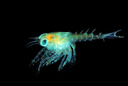
A female is ready to mate at about 5 years of age. Mating must occur within 48 hours after the female molts, and the process usually lasts about a minute. The female will spawn her eggs between one month and two years after mating, at which time they become fertilized by sperm that has been stored. The number of eggs the female spawns is dependent on body size, where an 18 cm lobster will lay about 3,000 eggs and a 45 cm lobster will lay around 75,000 eggs. The female will then carry the eggs underneath her tail for about 10 to 11 months until they hatch. Only about 1/10 of 1 per cent of the young survive after four weeks, mainly due to predation. The young will move about the water column for about 12 days, then move to the bottom. (Author unknown, 2001; Bliss, 1990; Gulf of Maine Aquarium, 1999)
- Key Reproductive Features
- gonochoric/gonochoristic/dioecious (sexes separate)
- sexual
- oviparous
- sperm-storing
-
- Average age at sexual or reproductive maturity (female)
- 5 years
- Parental Investment
- female parental care
Behavior
American Lobsters are solitary. Individuals stay among the rocks during the day to avoid predators (mainly cod) and venture out at night in search for food.
Lobsters rarely interact with each other. Studies show that when introduced into a community, lobsters have a social hierarchy. This social system plays a role when mating season comes along. A male who has a higher status among its neighbors will have a secured shelter and will be able to mate with multiple females. A theory as to the mechanisms that maintain this social hierarchy is that the lobsters recognize each other by the chemicals they excrete. A lobster has been show to recognize another lobster with which it has met before for up to two weeks. (Grzimek, 1972; Gulf of Maine Aquarium, 1999; Karavanich and Atema, 1998)
- Key Behaviors
- nocturnal
- motile
- sedentary
- solitary
- territorial
- dominance hierarchies
Communication and Perception
- Other Communication Modes
- pheromones
- Perception Channels
- chemical
Food Habits
Three stomachs make up the digestive system, which is within the cephalothorax (the head and thorax). The first stomach (forgut) grinds food into small particles with grinding teeth. The second stomach (midgut) has glands to digest particles. The glands are the green portion of the lobster eaten by some humans (called the "tomalley"). The third stomach (hindgut) receives non-absorbed particles which are passed to the retum and anus.
Homarus americanus does the majority of its eating at night. It is usually a scavenger, feeding on dead animals, but is also capable of capturing its own prey. The lobster's diet consists mostly of clams, crabs, snails, small fish, algae and other plants called eelgrass. Since lobsters sometimes eat their own molted shell they were thought to be cannabalistic, but this has never been recorded in the wild. However, they will eat other lobsters when in captivity. (Author unknown, 2001; Grzimek, 1972; Romanowsky, 2000a)
- Primary Diet
-
carnivore
- piscivore
- eats non-insect arthropods
- molluscivore
- scavenger
- omnivore
- Animal Foods
- fish
- carrion
- mollusks
- aquatic crustaceans
- Plant Foods
- algae
- macroalgae
Predation
Humans are the main predators. Cod, flounder, sculpins, ells, rock gunnels, crabs and seals also eat lobsters. (Romanowsky, 2000a)
Economic Importance for Humans: Positive
The American Lobster is commercially valuable as food. Its white meat is considered a delicacy. The meat is found in the claws, legs, and its large abdominal muscle commonly called the tail. (Banister and Campbell, 1985)
- Positive Impacts
- food
Economic Importance for Humans: Negative
There are no negative consequences for humans by the lobster.
Conservation Status
Although this species is not endangered, conservation efforts have been implemented to preserve lobster populations from overfishing. Laws regulate the size of lobsters taken, which increases the number of females reaching sexual maturity and reproducing before being harvested. Other regulations include limiting the number of traps set, limits on lobstering licenses, and times of the year when lobsters are harvested. Another volunteer program implemented is cutting a "V" notch in the tail when a female carrying eggs is trapped. She is returned to the sea and if caught again is not supposed to be harvested since she is a known egg producer. (Romanowsky, 2000b)
-
- IUCN Red List
-
No special status
More information
-
- IUCN Red List
-
No special status
More information
-
- US Federal List
- No special status
-
- CITES
- No special status
Other Comments
Lobsters have not been raised on a commercial basis because the cost to get them to marketable size is too high. (Romanosky, 2000c)
Contributors
Renee Sherman Mulcrone (editor).
Don Lydon (author), Southwestern University, Stephanie Fabritius (editor), Southwestern University.
Glossary
- Atlantic Ocean
-
the body of water between Africa, Europe, the southern ocean (above 60 degrees south latitude), and the western hemisphere. It is the second largest ocean in the world after the Pacific Ocean.

- benthic
-
Referring to an animal that lives on or near the bottom of a body of water. Also an aquatic biome consisting of the ocean bottom below the pelagic and coastal zones. Bottom habitats in the very deepest oceans (below 9000 m) are sometimes referred to as the abyssal zone. see also oceanic vent.
- bilateral symmetry
-
having body symmetry such that the animal can be divided in one plane into two mirror-image halves. Animals with bilateral symmetry have dorsal and ventral sides, as well as anterior and posterior ends. Synapomorphy of the Bilateria.
- carnivore
-
an animal that mainly eats meat
- carrion
-
flesh of dead animals.
- chemical
-
uses smells or other chemicals to communicate
- coastal
-
the nearshore aquatic habitats near a coast, or shoreline.
- dominance hierarchies
-
ranking system or pecking order among members of a long-term social group, where dominance status affects access to resources or mates
- ectothermic
-
animals which must use heat acquired from the environment and behavioral adaptations to regulate body temperature
- female parental care
-
parental care is carried out by females
- food
-
A substance that provides both nutrients and energy to a living thing.
- heterothermic
-
having a body temperature that fluctuates with that of the immediate environment; having no mechanism or a poorly developed mechanism for regulating internal body temperature.
- intertidal or littoral
-
the area of shoreline influenced mainly by the tides, between the highest and lowest reaches of the tide. An aquatic habitat.
- macroalgae
-
seaweed. Algae that are large and photosynthetic.
- molluscivore
-
eats mollusks, members of Phylum Mollusca
- motile
-
having the capacity to move from one place to another.
- native range
-
the area in which the animal is naturally found, the region in which it is endemic.
- nocturnal
-
active during the night
- omnivore
-
an animal that mainly eats all kinds of things, including plants and animals
- oviparous
-
reproduction in which eggs are released by the female; development of offspring occurs outside the mother's body.
- pheromones
-
chemicals released into air or water that are detected by and responded to by other animals of the same species
- piscivore
-
an animal that mainly eats fish
- saltwater or marine
-
mainly lives in oceans, seas, or other bodies of salt water.
- scavenger
-
an animal that mainly eats dead animals
- sedentary
-
remains in the same area
- sexual
-
reproduction that includes combining the genetic contribution of two individuals, a male and a female
- solitary
-
lives alone
- sperm-storing
-
mature spermatozoa are stored by females following copulation. Male sperm storage also occurs, as sperm are retained in the male epididymes (in mammals) for a period that can, in some cases, extend over several weeks or more, but here we use the term to refer only to sperm storage by females.
- tactile
-
uses touch to communicate
- temperate
-
that region of the Earth between 23.5 degrees North and 60 degrees North (between the Tropic of Cancer and the Arctic Circle) and between 23.5 degrees South and 60 degrees South (between the Tropic of Capricorn and the Antarctic Circle).
- territorial
-
defends an area within the home range, occupied by a single animals or group of animals of the same species and held through overt defense, display, or advertisement
References
Author unknown, 1994. B Johnston, ed. Colliers Encyclopedia. New York City, New York: Colliers.
Author unknown, 2001. The World Book Encyclopedia. Chicago, IL: World Book Inc..
Author unknown, 2003. "Encyclopedia Britanica Online" (On-line). Accessed May 6, 2003 at http://search.eb.com/eb/article?eu=49836&hook=253694#253694.hook.
Banister, K., A. Campbell. 1985. The Encyclopedia of Aquatic Life. New York City, New York: Facts On File, Inc..
Bliss, D. 1990. Shrimps, Lobsters and Crabs; Thier Fascinating Life Story. New York City, New York: Columbia University Press.
Grzimek, D. 1972. Grzimek's Animal Life Encyclopedia. New York City, New York: Van Nostrand Reinhold Company.
Gulf of Maine Aquarium, 1999. "Lobsters" (On-line). Accessed May 7, 2003 at http://www.gma.org/lobsters/.
Karavanich, C., J. Atema. 1998. Individual Recognition and Memory in Lobster Dominance. Animal Behaviour, Vol 56 Issue 6: 1553-1560.
Romanosky, K. 2000c. "The American Lobster: Frequently Asked Questions" (On-line). Accessed May 13, 2003 at http://www.parl.ns.ca/lobster/faq.htm.
Romanowsky, K. 2000b. "The American Lobster: Conservation and Preservation" (On-line). Accessed May 7, 2003 at http://www.parl.ns.ca/lobster/conservation.htm.
Romanowsky, K. 2000a. "The American Lobster: Overview of Homarus americanus: The American Lobster" (On-line). Accessed May 7, 2003 at http://www.parl.ns.ca/lobster/overview.htm.
The Lobster Conservancy, 2003. "The Lobster Conservancy: Sustaining a thriving lobster fishery through science and community" (On-line). Accessed (Date Unknown) at http://www.lobsters.org/.
Walsh, R. July-August 2000. The Lobster Pickle. Natural History, Vol 109 Issue 6: 72-74.
Whale, R. July 1993. Gimme Shelter. Natural History, Vol 102 Issue 7: 42-48.