Hippopotamidaehippopotamuses
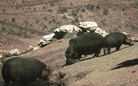


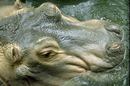

The modern hippos are divided into two genera and two species. The genera are very different in size, so much so that the common name of one, Choeropsis liberiensis, is the pygmy hippo. Nevertheless, all hippos are large compared to most mammals, with the larger species weighing up to 3600 kg and the smaller around 250 kg. They are also similar in shape, with huge heads, round or barrel-shaped bodies, and short, stumpy legs. Their skin is thick and nearly hairless; its pores secrete a pink substance known as blood sweat that probably helps protect against the sun. They have broad and square mouths. Their nostrils and eyes sit on top of their skulls, so that they are out of the water when the animal lies submerged with its head barely breaking the surface. Their tails are short and tufted.
The skull of hippos is relatively large and elongated, and the braincase is small. The orbits are high up on the skull. Hippos have a well developed sagittal crest and occipital ridges, and an incomplete postorbital bar. The foot bones are unfused and all four toes of each foot are functional and support the body. The lateral digits are nearly as well developed as the central ones. Hippos are digitigrade, but only the distal phalanx of each toe actually touches the ground, and the rest of the foot is braced by a pad of connective tissue. The stomach has three chambers but is non-ruminating.

The number of incisors is variable within both species and a general dental formula for the family is 2-3/1-3, 1/1, 4/4, 3/3 = 38-44. The tusk-like incisors and canines grow continuously. The lower incisors are longer than the uppers and project forward. The lower canines are the largest of the tusk-like teeth and curve up above the upper tooth row. The cheek teeth are progressively more complex toward the back of the jaw. The premolars are usually have single cusps, though this varies. The molars have two or three pairs of cusps which wear down to a trefoil, figure-eight and dumbbell-shaped enamel figures. They are bunodont.
Hippos are gregarious animals, living in herds of up to 40 animals. They are amphibious and excellent swimmers, spending much of the day in the water and emerging in the evening to feed on terrestrial vegetation. They also eat aquatic plants, which they may obtain by diving and swimming entirely submerged. Their terrestrial foraging areas may be several kilometers distant from where they pass the day, and they sometimes are responsible for considerable damage to crops and rangelands due to their foraging and their travel to foraging areas. Pygmy hippos are less social and are usually found in forested areas.
The historic range of both species included all of sub-Saharan Africa, the Nile river, Palestine and even Madagascar. Fossil hippos are known from late Miocene to late Pleistocene deposits in Europe, Asia and Africa.
References and literature cited:
Feldhamer, G. A., L. C. Drickamer, S. H. Vessey, and J. F. Merritt. 1999. Mammalogy. Adaptation, Diversity, and Ecology. WCB McGraw-Hill, Boston. xii+563pp.
Nowak, R.M. and J.L. Paradiso. 1983. Walker's Mammals of the World, 4th edition . John Hopkins University Press, Baltimore, MD.
Savage, R. J. G. and M. R. Long. 1986. Mammal Evolution: An Illustrated Guide. Facts on File Publications, UK. 251 pp.
Simpson, C. D. 1984. Artiodactyls. Pp. 563-587 in Anderson, S. and J. K. Jones, Jr. (eds). Orders and Families of Recent Mammals of the World. John Wiley and Sons, N.Y. xii+686 pp.
Vaughan, T. A. 1986. Mammalogy. Third Edition. Saunders College Publishing, N.Y. vii+576 pp.
Vaughan, T. A., J. M. Ryan, N. J. Czaplewski. 2000. Mammalogy. Fourth Edition. Saunders College Publishing, Philadelphia. vii+565pp.
Wilson, D. E., and D. M. Reeder. 1993. Mammal Species of the World, A Taxonomic and Geographic Reference. 2nd edition. Smithsonian Institution Press, Washington. xviii+1206 pp.
Contributors
David L. Fox (author), University of Michigan-Ann Arbor, Phil Myers (author), Museum of Zoology, University of Michigan-Ann Arbor.
Glossary
- bilateral symmetry
-
having body symmetry such that the animal can be divided in one plane into two mirror-image halves. Animals with bilateral symmetry have dorsal and ventral sides, as well as anterior and posterior ends. Synapomorphy of the Bilateria.
- chemical
-
uses smells or other chemicals to communicate
- endothermic
-
animals that use metabolically generated heat to regulate body temperature independently of ambient temperature. Endothermy is a synapomorphy of the Mammalia, although it may have arisen in a (now extinct) synapsid ancestor; the fossil record does not distinguish these possibilities. Convergent in birds.
- motile
-
having the capacity to move from one place to another.
- sexual
-
reproduction that includes combining the genetic contribution of two individuals, a male and a female
- tactile
-
uses touch to communicate