Hippodamia convergensconvergent lady beetle
Geographic Range
Hippodamia convergens can be found in most of the Nearctic and Neotropical regions. It is a common species throughout the United States, ranging from New Jersey to Texas to California. It also common in Canada and South America. (Casey, 1899; Jaques, 1951; The Michigan Entomological Society, 2005)
- Biogeographic Regions
- nearctic
- neotropical
Habitat
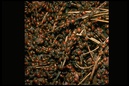
Hippodamia convergens, the convergent lady beetle, is found in a diverse array of habitats including forests, grasslands, agricultural fields, and suburban gardens. Convergent lady beetles are found on crops in gardens and farms where there are plenty of aphids and other prey to eat. Typical crops on which they live are wheat, sorghum, and alfalfa. During the winter, H. convergens can be found under logs, ground-covering vegetation, and even in buildings. (The Michigan Entomological Society, 2005)
- Habitat Regions
- terrestrial
- Terrestrial Biomes
- savanna or grassland
- forest
- Other Habitat Features
- suburban
- agricultural
Physical Description
Hippodamia convergens is semi-hemispherically shaped and has elytra that are yellow/red or tannish red with 12 black spots. The beetle does not have the typical oval shape of most lady beetles and the elytra are not as curvaceous. Hippodamia convergens has three separate spots on the posterior of the elytra, while their legs and underside are all black. These beetles have short legs with 3 segmented tarsi and short antennae as well. The prothorax is black with a white border and white lines that are directed inward towards one another and the abdomen; they are converging, thus giving this beetle its name. The prothorax does not align perfectly with the front edge of the elytra.
Eggs are typically 1 to 1.5 mm, elongated, and pointed at one end. Larvae look like alligators and are distinct because of the orange spots that they have on their prothorax. Pupae are orange and black and have a hemispherical shape. (Casey, 1899; Jaques, 1951; "Lady Beetles", 2012)
- Other Physical Features
- ectothermic
- heterothermic
- bilateral symmetry
- poisonous
- Sexual Dimorphism
- sexes alike
-
- Range length
- 4 to 5 mm
- 0.16 to 0.20 in
-
- Range wingspan
- 2.7 to 4.4 mm
- 0.11 to 0.17 in
Development
Hippodamia convergens goes through the same life cycle as other Coccinellids, progressing from the egg stage to the larval stage, then to pupation and finally adulthood. Eggs hatch after approximately a week, and then larvae develop through four instars over the course of two to three weeks. Convergent lady beetles are unique in that during food scarcity, they are able to alter their development in response. Individuals wait until they are between 5 to 35 mg (optimal weight being greater than 15 mg) to go through the process of pupation. It is common for a final instar larva to attach itself to the surface of leaves right before molting and forming a pupa. H. convergens generally has two generations a year, one in the spring and the other in the fall. During times of food scarcity or extreme temperatures, adults of H. convergens can enter diapause. The first generation of the year will often diapause at some point during the summer, while the second generation will diapause over winter. (Phoofolo, et al., 2009; Shelton, 2009; Vargas, et al., 2012; "Lady Beetles", 2012)
- Development - Life Cycle
- metamorphosis
- diapause
Reproduction
No information was found about the mating systems of these lady beetles specifically, but it is likely that they mate multiple times with multiple mates, as do other Coccinellidae.
- Mating System
- polygynandrous (promiscuous)
Hippodamia convergens is a bivoltine species, with two generations a year, one in the spring and the other in the fall. Females of H. convergens are able to enter into reproductive diapause during dry seasons or times of extreme temperature, when food resources are not plentiful enough for it to reproduce successfully. Egg laying generally coincides with aphid population cycles, with the most egg laying taking place when aphid populations are at their peak. Females have been shown to increase oviposition in the presence of aphids. A female can produce 200 to 500 eggs in her lifetime. (Hodek and Cerngier, 2000; Michaud and Qureshi, 2006; Sluss, 1968; Vargas, et al., 2012)
- Key Reproductive Features
- iteroparous
- seasonal breeding
- gonochoric/gonochoristic/dioecious (sexes separate)
- sexual
- fertilization
- oviparous
-
- Breeding interval
- H. convergens breeds continuously after reaching sexual maturity, while aphid numbers are high.
-
- Breeding season
- One generation mates in early spring, while the other generation mates in early fall.
-
- Range eggs per season
- 200 to 500
No information was found about parental investment in this species, but it is likely that, as with other coccinellids, it provides only nutrients in the egg as parental investment.
- Parental Investment
-
pre-hatching/birth
-
provisioning
- female
-
provisioning
Lifespan/Longevity
It takes about 4 to 7 weeks for H. convergens to develop from egg to an adult. Adults live for an extended period after that, with the second generation overwintering. (Shelton, 2009; "Lady Beetles", 2012)
Behavior
Little information is available concerning unique behavioral traits. Hippodamia convergens is mainly a solitary species, except when overwintering, when hundreds of H. convergens may collect. It is mostly active during the day. Adults can fly from plant to plant to find prey, while larvae move from plant to plant by walking across overlapping leaves, often following leaf veins. (Purandare and Tenhumberg, 2012; Sluss, 1968; The Michigan Entomological Society, 2005)
- Key Behaviors
- flies
- diurnal
- hibernation
- solitary
Communication and Perception
To locate prey, H. convergens uses primarily visual, olfactory, and chemical cues. Closely related species of coccinellids have been found to respond to aphid pheromones and other chemical cues. Honeydew secreted by aphid prey is also thought to be a significant chemical cue to coccinellids predators, and has even been shown to increase oviposition in H. convergens and other Coccinellidae. Larvae are also thought to respond to aphid chemical cues while searching for prey, though it is likely that prey search by larvae is more random than adults. Larvae rely heavily on tactile cues, and have been shown to follow along leaf veins until they either detect olfaction-based cues or just bump into aphid prey. (Darby, et al., 2003; Jamal and Brown, 2001)
Food Habits
Hippodamia convergens is predacious. It feeds on other insects and sometimes on small arthropods. Convergent lady beetles typically eat aphids, scale insects, and plant mites. Cotton, pea, melon, cabbage, potato, green peach, and corn leaf aphids are all prey that convergent lady beetles have been reported to eat. This makes this species a useful tool in controlling aphid populations on farms. Hippodamia convergens also eat the eggs and larvae of other insects, such as stinkbugs, asparagus beetles, and potato psyllids. Although both immature beetles and adults eat mostly aphids, during the fall when they are getting ready for hibernation, adults will feed on pollen to gain extra fat for hibernation. When there is food scarcity, it is not uncommon for coccinellids to become cannibalistic and eat their own larvae and eggs. (Saito and Bjornson, 2006; Shelton, 2009; The Michigan Entomological Society, 2005)
These beetles have a large appetite and may consume between 40 to 75 aphids per day. It has been shown that temperatures around 23 degrees Celsius cause these lady beetles to eat the most aphids. This indicates that the species is better at controlling aphid populations at this higher temperature. (Katsarou, et al., 2005; Shelton, 2009)
- Primary Diet
- carnivore
- Animal Foods
- insects
- terrestrial non-insect arthropods
- Plant Foods
- pollen
Predation
Generalist insect predators such as Geocoris bullatus and Nabis alternatus are known to eat eggs of H. convergens. Birds are often predators of H. convergens as well. In defense, the red and black coloration of the elytra of convergent lady beetles serves as warning coloration. Avian predators have been shown to recognize lady beetles with red color and black spots and eat them less frequently than lady beetles with no spots or different coloration. Additionally, like most coccinellids, H. convergens can likely bleed toxins from the joints in its exoskeleton. (Dolenska, et al., 2009; Takizawa and Snyder, 2012)
- Anti-predator Adaptations
- aposematic
-
- Known Predators
Ecosystem Roles
Hippodamia convergens is a significant predator of many agricultural pests, particularly aphids. They also feed on a variety of other insects. Birds and generalist predatory insects such as Geocoris bullatus and Nabis alternatus feed on H. convergens. Pathogens such as Microsporidia use convergent lady beetles as hosts, which causes delayed larval development. These pathogens are often horizontally transmitted among this species, as H. convergens will cannibalize its eggs and larvae in times of low prey density. The braconid wasp Perilitus coccinellae is known to use H. convergens as a host. Parasitoid hymenopterans such as Dinocampus coccinellae have been found to also use convergent lady beetles as hosts, with females being infected at a higher rate than males. Parasites travel with their host lady beetles that are shipped for agricultural control purposes, which has likely caused an increase of parasites in the regions to which they are shipped. (Bjornson, 2008; Saito and Bjornson, 2006; Sluss, 1968)
- Microsporidia
- Perilitus coccinellae
- Dinocampus coccinellae
Economic Importance for Humans: Positive
Hippodamia convergens is of great economic benefit to humans. Convergent lady beetles are reared and sold as pest control agents for farms and gardens, since they are the natural predators of agricultural pests, particularly many species of aphids and scale insects. (Bjornson, 2008; Casey, 1899; Michaud and Qureshi, 2006; Saito and Bjornson, 2006; Shelton, 2009)
- Positive Impacts
- controls pest population
Economic Importance for Humans: Negative
Although Hippodamia convergens is helpful and often transported for agricultural purposes, this species can act as a transmitter for diseases and parasites. The trade and transportation of this lady beetle has increased the risk of introducing new pathogens into the United States. (Saito and Bjornson, 2006)
Conservation Status
Hippodamia convergens has no special conservation status. (Bjornson, 2008; Casey, 1899; Phoofolo, et al., 2009; The Michigan Entomological Society, 2005; "Lady Beetles", 2012)
-
- IUCN Red List
- Not Evaluated
-
- US Federal List
- No special status
-
- CITES
- No special status
-
- State of Michigan List
- No special status
Other Comments
No additional comments.
Contributors
Adriana Saroki (author), University of Michigan Biological Station, Angela Miner (editor), Animal Diversity Web Staff, Brian Scholtens (editor), University of Michigan Biological Station.
Glossary
- Nearctic
-
living in the Nearctic biogeographic province, the northern part of the New World. This includes Greenland, the Canadian Arctic islands, and all of the North American as far south as the highlands of central Mexico.

- Neotropical
-
living in the southern part of the New World. In other words, Central and South America.
- agricultural
-
living in landscapes dominated by human agriculture.
- aposematic
-
having coloration that serves a protective function for the animal, usually used to refer to animals with colors that warn predators of their toxicity. For example: animals with bright red or yellow coloration are often toxic or distasteful.
- bilateral symmetry
-
having body symmetry such that the animal can be divided in one plane into two mirror-image halves. Animals with bilateral symmetry have dorsal and ventral sides, as well as anterior and posterior ends. Synapomorphy of the Bilateria.
- carnivore
-
an animal that mainly eats meat
- chemical
-
uses smells or other chemicals to communicate
- diapause
-
a period of time when growth or development is suspended in insects and other invertebrates, it can usually only be ended the appropriate environmental stimulus.
- diurnal
-
- active during the day, 2. lasting for one day.
- ectothermic
-
animals which must use heat acquired from the environment and behavioral adaptations to regulate body temperature
- fertilization
-
union of egg and spermatozoan
- forest
-
forest biomes are dominated by trees, otherwise forest biomes can vary widely in amount of precipitation and seasonality.
- heterothermic
-
having a body temperature that fluctuates with that of the immediate environment; having no mechanism or a poorly developed mechanism for regulating internal body temperature.
- hibernation
-
the state that some animals enter during winter in which normal physiological processes are significantly reduced, thus lowering the animal's energy requirements. The act or condition of passing winter in a torpid or resting state, typically involving the abandonment of homoiothermy in mammals.
- insectivore
-
An animal that eats mainly insects or spiders.
- internal fertilization
-
fertilization takes place within the female's body
- iteroparous
-
offspring are produced in more than one group (litters, clutches, etc.) and across multiple seasons (or other periods hospitable to reproduction). Iteroparous animals must, by definition, survive over multiple seasons (or periodic condition changes).
- metamorphosis
-
A large change in the shape or structure of an animal that happens as the animal grows. In insects, "incomplete metamorphosis" is when young animals are similar to adults and change gradually into the adult form, and "complete metamorphosis" is when there is a profound change between larval and adult forms. Butterflies have complete metamorphosis, grasshoppers have incomplete metamorphosis.
- native range
-
the area in which the animal is naturally found, the region in which it is endemic.
- oviparous
-
reproduction in which eggs are released by the female; development of offspring occurs outside the mother's body.
- poisonous
-
an animal which has a substance capable of killing, injuring, or impairing other animals through its chemical action (for example, the skin of poison dart frogs).
- polygynandrous
-
the kind of polygamy in which a female pairs with several males, each of which also pairs with several different females.
- seasonal breeding
-
breeding is confined to a particular season
- sexual
-
reproduction that includes combining the genetic contribution of two individuals, a male and a female
- solitary
-
lives alone
- suburban
-
living in residential areas on the outskirts of large cities or towns.
- tactile
-
uses touch to communicate
- terrestrial
-
Living on the ground.
- tropical savanna and grassland
-
A terrestrial biome. Savannas are grasslands with scattered individual trees that do not form a closed canopy. Extensive savannas are found in parts of subtropical and tropical Africa and South America, and in Australia.
- savanna
-
A grassland with scattered trees or scattered clumps of trees, a type of community intermediate between grassland and forest. See also Tropical savanna and grassland biome.
- temperate grassland
-
A terrestrial biome found in temperate latitudes (>23.5° N or S latitude). Vegetation is made up mostly of grasses, the height and species diversity of which depend largely on the amount of moisture available. Fire and grazing are important in the long-term maintenance of grasslands.
- visual
-
uses sight to communicate
References
Washington State Fruit Commission. 2012. "Lady Beetles" (On-line). Washington State University Tree Fruit Research & Extension Center Orchard Pest Management Online. Accessed August 09, 2012 at http://jenny.tfrec.wsu.edu/opm/displayspecies.php?pn=687.
Bjornson, S. 2008. Natural enemies of the convergent lady beetle, Hippodamia convergens Guérin-Méneville: Their inadvertent importation and potential significance for augmentative biological control. Biological Control, 44 (3): 305–311.
Casey, T. 1899. A revision of American Coccinellidae. Journal of The New York Entomological Society, 7: 71-168.
Darby, A., B. Raymond, A. Douglas. 2003. The olfactory response of coccinellids to aphids on plants. Entomologia Experimentalis et Applicata, 95(1): 113-117.
Dolenska, M., O. Nedved, P. Vesely, M. Tesarova, R. Fuchs. 2009. What constitutes optical warning signals of ladybirds (Coleoptera: Coccinellidae) towards bird predators: colour, pattern or general look?. Biological Journal of The Linnaen Society, 98 (1): 234-242.
EOL, 2012. "Hippodamia convergens: Convergent lady beetle" (On-line). Encyclopedia of Life. Accessed December 29, 2012 at http://eol.org/pages/1174377/overview.
Hodek, I., P. Cerngier. 2000. Sexual activity in Coccinellidae (Coleoptera): a review. European Journal of Entomology, 97: 449-456.
Jamal, E., G. Brown. 2001. Orientation of Hippodamia convergens (Coleoptera : Coccinellidae) larvae to volatile chemicals associated with Myzus nicotianae (Homoptera : Aphididae). Environmental Entomology, 30(6): 1012-1016.
Jaques, H. 1951. How to know the beetles. Dubuque: WM. C. Brown company Publishers.
Katsarou, I., J. Margaritopoulos, J. Tsitsipis, D. Perdikis, K. Zarpas. 2005. Effect of temperature on development, growth and feeding of Coccinella septempunctata and Hippodamia convergens reared on the tobacco aphid, Myzus persicae nicotianae. Biocontrol, 50 (4): 565-588.
Michaud, J., J. Qureshi. 2006. Reproductive diapause in Hippodamia convergens (Coleoptera: Coccinellidae) and its life history consequences. Biological Control, 39 (2): 193-200.
Phoofolo, M., N. Elliot, K. Giles. 2009. Analysis of growth and development in the final instar of three species of predatory Coccinellidae under varying prey availability. Entomologia Experimentalis et Applicata, 131 (3): 264-277.
Purandare, S., B. Tenhumberg. 2012. Influence of aphid honeydew on the foraging behaviour of Hippodamia convergens larvae. Ecological Entomology, 37(3): 184-192.
Saito, T., S. Bjornson. 2006. Horizontal transmission of a microsporidium from the convergent lady beetle, Hippodamia convergens Guérin-Méneville (Coleoptera: Coccinellidae), to three coccinellid species of Nova Scotia. Biological Control, 39 (3): 427-433.
Shelton, A. 2009. "Hippodamia convergens (Coleoptera: Coccinellidae) convergent Lady Beetle" (On-line). Cornell University, College of Agriculture and Life Sciences, Entomology Department, Biological Control. Accessed August 10, 2012 at http://www.biocontrol.entomology.cornell.edu/predators/Hippodamia.html.
Sluss, R. 1968. Behavioral and anatomical responses of the convergent lady beetle to parasitism by Perilitus coccinellae (Schrank) (Hymenoptera: Braconidae). Journal of Invertebrate Pathology, 10(1): 9-27.
Takizawa, T., W. Snyder. 2012. Alien vs. predator: Could biotic resistance by native generalist predators slow lady beetle invasions?. Biological Control, 63(2): 79-86.
The Michigan Entomological Society, 2005. "Lady Beetles Entomology Note No. 6" (On-line). Entomology Notes Published as a Service to the Michigan Entomology Society. Accessed August 09, 2012 at http://insects.ummz.lsa.umich.edu/MES/notes/entnotes6.html.
Vargas, G., J. Michaud, J. Nechols. 2012. Cryptic maternal effects in Hippodamia convergens vary with maternal age and body size. Entomologia Experimentalis et Applicata, 146(2): 302-311.