Heterodontus portusjacksoniBullhead(Also: Bullhead shark; Dogshark; Horn shark; Oyster crusher)
Geographic Range
Heterodontus portusjacksoni is one of the better known species of horn sharks (Heterodontus). It was named after Port Jackson in Sydney Harbour. They are found from southern coastal Australia to the central coast of Western Australia. Some have been found as far north as York Sound in Western Australia. According to studies of the genetics of the Port Jackson sharks, there are two different populations found in different regions that extend the length of the southern part of Australia. (McGrouther, 2005; Rogers, 2000)
- Biogeographic Regions
- australian
- pacific ocean
Habitat
Port Jackson sharks live in tropical marine waters usually near the bottom of rocky environments. They tend to be found in caves with sandy bottoms. They are nocturnal, bottom-dwelling sharks and are commonly found in depths of 100 meters, but have been found up to 275 meters. Some have been found in muddy areas with sea grass. (Rogers, 2000)
- Habitat Regions
- temperate
- tropical
- saltwater or marine
- Aquatic Biomes
- coastal
-
- Range depth
- 100 to 275 m
- 328.08 to 902.23 ft
-
- Average depth
- 100 m
- 328.08 ft
Physical Description
Port Jackson sharks are the largest in the genus Heterodontus. At birth, they are 23 to 24 cm. Females are usually larger as these sharks mature. At adolescence, males are between 50 and 80 cm, whereas females range between 64 and 83 cm. The difference between females and males is seen when fully mature, when females can measure more than 123 cm and males more than 105 cm. (Budker, 1971; McGrouther, 2005; Whitley, 1940)
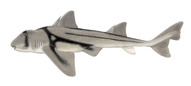
Their color is gray to light brown. They have a dark spot on their nose with a black bar running the length of their face as wide as the eye. There are black stripes that flow along the body, giving them the appearance of wearing a harness. (Budker, 1971; McGrouther, 2005; Whitley, 1940)
Port Jackson sharks have two dorsal fins with a spine at the tip. These are not venomous and can be very sharp when young, but usually dull with age. The spines can be found washed up on shores and are believed to be the origin for the name of the “horn sharks”. (Budker, 1971; McGrouther, 2005; Whitley, 1940)
Port Jackson sharks have two types of teeth: incisors for cutting and molars for crushing. They are ideal for holding, crushing, and breaking the shells of their crustacean and mollusk prey. (Budker, 1971; McGrouther, 2005; Whitley, 1940)
- Other Physical Features
- ectothermic
- heterothermic
- bilateral symmetry
- Sexual Dimorphism
- female larger
-
- Range length
- 25 to 170 cm
- 9.84 to 66.93 in
-
- Average length
- 85 cm
- 33.46 in
Development
Port Jackson sharks deposit their egg cases and then wedge them into rock crevices. The eggs develop into juvenile sharks in the egg case and then emerge after 10 to 12 months. After the young sharks are born, they move into nursery areas in bays and estuaries where they remain until maturity. Juvenile Port Jackson sharks remain in mixed sex groups for several years. After a few years, the young move into deeper waters and separate into female and male groups. (McGrouther, 2005)
Reproduction
Mature female Port Jackson sharks move to inshore reefs accompanied by some males beginning in July and August. They mate on coastal reefs and of the coast of New South Wales. Many males do not participate in breeding and remain in deeper water offshore. Breeding sharks congregate in caves but little is known about courtship and pair formation. (Rogers, 2000)
Port Jackson sharks are oviparous. During August and September, females lay 10 to 16 eggs in shallow reefs at depths of 5 to 30 meters. The egg cases are brown, spiraled structures that the females wedge into rock crevices. Females will hold an egg case in their mouth and insert it into a safe crevice. Females usually use the same breeding sites each year. Port Jackson sharks have been seen eating their own egg cases, but they have never been seen breeding. The young hatch out of the egg case after 10 to 12 months. (Budker, 1971; McGrouther, 2005; Rogers, 2000)
- Key Reproductive Features
- iteroparous
- seasonal breeding
- gonochoric/gonochoristic/dioecious (sexes separate)
- sexual
- fertilization
- oviparous
-
- Breeding interval
- Port Jackson sharks breed once yearly.
-
- Breeding season
- Port Jackson sharks breed seasonally, in July and August.
-
- Range number of offspring
- 10 to 16
-
- Average number of offspring
- 12
-
- Range gestation period
- 9 to 12 months
Once the female has layed her eggs, along with a supply of nutrients in the yolk sac, and placed them in safe rock crevices to develop, there is no further parental involvement. (Budker, 1971; McGrouther, 2005; Rogers, 2000)
- Parental Investment
- no parental involvement
-
pre-fertilization
- provisioning
-
protecting
- female
-
pre-hatching/birth
-
protecting
- female
-
protecting
Lifespan/Longevity
No information on lifespan was found for Port Jackson sharks.
Behavior
Port Jackson sharks segregate into same-sex groups. Males and females may occupy different habitats during most parts of the year. Males and females encounter each other only briefly during breeding. Port Jackson sharks are mainly active at night, when their prey are active, and rest in crevices and under rock outcroppings during the day. (McGrouther, 2005; Rogers, 2000)
- Key Behaviors
- natatorial
- nocturnal
- motile
- migratory
- social
Home Range
These sharks shows a pattern of migration southwards after breeding, moving up to 850 km north of breeding reefs before returning to the same sites the next year. Some may range as far south as Tasmania from the Sydney area in New South Wales in their migration. It is thought that migrating adult Port Jackson sharks move northwards along inshore coastal waters but return to their breeding reefs along deeper offshore waters. (McGrouther, 2005; Rogers, 2000)
Communication and Perception
Port Jackson sharks, like other sharks, probably have keen chemosensation and can detect small movements in the water with tactile organs. Nothing is known about communication in these sharks. (McGrouther, 2005)
Food Habits
Port Jackson sharks feed primarily on invertebrates, mainly echinoderms. They eat sea urchins, starfish, polychaetes, large gastropods, prawns, crabs, barnacles, and small fishes. Juveniles, with their smaller, more pointed teeth, apparently take more soft-bodied prey than adults. Food items in stomachs are usually broken into small pieces, which show how the powerful molar-like teeth grind the food. Food is apparently taken at night on the ocean bottom. Juveniles dig food out of the sand by sucking in water and sand and blowing it out of the gill covers. (McGrouther, 2005; Whitley, 1940)
Respiration can occur by pumping water into the first of the enlarged gill slits and out the last four, which is thought to allow the shark to crush and grind its prey at leisure without having to take in water through its mouth and risk food leaving the gill slits. (Budker, 1971)
- Primary Diet
-
carnivore
- eats non-insect arthropods
- molluscivore
- Animal Foods
- fish
- mollusks
- aquatic crustaceans
- echinoderms
- other marine invertebrates
Predation
The adults seem to be well protected by their sedentary habits, cryptic coloration, nocturnal behavior, fin spines, and disruptive color patterns. Some predators are large sharks such as great white sharks (Carcharodon carcharias) as well as sea lions (Otariidae). Juveniles in nursery grounds are more vulnerable to predation by other sharks. Eggs may be eaten by male Port Jackson sharks. (Budker, 1971; McGrouther, 2005; Rogers, 2000)
- Anti-predator Adaptations
- cryptic
-
- Known Predators
-
- Great White Sharks Carcharodon carcharias
- sea lions (Otariidae)
Ecosystem Roles
There are several known parasites of Port Jackson sharks, including parasitic isopods. Port Jackson sharks are important predators of echinoderms and crustaceans. Through predation on echinoderms it is likely that they positively influence populations of mollusks and algae.
Economic Importance for Humans: Positive
Port Jackson sharks are important members of healthy marine ecosystems.
Economic Importance for Humans: Negative
Port Jackson sharks are considered harmless to people. (McGrouther, 2005)
Conservation Status
Port Jackson sharks are not considered threatened currently.
-
- IUCN Red List
-
Least Concern
More information
-
- IUCN Red List
-
Least Concern
More information
-
- US Federal List
- No special status
-
- CITES
- No special status
-
- State of Michigan List
- No special status
Contributors
Tanya Dewey (editor), Animal Diversity Web.
Jace Hopper (author), University of Notre Dame, Karen Powers (editor, instructor), Radford University.
Glossary
- Australian
-
Living in Australia, New Zealand, Tasmania, New Guinea and associated islands.

- Pacific Ocean
-
body of water between the southern ocean (above 60 degrees south latitude), Australia, Asia, and the western hemisphere. This is the world's largest ocean, covering about 28% of the world's surface.
- bilateral symmetry
-
having body symmetry such that the animal can be divided in one plane into two mirror-image halves. Animals with bilateral symmetry have dorsal and ventral sides, as well as anterior and posterior ends. Synapomorphy of the Bilateria.
- carnivore
-
an animal that mainly eats meat
- chemical
-
uses smells or other chemicals to communicate
- coastal
-
the nearshore aquatic habitats near a coast, or shoreline.
- cryptic
-
having markings, coloration, shapes, or other features that cause an animal to be camouflaged in its natural environment; being difficult to see or otherwise detect.
- ectothermic
-
animals which must use heat acquired from the environment and behavioral adaptations to regulate body temperature
- fertilization
-
union of egg and spermatozoan
- heterothermic
-
having a body temperature that fluctuates with that of the immediate environment; having no mechanism or a poorly developed mechanism for regulating internal body temperature.
- internal fertilization
-
fertilization takes place within the female's body
- iteroparous
-
offspring are produced in more than one group (litters, clutches, etc.) and across multiple seasons (or other periods hospitable to reproduction). Iteroparous animals must, by definition, survive over multiple seasons (or periodic condition changes).
- migratory
-
makes seasonal movements between breeding and wintering grounds
- molluscivore
-
eats mollusks, members of Phylum Mollusca
- motile
-
having the capacity to move from one place to another.
- natatorial
-
specialized for swimming
- native range
-
the area in which the animal is naturally found, the region in which it is endemic.
- nocturnal
-
active during the night
- oviparous
-
reproduction in which eggs are released by the female; development of offspring occurs outside the mother's body.
- saltwater or marine
-
mainly lives in oceans, seas, or other bodies of salt water.
- seasonal breeding
-
breeding is confined to a particular season
- sexual
-
reproduction that includes combining the genetic contribution of two individuals, a male and a female
- social
-
associates with others of its species; forms social groups.
- tactile
-
uses touch to communicate
- temperate
-
that region of the Earth between 23.5 degrees North and 60 degrees North (between the Tropic of Cancer and the Arctic Circle) and between 23.5 degrees South and 60 degrees South (between the Tropic of Capricorn and the Antarctic Circle).
- tropical
-
the region of the earth that surrounds the equator, from 23.5 degrees north to 23.5 degrees south.
References
Budker, P. 1971. The Life of Sharks. New York: Columbia University Press.
McGrouther, M. 2005. "Port Jackson Shark, Heterodontus portjacksoni" (On-line). Fishes: Australian Museum Fish Site. Accessed March 06, 2006 at http://www.amonline.net.au/fishes/students/focus/heter.htm.
Rogers, C. 2000. Port Jackson Sharks. Nature Australia, 10: 26-33.
Whitley, G. 1940. The Fishes of Australia. Sydney: Royal Zoological Society N.S.W..