Heterodon platirhinosEastern Hognose Snake


Geographic Range
Eastern hognose snakes, Heterondon platirhinos, are native to the Nearctic region (North America). Their range extends along the east coast and into the central United States. In total, they are found in about thirty states in the United States and are also found in southern Ontario. Their east coast populations range from southern New Hampshire south to the southern tip of Florida. Their central United States populations range from as far north as Minnesota to as far south as southern Texas. Eastern hognose snakes are also found as far west as Texas, Oklahoma, Kansas, Nebraska, and into the southern tip of South Dakota. (Bartlett and Bartlett, 2005; Linzey and Clifford, 1981; Wright and Wright, 1957)
Habitat
Eastern hognose snakes are mostly found in areas with dry, sandy, or mixed sandy soils. They are often found in grassy fields, fields that contain crops, and along woodland edges. When found along woodland edges, they are mostly found in thinly wooded pine and/or hardwood areas. Occasionally they can be found near small bodies of water but are typically found in well drained areas. Eastern hognose snakes are also sometimes found in buildings such as greenhouses and barns but are not typical habitats for this snake species. Maximum reported elevation is 830m, with an average elevation of 330m. (Bartlett and Bartlett, 2005; Linzey and Clifford, 1981; Munyer, 1967; Pinder and Mitchell, 2001; Wright and Wright, 1957)
- Habitat Regions
- temperate
- terrestrial
- Terrestrial Biomes
- savanna or grassland
- forest
- Other Habitat Features
- agricultural
- riparian
-
- Range elevation
- 830 (high) m
- 2723.10 (high) ft
-
- Average elevation
- 330 m
- 1082.68 ft
Physical Description
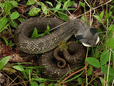
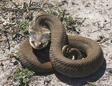
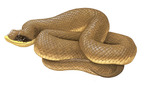
Eastern hognose snakes are characterized by thick bodies, wide heads, and a slightly upturned and pointed snout. Adult length is 45-105cm, and females are larger than males. As juveniles, these snakes have a pinkish coloration with dark brown to black blotches arranged in alternating rows down the length of their bodies. As adults, these snakes vary greatly in color from light brown, light gray, red, tan, grayish green, yellowish, and even solid dark gray or black. The snakes with the lighter colorations usually also exhibit the same alternating pattern of dark blotches as the juveniles and also typically have a darker color pattern on the top of the head. The blotches observed are typically larger on the dorsal side of the body and smaller on the lateral side of the body. The ventral side of the body ranges in color from white to a light gray but is lighter than the dorsal coloration. In addition, the underside of the tail typically has a lighter coloration than the ventral coloration. Eastern hognose snakes typically have twenty-three to twenty-five dorsal scale rows with a divided anal plate. Males of this species typically have an average of one hundred and twenty-six ventral scales and fifty-one subcaudal scales while females have an average of one hundred thirty-eight ventral scales and thirty-nine subcaudal scales. Both sexes of this species typically have between thirty-seven and sixty caudal scales. (Bartlett and Bartlett, 2005; Ernst and Ernst, 2003; Linzey and Clifford, 1981; Mattison, 2007; Mitchell, 1994; Pinder and Mitchell, 2001; Simon, 1979; Wright and Wright, 1957)
- Other Physical Features
- ectothermic
- bilateral symmetry
- Sexual Dimorphism
- female larger
-
- Range length
- 45 to 105 cm
- 17.72 to 41.34 in
-
- Average length
- 60 cm
- 23.62 in
Development
The appearances of centers of ossification is similar in most snakes. The brown water snake (Nerodia taxispilota) is more frequently studied than the hognose snake but both develop almost identically (Franklin, 1945). In the brown water snake on the 25th day of egg development, ossification of the centra of the first cervical vertebrae can be observed along with the remainder of vertebrae ossifying almost simultaneously. On the 27th day, centres of ossification of the palatine and pterygoid bones of the skull can be observed and apparent two days later are the ossification centres of the exoccipital, dentary, vomer, pre-maxilla, and angular bones. On day 33, prootic, nasal, and prefrontal bone ossification centres can be seen and on day 34 the maxilla and rib ossification centres can be seen. On day 35, ossification centres of the quadrate and prefrontal bones are apparent and on day 36 the articular and coronoid bones of the lower jaw are apparent. Also on day 36, ossification of the spinous process can be observed along with the fusing of the neural arch. Ossification of bones in all snakes is not complete until the snake reaches early maturity. In the hognose snake, the maxilla, nasal, and vomer bones have an ossification centre that appears slightly earlier (by a day or two) than the brown water snake while the ribs are more developed in the hognose snake than at the same time point in the brown water snake. In general, hognose snake hatchlings are more completely ossified than brown water snakes. During their exponential growth period, eastern hognose snakes can grow as fast as two centimeters per month. Snakes' growth slows after they reach maturity but never completely stops. (Franklin, 1945)
- Development - Life Cycle
- indeterminate growth
Reproduction
Eastern hognose snakes are polygynandrous meaning that both the males and females have multiple mates in a single mating period. In order to find mates, males follow female scent trails much like the way these snakes follow prey scent trails. (Cunnington and Cebek, 2005)
- Mating System
- polygynandrous (promiscuous)
Eastern hognose snakes mate once yearly, predominantly in the spring and early summer months. If they have a second breeding period between September and October, the female will store the male's sperm until the following spring. Males tend to travel much farther in search of mates whereas females tend to stay near optimal egg-laying areas that will maximize the hatching success of their eggs. These nests are typically between 23-26 degrees Celsius and are located in areas of high sunlight exposure. Once a male finds a female, copulation can last as long as one to three days with males alternating between their hemipenes. The gestation period for female eastern hognose snakes is typically between 40-50 days. Females typically lay 10-30 eggs from early June to late July. Clutch size is positively correlated with the females' snout-vent length (SVL). Eggs are often laid beneath rocks and buried 10-15 centimeters deep into sandy soils. Eastern hognose snake eggs weigh 3-12 grams and hatch during August and September and hatchlings can range from 10-20 centimeters long. During their growth period, these snakes can grow as fast as two centimeters per month. Males usually take 18-24 months to reach maturity, which is defined by attaining a SVL of 40 centimeters. Females reach maturity at around a SVL of 45 centimeters and this growth usually takes around 21 months. (Bartlett and Bartlett, 2005; Cunnington and Cebek, 2005; Ernst and Ernst, 2003; Lagory, et al., 2009; Linzey and Clifford, 1981; Mattison, 2007; Mitchell, 1994; Munyer, 1967; Peet-Pare and Blouin-Demers, 2012)
- Key Reproductive Features
- iteroparous
- seasonal breeding
- sexual
- oviparous
- sperm-storing
-
- Breeding interval
- Eastern hognose snake females breed once yearly
-
- Breeding season
- April to July
-
- Range number of offspring
- 4 to 69
-
- Average number of offspring
- 25
-
- Range gestation period
- 40 to 50 days
-
- Average time to independence
- 0 days
-
- Average age at sexual or reproductive maturity (female)
- 21 months
-
- Range age at sexual or reproductive maturity (male)
- 18 to 24 months
-
- Average age at sexual or reproductive maturity (male)
- 26 months
Female eastern hognose snakes will often incubate their eggs for 39-65 days (average 56 days). When incubation occurs, the female will bury herself with her eggs and coil around them. The incubation period depends heavily on the nest temperature and the ambient temperature. The higher the nest/ambient temperature, the shorter the incubation period. Some female eastern hognose snakes may guard their eggs. Not all females will incubate or guard their eggs but guarding only occurs with incubation. (Wright and Wright, 1957)
- Parental Investment
- precocial
-
pre-hatching/birth
-
protecting
- female
-
protecting
Lifespan/Longevity
Eastern hognose snakes are rarely kept in captivity. Those in captivity lived for up to seven years but average five to six years. Lifespan of these snakes in the wild is unknown. (Ernst and Ernst, 2003)
-
- Range lifespan
Status: captivity - 7 (high) years
- Range lifespan
-
- Average lifespan
Status: captivity - 5.5 years
- Average lifespan
Behavior
Eastern hognose snakes are predominantly diurnal animals and are more active around mid-day. They will swim in order to cross between habitats and to find food or potential mates. Eastern hognose snakes are mostly active during the summer months, from early April until October or November depending on the temperatures (as low as 19 degrees Celsius). Eastern hognose snakes usually begin hibernation anywhere from early September into November. If the temperatures drop to 19 degrees Celsius, they will begin their hibernation. During the active period, their body temperature typically stays between 23-34 degrees Celsius with ambient temperatures between 19-27 degrees Celsius. Eastern hognose snakes hibernate individually in either self-made burrows or abandoned mammal burrows. Eastern hognose snakes tend to burrow at night into sandy soil. When burrowing, they thrust their heads downwards into the soil and use side-to-side motions and force from the anterior portion of their bodies until they are completely burrowed into the soil, sometimes up to 25 centimeters deep or more when sleeping and hibernating. (Ernst and Ernst, 2003; Lagory, et al., 2009; Linzey and Clifford, 1981; Mitchell, 1994; Peet-Pare and Blouin-Demers, 2012; Smith, 1976; Wright and Wright, 1957)
- Key Behaviors
- terricolous
- fossorial
- diurnal
- hibernation
- solitary
Home Range
Eastern hognose snakes have a home range that averages at about fifty hectares and are often at low slopes in order to minimize the amount of energy that is needed to travel. Males also tend to have a larger home range because they travel farther in search of mates while females have a smaller home range in order to stay close to areas that are ideal for egg development. Eastern hognose snakes do not defend a territory within the home range. (Ernst and Ernst, 2003; Wright and Wright, 1957)
Communication and Perception
Eastern hognose snakes, like other snakes, rely mostly on olfactory cues to perceive their environment. Eastern hognose snakes have been shown to have extreme difficulty utilizing sight in order to find prey. In order to find prey, they perform tongue flicks that pick up chemicals from the outside environment and are then transferred to an olfactory organ in the vomeronasal system when the tongue is pulled back inside the mouth called the Jacobsob's organ that is located on the roof of the mouth. By performing continuous tongue flicks, they are able to follow scent trails in order to find prey. In order to find mates, male eastern hognose snakes follow pheromone trails left by female snakes similar to how they follow prey trails. (Byerly, et al., 2013; Cooper Jr and Secor, 2007; Ernst and Ernst, 2003; Kroll, 1976; Linzey and Clifford, 1981)
- Other Communication Modes
- pheromones
- Perception Channels
- chemical
Food Habits
Eastern hognose snakes have a varying diets consisting mostly of toads, specifically Anaxyrus terrestris. They have also been known to eat frogs, various reptiles, small birds, small mammals, fish, salamanders (mostly tiger salamanders Ambystoma tigrinum and marbled salamanders Ambystoma opacum), and even worms and insects. These snakes swallow their prey whole and often eat frogs and toads alive. Toads are known to secrete toxins that are often fatal to anything that tries to eat them but eastern hognose snakes have digestive enzymes that neutralize those toxins and are of no harm to the snake. Toads will also inflate their bodies as a defense mechanism but these snakes also have enlarged teeth that have been said to be used to deflate toads to make them easier to swallow. In addition, the eastern hognose snakes' upturned snout allows them to be able to dig into the soil to root out burrowing toads. Eastern hognose snakes also have enlarged rear fangs that contain a mild venom used to subdue prey. Juvenile eastern hognose snakes have been known to eat mostly crickets and other small insects. (Cooper Jr and Secor, 2007; Diener, 1957; Ernst and Ernst, 2003; Linzey and Clifford, 1981; Mattison, 2007; Mitchell, 1994; Munyer, 1967; Platt, 1969; Wright and Wright, 1957)
- Primary Diet
-
carnivore
- eats terrestrial vertebrates
- Animal Foods
- birds
- mammals
- amphibians
- reptiles
- fish
- insects
- terrestrial non-insect arthropods
- terrestrial worms
Predation
Eastern hognose snakes are preyed on by many animals such as raccoons (Procyon lotor), Virginia opossums (Didelphis virginiana), foxes, hawks and other predatory birds, snakes such as king snakes (Lampropeltis getula) and cottonmouths (Agkistrodon piscivorus), tarantulas (Eurypelma californica), and humans (Homo sapiens).
When threatened, eastern hognose snakes will often lunge at the predator and try to bite in the direction of the predator. They will often bite when threatened but rarely bite humans. When biting/lunging doesn't scare off the predator, these snakes will often perform what is called "death feigning" on land and in water. When death feigning, eastern hognose snakes will flatten their heads and necks to increase the width. They will then hiss loudly, inflate their bodies with air, roll on their back, open their mouth and allow their tongue to hang out limply, evert the cloaca, and even convulse. If they are righted while performing death feigning, they will often flip back over and continue the defensive behavior. Newborn eastern hognose snakes will perform the same defense as the adult snakes. (Bartlett and Bartlett, 2005; Conant and Collins, 1998; Ernst and Ernst, 2003; Linzey and Clifford, 1981; Mattison, 1986; Mitchell, 1994; Munyer, 1967)
-
- Known Predators
-
- raccoons (Procyon lotor)
- Virginia opossums (Didelphis virginiana)
- red foxes (Vulpes vulpes)
- hawks (Accipitridae)
- king snakes (Lampropeltis getula)
- cottonmouths (Agkistrodon piscivorus)
- tarantulas (Eurypelma californica)
- humans (Homo sapiens)
Ecosystem Roles
Eastern hognose snakes are used as a host by the coccidian parasite Caryospora lampropeltis, which are expelled in the feces of these snakes. These snakes are also hosts to nematode parasites called Rhabdias fuscovenosa and Lechriorchis primus which infect the lungs. They are also parasitized by nematodes (Cosmocercoides variabilis, Kalicephalus parvus) and tapeworms (Ochetosoma kansense, Ochetosoma ellipticum, and Ochetosoma elongatum) which infect various parts of the digestive tract. (Dyer, 1994; Dyer, 1999; McAllister, et al., 2008; McAllister, et al., 2015)
- coccidia Caryospora lampropeltis
- roundworms Rhabdias fuscovenosa
- roundworms Lechriorchis primus
- tapeworms Ochetosoma elongatum
- tapeworms Ochetosoma ellipticum
- tapeworms Ochetosoma kansense
- roundworms Cosmocercoides variabilis
- roundworms Kalicephalus parvus
Economic Importance for Humans: Positive
Eastern hognose snakes eat a variety of small mammals, insects, and amphibians and therefore have a role in limiting these populations, some of which often exhibit pest-like characteristics. They have the strongest role in limiting toad populations because toads are their primary source of nutrition. (Ernst and Ernst, 2003)
- Positive Impacts
- controls pest population
Economic Importance for Humans: Negative
Eastern hognose snakes have been reported to be mildly venomous to humans. Bites from these snakes can result in swelling, bruising, and pain around the bite area. (Bartlett and Bartlett, 2005; Grogan Jr, 1974)
- Negative Impacts
-
injures humans
- bites or stings
- venomous
Conservation Status
Eastern hognose snakes are listed as a species of "least concern" on the IUCN red list and have no special status on any United States federal government lists. In the future, they may be of concern due habitat destruction and decline of toad populations in their native areas. Eastern hognose snakes are sometimes mistaken for pygmy rattlesnakes (Sistrurus miliarius) and are often killed due to this mistaken identity. (Ernst and Ernst, 2003; Lagory, et al., 2009)
-
- IUCN Red List
-
Least Concern
More information
-
- IUCN Red List
-
Least Concern
More information
-
- US Federal List
- No special status
-
- CITES
- No special status
-
- State of Michigan List
- No special status
Contributors
Renee Jessee (author), Radford University - Fall 2015, Karen Powers (editor), Radford University, April Tingle (editor), Radford University, Cari Mcgregor (editor), Radford University, Zeb Pike (editor), Radford University, Jacob Vaught (editor), Radford University, Tanya Dewey (editor), University of Michigan-Ann Arbor.
Glossary
- Nearctic
-
living in the Nearctic biogeographic province, the northern part of the New World. This includes Greenland, the Canadian Arctic islands, and all of the North American as far south as the highlands of central Mexico.

- agricultural
-
living in landscapes dominated by human agriculture.
- bilateral symmetry
-
having body symmetry such that the animal can be divided in one plane into two mirror-image halves. Animals with bilateral symmetry have dorsal and ventral sides, as well as anterior and posterior ends. Synapomorphy of the Bilateria.
- carnivore
-
an animal that mainly eats meat
- chemical
-
uses smells or other chemicals to communicate
- diurnal
-
- active during the day, 2. lasting for one day.
- ectothermic
-
animals which must use heat acquired from the environment and behavioral adaptations to regulate body temperature
- forest
-
forest biomes are dominated by trees, otherwise forest biomes can vary widely in amount of precipitation and seasonality.
- fossorial
-
Referring to a burrowing life-style or behavior, specialized for digging or burrowing.
- hibernation
-
the state that some animals enter during winter in which normal physiological processes are significantly reduced, thus lowering the animal's energy requirements. The act or condition of passing winter in a torpid or resting state, typically involving the abandonment of homoiothermy in mammals.
- indeterminate growth
-
Animals with indeterminate growth continue to grow throughout their lives.
- iteroparous
-
offspring are produced in more than one group (litters, clutches, etc.) and across multiple seasons (or other periods hospitable to reproduction). Iteroparous animals must, by definition, survive over multiple seasons (or periodic condition changes).
- native range
-
the area in which the animal is naturally found, the region in which it is endemic.
- oviparous
-
reproduction in which eggs are released by the female; development of offspring occurs outside the mother's body.
- pheromones
-
chemicals released into air or water that are detected by and responded to by other animals of the same species
- polygynandrous
-
the kind of polygamy in which a female pairs with several males, each of which also pairs with several different females.
- riparian
-
Referring to something living or located adjacent to a waterbody (usually, but not always, a river or stream).
- seasonal breeding
-
breeding is confined to a particular season
- sexual
-
reproduction that includes combining the genetic contribution of two individuals, a male and a female
- solitary
-
lives alone
- sperm-storing
-
mature spermatozoa are stored by females following copulation. Male sperm storage also occurs, as sperm are retained in the male epididymes (in mammals) for a period that can, in some cases, extend over several weeks or more, but here we use the term to refer only to sperm storage by females.
- temperate
-
that region of the Earth between 23.5 degrees North and 60 degrees North (between the Tropic of Cancer and the Arctic Circle) and between 23.5 degrees South and 60 degrees South (between the Tropic of Capricorn and the Antarctic Circle).
- terrestrial
-
Living on the ground.
- tropical savanna and grassland
-
A terrestrial biome. Savannas are grasslands with scattered individual trees that do not form a closed canopy. Extensive savannas are found in parts of subtropical and tropical Africa and South America, and in Australia.
- savanna
-
A grassland with scattered trees or scattered clumps of trees, a type of community intermediate between grassland and forest. See also Tropical savanna and grassland biome.
- temperate grassland
-
A terrestrial biome found in temperate latitudes (>23.5° N or S latitude). Vegetation is made up mostly of grasses, the height and species diversity of which depend largely on the amount of moisture available. Fire and grazing are important in the long-term maintenance of grasslands.
- venomous
-
an animal which has an organ capable of injecting a poisonous substance into a wound (for example, scorpions, jellyfish, and rattlesnakes).
- visual
-
uses sight to communicate
- young precocial
-
young are relatively well-developed when born
References
Bartlett, R., P. Bartlett. 2005. Guide and Reference to the Snakes of Eastern and Central North America. Gainesville, FL: University Press of Florida.
Byerly, T., A. Robinson, M. Vierya. 2013. Do snakes use olfactory receptors in the nose to detect odors? A prediction based on the percentage of nonfunctional olfactory receptor genes amplified in four species of snakes. Journal of the South Carolina Academy of Science, 8/1: 1-3.
Conant, R., J. Collins. 1998. A Field Guide to Reptiles & Amphibians of Eastern and Central North America. New York, NY: Houghton Mifflin Company.
Cooper Jr, W., S. Secor. 2007. Strong response to anuran chemical cues by an extreme dietary specialist, the eastern hog-nosed snake (Heterodon platirhinos). Canadian Journal of Zoology, 85: 619-625.
Cunnington, G., J. Cebek. 2005. Mating and nesting behavior of the eastern hognose snake (Heterodon platirhinos) in the northern portion of its range. The American Midland Naturalist, 154: 474-478.
Diener, R. 1957. A western hognose snake eats a collared lizard. Herpetologica, 13/2: 122.
Dyer, W. 1999. Newly reported snake hosts for two Ochetosomatid digeneans in Illinois. Transactions of the Illinois State Academy of Science, 92/3,4: 243-245.
Dyer, W. 1994. Some helminths of the Racer, Coluber constrictor, and the eastern hognose snake, Heterodon platirhinos, in southern Illinois. Transactions of the Illinois State Academy of Science, 87/1,2: 43-45.
Ernst, C., E. Ernst. 2003. Snakes of the United States and Canada. Washington: Smithsonian Institution Press.
Franklin, M. 1945. The embryonic appearance of centres of ossification in the bones of snakes. Copeia, 1945/2: 68-72.
Grogan Jr, W. 1974. Effects of accidental envenomation from the saliva of the eastern hognose snake, Heterodon platyrhinos. Herpetologica, 30/3: 248-249.
Kroll, J. 1976. Feeding adaptations of hognose snakes. The Southwestern Naturalist, 20/4: 537-557.
Lagory, K., L. Waltson, C. Goulet, R. Van Lonkhuyzen, S. Najjar, C. Andrews. 2009. An examination of scale-dependent resource use by eastern hognose snakes in southcentral New Hampshire. The Journal of Wildlife Management, 73: 1387-1393.
Linzey, D., M. Clifford. 1981. Snakes of Virginia. Charlottesville, VA: University Press of Virginia.
Mattison, C. 2007. The New Encyclopedia of Snakes. Princeton, NJ: Princeton University Press.
Mattison, C. 1986. Snakes of the World. New York, NY: Facts on File, Inc.
McAllister, C., C. Bursey, S. Trauth. 2008. New host and geographic distribution records for some endoparasites (Myxosporea, Trematoda, Cestoidea, Nematoda) of amphibians and reptiles from Arkansas and Texas, U.S.A.. Comparative Parasitology, 75/2: 241-254.
McAllister, C., S. Seville, M. Connior. 2015. A new host for Caryospora lampropeltis (Apicomplexa: Eimeriidae) from the eastern hognose snake, Heterodon platirhinos (Ophidia: Colubroidea: Dipsadinae), from Arkansas, U.S.A., with a summary of hosts of this coccidian. Comparative Parasitology, 82/1: 151-154.
Mitchell, J. 1994. The Reptiles of Virginia. Washington: Smithsonian Institution Press.
Munyer, E. 1967. Behavior of an eastern hognose snake, Hetorodon platyrhinos, in water. Copeia, 3: 668-670.
Peet-Pare, C., G. Blouin-Demers. 2012. Female eastern hog-nosed snakes (Heterodon platirhinos) choose nest sites that produce offspring with phenotypes likely to improve fitness. Canadian Journal of Zoology, 90: 1215-1220.
Pinder, M., J. Mitchell. 2001. A Guide to the Snakes of Virginia. Richmond, VA: Virginia Department of Game and Inland Fisheries.
Platt, 1969. Ambystoma maculatum (Ambystomatidae) in the diet of Heterodon platyrhinos (Colubridae) from northern Arkansas. The Southwestern Naturalist, 27/2: 230.
Simon, H. 1979. Easy Identification Guide to North American Snakes. New York, NY: Dodd, Mead & Company.
Smith, G. 1976. Ecological energetics of three species of ectothermic vertebrates. Ecology, 57: 252-264.
Wright, A., A. Wright. 1957. Handbook of Snakes of the United States and Canada. Ithaca, NY: Comstock Publishing Associates.
Yildirimhan, H., C. Bursey, S. Goldberg. 2007. Helminth parasites of the grass snake, Natrix natrix, and the dice snake, Natrix tessellata (Serpentes: Colubridae), from Turkey. Comparative Parasitology, 74/2: 343-354.