Gymnothorax funebrisMorena verde
Geographic Range
Gymnothorax funebris, green moray eels, can be found in the western Atlantic Ocean, including the Gulf of Mexico and the Caribbean Sea. Typically, these moray eels range as far north as New Jersey and as far south as Brazil. One individual was reported off the coast of Nova Scotia. Experts speculate that this animal had been carried there by the Gulf Stream. The species is most common in the Gulf of Mexico, the Caribbean Sea, the Bahamas, and the Florida Keys. These eels make small migrations to spawning sites. ("Gymnothorax funebris", 2003)
- Biogeographic Regions
- nearctic
- neotropical
- atlantic ocean
Habitat
Green morays live in rocky, intertidal areas, coral reefs, mangroves, tidal creeks, harbors, seagrass beds, and other areas over sandy or muddy bottoms. They reside in rock crevices and small caves, usually no deeper than 30 m. ("Gymnothorax funebris", 2003; Moyle and Cech, 1982)
- Habitat Regions
- temperate
- tropical
- saltwater or marine
- Other Habitat Features
- estuarine
- intertidal or littoral
-
- Range depth
- 1 to 30 m
- 3.28 to 98.43 ft
Physical Description
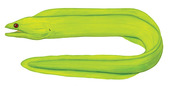
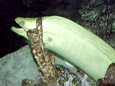
The body of Gymnothorax funebris is long and laterally compressed. This animal has no scales on its dark brown/grey skin, the entirety of which is covered by a yellow mucus. This mucus serves to protect these eels from parasites and bacteria. The yellow color of the mucus, when mixed with the brown or grey color of the eel's skin, results in a green hue, for which the animal is named. Green morays, like all eels, have no pelvic fins and, like all morays, have no pectoral fins. Their dorsal fin runs the length of the body and is continuous with the caudal fin. On the face there are two cylindrical structures- its incurrent nostrils. The excurrent nostrils are marked by simple openings. The teeth are large and smooth-edged. On the upper jaw, there are two rows of teeth, while on the bottom, there is only one. The largest specimen ever recorded was 2.5 m from nose to tail, with a mass of 29 kg. The average individual is estimated to be 1.8 m from nose to tail and have a mass of 13.3 kg. ("Gymnothorax funebris", 2003; Moyle and Cech, 1982; Nelson, 1984)
- Other Physical Features
- ectothermic
- heterothermic
- bilateral symmetry
- Sexual Dimorphism
- sexes alike
-
- Range mass
- 29 (high) kg
- 63.88 (high) lb
-
- Average mass
- 13.3 kg
- 29.30 lb
-
- Range length
- 2.5 (high) m
- 8.20 (high) ft
-
- Average length
- 1.8 m
- 5.91 ft
Development
When the fertilized eggs of green morays hatch, prolarvae emerge. Shortly thereafter the prolarvae transform into leptocephalus larvae, which grow to be between 5 and 10 cm in length. The leptocephalus larva shares a number of morphological characteristics with its adult counterparts: both are long and laterally compressed and their dorsal, caudal and anal fins are continuous. Unlike adults, they have a "gelatinous" consistency and their tissues (with the exception of bone) are transparent.
The leptocephalus larva will undergo its final metamorphosis in open water. The juvenile resembles the mature animal, save that it is smaller in size. Ocean currents disperse the animals after metamorphosis and, once they have reached a permanent habitat, they mature. This process not only involves an increase in size, but two stages of sexual maturity: a hermaphroditic stage as a juvenile (during which individuals posess both male and female sex organs) before a determined male or female stage as an adult. Experts speculate that environment plays a role in the final sex determination, with more stressful environments producing more females. Based on the documented larval development of the European eel,the larval stage of the green moray probably lasts on the order of 2.5 years. ("Gymnothorax funebris", 2003; Bertin, 1957; Moyle and Cech, 1982; Nelson, 1984)
- Development - Life Cycle
- metamorphosis
Reproduction
The mating system of Gymnothorax funebris has yet to be described. We do know that fertilization occurs externally and at a spawning site. Based on what is known about European eels (Anguilla anguilla), it is plausible that green morays are promiscuous and that spawning sites are farther from the shoreline than the eel's foraging habitat, between 400 m and 500 m deep. ("Gymnothorax funebris", 2003; Bertin, 1957)
- Mating System
- polygynandrous (promiscuous)
The reproductive habits of Gymnothorax funebris are not well known. There is no record of when these animals spawn, though close relatives are known to spawn in the early months of the year, around January or February. At a given spawning site, millions of eggs are released, but significantly less are fertilized and fewer still (on the order of one in every six million) survive into adulthood. ("Gymnothorax funebris", 2003; Bertin, 1957)
- Key Reproductive Features
- iteroparous
- gonochoric/gonochoristic/dioecious (sexes separate)
- sexual
- fertilization
- broadcast (group) spawning
- oviparous
-
- Breeding interval
- It is unknown how frequently green morays breed.
-
- Breeding season
- Green morays may breed in the early months of the year; in January or February
After they have spawned, adult eels leave the area to die or return to their home range. There is no parental involvement after the eggs have been fertilized. ("Gymnothorax funebris", 2003; Bertin, 1957)
- Parental Investment
- no parental involvement
-
pre-fertilization
- provisioning
-
protecting
- female
Lifespan/Longevity
The lifespan of Gymnothorax funebris is not well known. There are records of other Anguilliformes with life spans between 8 and 30 years of age in the wild. One captive specimen lived to be 85 years of age. ("Gymnothorax funebris", 2003; Moriarty, 1978)
Behavior
This species is solitary and nocturnal. Adults are rarely active outside of feeding and spawning. Larvae, however, must migrate from the spawning site to a suitable habitat. Adults activley hunt fish in caves and crevices along coral reefs or shorelines. When an eel encounters a fish too large to swallow whole, it wraps itself around its prey in a characteristic knot, allowing for leverage against the fish. It then tears its prey into smaller pieces, which can be swallowed more easily. The larvae are also active predators of zooplankton. ("Gymnothorax funebris", 2003; Moyle and Cech, 1982)
- Key Behaviors
- natatorial
- nocturnal
- motile
- sedentary
- solitary
Communication and Perception
Because of their solitary lifestyle, these animals rarely have occasion to communicate with conspecifics. Little is known about how they communicate with potential mates. Their senses, the strongest of which is smell, are dedicated to locating food and a spawning site. ("Gymnothorax funebris", 2003; Bertin, 1957)
Food Habits
Gymnothorax funebris is a dietary generalist. It readily consumes most species of fish, so long as they are small enough to swallow whole or can be ripped into manageable pieces. Green morays will also prey on crustaceans and cephalopods. Larvae prey on diatoms, smaller crustaceans, and other zooplankton. ("Gymnothorax funebris", 2003)
- Primary Diet
-
carnivore
- piscivore
- eats non-insect arthropods
- molluscivore
- Animal Foods
- fish
- mollusks
- aquatic crustaceans
- zooplankton
- Other Foods
- microbes
Predation
As larvae, green morays are eaten by most any animal that consumes zooplankton. As for adults, little information has been recorded about their predators. Presumably, large individuals would have very few natural predators, since they are relatively large and will viciously attack any potential threats. ("Gymnothorax funebris", 2003; Moyle and Cech, 1982)
- Anti-predator Adaptations
- cryptic
Ecosystem Roles
Very little is known about the role of Gymnothorax funebris in its ecosystem, beyond that it is a top predator. Reportedly, some maintain a mutualistic relationship with gobies, wrasses, and some shrimp, all of which eat microbes off of the eel's skin. ("Gymnothorax funebris", 2003; "Gymnothorax funebris", 2003; "Gymnothorax funebris", 2003)
Economic Importance for Humans: Positive
Green morays are objects of great interest to divers and tourists at coral reefs and other natural habitats. Commercially, they are sold as pets to private aquarists with adequate facilities to keep them. They are also common in public aquaria. Less often, they are sold as food. ("Gymnothorax funebris", 2003)
- Positive Impacts
- pet trade
- food
- ecotourism
- research and education
Economic Importance for Humans: Negative
These animals are feared for their vicious bite. However, it is worth noting that they rarely bite unless provoked. Also, large individuals are potentially ciguatoxic (a common toxin found in large fish between 35 degrees N and 34 degrees S latitude). Some of the eel's prey consume dinoflagellates that produce ciguatoxins. The toxin concentrates as it moves up the food chain. As a result, it is particularly dangerous to humans who eat large top predators from these ecosystems. ("Gymnothorax funebris", 2003; Moyle and Cech, 1982; Nelson, 1984)
- Negative Impacts
-
injures humans
- bites or stings
- carries human disease
Conservation Status
Green moray eels are not currently threatened.
-
- IUCN Red List
- No special status
-
- US Federal List
- No special status
-
- CITES
- No special status
Contributors
Tanya Dewey (editor), Animal Diversity Web.
Kyle Wilson (author), Kalamazoo College, Ann Fraser (editor, instructor), Kalamazoo College.
Glossary
- Atlantic Ocean
-
the body of water between Africa, Europe, the southern ocean (above 60 degrees south latitude), and the western hemisphere. It is the second largest ocean in the world after the Pacific Ocean.

- Nearctic
-
living in the Nearctic biogeographic province, the northern part of the New World. This includes Greenland, the Canadian Arctic islands, and all of the North American as far south as the highlands of central Mexico.
- Neotropical
-
living in the southern part of the New World. In other words, Central and South America.
- bilateral symmetry
-
having body symmetry such that the animal can be divided in one plane into two mirror-image halves. Animals with bilateral symmetry have dorsal and ventral sides, as well as anterior and posterior ends. Synapomorphy of the Bilateria.
- carnivore
-
an animal that mainly eats meat
- chemical
-
uses smells or other chemicals to communicate
- coastal
-
the nearshore aquatic habitats near a coast, or shoreline.
- cryptic
-
having markings, coloration, shapes, or other features that cause an animal to be camouflaged in its natural environment; being difficult to see or otherwise detect.
- ecotourism
-
humans benefit economically by promoting tourism that focuses on the appreciation of natural areas or animals. Ecotourism implies that there are existing programs that profit from the appreciation of natural areas or animals.
- ectothermic
-
animals which must use heat acquired from the environment and behavioral adaptations to regulate body temperature
- estuarine
-
an area where a freshwater river meets the ocean and tidal influences result in fluctuations in salinity.
- external fertilization
-
fertilization takes place outside the female's body
- fertilization
-
union of egg and spermatozoan
- food
-
A substance that provides both nutrients and energy to a living thing.
- heterothermic
-
having a body temperature that fluctuates with that of the immediate environment; having no mechanism or a poorly developed mechanism for regulating internal body temperature.
- intertidal or littoral
-
the area of shoreline influenced mainly by the tides, between the highest and lowest reaches of the tide. An aquatic habitat.
- iteroparous
-
offspring are produced in more than one group (litters, clutches, etc.) and across multiple seasons (or other periods hospitable to reproduction). Iteroparous animals must, by definition, survive over multiple seasons (or periodic condition changes).
- metamorphosis
-
A large change in the shape or structure of an animal that happens as the animal grows. In insects, "incomplete metamorphosis" is when young animals are similar to adults and change gradually into the adult form, and "complete metamorphosis" is when there is a profound change between larval and adult forms. Butterflies have complete metamorphosis, grasshoppers have incomplete metamorphosis.
- molluscivore
-
eats mollusks, members of Phylum Mollusca
- motile
-
having the capacity to move from one place to another.
- natatorial
-
specialized for swimming
- native range
-
the area in which the animal is naturally found, the region in which it is endemic.
- nocturnal
-
active during the night
- oviparous
-
reproduction in which eggs are released by the female; development of offspring occurs outside the mother's body.
- pet trade
-
the business of buying and selling animals for people to keep in their homes as pets.
- piscivore
-
an animal that mainly eats fish
- polygynandrous
-
the kind of polygamy in which a female pairs with several males, each of which also pairs with several different females.
- reef
-
structure produced by the calcium carbonate skeletons of coral polyps (Class Anthozoa). Coral reefs are found in warm, shallow oceans with low nutrient availability. They form the basis for rich communities of other invertebrates, plants, fish, and protists. The polyps live only on the reef surface. Because they depend on symbiotic photosynthetic algae, zooxanthellae, they cannot live where light does not penetrate.
- saltwater or marine
-
mainly lives in oceans, seas, or other bodies of salt water.
- sedentary
-
remains in the same area
- sexual
-
reproduction that includes combining the genetic contribution of two individuals, a male and a female
- solitary
-
lives alone
- tactile
-
uses touch to communicate
- temperate
-
that region of the Earth between 23.5 degrees North and 60 degrees North (between the Tropic of Cancer and the Arctic Circle) and between 23.5 degrees South and 60 degrees South (between the Tropic of Capricorn and the Antarctic Circle).
- tropical
-
the region of the earth that surrounds the equator, from 23.5 degrees north to 23.5 degrees south.
- visual
-
uses sight to communicate
- zooplankton
-
animal constituent of plankton; mainly small crustaceans and fish larvae. (Compare to phytoplankton.)
References
2003. Gymnothorax funebris. Pp. 254-258; 266-267 in M Hutchins, D Thoney, P Loiselle, N Schlager, eds. Grzinek's Animal Life Encyclopedia, Vol. 4, 2 Edition. Farmington Hills, MI: Gale Group.
Bertin, L. 1957. Eels: A Biological Study. New York, NY: Philosophical Library, Inc..
Moriarty, C. 1978. Eels: A Natural and Unnatural History. New York, NY: Universe Books.
Moyle, P., J. Cech. 1982. Fishes: An Introduction to Ichthyology. Englewood Cliffs, NJ: Prentice-Hall, Inc..
Nelson, J. 1984. Fishes of the World. Toronto: John Wiley & Sons, Inc..