Grus japonensisred-crowned crane


Geographic Range
Grus japonensis is the second rarest crane in the world. They can be found at the Amur River basin in eastern Russia and in southeastern Asia, including China and Japan. They are a migratory species; they spend their springs and summers in the wetlands of temperate East Asia. They winter in the salt and freshwater marshes of China, Japan and the Korean Peninsula. There is also a non-migratory population that remains in Hokkaido, Japan, the countries' northernmost island. ("Threatened Birds of Asia: The BirdLife International Red Data Book", 2001; Collar, et al., 1988; "International Crane Foundation, Crane Species, Red Crowned Crane", 2001; Plemons, 2001; Smirenski, 2000)
- Biogeographic Regions
- palearctic
- oriental
Habitat
Red-crowned cranes nest and feed in marshes with deep water. This habitat preference is rare for cranes; most of their close relatives prefer shallow water. They will also nest only in areas with standing dead vegetation. Red-crowned cranes are sometimes found in agricultural areas. (Collar, et al., 1988; Meine and Archibald, 2004; Plemons, 2001; Smirenski, 2000)
- Habitat Regions
- temperate
- terrestrial
- Wetlands
- marsh
- Other Habitat Features
- agricultural
Physical Description
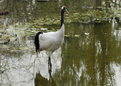
These cranes have white bodies with black on the tips of their wings and necks. They are named because of the red circle on their heads, which is actually exposed skin. Males and females look alike. Red-crowned cranes have very long and pointy beaks and can weigh up to twenty pounds. Their wingspan can be as wide as eight feet and they can reach 5 feet in height. They are one of the world's largest birds. Their basal metabolic rate is 31.4 cm^3 oxygen/hour. ("IUCN Red List of Threatened Species", 2003; Meine and Archibald, 2004; Plemons, 2001; Smirenski, 2000)
- Other Physical Features
- endothermic
- homoiothermic
- bilateral symmetry
- Sexual Dimorphism
- sexes alike
-
- Average mass
- 9500 g
- 334.80 oz
-
- Average mass
- 8500 g
- 299.56 oz
- AnAge
-
- Average length
- 1.6 m
- 5.25 ft
-
- Average wingspan
- 2.4 m
- 7.87 ft
-
- Average basal metabolic rate
- 31.4 cm3.O2/g/hr
Reproduction
Red-crowned cranes have a dancing display used in courtship and to communicate between the other members of its species. The dance is a series of bows, head bobbing, leaps, and various other gestures. There is also a unison call given by the male and female before they start other dance elements. These cranes are monogamous and stay together throughout the year, they often remain together for many years or until one of them dies. ("International Crane Foundation, Crane Species, Red Crowned Crane", 2001; Smirenski, 2000)
- Mating System
- monogamous
Grus japonensis breeds in the spring and summer. The female usually lays two eggs; the eggs hatch at the same time, but often only one chick lives. The chicks fledge in 70 days and the young reach sexual maturity in two to three years. (Blair-Newton, Date Unknown; Collar, et al., 1988; "IUCN Red List of Threatened Species", 2003; Plemons, 2001)
- Key Reproductive Features
- iteroparous
- seasonal breeding
- gonochoric/gonochoristic/dioecious (sexes separate)
- sexual
- fertilization
- oviparous
-
- Breeding season
- spring and summer months
-
- Average eggs per season
- 2
-
- Average eggs per season
- 2
- AnAge
-
- Average time to hatching
- 31 days
- AnAge
-
- Average fledging age
- 70 days
-
- Average age at sexual or reproductive maturity (female)
- 2-3 years
-
- Average age at sexual or reproductive maturity (female)
Sex: female - 1095 days
- AnAge
- Average age at sexual or reproductive maturity (female)
-
- Average age at sexual or reproductive maturity (male)
- 2-3 years
-
- Average age at sexual or reproductive maturity (male)
Sex: male - 1095 days
- AnAge
- Average age at sexual or reproductive maturity (male)
Both the male and female G. japonensis help to build the nest and incubate the eggs. When the eggs hatch, the female does more of the feeding while the male defends the chicks from predators. ("International Crane Foundation, Crane Species, Red Crowned Crane", 2001; Meine and Archibald, 2004)
- Parental Investment
- no parental involvement
- precocial
-
pre-hatching/birth
-
protecting
- male
- female
-
protecting
-
pre-weaning/fledging
-
provisioning
- male
- female
-
protecting
- male
- female
-
provisioning
-
pre-independence
-
provisioning
- male
- female
-
protecting
- male
- female
-
provisioning
Lifespan/Longevity
These cranes usually live for 30 years in the wild and can live for over sixty years in captivity. ("Threatened Birds of Asia: The BirdLife International Red Data Book", 2001; "Let's Learn About Cranes", 2004; Song, 2000)
-
- Average lifespan
Status: wild - 30 years
- Average lifespan
-
- Range lifespan
Status: captivity - 65 (high) years
- Range lifespan
-
- Average lifespan
Status: wild - 25 years
- Average lifespan
-
- Average lifespan
Status: captivity - 50 years
- Average lifespan
-
- Average lifespan
Status: captivity - 25.2 years
- Max Planck Institute for Demographic Research
- Average lifespan
Behavior
Red-crowed cranes are communal and live in flocks. When preening they rub special oil that is secreted from a gland at the top of their tail onto their feathers to keep the feathers conditioned. Red-crowned crane bills are very pointed and sharp; cranes use them like spears. The shape of the bill makes it easier to gather food. This species is able to feed in deeper water than other cranes because of its walk and peck technique. ("International Crane Foundation, Crane Species, Red Crowned Crane", 2001; "IUCN Red List of Threatened Species", 2003; Plemons, 2001; Smirenski, 2000)
Home Range
We do not have information on home range for this species at this time.
Communication and Perception
Red-crowned cranes use their courtship dance, which consists of bowing, head bobbing and leaping in order to communicate with each other. The dance is very beautiful and strengthens the bond between male and female pairs. They also have a contact call that lets other birds know where they are. The chick's contact call is much louder and more strident than the adult's, this helps them to get attention in times of distress. They can also communicate aggression by inflating the red cap on their heads. (Blair-Newton, Date Unknown; "Let's Learn About Cranes", 2004; "International Crane Foundation, Crane Species, Red Crowned Crane", 2001)
Food Habits
Their diet in the wild consist of insects, aquatic invertebrates, fish, amphibians, rodents, reeds, grasses, heath berries, corn, and other plants. During winter months, they also feed on waste and grain in agricultural fields. In zoos, however, they are fed crane pellets, 500 grams of silverside fish (per day), and occasionally insects.
Red-crowned crane bills are very pointed and sharp; cranes use them like spears. The shape of the bill makes it easier to gather food. This species is able to feed in deeper water than other cranes because of its walk and peck technique. (Collar, et al., 1988; "International Crane Foundation, Crane Species, Red Crowned Crane", 2001; "IUCN Red List of Threatened Species", 2003; Plemons, 2001; Smirenski, 2000)
- Primary Diet
- omnivore
- Animal Foods
- mammals
- amphibians
- fish
- insects
- terrestrial non-insect arthropods
- terrestrial worms
- aquatic or marine worms
- Plant Foods
- leaves
- seeds, grains, and nuts
- fruit
Predation
Red-crowned cranes are large birds and can outrun or fly to get away from most predators in their ecosystem. They also have sharp beaks that they can use to defend themselves against predators. ("Threatened Birds of Asia: The BirdLife International Red Data Book", 2001; "Let's Learn About Cranes", 2004; "IUCN Red List of Threatened Species", 2003; Smirenski, 2000)
Ecosystem Roles
Because red-crowned cranes are omnivores, they impact their deep marshes ecosystem by eating both plants and animals. (Collar, et al., 1988; "International Crane Foundation, Crane Species, Red Crowned Crane", 2001; "IUCN Red List of Threatened Species", 2003; Meine and Archibald, 2004)
Economic Importance for Humans: Positive
Red-crowned cranes are significant to people in Asia because they are strongly associated with luck and love. They may also help control pest populations because they feed on many small insects and rodents. They are also important subjects for research and education. ("Threatened Birds of Asia: The BirdLife International Red Data Book", 2001; "International Crane Foundation, Crane Species, Red Crowned Crane", 2001; Plemons, 2001; Smirenski, 2000)
- Positive Impacts
- research and education
- controls pest population
Economic Importance for Humans: Negative
These animals are in constant conflict with humans in Asia because the Asian countries where the cranes live are so heavily populated. There is a constant demand for more industrialization and agricultural expansion, which reduces the habitat where a large number of these cranes reside.
Conservation Status
Economic development, especially agricultural expansion, river canalizations, deforestation, and road building, is destroying many of the breeding wetlands in Hokkaido, which support more than a quarter of the red-crowned crane population. The agricultural development of breeding and wintering grounds for the cranes is also a critical threat in China and other places that the cranes reside. Some measures have been taken to help protect Grus japonensis and its habitat. There have been international agreements and cooperative research has been done on the species and its migratory patterns. Protected areas have also been established to safeguard the cranes' habitat and minimize disturbance. People have developed winter feeding stations, which help the cranes survive the winter months. Japan has marked its nearby utility lines to help reduce collisions and there are frequent surveys done on the breeding and wintering grounds. Red-crowned cranes have lived in captivity for centuries and have been bred by humans since 1861. A few limited reintroduction efforts have been made to help bring the birds in captivity back to the wild and educational programs have been set up to focus on helping these cranes. There are also efforts to develop an umbrella international agreement for all cranes in east Asia and also to build a complete recovery plan for Grus japonensis. It is now illegal to hunt red-crowned cranes in all nations where they naturally occur. They are listed as 'Endangered' by the IUCN and are listed under Appendix I by CITES. ("Threatened Birds of Asia: The BirdLife International Red Data Book", 2001; Collar, et al., 1988; "International Crane Foundation, Crane Species, Red Crowned Crane", 2001; "IUCN Red List of Threatened Species", 2003; Meine and Archibald, 2004)
-
- IUCN Red List
-
Endangered
More information
-
- IUCN Red List
-
Endangered
More information
-
- CITES
- Appendix I
Other Comments
In Asia, red-crowned cranes have been symbols of fidelity in marriage, good luck, long life and love. They are considered to be very sacred. They have been the subjects of many poems, mythology and art from this region, and loosing them would mean loosing a symbol of peace and luck for the people of Asia.
Contributors
Alaine Camfield (editor), Animal Diversity Web.
Victoria DeCarlo (author), School of Music, University of Michigan, Phil Myers (editor), Museum of Zoology, University of Michigan-Ann Arbor.
Glossary
- Palearctic
-
living in the northern part of the Old World. In otherwords, Europe and Asia and northern Africa.

- acoustic
-
uses sound to communicate
- agricultural
-
living in landscapes dominated by human agriculture.
- bilateral symmetry
-
having body symmetry such that the animal can be divided in one plane into two mirror-image halves. Animals with bilateral symmetry have dorsal and ventral sides, as well as anterior and posterior ends. Synapomorphy of the Bilateria.
- chemical
-
uses smells or other chemicals to communicate
- endothermic
-
animals that use metabolically generated heat to regulate body temperature independently of ambient temperature. Endothermy is a synapomorphy of the Mammalia, although it may have arisen in a (now extinct) synapsid ancestor; the fossil record does not distinguish these possibilities. Convergent in birds.
- fertilization
-
union of egg and spermatozoan
- iteroparous
-
offspring are produced in more than one group (litters, clutches, etc.) and across multiple seasons (or other periods hospitable to reproduction). Iteroparous animals must, by definition, survive over multiple seasons (or periodic condition changes).
- marsh
-
marshes are wetland areas often dominated by grasses and reeds.
- migratory
-
makes seasonal movements between breeding and wintering grounds
- monogamous
-
Having one mate at a time.
- motile
-
having the capacity to move from one place to another.
- native range
-
the area in which the animal is naturally found, the region in which it is endemic.
- omnivore
-
an animal that mainly eats all kinds of things, including plants and animals
- oriental
-
found in the oriental region of the world. In other words, India and southeast Asia.
- oviparous
-
reproduction in which eggs are released by the female; development of offspring occurs outside the mother's body.
- seasonal breeding
-
breeding is confined to a particular season
- sexual
-
reproduction that includes combining the genetic contribution of two individuals, a male and a female
- social
-
associates with others of its species; forms social groups.
- tactile
-
uses touch to communicate
- temperate
-
that region of the Earth between 23.5 degrees North and 60 degrees North (between the Tropic of Cancer and the Arctic Circle) and between 23.5 degrees South and 60 degrees South (between the Tropic of Capricorn and the Antarctic Circle).
- terrestrial
-
Living on the ground.
- visual
-
uses sight to communicate
- young precocial
-
young are relatively well-developed when born
References
BirdLife International. 2001. Threatened Birds of Asia: The BirdLife International Red Data Book. Cambridge, U.K.: BirdLife International.
IUCN. 2003. "IUCN Red List of Threatened Species" (On-line). Accessed April 21, 2004 at http://www.redlist.org.
International Crane Foundation. 2001. "International Crane Foundation, Crane Species, Red Crowned Crane" (On-line). Accessed April 21, 2004 at http://www.savingcranes.org/species/red-crwn.asp.
Children of the Earth. 2004. "Let's Learn About Cranes" (On-line). Accessed April 21, 2004 at Http://www.childrenoftheearth.org/Navy%20Pages/learn_about_the_cranes.htm.
Blair-Newton, S. Date Unknown. "Cranes Topic of Bird Club Talk" (On-line). Winona Post Online. Accessed March 21, 2003 at Http://www.winona.com/032002/outdoor.html.
Collar, N., P. Andrew, L. Gonzaga, R. Grimmett, T. Johnson. 1988. Birds To Watch; The ICBP World Checklist of Threatened Birds. Washington D.C.: Smithsonian Institution Press.
Gotch, A. 1981. Birds-Their Latin Names Expanded. London, England: Blandford Press.
Meine, C., G. Archibald. 2004. "USGS; Science for a Changing World" (On-line). The Cranes: Status Survey and Conservation Action Plan. Accessed April 21, 2004 at http://www.npwrc.usgs.gov/resource/distr/birds/cranes/cranes.htm.
Plemons, B. 2001. "Red Crowned Crane (Tancho Tsuru)" (On-line). Accessed April 21, 2004 at http://www.whozoo.org/Anlife2001/bricplem/BP_redcrownedcrane.html.
Smirenski, S. 2000. "Red-Crowned Crane" (On-line). Accessed April 21, 2004 at http://www.thewildones.org/Animals/redcrown.html.
Song, L. 2000. Red-Crowned cranes raised at the Yancheng Reserve. China Daily. Accessed April 21, 2004 at http://www.cein.net/cgi-bin/en/NewsDetail.asp?ID=227.