Graptemys flavimaculataYellow-blotched Map Turtle
Geographic Range
Yellow-blotched sawback turtles (or Yellow-blotched map turtles) (Graptemys flavimaculata) are native to rivers of southeastern Mississippi. The main river these turtles inhabit is the Pascagoula River, as well as three tributary rivers: the Leaf River, the Chickasawhay River, and the Escatawpa River. The Leaf River and the Chickasawhay River are both north of the Pascagoula River while the Escatawpa River flows east from the Pascagoula River. The Leaf River flows from the northwest, the Chickasawhay River flows from the northeast, and the Escatawpa River flows from Alabama into Mississippi, feeding into the Pascagoula River. (Ernst and Lovich, 2009; Horne, et al., 2003; Jones, 1996)
- Other Geographic Terms
- holarctic
Habitat
Yellow-blotched sawback turtles can inhabit differing widths of rivers, having been found in rivers with widths between 110 and 120m as well as rivers with widths between 20 and 50m. They live in reaches of these rivers that contain sandbars for nesting, floating logs for basking, and where the water is exposed to sunlight at some point during the day. The substrates of these rivers are typically sand and silt. Yellow-blotched sawbacks prefer areas where there is flowing water, but they have been found in stagnant lakes or ponds. In addition to this, they remain in areas where the water stays between 10-35 °C. In warmer weather (June through October), yellow-blotched sawbacks remain in areas with reduced water flow. In cooler weather (November through May), these turtles tend to remain where there is greater water flow. Jones (1996) found that both sexes move to areas differing in depth and the distance from the shore throughout the year. Jones also found that during the warmer months, males remain in rivers with a 3.6m depth and 4.4m from the shore while females move out to a 5.0m depth and 9.9m distance from land. In the colder months, males move to a 1.8m depth and 4.9m from the shore and females return to just 3.6m depths and 1.7m distance from the shore. (Horne, et al., 2003; Jones, 1996; Selman, 2012; Selman and Jones, 2011; "Yellow-blotched map turtle (Graptemys flavimaculata) recovery plan", 1993)
- Aquatic Biomes
- lakes and ponds
- rivers and streams
-
- Range depth
- 0 to 5.0 m
- 0.00 to 16.40 ft
Physical Description
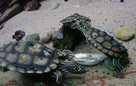
Yellow-blotched sawback turtles have distinctive stripes covering their head, neck, and legs. These stripes alternate from yellow to olive green and begin with yellow circles surrounding the eyes, which then extend posterior to the base of the shell. The shells of yellow-blotched sawbacks have orange spots in circular orbits around the shell. They also have tall ridges bisecting the shell on the first four vertebrae. These ridges are black and sometimes are lacking in adult females. The carapace of yellow-blotched sawbacks can be light brown to olive in color.
Yellow-blotched sawbacks differ in coloration in comparison to other turtles within Graptemys. Ringed sawbacks (Graptemys oculifera) and black-knobbed map turtles (Graptemys nigrinoda) have a ring on each costal which is light in color and have patterns on their heads that differ from yellow-blotched sawbacks. These two are also lacking in the black vertebrae that are distinctive in yellow-blotched sawbacks.
Adult females are typically seven to ten times the mass of adult males. The minimum carapace length (CL) of females is 8cm and the maximum CL is 18cm. Males have a CL range of 4.75cm to 11cm. The minimum mass of male yellow-blotched sawbacks is 50g while the maximum mass is 226.7g. For females, the minimum mass is 98.3g and the maximum is 1,183.3g. Males possess longer front claws and thicker tails than females.
At hatching, yellow-blotched sawbacks typically measure 29.9mm to 34.3mm. The minimum mass of juveniles is 12.5g while the maximum is 45g. When these turtles hatch, their markings are generally darker and more defined than full-grown adults. Although the shape and placement of the markings do not change, these markings lighten as the turtles age. Even as juveniles, yellow-blotched sawbacks have vertebrae that come out of the spine on the dorsal side of the shell. (Ennen, et al., 2010; Ernst and Lovich, 2009; Killebrew, 1997; Mitchell, et al., 2019; Selman, 2012; Selman and Jones, 2011)
- Other Physical Features
- ectothermic
- bilateral symmetry
- Sexual Dimorphism
- female larger
- sexes shaped differently
-
- Range mass
- 50 to 1183.3 g
- 1.76 to 41.70 oz
-
- Range length
- 4.75 to 18 cm
- 1.87 to 7.09 in
Development
In general, yellow-blotched sawbacks only grow about 2-3cm each year as adults. After the first year, these turtles’ carapaces are as wide as they are long, 44mm, and plastrons average 37mm. Sexual maturity for males can be reached in their second year, at a plastron length as small as 7.1cm. However, males are generally in the third and fourth years of development when they reach an 8cm plastron length. Females grow slightly faster, yet do not reach age of sexual maturity until year 10 or above. Sexually-mature females have a plastron length of at least 14cm. Temperature of the incubation period determines what the sex of the hatchlings are. The incubation temperature has a reported average of 25.9 °C for nests dug beside riverbanks and an average of 28.7 °C for nests that are made in sandbars. Lower temperatures will produce male hatchlings and higher temperatures will produce female hatchlings. The pivotal point for sex determination is 29-30°C. Therefore, nests that are built along riverbanks are more likely to produce male hatchlings. Hatchlings have darker and more noticeable markings than adult yellow-blotched sawbacks. These growth rings fade as the turtles grow, both in size and in the area of shell that they cover. (Ernst and Lovich, 2009; Selman and Jones, 2011)
- Development - Life Cycle
- temperature sex determination
- indeterminate growth
Reproduction
Yellow-blotched sawbacks are polygynadrous. Mating begins underwater when males approach the females while extending their necks forward. Females will face the males and likewise extend their necks. Males will then stroke females’ faces with their claws. Females will attempt to also stroke the males’ faces and necks. Ernst and Lovich (2009) reported males biting females on the legs and neck before placing their tails under the females'. (Ernst and Lovich, 2009; Selman and Jones, 2011)
- Mating System
- polygynandrous (promiscuous)
Yellow-blotched sawback females are gravid as early as May and as late as August, but exact gestation period cannot be determined. Nests are also found as early as May and as late as August. It takes an average of 34 minutes for females to build a nest for egg laying. They typically mate once a year but can occasionally mate twice per year. Females dig a nest in which to lay the eggs. The eggs are a creamy white color when laid, as well as slightly pliable. The egg sizes are, on average, 36.8mm by 22.9mm, with an average mass of 15.0g. The incubation period in captivity was reported by Ernst and Lovich (2009) as 98 days. Clutch sizes are typically three to nine eggs, and hatchlings in nature were observed by Ernst and Lovich (2009) emerging from their nests in September or October. At hatching, the young are completely independent from both parents. Sexual maturity for males is reached when the plastron length is 7.1-8cm, which happens between age 2-4. Females are thought to become sexually mature at 8-10 years of age. (Ernst and Lovich, 2009; Horne, et al., 2003; Selman and Jones, 2011; "Yellow-blotched map turtle (Graptemys flavimaculata) 5-year review: summary and evaluation", 2018)
- Key Reproductive Features
- iteroparous
- seasonal breeding
- gonochoric/gonochoristic/dioecious (sexes separate)
- sexual
- fertilization
- oviparous
-
- Breeding interval
- Yellow-blotched sawbacks breed once to twice per year.
-
- Breeding season
- May through October
-
- Range number of offspring
- 3 to 9
-
- Average number of offspring
- 4.7
-
- Range time to independence
- 0 (low) minutes
-
- Range age at sexual or reproductive maturity (female)
- 8 to 10 years
-
- Range age at sexual or reproductive maturity (male)
- 2 to 4 years
Male parents only play a role in the fertilization of the eggs. Females must carry the eggs. Females will dig nests in a sandbar, or a steep riverbank made of clay. Females will lay the eggs at any time during the day and it takes an average of 34.6 minutes for females to build this nest. Once the eggs are laid, females leave them and provide no further parental investment. (Ernst and Lovich, 2009; Horne, et al., 2003; Selman and Jones, 2011)
- Parental Investment
-
pre-fertilization
- provisioning
-
protecting
- female
Lifespan/Longevity
Exact lifespan of yellow-blotched sawbacks is unknown. Other members of the genus Grapemys are known to live 14-36 years. The lifespan of yellow-blotched sawbacks is thought to be 20 years, but this is unsure. Egg survivorship is about 10% due to predation and flooding that eggs experience. Although yellow-blotched sawbacks are kept in captivity for scientific study, their lifespan is still unknown. (Slavens and Slavens, 2018; Snider and Bowler, 1992)
Behavior
Yellow-blotched sawbacks live mostly on the ground; however, they have the ability to swim in order to reach basking points. Basking has been observed mostly during midday and under cloudy conditions. Selman and Qualls (2011) reported that basking duration for males averaged 36.2 minutes, 42.8 minutes for females, and 23.5 minutes for juveniles. Basking occurs across all months of the year and in all temperatures. Yellow-blotched sawbacks will dive into the water when disturbed by humans or animal predators. As natatorial turtles, they are able to swim away under these circumstances. Yellow-blotched sawbacks are diurnal, but there are some cases in which they are found in evening hours basking, which commonly continues past sunset. In other cases, both males and females will climb across riverbanks and onto protruding tree limbs near the surface in order to bask. Females are able to move further into the waterway to bask simply due to their larger body size. Mating behavior typically includes males and females bobbing their heads and males biting females’ tail and legs. Adult females will dig nests on sandbars in order to lay their eggs, a process which takes an average of 34 minutes. Yellow-blotched sawbacks are polygynadrous and live solitary lives. Although they may happen to bask on the same log or tree rot, yellow-blotched sawbacks do not live in groups. (Ernst and Lovich, 2009; Jones, 1996; Selman and Lindeman, 2015; Selman and Lindeman, 2018; Selman and Qualls, 2011; Selman, et al., 2013)
- Key Behaviors
- terricolous
- natatorial
- diurnal
- motile
- nomadic
- solitary
Home Range
Jones (1996) reported home range for yellow-blotched sawbacks from 0.5ha-14ha. There was no correlation in range size to body mass; the average home range of females was slightly larger than that of males, but not significantly. Yellow-blotched sawbacks to not have a territory that they defend. (Jones, 1996)
Communication and Perception
Yellow-blotched sawbacks are able to see well enough to avoid predators and to find small insects for food. They also are reactive to their environments, specifically while basking, to noises such as boats and humans who may pass by. These turtles can also see the shadows of birds and avoid these potential predators. Because members of the genus Graptemys use pheromones in order to elicit courtship, it is likely yellow-blotched sawbacks use pheromones in this way as well. Head-bobbing and biting is also used during mating communication in yellow-blotched sawbacks. This head bobbing is also found in communication between turtles of the same sex. Although little is known about yellow-blotched sawbacks, use of chemical signals is common in communication between turtles. These chemicals can be secreted through glands that most turtles have on the skin below their shells. It is likely that yellow-blotched sawbacks have these same means of communication through chemicals. (Jenkins, 1979; Selman and Qualls, 2011)
- Other Communication Modes
- pheromones
Food Habits
Yellow-blotched sawbacks consume sponges, other invertebrates, plants, and algae. The proportions of these can change depending on what is available in the area where these turtles are living; however, the largest portion in volume of diet is sponges: 71% for males and 55% for females. If there are more plants than sponges, they will eat a greater volume of plants without significant effects on their health. Generally, females consume more mollusks than males because they have larger jaws (about 40% more mussels in volume than males). Other animals and plants that these turtles ingest are plant stems, moss, spiders, fruits, seeds, and flowers. In captivity, yellow-blotched sawbacks will also consume fish. (McCoy, et al., 2020; Selman and Jones, 2011; Selman and Lindeman, 2018; "Yellow-blotched map turtle (Graptemys flavimaculata) recovery plan", 1993)
- Primary Diet
-
carnivore
- insectivore
- eats non-insect arthropods
- molluscivore
- eats other marine invertebrates
-
herbivore
- folivore
- algivore
- Animal Foods
- insects
- terrestrial non-insect arthropods
- mollusks
- Plant Foods
- flowers
- algae
Predation
Predators of yellow-blotched sawbacks mainly target nests. These predators include fish crows (Corvus ossifragus; especially on sand bars), but other nest predators include red imported fire ants (Solenopsis invicta), speckled kingsnakes (Lampropeltis getula), raccoons (Procyon lotor), feral pigs (Sus scrofa), nine-banded armadillos (Dasypus novemcinctus), and gray foxes (Urocyon cinereoargenteus). Ernst and Lovich (2009) reported that speckled kingsnakes are able to consume the eggs of multiple nests at one time. Fish crows will fly along and above sandbars, looking for females creating nests and will even consume eggs before the females have finished laying them. Human (Homo sapiens) disturbance can trample nests, startle females as they attempt to dig nests, or humans can dig up existing nests. Foot traffic and passing motorboats can directly injure or kill these turtles. (Ernst and Lovich, 2009; Horne, et al., 2003; Selman and Jones, 2011)
-
- Known Predators
-
- fish crows Corvus ossifragus
- fire ants Solenopsis invicta
- speckled kingsnakes Lampropeltis getula
- raccoons Procyon lotor
- feral pigs Sus scrofa
- armadillos Dasypus novemcinctus
- gray foxes Urocyon cinereoargenteus
- humans Homo sapiens
Ecosystem Roles
Yellow-blotched sawbacks consume mostly sponges, but they will also eat insects, plants, algae, mussels, spiders, seeds, moss, and flowers. Yellow-blotched sawback eggs are consumed by fish crows (Corvus ossifragus), red imported fire ants (Solenopsis invicta), speckled kingsnakes (Lampropeltis holbrooki), raccoons (Procyon lotor), feral pigs (Sus scrofa), nine-banded armadillos (Dasypus novemcinctus), and gray foxes (Urocyon cinereoargenteus). There are no natural predators for adult yellow-blotched sawbacks.
Lindeman and Barger (2005) found acanthocephalans (Neoechinorhynchus stunkardi) in the gut of yellow-blotched sawbacks. Steinauer and Horne (2002) found acanthocephalans (Neoechinorhynchus stunkardi), trematodes (Telorchis corti, Telorchis angustus, Telorchis singularis, and Cotylaspsis cokeri), nematodes (Flacaustra procera and Spiroxys), and an unidentified trematode from the family Pronocephalidae in their guts. (Hidalgo-Vila, et al., 2008; Lindeman and Barger, 2005; Steinauer and Horne, 2002)
- acantocephalan Neoechinorhynchus stunkardi
- trematode Telorchis corti
- trematode Telorchis angustus
- trematode Telorchis singularis
- trematode Cotylaspsis cokeri
- nematode Flacaustra procera
- nematode Spiroxys
- trematode in family Pronocephalidae
Economic Importance for Humans: Positive
Yellow-blotched sawbacks are collected for pet trade; they reportedly sold for $65 each in 1989 (Yellow-blotched Map Turtle (Graptemys flavimaculata) Recovery Plan, 1993). According to Hahnert et al. (2014) between 1989 and 1997, 50 yellow-blotched sawbacks were part of illegal the pet trade. However, it is presumed that many more go undetected. Humans will also use yellow-blotched sawbacks as a form of food. (Hahnert, et al., 2014; Selman, et al., 2013; "Yellow-blotched map turtle (Graptemys flavimaculata) recovery plan", 1993)
Economic Importance for Humans: Negative
Turtles in the genus Graptemys, including yellow-blotched sawbacks, have been found to carry salmonella. They can potentially transfer this to humans when held in captivity. ("Yellow-blotched map turtle (Graptemys flavimaculata) 5-year review: summary and evaluation", 2018)
- Negative Impacts
-
injures humans
- carries human disease
Conservation Status
Yellow-blotched sawbacks are listed as “Vulnerable” on the IUCN Red List. In 1991, these turtles were listed as federally threatened under the Endangered Species Act and endangered in 1996. Yellow-blotched sawbacks were also listed as endangered in Mississippi and were part of CITES Appendix III in 2006. This is when a species has been protected by one country (in this case, the United States), but more international protection of the species is warranted. Yellow-blotched sawbacks have no special status on the State of Michigan list.
Threats vary across these turtles’ range. For example, the population decrease of yellow-blotched sawbacks is especially clear in the lower part of the Pascagoula River. In addition, upper parts of the Pascagoula River are nearly devoid of yellow-blotched sawbacks. Hurricane Katrina in 2005 also caused significant declines. Sawbacks are threatened by recreational human activities such as fishing, shooting, and motorboating. Humans kill yellow-blotched sawbacks accidentally by motorboat propeller impact and drowning in fishnets, it is also common for humans to shoot basking sawbacks recreationally. Effects on water quality is another factor for the continuing of the decrease in population numbers, which also causes declines in reproductive output. Horne et al. (2003) found that female yellow-blotched sawbacks only produced about one clutch per year while historically they have produced one to two clutches. Only producing one clutch could be caused by pollution affecting the hormone system of this species. Horne et al. also found that only 38 nests of the 1500 nests they found survived. This poor hatching success may be a result of predation and flooding. Ernst and Lovich (2009) reported that yellow-blotched sawbacks were common upstream from a pulp processing plant, but scarce downstream from this plant. The illegal pet trade negatively affects native populations, as well (Hahnert et al., 2014). Removal of basking locations by humans also threatens the health and number of yellow-blotched sawbacks.
After being listed as federally threatened in 1991, a recovery plan was put in place in 1993 which lists six actions for conservation. Firstly, an assessment of the population trends throughout the entire range of the species should be completed, and a better understanding of their natural history is needed. Quality of water and habitat should be assessed to determine the habitat suitability of remaining waterways. From this point actions should be put in place to create and keep a suitable environment including basking areas, nesting areas, and clean rivers for these turtles. Educational materials should be created about this habitat and the threats that yellow-blotched sawback's experience. This managed, suitable environment should then be monitored to stabilize populations. Monitoring of the population should be done by researchers and include protection of adult turtles and protection of nesting beaches. Law enforcement should address the illegal pet trade so that yellow-blotched sawbacks are not subject to population decrease from illegal trading. (Ernst and Lovich, 2009; Hahnert, et al., 2014; Horne, et al., 2003; Moore and Seigel, 2006; Steinauer and Horne, 2002; van Dijk, 2011; "Yellow-blotched map turtle (Graptemys flavimaculata) 5-year review: summary and evaluation", 2018; "Yellow-blotched map turtle (Graptemys flavimaculata) recovery plan", 1993)
-
- IUCN Red List
-
Endangered
More information
-
- IUCN Red List
-
Endangered
More information
-
- CITES
- Appendix III
-
- State of Michigan List
- No special status
Contributors
Jordan Reddy (author), Radford University, Karen Powers (editor), Radford University, Victoria Raulerson (editor), Radford University, Christopher Wozniak (editor), Radford University, Genevieve Barnett (editor), Colorado State University.
Glossary
- Nearctic
-
living in the Nearctic biogeographic province, the northern part of the New World. This includes Greenland, the Canadian Arctic islands, and all of the North American as far south as the highlands of central Mexico.

- acoustic
-
uses sound to communicate
- bilateral symmetry
-
having body symmetry such that the animal can be divided in one plane into two mirror-image halves. Animals with bilateral symmetry have dorsal and ventral sides, as well as anterior and posterior ends. Synapomorphy of the Bilateria.
- carnivore
-
an animal that mainly eats meat
- chemical
-
uses smells or other chemicals to communicate
- diurnal
-
- active during the day, 2. lasting for one day.
- ectothermic
-
animals which must use heat acquired from the environment and behavioral adaptations to regulate body temperature
- fertilization
-
union of egg and spermatozoan
- folivore
-
an animal that mainly eats leaves.
- food
-
A substance that provides both nutrients and energy to a living thing.
- herbivore
-
An animal that eats mainly plants or parts of plants.
- holarctic
-
a distribution that more or less circles the Arctic, so occurring in both the Nearctic and Palearctic biogeographic regions.
Found in northern North America and northern Europe or Asia.
- indeterminate growth
-
Animals with indeterminate growth continue to grow throughout their lives.
- insectivore
-
An animal that eats mainly insects or spiders.
- iteroparous
-
offspring are produced in more than one group (litters, clutches, etc.) and across multiple seasons (or other periods hospitable to reproduction). Iteroparous animals must, by definition, survive over multiple seasons (or periodic condition changes).
- molluscivore
-
eats mollusks, members of Phylum Mollusca
- motile
-
having the capacity to move from one place to another.
- natatorial
-
specialized for swimming
- native range
-
the area in which the animal is naturally found, the region in which it is endemic.
- nomadic
-
generally wanders from place to place, usually within a well-defined range.
- oviparous
-
reproduction in which eggs are released by the female; development of offspring occurs outside the mother's body.
- pet trade
-
the business of buying and selling animals for people to keep in their homes as pets.
- pheromones
-
chemicals released into air or water that are detected by and responded to by other animals of the same species
- polygynandrous
-
the kind of polygamy in which a female pairs with several males, each of which also pairs with several different females.
- seasonal breeding
-
breeding is confined to a particular season
- sexual
-
reproduction that includes combining the genetic contribution of two individuals, a male and a female
- solitary
-
lives alone
- threatened
-
The term is used in the 1994 IUCN Red List of Threatened Animals to refer collectively to species categorized as Endangered (E), Vulnerable (V), Rare (R), Indeterminate (I), or Insufficiently Known (K) and in the 1996 IUCN Red List of Threatened Animals to refer collectively to species categorized as Critically Endangered (CR), Endangered (EN), or Vulnerable (VU).
- visual
-
uses sight to communicate
References
U.S. Fish and Wildlife Service. Yellow-blotched map turtle (Graptemys flavimaculata) 5-year review: summary and evaluation. none. Jackson, Mississippi: U.S. Fish and Wildlife Service. 2018.
U.S. Fish and Wildlife Service. Yellow-blotched map turtle (Graptemys flavimaculata) recovery plan. none. Jackson, Mississippi: U.S. Fish and Wildlife Service. 1993.
Ennen, J., B. Kreisser, C. Qualls, J. Lovich. 2010. Morphological and molecular reassessment of Graptemys oculifera and Graptemys flavimaculata (Testudines: Emydidae). Journal of Herpetology, 44/4: 544-554.
Ernst, C. 1974. Observations on the courtship of male Graptemys pseudogeographica. Journal of Herpetology, 8/4: 377-378.
Ernst, C., J. Lovich. 2009. Turtles of the United States and Canada. Baltimore, MD: The Johns Hopkins University Press.
Hahnert, T., L. Schober, M. Richter, G. Kalter. 2014. "Graptemys studbooks overview" (On-line). Accessed October 30, 2021 at https://studbooks.eu/site/assets/files/1466/graptemys_studbooks_overview_082014.pdf.
Hidalgo-Vila, J., C. Días-Paniagua, N. Pérez-Santigosa, C. de Frutos-Escobar, A. Herrero-Herrero. 2008. Salmonella in free-living exotic and native turtles and in pet exotic turtles from SW Spain. Research in Veterinary Science, 85/3: 449-452.
Horne, B., R. Brauman, M. Moore, R. Seigel. 2003. Reproductive and nesting ecology of the yellow-blotched map turtle, Graptemys flavimaculata: Implications for conservation and management. Copeia, 2003/4: 729-738.
Jenkins, J. 1979. Notes on the courtship of the map turtle Graptemys pseudogeographica (Gray) (Reptilia, Testudines, Emydidae). Journal of Herpetology, 13/1: 129-131.
Jones, R. 1996. Home range and seasonal movements of the turtle Graptemys flavimaculata. Journal of Herpetology, 30/3: 376-385.
Killebrew, F. 1997. Osteological variation between Graptemys flavimaculata and Graptemys nigrinoda (Testudines: Emydidae). Herpetologica, 35/2: 146-153.
Lindeman, P., M. Barger. 2005. Acanthocephalan (Neoechinorhynchus emydis) infections in Texas map turtles (Graptemys versa). The Southwestern Naturalist, 50/1: 12-16.
McCoy, C., O. Flores-Villela, R. Vogt, M. Pappas, K. McCoy. 2020. Ecology of riverine turtle communities in the southern United States: Food resource use and trophic niche dimensions. Chelonian Conservation and Biology, 19/2: 197-208.
Mitchell, J., P. Lindeman, M. Welc, K. Bosma, G. Brown, W. Selman, J. Iverson. 2019. Graptemys flavimaculata (yellow-blotched sawback), Graptemys geographica (northern map turtle), and Graptemys gibbonsi (Pascagoula map turtle). Herpetological Review, 50/2: 353-354.
Moore, M., R. Seigel. 2006. No place to nest or bask: Effects of human disturbance on the nesting and basking habits of yellow-blotched map turtles (Graptemys flavimaculata). Biological Conservation, 130/3: 386-393.
Selman, W., B. Kreiser, C. Qualls. 2013. Conservation genetics of the yellow-blotched sawback Graptemys flavimaculata (Testudines: Emydidae). Conservative Genetics, 14: 1193-1203.
Selman, W. 2012. Intradrainage variation in population structure, shape, morphology, and sexual size dimorphism in the yellow-blotched sawback, Graptemys flavimaculata. Herpetological Conservation and Biology, 7/2: 427-436.
Selman, W., R. Jones. 2011. Graptemys flavimaculata Cagle 1954 - Yellow-blotched sawback, yellow-blotched map turtle. Pp. 1-11 in A Rhodin, P Pritchard, P van. Dijk, R Saumure, K Buhlmann, J Iverson, R Mittermeier, eds. Conservation and Biology of Freshwater Turtles and Tortoises. Arlington, VT: Chelonian Research Foundation.
Selman, W., P. Lindeman. 2015. Life history and ecology of the Pascagoula map turtle (Graptemys gibbonsi). Herpetological Conservation and Biology, 10/2: 781-800.
Selman, W., P. Lindeman. 2018. Spatial, seasonal, and sexual variation in the diet of Graptemys flavimaculata, a threatened turtle of the Pascagoula River system, Mississippi, USA. Copeia, 106/2: 247-254.
Selman, W., C. Qualls. 2011. Basking ecology of the yellow-blotched sawback (Graptemys flavimaculata), an imperiled turtle species of the Pascagoula river system, Mississippi, United States. Chelonian Conservation and Biology, 10/2: 188-197.
Selman, W., C. Qualls, J. Owen. 2013. Effects of human disturbance on the behavior and physiology of an imperiled freshwater turtle. Journal of Wildlife Management, 77/5: 877-885.
Shelby, J., M. Mendonça, B. Horne, R. Seigel. 2000. Seasonal variation in reproductive steroids of male and female yellow-blotched map turtles, Graptemys flavimaculata. General and Comparative Endocrinology, 119/1: 43-51.
Slavens, F., K. Slavens. 2018. "Frank and Kate's Web Page" (On-line). Reptiles and Amphibians in Captivity. Accessed November 19, 2021 at http://www.pondturtle.com/lturtle.html#Graptemys.
Snider, A., J. Bowler. 1992. Longevity of Reptiles and Amphibians in North American Collections, Second Edition. none: Society for the Study of Amphibians and Reptiles.
Steinauer, M., B. Horne. 2002. Enteric helminths of Graptemys flavimaculata Cagle, 1954, a threatened Chelonian species from the Pascagoula River in Mississippi, U.S.A. Comparative Parasitology, 69/2: 219-222.
Zug, G., L. Vitt, J. Caldwell. 1993. Herpetology: An Introductory Biology of Amphibians and Reptiles. San Diego, California: Academic Press.
van Dijk, P. 2011. "Graptemys flavimaculata (errata version published in 2016)" (On-line). The IUCN Red List of Threatened Species 2011: e.T9498A97418378. Accessed October 29, 2021 at https://dx.doi.org/10.2305/IUCN.UK.2013.RLTS.T9498A12996484.en.