Gorilla gorillawestern gorilla(Also: western lowland gorilla)



Geographic Range
Western or lowland gorillas inhabit the forests of equatorial Africa from the western lowlands near the Cameroon coast through the Central African Republic, Equatorial Guinea, Gabon, Nigeria, Republic of Congo, Angola, and possibly the Democratic Republic of Congo. There are two recognized subspecies, G. gorilla, western lowland gorilla, occurs in Cameroon south to the Congo River and east to the Oubangi River. Gorilla gorilla diehli, eastern lowland gorilla, is found in a small part of the Nigerian/Cameroon border in the upper drainage of the Cross River. (Deblase and Martin, 1981; MacDonald, 1987; Wilson and Reeder, 1993; Deblase and Martin, 1981; MacDonald, 1987; Wilson and Reeder, 1993; Deblase and Martin, 1981; IUCN, 2008; MacDonald, 1987; Wilson and Reeder, 1993)
Habitat
Africa's tropical secondary forests, where the open canopy allows much light to reach the forest floor, provide the best habitat for western gorillas. ("Microsoft Encarta Encyclopedia '99 CD-ROM", 1999; Deblase and Martin, 1981; MacDonald, 1987)
- Habitat Regions
- tropical
- terrestrial
- Terrestrial Biomes
- forest
- rainforest
Physical Description
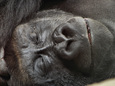
Western gorillas are exceptionally large and powerful primates. They have no tails and jet black skin. Facial features include short muzzles, a prominent brow ridge, large nostrils, and small eyes and ears. Western gorillas have large jaw muscles and broad, strong teeth. Coarse, dark hair covers the entire body except for the face, ears, hands, and feet. Generally, the hair on the back and rump of older males grows grey and is lost with age. This coloration pattern has resulted in older males being known as "silverbacks". Western gorillas have a slightly more brown/grey coat color with shorter hair and are usually slightly smaller than mountain gorillas (G. beringei).
Males are usually larger than females, reaching weights up to 275 kg in captivity. In the wild, male gorillas average 180 kg, with females often almost half that weight. Male gorillas have stocky bodies standing usually 1.75 meters in height with bent knees. On average, females are only 1.25 meters tall. This marked sexual dimorphism is critical in group structure and mating. Large males, with large body size, canines, and jaw musculature, have increased physical and social power within the group.
Hands are proportionately large with nails on all digits and very large thumbs. Western gorillas frequently stand upright, but walk in a hunched, quadrupedal fashion, with hands curled and knuckles touching the ground. Walking quadrupedally requires long arms, and the armspan of gorillas is larger than their standing height. Limbs are plantigrade and pentadactyl. ("Microsoft Encarta Encyclopedia '99 CD-ROM", 1999; Deblase and Martin, 1981; MacDonald, 1987; Walker, 1975)
- Other Physical Features
- endothermic
- homoiothermic
- bilateral symmetry
- Sexual Dimorphism
- male larger
- sexes colored or patterned differently
-
- Range mass
- 275 (high) kg
- 605.73 (high) lb
-
- Average mass
- 180 kg
- 396.48 lb
-
- Average wingspan
- males 175 cm; females 125 cm
- in
Reproduction
Typically one dominant male within a gorilla troup mates with the females in that group. The dominant male, because of his superior fighting prowess and the perceived ability to better protect females and their offspring, is preferred by the females.
- Mating System
- polygynous
As in humans, there is no fixed breeding season for gorillas, and females menstruate every 28 days. A single young, weighing approximately 2 kg, is born after nine months of gestation. Young gorillas nurse for 3 to 4 years. Females give birth at about four-year intervals, beginning when they are approximately ten years of age. However, a high mortality rate means surviving offspring are produced only once every 6 to 8 years. Males, because of physical competition for mates, only rarely breed before the age of 15. ("Microsoft Encarta Encyclopedia '99 CD-ROM", 1999; MacDonald, 1987; Walker, 1975)
- Key Reproductive Features
- iteroparous
- year-round breeding
- gonochoric/gonochoristic/dioecious (sexes separate)
- sexual
- viviparous
-
- Breeding interval
- Females give birth at about four-year intervals.
-
- Breeding season
- Gorillas breed year round.
-
- Average number of offspring
- 1
-
- Average number of offspring
- 1
- AnAge
-
- Average gestation period
- 9 months
-
- Average gestation period
- 256 days
- AnAge
-
- Range weaning age
- 36 to 48 months
-
- Range time to independence
- 3 to 4 years
-
- Average age at sexual or reproductive maturity (female)
- 10 years
-
- Average age at sexual or reproductive maturity (female)
Sex: female - 2829 days
- AnAge
- Average age at sexual or reproductive maturity (female)
-
- Average age at sexual or reproductive maturity (male)
- 15 years
-
- Average age at sexual or reproductive maturity (male)
Sex: male - 4015 days
- AnAge
- Average age at sexual or reproductive maturity (male)
Infants are suckled for 3 to 4 years. In the case of multiple young, the mother, who must carry the infants, finds it difficult to care for two and frequently allows one to die. Young grow at approximately twice the rate of human babies and are able to crawl and cling to their mother by the age of 3 months. They remain dependent upon the mother for 3 to 4 years.
Females provide the young with transportation, food, and socialization. They protect their young within the group. Males do not typically interact much with the young, although they do protect their offspring by defending the social group against potentially infanticidal males who might wish to take over control of the group.
- Parental Investment
- altricial
-
pre-fertilization
- provisioning
-
protecting
- male
- female
-
pre-hatching/birth
-
provisioning
- female
-
protecting
- female
-
provisioning
-
pre-weaning/fledging
-
provisioning
- female
-
protecting
- male
- female
-
provisioning
-
pre-independence
-
protecting
- male
- female
-
protecting
- extended period of juvenile learning
Lifespan/Longevity
Wild gorillas live between 35 and 40 years with some captive gorillas living almost 50 years.
-
- Range lifespan
Status: wild - 35 to 40 years
- Range lifespan
-
- Range lifespan
Status: captivity - 50 (high) years
- Range lifespan
-
- Average lifespan
Sex: female
Status: captivity - 47.0 years
- Max Planck Institute for Demographic Research
- Average lifespan
-
- Average lifespan
Status: captivity - 39.3 years
- Max Planck Institute for Demographic Research
- Average lifespan
-
- Average lifespan
Status: wild - 47.0 years
- Max Planck Institute for Demographic Research
- Average lifespan
-
- Average lifespan
Status: captivity - 40.0 years
- Max Planck Institute for Demographic Research
- Average lifespan
-
- Average lifespan
Status: wild - 50.0 years
- Max Planck Institute for Demographic Research
- Average lifespan
-
- Average lifespan
Status: captivity - 54.0 years
- Max Planck Institute for Demographic Research
- Average lifespan
Behavior
Gorillas are generally peaceful, shy, and amiable unless threatened. However, males will stand erect and beat their chests with their fists in attempts to intimidate or show off their strength. They growl loudly and become very dangerous when annoyed or attacked. Gorillas also demonstrate aggression by charging towards perceived intruders. They rarely hit the intruder, though. Instead, they rush past and may charge again.
Gorillas band together in groups of 5 to 15 individuals. A typical group consists of one dominant male, many adult females with their young. In some cases, a smaller pack of less dominant males will associate on the periphery of this core group. The dominant male, sometimes known as a silverback because of the age-related greying hair on his back, remains dominant until another male displaces him from his position. Displaced silverbacks typically lead a solitary life.
Fighting plays an important role in group hierarchy. It is common that a newly-dominant male, after displacing the former dominant male, is likey to kill the infants in the group, thus returning all lactating females prematurely to reproductive cycling. In doing this, a male increases his chance to produce offspring, as his tenure as a dominant male is of unknown duration. To guard against potentially infanticidal males, a male's capacity to fight and ensure survival of his progeny is unquestionably paramount to receptive females.
Male gorillas are known to make a hooting sound as an alarm to all members of the group, each of whom becomes instantly alert. Groups may travel together for months and usually years at a time, but, because of the abundance of food in the vicinity of their camps and their imposing size, little time and energy is typically devoted to travel. For these reasons, no territorial defense is exhibited and often ranges of neighboring groups overlap.
Gorillas build day and night nests of branches and leaves for cushion on the ground or in trees. Lightweight individuals can be seen swinging from tree to tree by their arms (brachiation).
Mutual grooming is not as common in gorillas as it is in other primate species. ("Microsoft Encarta Encyclopedia '99 CD-ROM", 1999; MacDonald, 1987; Walker, 1975)
- Key Behaviors
- terricolous
- diurnal
- motile
- sedentary
- social
- dominance hierarchies
Communication and Perception
Gorillas communicate using calls, facial expressions and physical postures, and through tactile means. Scents may play some role in communication in these animals.
Food Habits
Wild gorillas are herbivores, subsisting mainly on juicy stemmed plants. They will also consume leaves, berries, ferns and fibrous bark. Usually gorillas feed during the morning and afternoon. Western gorillas climb trees up to 15 meters in height in search of food. Gorillas never completely strip vegetation from a single area. The rapid regrowth of the vegetation they consume allows them to stay within a reasonably confined home range for extended periods of time. (MacDonald, 1987; Walker, 1975)
- Plant Foods
- leaves
- wood, bark, or stems
- fruit
Predation
Predation upon gorillas is probably not common, due to their imposing size. Young animals may fall prey to raptors or large carnivores. Also, gorillas that have not yet been weaned are subject to infanticide by males of their species.
Ecosystem Roles
The roles these animals play within their ecosystem has not been described.
Economic Importance for Humans: Positive
Western gorillas have been used in medical study of human diseases and behavioral, linguistic, and psychological studies. The mental capacity of gorillas is still being explored. Western gorillas show more persistence and memory retention in problem solving studies than do their, more excitable, near relatives, chimpanzees (Pan). Western gorillas are more likely to perform a task out of interest than to earn a reward. After some success with chimpanzees, researchers in the mid-1970s turned their attention to communicating with gorillas using sign language, and one gorilla, Koko, mastered more than 1000 signs.
Western gorillas are also hunted illegally in Africa for their skins and their meat, which is served in restaurants of large towns. In addition, the capture and sale of gorillas for zoos, while reprehensible to many, is undoubtedly economically profitable. ("Microsoft Encarta Encyclopedia '99 CD-ROM", 1999; Walker, 1975)
- Positive Impacts
- food
- body parts are source of valuable material
- ecotourism
- research and education
Economic Importance for Humans: Negative
Western gorillas have been known to raid native plantations, destroying the crops and are considered a crop pest in western Africa. (MacDonald, 1987)
- Negative Impacts
- crop pest
Conservation Status
Western gorillas are critically endangered in the wild. Population estimates for G. gorilla are unavailable, but are almost certainly less than the often cited figure of 95,000. Estimates of G. gorilla diehli populations are from 250 to 300 individuals.
Even though all eight countries with wild gorilla (Gorilla) populations have laws governing their capture and hunting, in none of them are the laws strictly enforced. As recently as fifteen years ago, there was active trade in gorilla skulls from the Volcano National Park in Rwanda. Today, countries such as Rwanda are implementing educational, conservation, and tourism programs in an effort to demonstrate to the local population the value of the native flora and fauna. Still, long-term ecological stability is sacrificed for shorter term economical gain in many areas. Nevertheless, hunting is a relatively minor concern compared to deforestation and the effects of political unrest.
The forests which the gorillas depend on in Africa are slowly being cut down for timber and to make way for agricultural and, in some cases, industrial development. As a case in point, Nigeria was home to gorillas twenty-five years ago. Today, gorillas have become extinct there and cattle-ranches cover what used to be gorilla habitat. Until human population growth is curbed in central Africa, particularly DRC, gorilla habitat is in danger of shrinking yet further and becoming dangerously scarce. ("Convention on International Trade in Endangered Species of Wild Fauna and Flora", October 11, 1999; IUCN, 2008; MacDonald, 1987; Wilson and Reeder, 1993)
-
- IUCN Red List
-
Critically Endangered
More information
-
- IUCN Red List
-
Critically Endangered
More information
-
- US Federal List
- Endangered
-
- CITES
- Appendix I
Other Comments
The lives of gorillas in the wild was enigmatic until American zoologist George B. Schaller observed the species for many years and published a pioneering study titled, "The Mountain Gorilla: Ecology and Behavior" (1963). American Diane Fossey followed his work by studying and living among mountain gorillas from 1963 until her death in 1985 at the Karisoke Research Center, which she had established in Rwanda in 1967. ("Microsoft Encarta Encyclopedia '99 CD-ROM", 1999)
Contributors
Nancy Shefferly (editor), Animal Diversity Web.
Rebecca Ann Csomos (author), University of Michigan-Ann Arbor, Cynthia Sims Parr (editor), University of Michigan-Ann Arbor.
Glossary
- Ethiopian
-
living in sub-Saharan Africa (south of 30 degrees north) and Madagascar.

- acoustic
-
uses sound to communicate
- altricial
-
young are born in a relatively underdeveloped state; they are unable to feed or care for themselves or locomote independently for a period of time after birth/hatching. In birds, naked and helpless after hatching.
- bilateral symmetry
-
having body symmetry such that the animal can be divided in one plane into two mirror-image halves. Animals with bilateral symmetry have dorsal and ventral sides, as well as anterior and posterior ends. Synapomorphy of the Bilateria.
- chemical
-
uses smells or other chemicals to communicate
- diurnal
-
- active during the day, 2. lasting for one day.
- dominance hierarchies
-
ranking system or pecking order among members of a long-term social group, where dominance status affects access to resources or mates
- ecotourism
-
humans benefit economically by promoting tourism that focuses on the appreciation of natural areas or animals. Ecotourism implies that there are existing programs that profit from the appreciation of natural areas or animals.
- endothermic
-
animals that use metabolically generated heat to regulate body temperature independently of ambient temperature. Endothermy is a synapomorphy of the Mammalia, although it may have arisen in a (now extinct) synapsid ancestor; the fossil record does not distinguish these possibilities. Convergent in birds.
- folivore
-
an animal that mainly eats leaves.
- food
-
A substance that provides both nutrients and energy to a living thing.
- forest
-
forest biomes are dominated by trees, otherwise forest biomes can vary widely in amount of precipitation and seasonality.
- herbivore
-
An animal that eats mainly plants or parts of plants.
- iteroparous
-
offspring are produced in more than one group (litters, clutches, etc.) and across multiple seasons (or other periods hospitable to reproduction). Iteroparous animals must, by definition, survive over multiple seasons (or periodic condition changes).
- motile
-
having the capacity to move from one place to another.
- native range
-
the area in which the animal is naturally found, the region in which it is endemic.
- polygynous
-
having more than one female as a mate at one time
- rainforest
-
rainforests, both temperate and tropical, are dominated by trees often forming a closed canopy with little light reaching the ground. Epiphytes and climbing plants are also abundant. Precipitation is typically not limiting, but may be somewhat seasonal.
- sedentary
-
remains in the same area
- sexual
-
reproduction that includes combining the genetic contribution of two individuals, a male and a female
- social
-
associates with others of its species; forms social groups.
- tactile
-
uses touch to communicate
- terrestrial
-
Living on the ground.
- tropical
-
the region of the earth that surrounds the equator, from 23.5 degrees north to 23.5 degrees south.
- visual
-
uses sight to communicate
- viviparous
-
reproduction in which fertilization and development take place within the female body and the developing embryo derives nourishment from the female.
- year-round breeding
-
breeding takes place throughout the year
References
1999. Microsoft Encarta Encyclopedia '99 CD-ROM. United States: Microsoft Corporation.
October 11, 1999. "Convention on International Trade in Endangered Species of Wild Fauna and Flora" (On-line). Accessed November 9, 1999 at http://www.wcmc.org.uk:80/CITES/english/eap2fauna.htm.
"Dian Fossey Gorilla Fund" (On-line). Accessed October 8, 1999 at http://www.dianfossey.org/.
October 28, 1999. "World Conservation Monitoring Centre" (On-line). Accessed November 9, 1999 at http://www.wcmc.org.UK/species/animals/animal_redlist.html.
CITES Secretariat, October 11, 1999. "Convention on International Trade in Endangered Species of Wild Fauna and Flora" (On-line). Accessed November 9, 1999 at http://www.wcmc.org.uk:80/CITES/english/eap3fauna.htm.
Deblase, A., R. Martin. 1981. A Manual of Mammalogy with Keys to Families of the World, Second Edition,. Dubuque, Iowa: Wm. C. Brown Co. Publishers.
IUCN, 2008. "Gorilla gorilla" (On-line). 2008 IUCN Red List of Threatened Species. Accessed October 07, 2008 at http://redlist.org/details/9404.
MacDonald, D. 1987. The Encyclopedia of Mammals. New York: Facts on File Publications.
Walker, E. 1975. Mammals of the World , Third Edition, Volume I. Baltimore & London: Johns Hopkins University Press.
Wilson, D., D. Reeder. 1993. Mammal Species of the World: A Taxonomic and Geographic Reference, Second Edition. Washington & London: Smithsonian Institution Press.