Glaucomys volanssouthern flying squirrel



Geographic Range
Glaucomys volans, better known as the southern flying squirrel, is predominately found throughout the eastern half of the United States, as far west as the Great Plains. The southern flying squirrel is also found as far north as Quebec, Nova Scotia, and New Brunswick and as far south as Honduras. However, it is relatively uncommon to find this species inhabiting the Canadian provinces. (Dolan and Carter, 1977; Linzey and NatureServe (Hammerson G.), 2008)
Four subspecies of Glaucomys volans, including G. v. volans, G. v.texensis, G. v. saturatus, and G. v. querceti inhabit North American forests north of Mexico. Although these four species are specific to different geographic ranges, G. v. querceti, G. v. saturatus, and G. v. texensis, from east to west, in the south and G. v. volans in the north, no evidence has shown that the four subspecies are distinctly geographically separated from one another. Six isolated subspecies have been found to inhabit mountainous regions of Mexico and Central America. The subspecies G. v. madrensis inhabit the Sierra Madre Occidenal in areas of western Chihuahua and eastern Sinaloa. The next subspecies, G. v. herreranus inhabit the Sierra Madre Oriental throughout regions north and east of Mexico City, as far south as Veracruz. The range of G. v. chontali is limited to a small area southwest of Oaxaca. Glaucomys volans oaxacensis is found throughout the Madre del Sur, as far south as Oaxaca and as far north as Guerrero. Areas throughout the Chiapan highlands are inhabitaed by G. v. goldmani. Inland areas of Guatemala, as far south as northwest Honduras, are occupied by the subspecies G. v. underwoodi. (Dolan and Carter, 1977; Linzey and NatureServe (Hammerson G.), 2008)
Habitat
Southern flying squirrels are most commonly found in temperate to subtemperate deciduous and mixed forests. Due to the wide geographic range of this species, elevation has not been reported for the species as a whole. However, the subspecies found south of the United States tend to inhabit higher altitudes, such as mountain ranges. Although they are not restricted to any particular type of forest, southern flying squirrels are more commonly found in beech-maple, oak-hickory, and poplar forests. They tend to either nest inside tree cavities or in nests made of leaves. Nesting choice is influenced by both local availability of cavities and climate. Common nesting sites include abandoned woodpecker holes, bird and squirrel nests, and nest boxes. They also tend to nest more commonly in shelters within 100 meters of a body of water. (Bendel and Gates, 1987; Castellanos, et al., 2014; Dolan and Carter, 1977; Linzey and NatureServe (Hammerson G.), 2008; Sonenshine, et al., 1979; Weigl, 1978)
- Habitat Regions
- temperate
- terrestrial
Physical Description
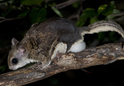
Southern flying squirrels grow to a maximum length of 285 mm (range: 200-285 mm) and a maximum weight of 90 g (range: 38-90 g). According to Whitaker Jr. and Hamilton Jr. (1998), measurements taken from 64 individuals in Indiana averaged: total length 228 mm, tail 100 mm, hind foot 31 mm, and weight 63 grams. Another set of measurements, reported by Whitaker Jr. and Hamilton Jr. (1998), taken from 66 individuals in Florida averaged: total length 221 mm, tail 100 mm, hind foot 30 mm, and weight 52 grams. Their ears are pink and hairless on the inside, and are covered in greyish brown hair on the outside. Each ear measures between 15 and 25 mm in total length. Southern flying squirrels have large eyes in relation to their body size. Eyes are black and encircled by black hair. The hair on their underbellies and under their nose is an off white cream color throughout, while the hair on their dorsal side and above their nose is greyish brown at the tips and black at the base. Their front and rear feet are nearly the same size, but their rear feet contain five claws while their front feet only contain four. They have 22 teeth, and their dental formula is 1023/1013. (Dolan and Carter, 1977; Linzey, 1998; Schwartz and Schwartz, 1981; Whitaker Jr. and Hamilton Jr., 1998)
Newborn southern flying squirrels are 3 - 5 grams in total mass, and are completely hairless. Their eyes and ears are sealed shut until approximately three to four weeks after birth, and they are nursed until they are approximately five weeks old. After three weeks, they are covered in dense fur everywhere other than their underbellies, which are densely furred by the fourth week. Once young squirrels are six to eight weeks old, they can only be distinguished from adults on the basis of size. Differentiation between male and female southern flying squirrels can only be determined by identification of external sex organs. Males have a penis bone that is, on average, 19 millimeters long. Both sexes have four sets of nipples that extend the entire length of the belly. (Dolan and Carter, 1977; Linzey, 1998; Schwartz and Schwartz, 1981; Whitaker Jr. and Hamilton Jr., 1998)
Members of this species are characterized by a loose fold of haired skin, known as either the patagium or the gliding membrane, which is bordered by black hair. The patagium extends from the front wrists to the rear ankles, and allows for the animals to glide when both their front and hind legs are extended. Individuals have soft, dense hair. (Dolan and Carter, 1977; Linzey, 1998; Schwartz and Schwartz, 1981; Whitaker Jr. and Hamilton Jr., 1998)
The southern flying squirrel can be differentiated from the northern flying squirrel, Glaucomys sabrinus, on the basis of underbelly color. The fur on the underbellies of southern flying squirrels is a white to cream color, while that of northern flying squirrels is grey. Southern flying squirrels are also distinguished from northern flying squirrels on the basis of size. The total length of northern flying squirrels ranges between 250 - 300 mm and mass is 70 - 140 grams. (Dolan and Carter, 1977; Linzey, 1998; Schwartz and Schwartz, 1981; Whitaker Jr. and Hamilton Jr., 1998)
- Other Physical Features
- endothermic
- homoiothermic
- bilateral symmetry
- Sexual Dimorphism
- sexes alike
-
- Range mass
- 38 to 90 g
- 1.34 to 3.17 oz
-
- Range length
- 200 to 285 mm
- 7.87 to 11.22 in
-
- Average basal metabolic rate
- 0.414 W
- AnAge
Reproduction
Southern flying squirrels breed twice a year, once in early spring (February to March) and again during the summer (May to July). The testes of male southern flying squirrels are abdominal from August to November, but become scrotal in mid-January, prior to the spring breeding season. Although males are capable of mating at this time, females are not fertile until the membrane that covers the opening of their vagina disappears shortly after males' testes become scrotal. These processes are triggered by the increasing photoperiod length, and may vary slightly in areas of differing climates. (Linzey, 1998; Schwartz and Schwartz, 1981; Whitaker Jr. and Hamilton Jr., 1998)
Once a female southern flying squirrel becomes fertile, males gather around the female in order to compete for her attention. Males compete for the female's attention through both kicks and rapid back and forth movements of their hind quarters. On most occurrences, the female will mate with the dominant male. However, the female will often allow a subordinate male to compete with the dominant male prior to making her final decision. The dominant male is usually successful, but nonetheless this process is important because it often leads to greater genetic diversity among populations of southern flying squirrels. (Dolan and Carter, 1977; Linzey, 1998; Schwartz and Schwartz, 1981; Whitaker Jr. and Hamilton Jr., 1998)
Southern flying squirrels are polygynandrous, but mating between a specific male and female may occur on multiple occasions throughout their lives. After mating occurs, male southern flying squirrels depart, and contribute no further parental care. Females are capable of reproducing during both the spring and summer breeding season. However, the percent of females that successfully deliver two litters each year is unknown. (Dolan and Carter, 1977; Linzey, 1998; Schwartz and Schwartz, 1981; Sollberger, 1943; Stapp and Mautz, 1991; Whitaker Jr. and Hamilton Jr., 1998)
- Mating System
- polygynandrous (promiscuous)
Breeding between male and female southern flying squirrels occurs biannually, with peaks from February to March (spring breeding season) and May through July (summer breeding season). A study conducted in New Hampshire, by Stapp and Mautz (1991), showed that the spring breeding season took place between February 11 and March 26, while the summer breeding season occurred between June 19 and July 8, assuming a gestational period of 40 days. Although the early breeding season peaks between February and March, it can begin as early as January in areas of warmer climate, and can be vary based on yearly weather and food production. If only a small amount of cached food is available for the spring breeding season, then the breeding season can be delayed. Therefore, winter severity and mast production affect the commencement of the spring breeding season. (Dolan and Carter, 1977; Linzey and Linzey, 1979; Linzey, 1998; Schwartz and Schwartz, 1981; Stapp and Mautz, 1991; Whitaker Jr. and Hamilton Jr., 1998)
The offspring produced during the spring mating period, in most cases, are born between early March and mid-April, while those conceived during the summer breeding season are generally born between July and August. Female offspring born during the summer breeding season reach sexual maturity and begin breeding by the following spring breeding season. One study, conducted by Sonenshine et al. (1979), showed that 94.2% of female southern flying squirrels became pregnant within six to eight months after birth. Female offspring born during the spring breeding season generally reproduce during the following spring season.
Female southern flying squirrels continue to reproduce during each breeding season until they reach approximately three years of age, after which they are no longer fertile. The oldest recorded female to give birth was three years and eight months old. Little research has been conducted on the reproductive details of male southern flying squirrels. However, it has been noted that males begin mating approximately 11 months after birth, and reach reproductive conditions prior to females. Therefore, it is suggested that the breeding seasons are dictated by female reproductive conditions. (Dolan and Carter, 1977; Linzey and Linzey, 1979; Linzey, 1998; Schwartz and Schwartz, 1981; Sonenshine, et al., 1979; Stapp and Mautz, 1991; Whitaker Jr. and Hamilton Jr., 1998)
Three studies have been published that reported both the mass at birth and litter size of southern flying squirrels, all of which found contradictory results pertaining to seasonal mass differences. To date, it is undetermined whether the mass at birth differs from the spring breeding season to the summer breeding season. However, average mass at birth was between 2.5 and 3.5 grams (range: 2 - 6 grams) in each study. No conclusive studies have shown a difference in average litter size between the two mating seasons, but spring litters generally contain two or three young, while summer litters are more likely to contain four to five young. The litter size, across both breeding seasons, can range from one to seven pups. (Dolan and Carter, 1977; Sollberger, 1943; Sonenshine, et al., 1979; Stapp and Mautz, 1991)
Female southern flying squirrels have an average gestation period of 40 days, after which the female takes care of her litter for approximately eight weeks. The mother nurses her young, on average, for the first six weeks of their lives (range 5-8 weeks), after which gradual weaning begins. Generally, by eight weeks old the young are able to take care of themselves. However, the mother and her young may stay together until the mother has her next litter. (Dolan and Carter, 1977; Linzey, 1998; Schwartz and Schwartz, 1981; Whitaker Jr. and Hamilton Jr., 1998)
- Key Reproductive Features
- iteroparous
- seasonal breeding
- gonochoric/gonochoristic/dioecious (sexes separate)
- sexual
- fertilization
- viviparous
-
- Breeding interval
- Southern flying squirrels breed biannually.
-
- Breeding season
- The two main breeding intervals for southern flying squirrels are February through March and May through July.
-
- Range number of offspring
- 1 to 7
-
- Average number of offspring
- 2-5
-
- Average number of offspring
- 4
- AnAge
-
- Average gestation period
- 40 days
-
- Average gestation period
- 40 days
- AnAge
-
- Range weaning age
- 5 to 8 weeks
-
- Average weaning age
- 6 weeks
-
- Average time to independence
- 8 weeks
-
- Average age at sexual or reproductive maturity (female)
- 6-8 months
-
- Average age at sexual or reproductive maturity (female)
Sex: female - 210 days
- AnAge
- Average age at sexual or reproductive maturity (female)
-
- Average age at sexual or reproductive maturity (male)
- 11 months
Although it is not uncommon to see pairs of southern flying squirrels, males leave females prior to the birth of the offspring, and females solely take care of their offspring. Before birthing, females build a new nest for their young inside of a tree cavity. Females become extremely territorial of this new nest, as parturition nears, and do not tolerate any other adults that are within the immediate vicinity of their nest. (Linzey, 1998; Schwartz and Schwartz, 1981; Whitaker Jr. and Hamilton Jr., 1998)
Female southern flying squirrels give birth to hairless, helpless young that are extremely uncoordinated and incapable of rolling over. During the first few days of their lives, the young continuously squirm while emitting faint squeaks. The newly born squirrels are nursed and cared for by their mother, on average, for the first six weeks of their lives, after which they are slowly weaned to independence. By eight weeks of age, juvenile southern flying squirrels are no longer nursed, resemble adult southern flying squirrels, and are capable of living independently. However, young southern flying squirrels tend to stay with their mother until she produces her next litter. (Dolan and Carter, 1977; Linzey, 1998; Schwartz and Schwartz, 1981; Whitaker Jr. and Hamilton Jr., 1998)
- Parental Investment
- female parental care
-
pre-hatching/birth
-
provisioning
- female
-
protecting
- female
-
provisioning
-
pre-weaning/fledging
-
provisioning
- female
-
protecting
- female
-
provisioning
-
pre-independence
-
provisioning
- female
-
protecting
- female
-
provisioning
- post-independence association with parents
Lifespan/Longevity
Southern flying squirrels have an average lifespan of three to five years in the wild. Their average lifespan increases when they are in captivity to 10 years, with a maximum of 19 years. (Dolan and Carter, 1977; Holmes and Austad, 1994; Linzey, 1998; Sollberger, 1943; Whitaker Jr. and Hamilton Jr., 1998)
-
- Range lifespan
Status: captivity - 19 (high) years
- Range lifespan
-
- Average lifespan
Status: wild - 3-5 years
- Average lifespan
-
- Average lifespan
Status: captivity - 10 years
- Average lifespan
-
- Average lifespan
Status: captivity - 12.0 years
- Max Planck Institute for Demographic Research
- Average lifespan
Behavior
Although squirrels are often thought to be confined to trees, southern flying squirrels travel along the ground and on top of logs while they forage. Southern flying squirrels are strictly nocturnal, and are extremely active at all times of the night during the summer months. However, during colder months their activity is limited to shortly after dusk and shortly prior to dawn. During periods of extreme cold, southern flying squirrels will stay in their nests for a few days at a time. (Linzey, 1998; Schwartz and Schwartz, 1981; Whitaker Jr. and Hamilton Jr., 1998)
Southern flying squirrels are extremely sociable animals that congregate in one nest during winter months and communicate with one another throughout the night. Although these animals emerge from their nests at sunset, communication between squirrels is not made until astronomical twilight. Communication is made through both ultrasonic frequencies and a variety of squeaky notes that sound similar to that of a bird. During winter months, southern flying squirrels nest together in high numbers, sometimes as many as 20 will nest together for warmth. During warmer months, this number decreases to an average of five squirrels per nest. These nests are always very clean, and each southern flying squirrel keeps itself carefully groomed. (Dolan and Carter, 1977; Linzey, 1998; Madden, 1974; Murrant, et al., 2014; Muul, 1970; Schwartz and Schwartz, 1981; Weigl, 1978; Whitaker Jr. and Hamilton Jr., 1998)
Contradictory of their name, southern flying squirrels do not actually fly, but rather glide between trees using their patagium. Prior to gliding, southern flying squirrels move their head from side to side in order to determine the distance to the targeted landing site. Once the distance has been appraised, they launch themselves into the air and simultaneously spread their arms and legs apart in order to draw the gliding membrane taut. The spread gliding membrane creates air resistance, which allows the squirrels to successfully glide distances up to 28 meters, although most glides are between 6 and 9 meters in length. Slack can be created in either the left or right membrane in order for the squirrel to control angle, speed, and course of the glide. Southern flying squirrels use their tails to steer through the various branches that are present between trees. By flipping their tail upward, southern flying squirrels are able to raise the front part of their body and easily control the landing process. (Dolan and Carter, 1977; Linzey, 1998; Madden, 1974; Murrant, et al., 2014; Muul, 1970; Schwartz and Schwartz, 1981; Weigl, 1978; Whitaker Jr. and Hamilton Jr., 1998)
-
- Range territory size
- 4000 to 6000 m^2
Home Range
Female southern flying squirrels are territorial, and will defend both the tree containing their nest and the surrounding 4050 square meters of home range. Home ranges of female southern flying squirrels do not overlap with one another. If a female southern flying squirrel enters another's home range, the female squirrel occupying that home range will respond aggressively by staring, stamping her feet, lunging, jumping on, or even smacking the other female in the face. Females become even more territorial during both the mating seasons and when young are present. Although females are territorial, males do not defend any set territory, and occupy a home range of approximately 6000 square meters that overlaps that of other males. (Dolan and Carter, 1977; Linzey, 1998; Madden, 1974; Murrant, et al., 2014; Muul, 1970; Schwartz and Schwartz, 1981; Sonenshine, et al., 1979; Weigl, 1978; Whitaker Jr. and Hamilton Jr., 1998)
Communication and Perception
Southern flying squirrels are nocturnal animals that rely heavily on their visual and auditory senses when foraging and communicating at night. Because they are nocturnal, southern flying squirrels have rather large eyes in relation to their body size, which allow them to see better at night. Little research has been conducted on the communication patterns of Glaucomys volans because nearly all communication occurs at night. However, research conducted by Gilley (2013) showed that at least one population of southern flying squirrels, located in North Carolina, communicate through three distinct calls, which have been characterized as either arc-whistles, trills, or crows. Of these three calls, trills occur the most often (45.1%), followed by arc-whistles (33%) and crows (21.9%). Certain individuals emit high frequency sounds, while gliding, that are believed to serve a purpose in echolocation. Young squirrels generate a variety of high-pitched squeaks, and may even communicate to others through ultrasonic notes. (Dolan and Carter, 1977; Gilley, 2013; Madden, 1974; Murrant, et al., 2014; Muul, 1970; Weigl, 1978)
- Perception Channels
- visual
- tactile
- acoustic
- ultrasound
- echolocation
- chemical
Food Habits
Southern flying squirrels are omnivores, but display feeding habits that make them among the most carnivorous members of the Sciuridae family. The primary diet of southern flying squirrels includes insects, nuts, bird eggs, berries, carrion, and seeds. However, they have been known to opportunistically consume nestlings, blossoms, buds, fungi, lichen, and bark. Insects consumed by southern flying squirrels include various species of wood-boring beetles. When foraging, individuals tend to stay within 160 meters of their nest, and consume what is readily available. (Dolan and Carter, 1977; Linzey and NatureServe (Hammerson G.), 2008; Sonenshine, et al., 1979; Whitaker Jr. and Hamilton Jr., 1998)
Southern flying squirrels forage nearly year round during the nighttime, excluding occasions of severe cold, during which they will enter a period of torpor. Beginning in November, they collect and cache food for the winter within cracks and cavities of their nests, and sometimes even in partially completed woodpecker holes. Food stored by southern flying squirrels include various types of nuts, such as hickory nuts and acorns. (Dolan and Carter, 1977; Linzey and NatureServe (Hammerson G.), 2008; Thomas and Weigl, 1998; Whitaker Jr. and Hamilton Jr., 1998)
- Animal Foods
- birds
- eggs
- carrion
- insects
- Plant Foods
- wood, bark, or stems
- seeds, grains, and nuts
- fruit
- flowers
- lichens
- Other Foods
- fungus
- Foraging Behavior
- stores or caches food
Predation
Southern flying squirrels avoid many predators by foraging at night, gliding between trees, and scurrying across the ground. Predators of the southern flying squirrel include owls, hawks, snakes, bobcats (Lynx rufus), raccoons (Procyon lotor), weasels, and domestic cats (Felis catus). Although multiple species of snakes will opportunistically consume southern flying squirrels, black rat snakes (Pantherophis) are among the most common predators of the southern flying squirrel. In suburban areas, domestic cats have shown to take a large toll on the population numbers of southern flying squirrels. (Dolan and Carter, 1977; Karmacharya, et al., 2013; Schwartz and Schwartz, 1981; Whitaker Jr. and Hamilton Jr., 1998)
Southern flying squirrels have greyish brown fur, which allows them to be very well camouflaged when against a tree. These animals are highly social and communicate information, such as the presence of a predator, to one another through a variety of high pitched signals. Some communication between members of the species occurs at ultrasonic frequencies, which may be above the hearing range of many predators. Gliding between trees allows these squirrels to escape many terrestrial predators. However, some terrestrial predators will occasionally capture and consume a southern flying squirrel as it scurries across the ground. (Linzey, 1998; Schwartz and Schwartz, 1981; Whitaker Jr. and Hamilton Jr., 1998)
- Anti-predator Adaptations
- cryptic
-
- Known Predators
-
- owls, hawks, snakes, bobcats (Lynx rufus), raccoons (Procyon lotor), weasels, and cats (Felis catus)
Ecosystem Roles
Southern flying squirrels play several key roles that positively affect the environment(s) that they inhabit, which include the dispersal of seeds, nuts, and fungi. Because members of this species often bury seeds and nuts, they contribute to the continuation of forests. Southern flying squirrels consume the fruiting bodies of various types of fungi, and as a result, spores are spread via the feces these animals. The dispersal of these spores leads to the emergence of new fungi. Southern flying squirrels also feed on tree buds and wood-burrowing insects, which can stimulate tree growth. In areas where both southern and northern flying squirrels are present, the smaller southern flying squirrels often outcompete and displace the larger, endangered, northern flying squirrels.
Southern flying squirrels are arboreal animals that tend to nest in large numbers within tree cavities, which increases the chance of parasites spreading from one individual to another. Parasites that affect southern flying squirrels include mites, lice, fleas, protozoans, acanthocephalans, cestodes, and nematodes. Species of mites include: Psorergates glaucomys, Euhaemogamasus ambulans, Trombicula microti, and Haemolaelaps megaventralis. Species of lice include: Haploplura trispinosa, Neohaematopinus sciuropteri, Enderleinellus replicatus. Species of fleas include: Opisodasys pseudarctomys, Epitedia faceta, Orchopeas howardii, Peromyscopsylla catatina, Conorhinopsylla stanfordi, and Leptopsylla segnis. Species of protozoans include Eimeria parasciurorum, Eimeria glaucomydis, and Trypanosoma denysi. Species of nematodes include: Capillaria americana, Citellinema bifurcatum, Enterobius sciuri, Syphacia thompsoni, and Strongyloides robustus. Southern flying squirrels are hosts to only one species in Acanthocephala, Moniliformis clarki, and one species in Cestoda, Raillietina bakeri. (Day and Benton, 1980; Dolan and Carter, 1977; Linzey, 1998; Schwartz and Schwartz, 1981; Whitaker Jr. and Hamilton Jr., 1998)
- Ecosystem Impact
- disperses seeds
- Mites (Psorergates glaucomys, Euhaemogamasus ambulans, Trombicula microti, Haemolaelaps megaventralis)
- Lice (Haploplura trispinosa, Neohaematopinus sciuropteri, Enderleinellus replicatus)
- Acanthocephalans (Moniliformis clarki)
- Cestodans (Raillietina bakeri)
- Nematodes (Capillaria americana, Citellinema bifurcatum, Enterobius sciuri, Syphacia thompsoni, Strongyloides robustus)
- Fleas (Opisodasys pseudarctomys, Epitedia faceta, Orchopeas howardii, Peromyscopsylla catatina, Conorhinopsylla stanfordi, Leptopsylla segnis)
- Protozoans (Eimeria parasciurorum, Eimeria glaucomydis, Trypanosoma denysi)
Economic Importance for Humans: Positive
Southern flying squirrels are sometimes kept as pets, and are traded internationally. (Masuzawa, et al., 2006)
- Positive Impacts
- pet trade
Economic Importance for Humans: Negative
Southern flying squirrels are sometime kept as pets, which assists the transmission of disease causing bacteria from squirrels to humans. However, most cases of human-related diseases are caused by wild southern flying squirrels and their nests. Southern flying squirrels have been associated with several cases of typhus fever from the bacterium, Rickettsia prowazekii. Other than lice and humans, southern flying squirrels are the only animals known to be carriers of this harmful bacteria. Between 1976 and 2001, there were 39 reported cases of typhus fever in humans that had no previous contact with lice. A majority of these cases occurred within the geographic range of southern flying squirrels. Approximately one-third of these 39 individuals who were diagnosed with typhus had previously came in contact with either a southern flying squirrel or southern flying squirrel nests. (Bozeman, et al., 1975; Masuzawa, et al., 2006; Reynolds, et al., 2003)
- Negative Impacts
-
injures humans
- causes disease in humans
- carries human disease
Conservation Status
Southern flying squirrels are listed as a species of "Least Concern" by the IUCN Red List, and have no special status on any of the government lists in the United States or internationally (CITES). This species is not considered to be threatened because it can be abundant in areas across its wide geographic range. Although there are no major threats to southern flying squirrels, minor threats include the losses of habitat, cavity bearing trees, and mast producing trees. In areas that experience deforestation, resource depletion has shown to displace southern flying squirrels. (Linzey and NatureServe (Hammerson G.), 2008)
-
- IUCN Red List
-
Least Concern
More information
-
- IUCN Red List
-
Least Concern
More information
-
- US Federal List
- No special status
-
- CITES
- No special status
Contributors
Alex Atwood (author), Radford University, Cari Mcgregor (editor), Radford University, Zeb Pike (editor), Radford University, Karen Powers (editor), Radford University, April Tingle (editor), Radford University, Jacob Vaught (editor), Radford University, Tanya Dewey (editor), University of Michigan-Ann Arbor.
Glossary
- Nearctic
-
living in the Nearctic biogeographic province, the northern part of the New World. This includes Greenland, the Canadian Arctic islands, and all of the North American as far south as the highlands of central Mexico.

- acoustic
-
uses sound to communicate
- arboreal
-
Referring to an animal that lives in trees; tree-climbing.
- bilateral symmetry
-
having body symmetry such that the animal can be divided in one plane into two mirror-image halves. Animals with bilateral symmetry have dorsal and ventral sides, as well as anterior and posterior ends. Synapomorphy of the Bilateria.
- carnivore
-
an animal that mainly eats meat
- carrion
-
flesh of dead animals.
- causes disease in humans
-
an animal which directly causes disease in humans. For example, diseases caused by infection of filarial nematodes (elephantiasis and river blindness).
- chemical
-
uses smells or other chemicals to communicate
- cryptic
-
having markings, coloration, shapes, or other features that cause an animal to be camouflaged in its natural environment; being difficult to see or otherwise detect.
- echolocation
-
The process by which an animal locates itself with respect to other animals and objects by emitting sound waves and sensing the pattern of the reflected sound waves.
- endothermic
-
animals that use metabolically generated heat to regulate body temperature independently of ambient temperature. Endothermy is a synapomorphy of the Mammalia, although it may have arisen in a (now extinct) synapsid ancestor; the fossil record does not distinguish these possibilities. Convergent in birds.
- female parental care
-
parental care is carried out by females
- fertilization
-
union of egg and spermatozoan
- forest
-
forest biomes are dominated by trees, otherwise forest biomes can vary widely in amount of precipitation and seasonality.
- frugivore
-
an animal that mainly eats fruit
- granivore
-
an animal that mainly eats seeds
- herbivore
-
An animal that eats mainly plants or parts of plants.
- insectivore
-
An animal that eats mainly insects or spiders.
- iteroparous
-
offspring are produced in more than one group (litters, clutches, etc.) and across multiple seasons (or other periods hospitable to reproduction). Iteroparous animals must, by definition, survive over multiple seasons (or periodic condition changes).
- motile
-
having the capacity to move from one place to another.
- mountains
-
This terrestrial biome includes summits of high mountains, either without vegetation or covered by low, tundra-like vegetation.
- native range
-
the area in which the animal is naturally found, the region in which it is endemic.
- nocturnal
-
active during the night
- nomadic
-
generally wanders from place to place, usually within a well-defined range.
- omnivore
-
an animal that mainly eats all kinds of things, including plants and animals
- pet trade
-
the business of buying and selling animals for people to keep in their homes as pets.
- polygynandrous
-
the kind of polygamy in which a female pairs with several males, each of which also pairs with several different females.
- scavenger
-
an animal that mainly eats dead animals
- seasonal breeding
-
breeding is confined to a particular season
- sexual
-
reproduction that includes combining the genetic contribution of two individuals, a male and a female
- social
-
associates with others of its species; forms social groups.
- stores or caches food
-
places a food item in a special place to be eaten later. Also called "hoarding"
- tactile
-
uses touch to communicate
- temperate
-
that region of the Earth between 23.5 degrees North and 60 degrees North (between the Tropic of Cancer and the Arctic Circle) and between 23.5 degrees South and 60 degrees South (between the Tropic of Capricorn and the Antarctic Circle).
- terrestrial
-
Living on the ground.
- territorial
-
defends an area within the home range, occupied by a single animals or group of animals of the same species and held through overt defense, display, or advertisement
- ultrasound
-
uses sound above the range of human hearing for either navigation or communication or both
- visual
-
uses sight to communicate
- viviparous
-
reproduction in which fertilization and development take place within the female body and the developing embryo derives nourishment from the female.
References
Bendel, P., E. Gates. 1987. Home range and microhabitat partitioning of the southern flying squirrel (Glaucomys volans). Journal of Mammalogy, 68/2: 243-255.
Bozeman, F., S. Masiello, M. Williams, B. Elisberg. 1975. Epidemic typhus rickettsiae isolated from flying squirrels. Nature, 255: 545-547.
Castellanos, I., E. Gate, D. Campuzano-Chávez-Peón. 2014. Characteristics of nest-sites of the southern flying squirrel (Glaucomys volans) in a pine-oak forest of Central Mexico. Southwestern Naturalist, 59/1: 75-80.
Day, J., A. Benton. 1980. Population dynamics and coevolution of adult siphonapteran parasites of the southern flying squirrel (Glaucomys volans volans). The American Midland Naturalist, 103/2: 333-338.
Dolan, P., D. Carter. 1977. Glaucomys volans. Mammalian Species, 78: 1-6.
Gilley, L. 2013. Discovery and Characterization of High-frequency Calls in North American Flying Squirrels (Glaucomys sabrinus and G. volans): Implications for Ecology, Behavior, and Conservation, PhD Dissertation. Auburn, AL: Auburn University.
Holmes, D., S. Austad. 1994. Fly now, die later: Life-history correlates of gliding and flying in mammals. Journal of Mammalogy, 75/1: 224-226.
Karmacharya, B., J. Hostetler, M. Conner, G. Morris, M. Oli. 2013. The influence of mammalian predator exclusion, food supplementation, and prescribed fire on survival of Glaucomys volans. Journal of Mammalogy, 94/3: 672-682.
Linzey, A., NatureServe (Hammerson G.). 2008. "Glaucomys volans" (On-line). The IUCN Red List of Threatened Species 2008: e.T9240A12970650. Accessed January 28, 2016 at http://dx.doi.org/10.2305/IUCN.UK.2008.RLTS.T9240A12970650.en.
Linzey, D. 1998. The Mammals of Virginia. Saline, MI: The McDonald & Woodward Publishing Company.
Linzey, D., A. Linzey. 1979. Growth and development of the southern flying squirrel (Glaucomys volans volans). Journal of Mammalogy, 60/3: 615-620.
Madden, J. 1974. Female territoriality in a Suffolk County, Long Island population of Glaucomys volans. Journal of Mammalogy, 55/3: 647-652.
Masuzawa, T., Y. Okamoto, Y. Une, T. Takeuchi, And Others. 2006. Leptospirosis in squirrels imported from United States to Japan. Emerging Infectious Diseases, 12/7: 1153-1155.
Murrant, M., J. Bowman, P. Wilson. 2014. A test of non-kin social foraging in the southern flying squirrel (Glaucomys volans). Biological Journal of the Linnean Society, 113/4: 1126-1135.
Muul, I. 1970. Intra-and inter-familial behavior of Glaucomys volans (Rodentia) following Partrition. Animal Behavior, 18/1: 20-25.
Reynolds, M., J. Krebs, T. Rushton, C. Lopez, And Others. 2003. Flying squirrel-associated typhus, United States. Emerging Infectious Diseases, 9/10: 1341-1343.
Schwartz, C., E. Schwartz. 1981. The Wild Mammals of Missouri. Columbia, MO: University of Missouri Press.
Sollberger, D. 1943. Notes on the breeding habits of the eastern flying squirrel (Glaucomys volans volans). Journal of Mammalogy, 24/2: 163-173.
Sonenshine, D., D. Lauer, T. Walker, B. Elisberg. 1979. The ecology of Glaucomys volans (Linnaeus, 1758) in Virginia. Acta Theriologica, 24/26: 363-377.
Stapp, P., W. Mautz. 1991. Breeding habits and postnatal growth of the southern flying squirrel (Glaucomys volans) in New Hampshire. The American Midland Naturalist, 126/1: 203-208.
Thomas, R., P. Weigl. 1998. Dynamic foraging behavior in the southern flying squirrel (Glaucomys volans): Test of a model. The American Midland Naturalist, 140/2: 264-270.
Weigl, P. 1978. Resource overlap, interspecific interactions and the distribution of the flying squirrels, Glaucomys volans and G. sabrinus. The American Midland Naturalist, 100/1: 83-96.
Whitaker Jr., J., W. Hamilton Jr.. 1998. Mammals of the Eastern United States. Ithaca, NY: Comstock Publishing Associates.