Geocapromys browniiBrown's hutia
Geographic Range
Geocapromys brownii, commonly known as the Jamaican hutia, is restricted to the interior regions of the Caribbean island of Jamaica.
- Biogeographic Regions
- neotropical
- Other Geographic Terms
- island endemic
Habitat
The Jamaican hutia prefers to live on exposed sites usually made of limestone. Geocapromys brownii will fashion homes out of natural crevices or tunnels in the rock. In captivity, they have shown that they do not build nests, but prefer empty, enclosed spaces. At night, Jamaican hutias will move through the shrubby areas, foraging for food (Anderson et al. 1983).
- Terrestrial Biomes
- scrub forest
Physical Description
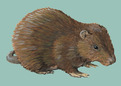
These large rodents have a body length of 330 to 445 mm. Geocapromys brownii have short, nearly vestigial tails between 35 and 64 mm. in length (Nowak 1999). They have the shortest tails of all of the hutias. Due to their massive heads and short necks and legs, Jamaican hutias take on a stout appearance. The fur on the back is thick and coarse, ranging in color from reddish-brown to almost black. The tail is scaly with tufts of black fur on its upper surface. The feet are covered in very rough, short black hair. The whiskers or vibrassae are long and the ears short.
Geocapromys brownii have the largest skulls of all of the three species of hutia. The sagittal crest is fairly prominent. The jugal is also unusually wide and located far below the orbits.
The dental formula is 1/1, 0/0, 1/1, 3/3 (incisor, canine, premolar, and molar, respectively). The cheekteeth display a hypsodont occlusal pattern and are almost perfectly flat on their upper surfaces (Anderson et al. 1983).
- Other Physical Features
- endothermic
- bilateral symmetry
-
- Range mass
- 1.000 to 2.000 kg
- 2.20 to 4.41 lb
-
- Average basal metabolic rate
- 4.11 W
- AnAge
Reproduction
Geocapromys brownii have been known to breed throughout the year in the wild, producing two to three litters annually. With a gestation period of about 123 days, females produce an average of 1.49 offspring per litter (Anderson et al. 1983). Jamaican hutias will most commonly have between one and two offspring, but litters of three have been reported. Upon their birth, the infants are quite capable. It has been reported that after the first 30 hours of life, the infants are already eating solid foods (Nowak 1999). A female's estrous cycle lasts about 10 days (Anderson, Jones et al. 1984). Males leave scent-marks that may play a role in breeding, but little information exists on reproduction (Anderson et al. 1983). (Anderson, et al., 1983; Nowak, 1999)
- Key Reproductive Features
- iteroparous
- year-round breeding
- gonochoric/gonochoristic/dioecious (sexes separate)
- sexual
- viviparous
-
- Range number of offspring
- 1 to 3
-
- Average number of offspring
- 1.49
-
- Average number of offspring
- 2
- AnAge
-
- Average gestation period
- 123 days
-
- Average gestation period
- 123 days
- AnAge
-
- Average age at sexual or reproductive maturity (female)
Sex: female - 365 days
- AnAge
- Average age at sexual or reproductive maturity (female)
- Parental Investment
- precocial
Lifespan/Longevity
-
- Average lifespan
Status: captivity - 8.3 years
- Max Planck Institute for Demographic Research
- Average lifespan
Behavior
These mysterious creatures are nocturnal and are seldom seen in the wild. This had led scientists to the misconception that Jamaican hutias were always quite rare (Nowak 1999). These terrestrial mammals emerge from their crevice or tunnel homes at night to forage. Although Jamaican hutias are seldom seen, the evidence that they leave behind in the form of damage to fruit, bark, and foliages is not so inconspicous. Along their trails, these animals leave scent marks and an abundance of fecal matter. They are social creatures, living in families ranging from a pair to six individuals. During the day, individuals rest together in very close contact with one another (Anderson et. al. 1983). When threatened, they chatter their teeth. If further disturbed, Jamaican hutias may emit calls ranging from grunts to chirping sounds (Anderson, Jones et al. 1984).
Communication and Perception
Food Habits
Jamaican hutias are nocturnal foragers. These herbivores feed on numerous plant species and plant parts. They scour large expanses of land for any exposed roots, bark, shoots, and fruit. Geocapromys brownii also eat the foliage from a great variety of plant species (Anderson et al. 1983).
Economic Importance for Humans: Positive
Jamaican hutias are still used as a food source by local peoples. They are widely hunted by means of traps or dogs (Parker 1990).
- Positive Impacts
- food
Economic Importance for Humans: Negative
Jamaican hutias can inflict considerable damage to fruit, bark, and foliage. But there have not been any recorded complaints of damage to commercial or food crops (Anderson, Jones et al. 1984).
Conservation Status
The IUCN had classified G. brownii as vulnerable. There has been concern that Jamaican hutias may soon be wiped out because of human activities. A few of its fellow species have already gone extinct from other Caribbean islands. In the past 30 years, this species has declined drastically due to human activities. Hutias are protected under Jamaica's Wildlife Protection Act of 1945, but it has not been enforced and the hunting continues. This species continues to decline because of the demand for agricultural lands. Mongooses also have been introduced to the region and have been partly to blame for the popululation losses (Anderson et al. 1983).
-
- IUCN Red List
-
Vulnerable
More information
-
- IUCN Red List
-
Vulnerable
More information
-
- CITES
- No special status
Other Comments
The fate of the Jamaican hutia appears to be grim, but their habitats may be preserved. A National Park system has been proposed which would include much of the native habitat of the species. A captive breeding program is also underway with reintroduction planned in the near future (Anderson, Jones et al. 1984). In an effort to raise conservation awareness, Jamaica issued a set of four postage stamps featuring hutias (Anderson et al. 1983).
Contributors
Erica Raffo (author), University of Michigan-Ann Arbor, Phil Myers (editor), Museum of Zoology, University of Michigan-Ann Arbor.
Glossary
- Neotropical
-
living in the southern part of the New World. In other words, Central and South America.

- bilateral symmetry
-
having body symmetry such that the animal can be divided in one plane into two mirror-image halves. Animals with bilateral symmetry have dorsal and ventral sides, as well as anterior and posterior ends. Synapomorphy of the Bilateria.
- chemical
-
uses smells or other chemicals to communicate
- endothermic
-
animals that use metabolically generated heat to regulate body temperature independently of ambient temperature. Endothermy is a synapomorphy of the Mammalia, although it may have arisen in a (now extinct) synapsid ancestor; the fossil record does not distinguish these possibilities. Convergent in birds.
- food
-
A substance that provides both nutrients and energy to a living thing.
- island endemic
-
animals that live only on an island or set of islands.
- iteroparous
-
offspring are produced in more than one group (litters, clutches, etc.) and across multiple seasons (or other periods hospitable to reproduction). Iteroparous animals must, by definition, survive over multiple seasons (or periodic condition changes).
- motile
-
having the capacity to move from one place to another.
- native range
-
the area in which the animal is naturally found, the region in which it is endemic.
- scrub forest
-
scrub forests develop in areas that experience dry seasons.
- sexual
-
reproduction that includes combining the genetic contribution of two individuals, a male and a female
- social
-
associates with others of its species; forms social groups.
- tactile
-
uses touch to communicate
- viviparous
-
reproduction in which fertilization and development take place within the female body and the developing embryo derives nourishment from the female.
- year-round breeding
-
breeding takes place throughout the year
- young precocial
-
young are relatively well-developed when born
References
Anderson, S., J. Jones. 1984. Orders and Families of Recent Mammals of the World. New York: John Wiley and Sons.
Anderson, S., C. Woods, G. Morgan, W. Oliver. 1983. Mammalian Species No. 201. The American Society of Mammalogists.
Nowak, R. 1999. Walker's Mammals of the World Vol. 2 6th Edition. Baltimore: John Hopkins University Press.
Parker, S. 1990. Grimzek's Encyclopedia of Mammals Vol. 3. New York: McGraw-Hill Publishing Company.