Genetta tigrinaCape large-spotted genet(Also: Cape genet; South African large-spotted genet; blotched genet)
Geographic Range
Cape genets, or large-spotted genets (Genetta tigrina), are native to southern Africa. They can be found in the extreme northeastern parts of Namibia, in northern and eastern Botswana, and eastern areas of southern Africa including Zimbabwe, Mozambique, Swaziland and Lesotho, and South Africa. Cape genets are absent from arid areas within this range. (Meester, et al., 1986; Skinner and Chimimba, 2005; Stuart, 1981)
Habitat
Cape genets prefer habitats with high vegetation cover and permanent water sources. Unlike small-spotted genets (Genetta genetta), they do not favor arid conditions and are found only in areas with greater than 450 mm of annual rainfall. Cape genets can be found in well-watered savannah woodlands and the fynbos biome, where cover is sufficient. Additionally, they appear to be well-adapted to areas of cultivation and human settlement. (Kingdon, 1977; Skinner and Chimimba, 2005; Smithers, 1971; Stuart, 1981)
- Habitat Regions
- temperate
- tropical
- terrestrial
- Terrestrial Biomes
- savanna or grassland
- forest
- scrub forest
- Other Habitat Features
- riparian
Physical Description
Genets in general are somewhat cat-like in appearance. Cape genets have a mass of 0.84 to 3.2 kg (average 1.82 kg). Males and females are very similar in mass (male average: 1.89 kg; female average: 1.76 kg). Body length ranges from 650 to 1080 mm (average 927 mm), and there is little difference in body length between sexes (male average: 939 mm; female average: 914 mm). The ratio between the head-body and tail length is between 1.1 and 1.4. (Ewer, 1973; Gaubert, et al., 2008; Skinner and Chimimba, 2005)
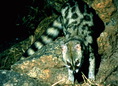
Cape genets, like most genets have a light coat with dark spots, a dorsal stripe on the body, and dark rings on the tail. The markings and base coat color can vary among and within individuals; dark markings range from black to a rusty red and the base color varies from off-white to grey. The spots of Cape genets are relatively larger than those of small-spotted genets. However, spot size alone is not sufficient to distinguish these species. The coat of Cape genets is shorter and softer than of small-spotted genets. Cape genets have a dark-tipped tail, while small-spotted genets have a light-tipped tail. Although the facial markings (white bands on the inner side of the eyes and a brown patch at the base of the vibrissae) of Cape and small-spotted genets are similar, those of Cape genets are not as stark as those of small-spotted genets. In addition, Cape genets have a light-colored chin, while small-spotted genets have a black chin. (Ewer, 1973; Gaubert, 2003; Kingdon, 1977; Meester, et al., 1986; Skinner and Chimimba, 2005)
The skull and dentition of genets, including Cape genets, are much less specialized than those of Felidae. Genets have a longer jaw and a greater number of upper molars than Felids, and the protocone of the fourth premolar and the talonid of the first molar are large. The dental formula of Cape genets (and also small-spotted genets) is 3/3 1/1 4/4 2/2. The skull of Cape genets is more massive than that of small-spotted genets. The canines of most Cape genet specimens are longer and heavier than those of small-spotted genets, though there are exceptions, which makes canines alone insufficient to distinguish between these species. (Ewer, 1973; Skinner and Chimimba, 2005)
- Other Physical Features
- endothermic
- bilateral symmetry
- Sexual Dimorphism
- sexes alike
-
- Range mass
- 0.84 to 3.20 kg
- 1.85 to 7.05 lb
-
- Average mass
- 1.82 kg
- 4.01 lb
-
- Range length
- 650 to 1078 mm
- 25.59 to 42.44 in
-
- Average length
- 927 mm
- 36.50 in
-
- Average basal metabolic rate
- 4.189 W
- AnAge
Reproduction
The mating system of Cape genets is as yet unknown.
Cape genets breed in the warm, wet season from about September to March. Breeding peaks annually earl and late in this season (small-spotted genets are reported to have two litters per year). Mating behavior of captive genets has been described as cat-like; the male appears to initiate mating by following the female and repeatedly making a low call. After a while, he is permitted to smell the female's genital region, an action that she may reciprocate. Eventually the female assumes a mating posture with her shoulders low and her hindquarters slightly raised. The male mounts and subsequently grips her neck during copulation, which does not usually last longer than five minutes. After copulation, both genets lick their genitals. (Ewer, 1973; Skinner and Chimimba, 2005)
Mother Cape genets give birth in a variety of nooks and crannies including hollow trees, among loose boulders, holes in the ground and in the roofs of houses. Litter size ranges from 1 to 5 kittens, and gestation is 70 to 77 days. Females have two pairs of abdominal teats, and newborn Cape genets show ‘milk tread’ behavior in which newborns stimulate milk flow by pushing on the mother’s body with forepaws while feeding. Newborns also purr while they suckle. Newborn genets weigh between 61 and 82 g. Although no records of neonatal length exist for Cape genets, small-spotted genet neonates are 14 to 15 cm in length. Kittens open their eyes and ears after 5 to 18 days, their first pair of canine teeth erupt by 4 weeks, and by 42 to 91 days the kittens are able to eat solid food. Even before the kittens can see, they respond defensively to perturbations by hissing or spitting. Cape genets are weaned by 8 to 11 weeks, and juveniles are able to kill their first prey by about 7 months of age. By 11 to 12 months, genets reach adult body mass and the permanent set of canines erupt. (Ewer, 1973; Hayssen, et al., 1993; Kingdon, 1977; Rowe-Rowe, 1971; Rowe-Rowe, 1978; Skinner and Chimimba, 2005; Smithers, 1971)
- Key Reproductive Features
- seasonal breeding
- gonochoric/gonochoristic/dioecious (sexes separate)
- sexual
- viviparous
-
- Breeding interval
- Cape genets breed once each year, and may breed more frequently.
-
- Breeding season
- Cape genets breed from September to March.
-
- Range number of offspring
- 1 to 5
-
- Average number of offspring
- 2.5
- AnAge
-
- Range gestation period
- 70 to 77 days
-
- Range weaning age
- 8 to 11 weeks
-
- Average age at sexual or reproductive maturity (female)
Sex: female - 1461 days
- AnAge
- Average age at sexual or reproductive maturity (female)
As newborn Cape genets are unable to fend for themselves, mothers stay with their kittens to provide protection and food. Kittens are weaned at 6 to 11 weeks of age, but some females lactate as late as 6 months after giving birth. The mother licks away the excreta of her kittens much like cats, and in so doing keeps the living area of the kittens clean. Once young are able to leave their birthing area, they may accompany their mother on excursions of up to 2 hours, possibly to begin learning how to hunt. (Kingdon, 1977; Skinner and Chimimba, 2005)
- Parental Investment
- altricial
- female parental care
-
pre-fertilization
-
protecting
- female
-
protecting
-
pre-hatching/birth
-
provisioning
- female
-
protecting
- female
-
provisioning
-
pre-weaning/fledging
-
provisioning
- female
-
protecting
- female
-
provisioning
Lifespan/Longevity
Little information is available regarding lifespan of Cape genets. One individual lived 34 years in captivity. (Kingdon, 1977)
-
- Range lifespan
Status: captivity - 34 (high) years
- Range lifespan
-
- Average lifespan
Status: captivity - 9.5 years
- Max Planck Institute for Demographic Research
- Average lifespan
Behavior
Cape genets are predominantly solitary, except while mating or when females rear young. Females appear to be territorial, and they may defend territories, as adults fight fiercely in captivity. Cape genets are usually nocturnal, becoming active a couple hours after sunset and remain active until about 0200. During the day, they hide in dark places such as hollow logs, holes in trees, thick underbrush, under loose boulders and under heaps of dry plant material. (Kingdon, 1977; Rowe-Rowe, 1978; Skinner and Chimimba, 2005; Smithers, 1971)
Cape genets are well-adapted to both arboreal and terrestrial life; they are skilled at jumping and climbing and also maintain a fast run. They are thought to be more arboreal than small-spotted genets and can jump from tree to tree over distances of 3 or 4 m. Cape genets hold themselves close to the surface of branches and the ground, keeping their backs and tails horizontal with their head somewhat lowered. They swing their legs out in a lateral arc when walking on a branch, allowing for quick recovery should there be a misstep. Cape genets have also been observed swimming. (Kingdon, 1977; Rowe-Rowe, 1978; Skinner and Chimimba, 2005; Taylor, 1970)
When a Cape genet is alarmed, it may arch its back and erect its fur much like a cat. If more seriously alarmed, it may run or bound towards cover. To improve the visibility of their surroundings, Cape genets sit upright on their hind legs in a vertical stance, balancing with their tail. (Kingdon, 1977; Skinner and Chimimba, 2005)
- Key Behaviors
- arboreal
- nocturnal
- motile
- solitary
- territorial
Home Range
Little is known regarding the home range of Cape genets. In one case, captive genets 34 to 36 weeks old roamed within an area of at least 1.1 ha.
Communication and Perception
There are many parallels between the vocal repertoire of Cape genets and cats; both purr, ‘meow’, hiss and ‘spit’ in similar situations. Cape genets also make ‘churring’ and ‘yapping’ noises in stressful situations. In a number of viverrid species a ‘lost call’ vocalization has been described; young of a litter show a strong propensity to stay together, and if one kitten becomes separated from the others it emits a series of abrupt calls, causing its littermates to run to its location. (Ewer, 1973; Kingdon, 1977; Rowe-Rowe, 1971)
Cape genets have sebaceous anal glands that secrete a substance with a musky odour. Male Cape genets perform handstands while spreading anal secretions on vertical surfaces, and the odor often indicates points where they have urinated. The behavioral role of this scent marking is poorly understood in Cape genets, however, in small-spotted genets marking behavior may permit recognition of conspecifics and their physiological state (e.g., female in estrus) using olfactory cues. Male small-spotted genets can distinguish pregnant and non-pregnant females by olfaction of secretions from the flank glands, which appear to be under hormonal control. Unfortunately, the structure and use of these flank glands is not well understood in Cape genets. (Ewer, 1973; Kayanja and Schliemann, 1981; Kingdon, 1977; Roeder, 1980; Skinner and Chimimba, 2005)
- Other Communication Modes
- scent marks
Food Habits
Cape genets are omnivorous, due to their diverse, generalist diet that changes seasonally. During the summer months insects (e.g., Coleopterans, some Myriapods) dominate the diet, while in the winter Cape genets prey more heavily on rodents of the family Muridae (e.g., Mastomys spp., Saccostomus campestris, Tatera, Aethomys spp., and Dendromus melantois). Murids are thought to be the most important food items in the diet of Cape genets. Cape genets also consume prey such as reptiles (e.g., snakes, skinks, and geckos) and arachnids, and less frequently consume amphibians and birds (including poultry). Cape genets also consume seeds and fruits, and sometimes grass.
In areas where both species are present, Cape genets prefer murids even when other food sources are available, while small-spotted genets consume a variety of food sources available to them. (Ewer, 1973; Roberts, et al., 2007; Rowe-Rowe, 1971; Rowe-Rowe, 1978; Skinner and Chimimba, 2005; Smithers, 1971; Stuart, 1981)
Cape genets feed primarily on the ground, where they normally stalk and pounce on their prey. Prey are usually subdued by repeated bites where the teeth are not fully retracted from the flesh. When a prey item is particularly tough, Cape genets may hold it with their forefeet and rake it with the claws of their hind feet. (Ewer, 1973; Skinner and Chimimba, 2005; Stuart, 1981)
- Primary Diet
-
carnivore
- eats terrestrial vertebrates
- insectivore
- eats non-insect arthropods
- omnivore
- Animal Foods
- birds
- mammals
- amphibians
- reptiles
- insects
- terrestrial non-insect arthropods
- Plant Foods
- fruit
Predation
Little information is available regarding predators of Cape genets, however, humans are known to shoot genets on poultry farms. (Ewer, 1973)
Ecosystem Roles
Cape genets consume a variety of terrestrial invertebrates, particularly Murids. They may also act as seed dispersers, as they occasionally consume seeds and fruits.
Economic Importance for Humans: Positive
The benefits of Cape genets on humans have not been documented.
Economic Importance for Humans: Negative
Cape genets are known to kill poultry, especially those that roost in trees, and they can easily enter most chicken enclosures. Cape genets also frequent garbage dumps within their range. (Ewer, 1973; Rowe-Rowe, 1978; Stuart, 1981)
Conservation Status
Cape genets are considered to be of ‘least concern’ under the International Union for Conservation of Nature (IUCN) list of threatened species and have no special status in the appendices of the Convention on International Trade in Endangered Species (CITES). (Gaubert and Hoffmann, 2011)
-
- IUCN Red List
-
Least Concern
More information
-
- IUCN Red List
-
Least Concern
More information
-
- CITES
- No special status
Other Comments
Although there has been debate regarding classification within the genus Genetta, recent molecular and morphological studies have confirmed the species status of Cape genets (G. tigrina); this species is distinct from others of the large-spotted genet complex, G. pardina and G. maculata. In addition, Cape genets are recognized as a separate species from rusty-spotted genets (G. rubiginosa), as they are craniometrically distinct. (Crawford-Cabral and Pacheco, 1992; Gaubert, 2003; Skinner and Chimimba, 2005)
Contributors
Sarah Makenbach (author), University of Manitoba, Jane Waterman (editor), University of Manitoba, Gail McCormick (editor), Animal Diversity Web Staff.
Glossary
- Ethiopian
-
living in sub-Saharan Africa (south of 30 degrees north) and Madagascar.

- acoustic
-
uses sound to communicate
- altricial
-
young are born in a relatively underdeveloped state; they are unable to feed or care for themselves or locomote independently for a period of time after birth/hatching. In birds, naked and helpless after hatching.
- arboreal
-
Referring to an animal that lives in trees; tree-climbing.
- bilateral symmetry
-
having body symmetry such that the animal can be divided in one plane into two mirror-image halves. Animals with bilateral symmetry have dorsal and ventral sides, as well as anterior and posterior ends. Synapomorphy of the Bilateria.
- carnivore
-
an animal that mainly eats meat
- chemical
-
uses smells or other chemicals to communicate
- endothermic
-
animals that use metabolically generated heat to regulate body temperature independently of ambient temperature. Endothermy is a synapomorphy of the Mammalia, although it may have arisen in a (now extinct) synapsid ancestor; the fossil record does not distinguish these possibilities. Convergent in birds.
- female parental care
-
parental care is carried out by females
- forest
-
forest biomes are dominated by trees, otherwise forest biomes can vary widely in amount of precipitation and seasonality.
- insectivore
-
An animal that eats mainly insects or spiders.
- motile
-
having the capacity to move from one place to another.
- native range
-
the area in which the animal is naturally found, the region in which it is endemic.
- nocturnal
-
active during the night
- omnivore
-
an animal that mainly eats all kinds of things, including plants and animals
- riparian
-
Referring to something living or located adjacent to a waterbody (usually, but not always, a river or stream).
- scent marks
-
communicates by producing scents from special gland(s) and placing them on a surface whether others can smell or taste them
- scrub forest
-
scrub forests develop in areas that experience dry seasons.
- seasonal breeding
-
breeding is confined to a particular season
- sexual
-
reproduction that includes combining the genetic contribution of two individuals, a male and a female
- solitary
-
lives alone
- tactile
-
uses touch to communicate
- temperate
-
that region of the Earth between 23.5 degrees North and 60 degrees North (between the Tropic of Cancer and the Arctic Circle) and between 23.5 degrees South and 60 degrees South (between the Tropic of Capricorn and the Antarctic Circle).
- terrestrial
-
Living on the ground.
- territorial
-
defends an area within the home range, occupied by a single animals or group of animals of the same species and held through overt defense, display, or advertisement
- tropical
-
the region of the earth that surrounds the equator, from 23.5 degrees north to 23.5 degrees south.
- tropical savanna and grassland
-
A terrestrial biome. Savannas are grasslands with scattered individual trees that do not form a closed canopy. Extensive savannas are found in parts of subtropical and tropical Africa and South America, and in Australia.
- savanna
-
A grassland with scattered trees or scattered clumps of trees, a type of community intermediate between grassland and forest. See also Tropical savanna and grassland biome.
- temperate grassland
-
A terrestrial biome found in temperate latitudes (>23.5° N or S latitude). Vegetation is made up mostly of grasses, the height and species diversity of which depend largely on the amount of moisture available. Fire and grazing are important in the long-term maintenance of grasslands.
- visual
-
uses sight to communicate
- viviparous
-
reproduction in which fertilization and development take place within the female body and the developing embryo derives nourishment from the female.
References
Crawford-Cabral, J., A. Pacheco. 1992. Are the large-spotted and rusty-spotted genets separate species? (Carnivora, Viverridae, genus Genetta). Garcia de Orta - Série de Zoologia, 16(1-2): 7-17.
Ewer, R. 1973. The Carnivores. Ithaca, New York: Cornell University Press.
Gaubert, P. 2003. Description of a new species of genet (Carnivora; Viverridae; genus Genetta) and taxonomic revision of forest forms related to the large-spotted genet complex. Mammalia, 67(1): 85-108.
Gaubert, P., M. Hoffmann. 2011. "Genetta tigrina" (On-line). In: IUCN 2011. IUCN Red List of Threatened Species. Version 2011.2. Accessed January 14, 2012 at http://www.iucnredlist.org/apps/redlist/details/41702/0.
Gaubert, P., M. Weltz, A. Chalubert. 2008. An interactive identification key for genets and oyans (Carnivora, Viverridae, Genettinae, Genetta spp. and Poiana spp.) using Xper(2). Zootaxa, 1717: 39-50. Accessed January 31, 2012 at http://lis-upmc.snv.jussieu.fr/genettes/web/fiches_en/taxa/genetta_tigrina.html.
Hayssen, V., A. van Tienhoven, A. van Tienhoven. 1993. Asdell's Patterns of Mammalian Reproduction: A Compendium of Species-Specific Data. Ithaca, New York: Cornell University Press.
Kayanja, F., H. Schliemann. 1981. Sebaceous glands of the anal sacs of Genetta tigrina (Schreber, 1778). Zeitschrift fur Saugetierkunde, 46: 26-35.
Kingdon, J. 1977. East African Mammalsm, Vol IIIA. London: Academic Press.
Meester, J., I. Rautenbach, N. Dippenaar, C. Baker. 1986. Classification of Southern African Mammals. Pretoria, South Africa: Transvaal Museum.
Roberts, P., M. Somers, R. White, J. Nel. 2007. Diet of the South African large-spotted genet Genetta tigrina (Carnivora, Viverridae) in a coastal dune forest. Acta Theriologica, 52(1): 45-53.
Roeder, J. 1980. Marking Behaviour and Olfactory Recognition in Genets (Genetta genetta L., Carnivora-Viverridae). Behaviour, 72(3/4): 200-210.
Rowe-Rowe, D. 1971. The development and behaviour of a rusty spotted genet, Genetta rubignosa Puckeran. The Lammergeyer, 13: 29-43.
Rowe-Rowe, D. 1978. The small carnivores of Natal. The Lammergeyer, 25: 1-48.
Skinner, J., C. Chimimba. 2005. The Mammals of the Southern African Subregion. Cape Town, South Africa: Cambridge University Press.
Smithers, R. 1971. The Mammals of Botswana. Salisbury, Rhodesia: National Museums of Rhodesia.
Stuart, C. 1981. Notes on the mammalian carnivores of the Cape Province, South Africa. Bontebok, 1: 1-58.
Taylor, M. 1970. Locomotion in Some East African Viverrids. Journal of Mammalogy, 51(1): 42-51.